TL;DR:
- Proper removal of closed-cell spray foam requires manual mechanical methods and independent certification to satisfy UK mortgage lenders.
- Property owners should seek PCA-certified specialists who provide comprehensive documentation and avoid conflict-of-interest installers.
- Prompt inspection and removal can prevent timber decay, condensation issues, and mortgage rejection risks.
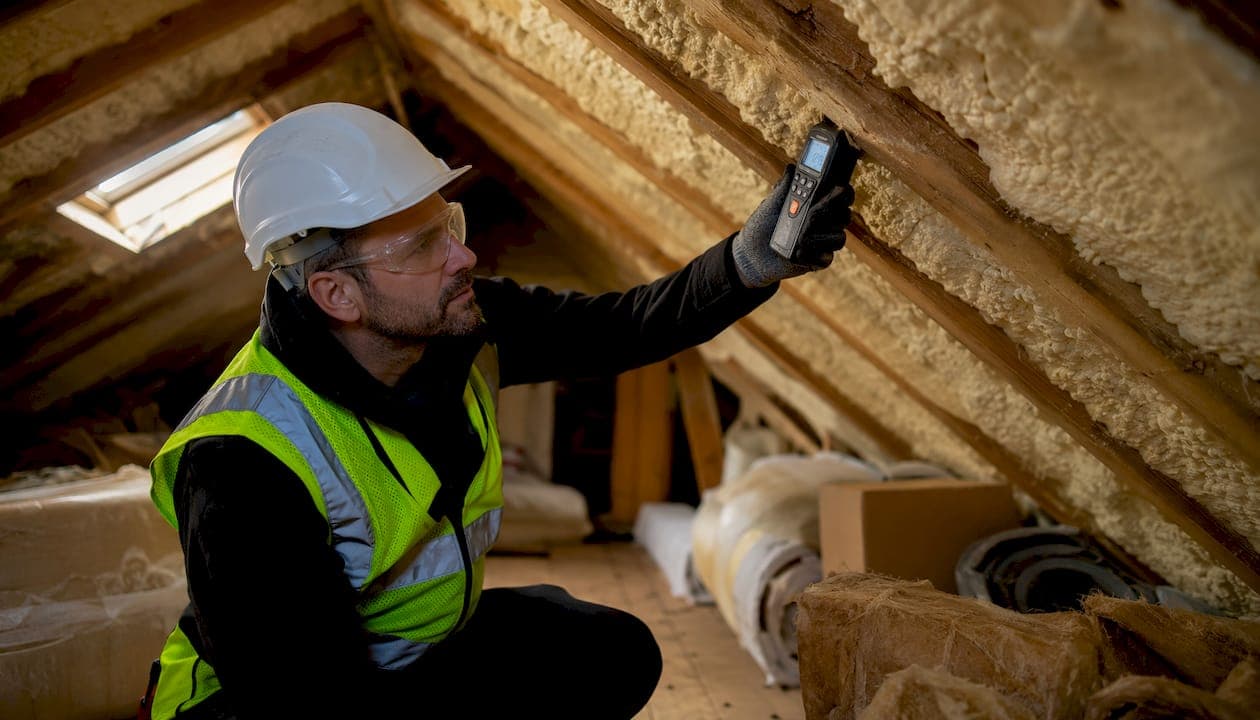
Closed cell spray foam is a dense, rigid polyurethane insulation that bonds tightly to roof timbers at densities over 30 kg/m³, forming a near-complete vapour barrier. If your property has it and you are trying to sell, remortgage, or simply get a surveyor to sign off, the first step is an independent, mortgage-compliant inspection from a specialist who has no commercial tie to the original installer.
What sets closed-cell foam apart from open-cell:
- Rigidity: Once cured, it is hard and brittle, not flexible like open-cell foam.
- Vapour barrier: It seals moisture in, which can accelerate timber decay if ventilation is compromised.
- Removal difficulty: Only manual mechanical removal is accepted by major UK mortgage lenders; chemical or heat-based methods are not.
Your immediate action list:
- Book an independent inspection aligned with RICS and Property Care Association (PCA) standards.
- Avoid unsolicited cold-call offers. RICS warns these are a known risk with spray foam.
- If removal is needed, insist on a full certification pack: date-stamped photos, moisture readings, and a signed independent statement.
- Ask about reinstatement options such as Superfoil once foam is cleared.
For London and South East homeowners, Sprayfoamremovalhelp (trading as Revive Maintenance) provides PCA-certified removal, independent certification packs, and a 10-year insurance-backed warranty, with direct contact to the team doing the work.
Table of Contents
- How do you know if your property has problematic closed-cell foam?
- How does professional removal work, step by step?
- What are the mortgage and compliance implications in the UK?
- How do you choose the right removal specialist?
- What should you expect on the day?
- What are your aftercare and reinstatement options?
- What are the health and safety risks during removal?
- How is removed foam disposed of, and what are the environmental rules?
- Closed-cell foam versus alternatives: long-term cost and efficiency
- Sprayfoamremovalhelp: certified removal, ready when you need it
- Key takeaways
- FAQ
How do you know if your property has problematic closed-cell foam?
Several signs point to a foam installation that surveyors and lenders will flag:
- Visible rigid coating on rafters rather than soft, spongy material.
- Condensation or damp patches in the loft, indicating trapped moisture.
- Timber discolouration or soft spots where decay has begun beneath the foam.
- A surveyor's retention or declined mortgage offer citing spray foam in the roof space.
- No original installation documentation, which lenders increasingly require.
Spray foam converting a cold roof to a warm roof alters moisture and ventilation regimes, raising condensation risk when not designed correctly. If you spot any of these signs, do not wait for a surveyor to raise it at the point of sale.
How does professional removal work, step by step?
Understanding the process helps you ask the right questions before you book.
1. Inspection and testing. A PCA-aligned specialist surveys the loft, records moisture readings, and photographs the foam and timber condition. The PCA's inspection protocol defines how surveyors identify whether foam has increased decay risk to roof timbers.
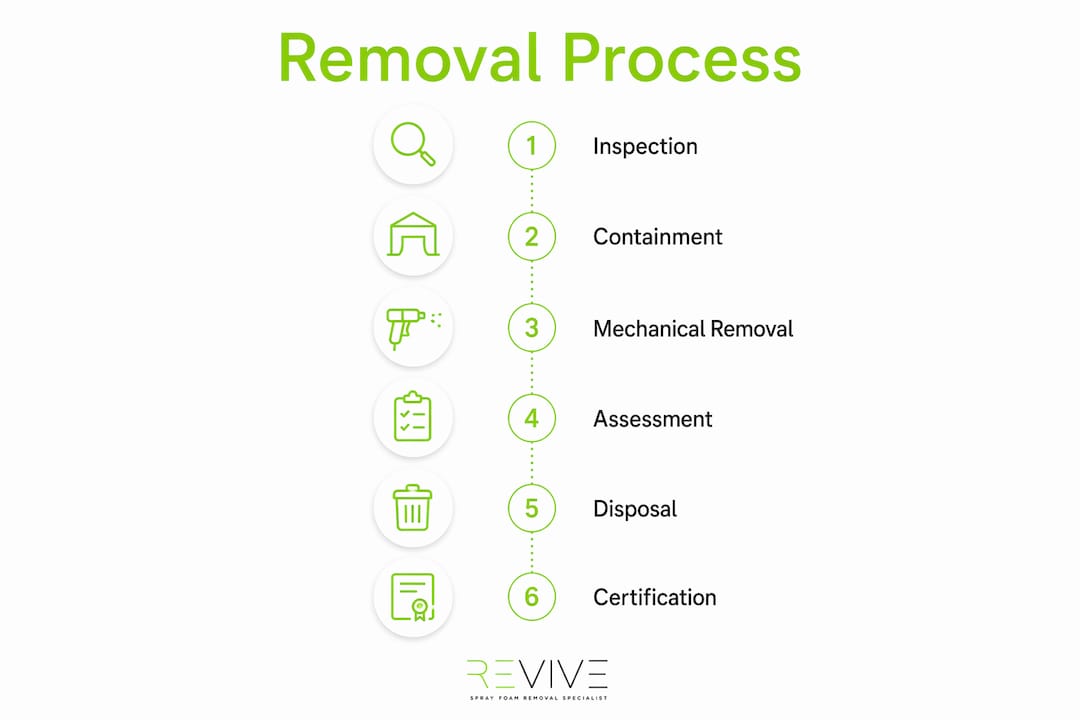
2. Containment. Dust sheets, negative-pressure units, and welfare screens protect the rest of the property. Occupants are typically asked to vacate the immediate work area.
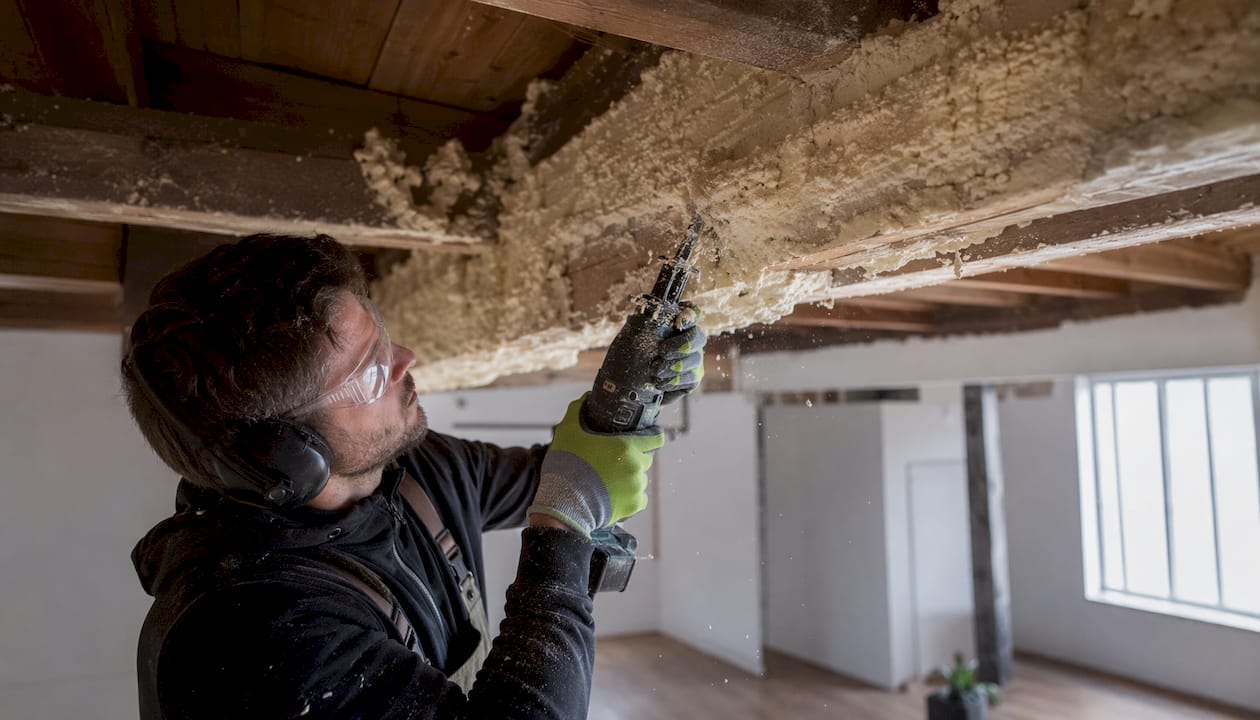
3. Mechanical removal. Technicians use chisels, oscillating tools, and hand scrapers to remove foam from each rafter bay. No chemicals, no heat. This is the only method lenders accept.
4. Timber assessment and repairs. Once foam is cleared, timbers are re-inspected. Damaged or decayed sections are repaired or sintered before any new insulation goes in.
5. Disposal. Removed foam is bagged, labelled, and taken to a licensed waste facility under the Environmental Protection Act 1990.
6. Documentation. The specialist produces a certification pack with date-stamped photos, independent moisture readings, and a signed statement of opinion. This pack is what your lender or surveyor will ask for. For a detailed walkthrough, see how spray foam is removed.
What are the mortgage and compliance implications in the UK?
Several major lenders, including TSB, Skipton Building Society, and Co-operative Bank, will not lend on properties where spray foam is found in the roof space. Others such as Lloyds, Nationwide, and Barclays consider applications case by case, relying on a valuer's report.
Lenders treat each property individually; removal alone does not automatically restore confidence. The quality and timing of the post-removal report matters. RICS expects the inspecting surveyor to be commercially independent from the installer, precisely to preserve lender confidence in the findings. Without a date-stamped, independent certification pack, many lenders will not release funds or permit remortgage. Your spray foam mortgage guide covers lender-specific requirements in detail.
How do you choose the right removal specialist?
The PCA has a specialist membership category for sprayed-foam problems, giving homeowners a clear route to find trained evaluators and remediators. Use it.
What to look for:
- PCA membership in the sprayed-foam specialism.
- Technicians who are independent from any foam installer or manufacturer.
- A written, itemised quote with no hidden fees.
- A 10-year insurance-backed warranty on the removal work.
- A full certification pack included, not offered as an optional extra.
Red flags to avoid:
- Cold-call or doorstep offers to remove foam.
- Quotes that arrive without a site visit.
- Specialists who also install spray foam, creating a conflict of interest.
- Vague promises of "lender-accepted" removal with no documentation detail.
Sprayfoamremovalhelp's direct specialist team meets all of the above criteria and serves London and the South East.
What should you expect on the day?
Prepare the loft for clear access: remove stored items, ensure the hatch is accessible, and confirm the property has power for tools and lighting. The team will arrive with containment equipment and carry out a brief pre-start walk-through with you.
Work typically runs in a single day for a standard semi-detached loft, though larger or more complex roofs may require two visits. You will be asked to keep children and pets away from the work area. At the end of the day, the team clears debris, takes final moisture readings, and photographs cleaned rafters before leaving. A free inspection can confirm the likely scope before you commit to a booking.
Pro Tip: Ask the specialist to confirm in writing which lenders' documentation requirements their certification pack is designed to satisfy. This saves time if your buyer's solicitor raises questions later.
What are your aftercare and reinstatement options?
Once foam is removed and timbers are sound, you need replacement insulation that lenders and surveyors will accept. Superfoil is a high-performance multi-foil insulation frequently specified after foam removal. It installs with minimal build-up thickness, making it practical in tight rafter bays, and it does not create the vapour-sealing problems associated with closed-cell foam. Mineral wool at ceiling level remains a cost-effective alternative where the loft is not a habitable space. Your specialist should discuss both options and provide written reinstatement recommendations as part of the post-removal report. See the insulation guide for a comparison of replacement options.
What are the health and safety risks during removal?
Closed-cell foam is combustible, and fire risk is a factor surveyors consider when assessing removal options. During mechanical removal, fine particulate dust is released. Certified technicians wear full respiratory protection (FFP3 masks), eye protection, and disposable coveralls. Occupants should vacate the loft area and ideally the floor directly below. Negative-pressure containment units prevent dust migrating into living spaces. A reputable specialist will brief you on welfare measures before work begins and will not start until containment is confirmed.
How is removed foam disposed of, and what are the environmental rules?
Removed spray foam is classified as controlled waste under the Environmental Protection Act 1990. It must be collected by a licensed waste carrier, transported in sealed bags, and taken to an authorised disposal or recycling facility. Fly-tipping foam waste is a criminal offence. Ask your specialist for a waste transfer note at the end of the job; this is the document that proves legal disposal and may be requested by your solicitor during a property sale. Responsible contractors include this as standard, not as an add-on.
Closed-cell foam versus alternatives: long-term cost and efficiency
Closed-cell spray foam is a better thermal insulator per millimetre than standard mineral wool. However, existing loft mineral wool can be topped up to current building regulation standards, often achieving better overall thermal performance than the typical 100 mm of foam installed between rafters. The energy saving claims made at the point of sale frequently assume perfect installation, which is rarely the case in retrofit scenarios.
Superfoil and upgraded mineral wool both allow roof timbers to breathe, avoiding the moisture-trapping that makes closed-cell foam a long-term liability. For most London and South East homeowners, the combination of mortgage risk, removal cost, and timber decay potential makes foam a poor long-term investment compared with breathable alternatives installed correctly from the outset. A roof inspection before choosing any replacement insulation is worth arranging.
Sprayfoamremovalhelp: certified removal, ready when you need it
Sprayfoamremovalhelp (Revive Maintenance) offers something most removal firms cannot: you speak directly to the PCA-certified technicians carrying out the work, with no call-centre layer and no subcontractors. Every job includes a full certification pack (date-stamped photos, independent moisture readings, signed statement of opinion), a 10-year insurance-backed warranty, and Superfoil reinstatement where required. Over 1,000 homeowners across London and the South East have used the service to resolve foam-related mortgage blocks.

Quotes are itemised, transparent, and provided after a site visit, never over the phone. If your situation is urgent, same-day emergency removal is available. Book a free no-obligation inspection to get a clear picture of your property's condition and a realistic timeline before you commit to anything.
How do Sprayfoamremovalhelp's service options compare?
| Service | Typical scope | Mortgage-compliant cert | Warranty | Coverage |
|---|---|---|---|---|
| Sprayfoamremovalhelp — full certified removal | Complete mechanical removal + certification pack | Yes | 10 years | London & South East |
| Emergency removal | Same-day containment and removal | Yes (provisional) | 10 years | London & South East |
| Inspection-only service | Assessment, moisture readings, report | Report only | — | London & South East |
| Superfoil reinstatement | Post-removal replacement insulation | N/A | Manufacturer warranty | London & South East |
Cost drivers across all categories include foam thickness, roof access difficulty, timber condition, and whether moisture damage requires repair before reinstatement.
Key takeaways
Mortgage-compliant closed-cell spray foam removal requires manual mechanical methods, an independent certification pack, and a specialist with PCA credentials and no commercial tie to the original installer.
| Point | Details |
|---|---|
| Closed-cell foam density | Over 30 kg/m³, rigid, and bonds tightly to timbers, making removal more intensive than open-cell. |
| Only accepted removal method | Manual mechanical removal; chemical and heat methods are not accepted by UK mortgage lenders. |
| Certification pack contents | Date-stamped photos, independent moisture readings, and a signed statement of opinion. |
| Lender stance | Major lenders consider applications case by case; a quality post-removal report is what enables reconsideration. |
| Sprayfoamremovalhelp | PCA-certified, direct-team removal across London and the South East, with a 10-year insurance-backed warranty. |
FAQ
What makes closed-cell foam harder to remove than open-cell?
Closed-cell foam is rigid and dense (over 30 kg/m³), bonding firmly to timber surfaces and forming a vapour barrier. Open-cell foam remains soft and is generally easier to detach without damaging the underlying structure.
Will removing spray foam fix my mortgage problem?
Removal helps, but lenders consider the whole property and the quality of the post-removal report. A date-stamped, independent certification pack is what gives lenders the evidence they need to reconsider.
What should a certification pack include?
It must contain date-stamped photographs of cleaned rafters, independent moisture readings, and a signed independent statement of opinion. A simple site visit letter is not sufficient for most lenders.
How long does removal typically take?
A standard semi-detached loft usually takes one day. Larger or more complex roofs, or those with timber damage, may require two visits.
Can Sprayfoamremovalhelp help if I need urgent removal?
Yes. Sprayfoamremovalhelp offers same-day emergency spray foam removal across London and the South East, including provisional certification for urgent mortgage or sale situations.
This article provides general information only and is not professional legal, structural, or financial advice. Confirm current lender requirements and regulatory obligations with a qualified surveyor or mortgage adviser for your specific situation.