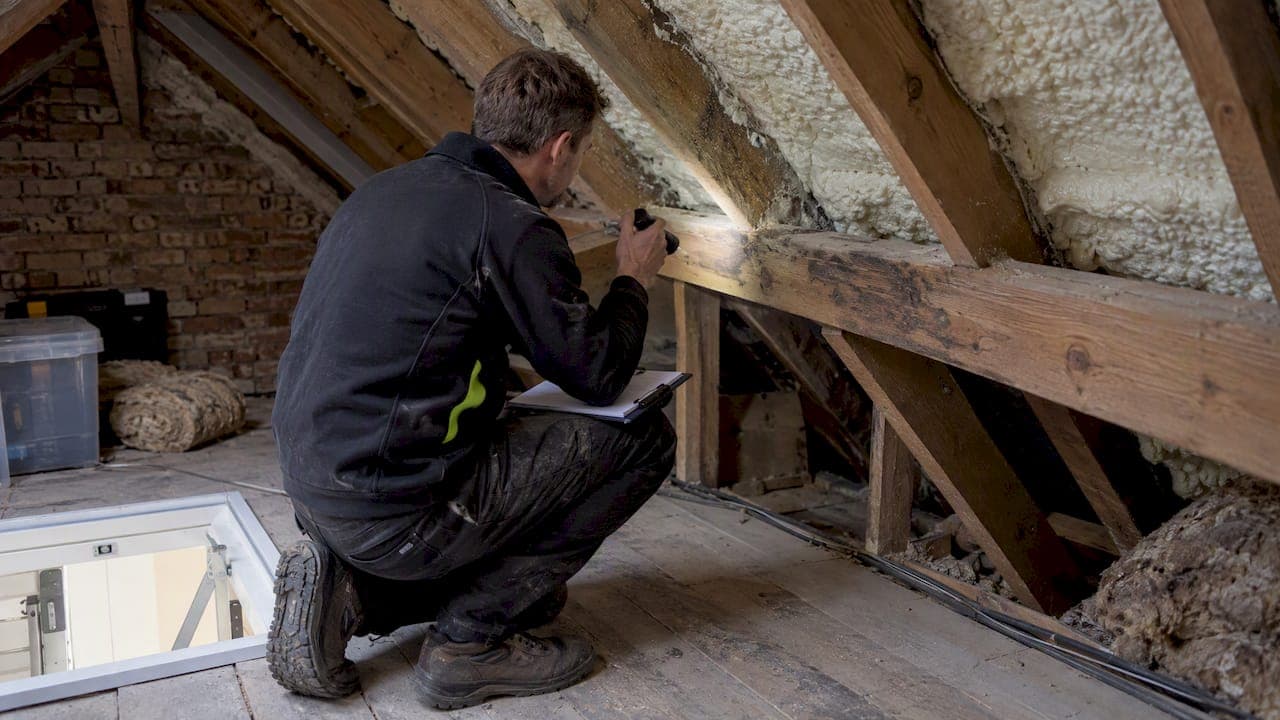
Spray foam does not automatically make a home uninsurable or un-mortgageable in the UK, but it very often triggers extra checks from insurers and lenders. The deciding factors are the foam type, the quality of the original installation and whether you can produce documentary evidence such as an inspection report or installation certificate. If you have spray foam in your loft, start by gathering any paperwork you already hold and arranging an independent inspection.
TL;DR:
- Proper documentation, including inspection reports and certificates, greatly improves the chances of insurance and mortgage acceptance for spray foam homes.
- Insurers and lenders are mainly concerned with hidden moisture and timber risks caused by foam application methods, not the foam itself.
- A thorough PCA- or RICS-registered inspection should identify foam type, ventilation adequacy, and timber condition to satisfy most underwriting criteria.
- Costs for removal and certification typically range from £1,000 to £7,000, with proper workflow involving surveys, removal, timber checks, and certification.
- Presenting detailed, standardized inspection reports backed by recognized standards reduces the risk of blanket declines and may improve policy terms.
Table of Contents
- At a glance: one-page checklist for homeowners with spray foam
- How UK insurers and mortgage lenders treat spray-foamed roofs
- What surveyors and inspectors look for
- Foam types, installation faults and the risk profile
- Remediation and removal: realistic options, costs and timelines
- What a compliant removal and certification workflow looks like
- Claims process for damage caused by spray foam insulation
- How spray foam affects premiums compared with traditional insulation
- Choosing an insurer or policy that works with spray foam
- Why market responses are changing and what it means for homeowners
- How a certified removal service can help
- FAQ
- Sources
At a glance: one-page checklist for homeowners with spray foam
Before anything else, work through a short set of practical steps. These keep you in control of the conversation with your insurer or lender, rather than letting a decline or a delay catch you off guard.
- Tell your insurer and your lender about the foam now, rather than waiting for a survey to raise it unprompted.
- Locate the original installation contract, product certificate, warranty and any photographs taken at the time of the job.
- If that paperwork is thin or missing, commission an independent PCA-registered inspection or a RICS specialist survey to fill the gap.
- Where an insurer or lender has already declined, ask a specialist broker to re-present the case, or obtain a post-removal certified report.
- Steer clear of cold-call installers and stick to TrustMark, PCA or RICS-registered professionals for any further work.
Pro Tip: Keep every document in one folder, digital or paper, from day one. A complete paper trail is often the single thing that turns a decline into an acceptance.
How UK insurers and mortgage lenders treat spray-foamed roofs
Insurers and lenders are not reacting to spray foam itself so much as to what it hides. Once foam is sprayed directly onto the underside of roofing felt or tiles, surveyors can no longer see the timbers, which makes it harder to check for rot, damp or structural movement. That loss of visibility, combined with concerns about moisture being trapped against timber and the combustibility of some products, is what drives caution.
In practice, the market response varies by lender and insurer rather than following one fixed rule:
- A straightforward decline, particularly where an automated valuation or standard survey flags foam with no supporting documentation.
- A roof exclusion added to the policy, so cover continues but roof-related claims are limited.
- Conditional acceptance, subject to an independent survey confirming the foam's condition.
- Referral to a specialist lender or insurer that already has an underwriting policy for foam-insulated properties.
One mortgage lender analysis found that around a quarter of the UK's largest mortgage lenders had tightened their stance on properties with spray foam in the roof by late 2024, with an estimated 250,000 UK homes affected. That is a meaningful share of the lending market, which is exactly why documentation matters so much.
Disclosure is not optional. Spray foam is normally treated as a material fact under the Insurance Act 2015, and failing to mention it can make a policy voidable if a claim later arises. If your insurer or lender has already said no, the path back in usually runs through a specialist broker who knows which underwriters accept foam-insulated roofs, backed by a PCA or RICS report, or in some cases by removal followed by formal certification.

What surveyors and inspectors look for
A standard home buyer's survey will note that spray foam is present and may stop there, flagging it as a risk without examining it further. A PCA-registered or RICS specialist inspection goes much further, and it is this deeper report that lenders and insurers generally want to see before they move away from a blanket decline.
A proper inspection should cover:
- Identification of the foam type, open cell or closed cell, since this changes the risk profile significantly.
- An assessment of roof ventilation and whether a vapour control layer is present or missing.
- Physical inspection of accessible timbers, with targeted sampling or small openings where hidden sections need checking.
- Photographic or drone evidence of the roof void, particularly where access is difficult.
- Clear, written remediation advice, stating whether the foam can remain, needs partial removal or should come out entirely.
Reports should reference recognised standards rather than offer a general opinion. BS 5250:2021 covers moisture control in buildings and is the benchmark against which correct installation is judged, while Property Care Association protocols give surveyors a structured route for assessing foam specifically. When you take a report to a broker or lender, ask that it directly answers the underwriting questions they care about: foam type, ventilation, timber condition and whether any remedial work is outstanding. A report that simply confirms foam is present, without addressing those points, rarely moves a decision forward.
Foam types, installation faults and the risk profile
Open-cell and closed-cell spray foam behave very differently once they are inside a roof, and that difference sits behind most of the caution from insurers and lenders. Open-cell foam is softer, less dense and vapour-permeable, meaning moisture can pass through it more readily. Closed-cell foam is dense, rigid and far less permeable, which makes it better at insulating but also better at trapping moisture against timber if ventilation has not been designed in properly.
Government correspondence and research referenced by Minister Rowley notes that timber degradation risk appears low where open-cell foam is applied in line with BS 5250:2021, but rises where installations depart from that guidance. The product itself is rarely the whole problem. The installation is.
Common faults that turn a reasonable product into a liability include:
- Spraying foam directly onto the back of roof tiles or slates rather than leaving the intended air gap.
- Omitting ventilation paths or vapour control layers that the product specification calls for.
- Covering timbers completely, so later problems go unnoticed until they are advanced.
- Using uncertified product with no BBA or Kiwa approval and no traceable installer.
Combustibility also plays into insurer thinking. Products are classified under BS EN 13501-1, and insurers increasingly ask which class a particular foam falls into, since this affects fire spread risk in a roof void. Installation date matters too: older jobs, done before current guidance was widely followed, carry more uncertainty than recent work completed by a certified, traceable installer using approved product.
Remediation and removal: realistic options, costs and timelines
The right first step is always inspection, not removal. A PCA or RICS report tells you whether the foam is causing an active problem, whether ventilation is adequate, and whether timbers are sound. Removal becomes necessary mainly when timbers cannot be properly inspected any other way, or when a lender's underwriting decision explicitly requires it before they will proceed.
Costs vary with the type of foam, the roof area, access and whether timber repairs are needed once the foam is out.
These figures come from our own removal cost guide, and the final price on any job depends on roof access, how much timber repair is needed, and whether membrane or insulation replacement forms part of the scope.
A compliant removal job should leave you with more than an empty loft. It should include a full inspection of the timbers once they are exposed, photographic records of the work, an itemised invoice and a certificate confirming the work meets current standards. When choosing a contractor, check PCA registration, ask for references, insist on a written contract that specifies the scope of work, and confirm what warranty backs the job once it is finished.
Pro Tip: Ask any contractor for their PCA registration number before booking, and check it independently rather than taking their word for it.

What a compliant removal and certification workflow looks like
A workflow that satisfies lenders and insurers tends to follow the same shape regardless of who carries it out: an initial survey, a PCA or RICS inspection to confirm scope, agreed removal work, timber reinstatement where needed, and an independent post-removal report with certification.
Before signing anything, ask your contractor to confirm:
- A written PCA or RICS inspector's report setting out the condition found before work began.
- Photographic evidence taken during removal, particularly of any timber repairs.
- An insurance-backed warranty, so you have cover if a problem emerges after the work is finished.
- An itemised invoice that separates removal, repair and certification costs.
- A formal installation or removal certificate you can hand directly to a broker, lender or insurer.
These documents are what the Property Care Association guidance points towards, and they are also what most underwriters ask for once a case is re-presented after remediation.
Claims process for damage caused by spray foam insulation
If spray foam has contributed to fire damage, trapped moisture or timber decay, you will need to notify your insurer promptly and be specific about what the foam is and when it was installed. Insurers typically send a loss adjuster or surveyor to assess the extent of the damage and to establish whether the foam itself, or the way it was applied, played a role.
Because spray foam is normally a material fact, any claim connected to it will be examined closely against what was disclosed when the policy was taken out or renewed. If the foam was never mentioned, the insurer may question the validity of the claim, so it helps enormously to have the installation paperwork or an inspection report ready to show alongside the claim.
Where moisture or decay is suspected, government research on spray foam applied to timber roofs points to the lack of visibility as the core issue, so expect the adjuster to ask for timber sampling or targeted openings before the claim is settled. A pre-existing PCA or RICS report, even one unrelated to the specific claim, can speed this process by giving the insurer a baseline condition to compare against.
How spray foam affects premiums compared with traditional insulation
Traditional loft insulation, such as mineral wool or fibreglass, rarely affects your premium at all, since insurers can see straight through it to the roof timbers during any inspection. Spray foam changes that picture because it is harder to inspect and, in poorly ventilated roofs, can be linked to hidden damp or timber problems.
Where an insurer agrees to cover a foam-insulated property without excluding the roof, the premium may carry a modest loading to reflect that uncertainty, though the amount depends entirely on the individual underwriter's view of the documentation you provide. A well-documented installation, backed by a BBA or Kiwa certificate and a PCA inspection confirming good condition, generally commands terms much closer to a standard policy than an undocumented one.
The practical lesson is that the foam itself is rarely the sole reason for a higher premium. The absence of evidence that it was done properly is usually what pushes the price up, or pushes the insurer towards an exclusion instead of full cover.
Choosing an insurer or policy that works with spray foam
Not every insurer treats spray foam the same way, so shopping around with the right information in hand matters more than it does for a standard policy. Start with a specialist broker who already knows which insurers have an established underwriting approach to foam-insulated roofs, rather than applying directly and risking an automatic decline.
Have your documentation ready before you approach anyone: foam type, installation date, any BBA or Kiwa certificate, and a PCA or RICS report if you have commissioned one. Insurers that are comfortable with spray foam will generally ask for exactly this evidence rather than refusing outright, so presenting it upfront can shorten the process considerably.
If a mainstream insurer declines or imposes a roof exclusion you are not happy with, a broker can often place the risk with a specialist market used to assessing non-standard construction and insulation types. Reassess your policy whenever you have new documentation, such as a fresh inspection or a removal certificate, since this can open up better terms than your current arrangement.
Why market responses are changing and what it means for homeowners
Lenders and insurers tightened their stance after a run of cases where poor installations hid timber problems that only surfaced later, often at the point of sale or remortgage. That caution was a reasonable response to real cases, but it has also meant some well-installed, low-risk properties were refused alongside genuinely problematic ones.
Industry protocols from the Property Care Association, RICS and BS 5250:2021 exist precisely to standardise how inspections are carried out, which should reduce blanket refusals over time as more lenders recognise a consistent report format. For now, the practical message for homeowners has not changed: documentation and a certified inspection remain the simplest route back to normal lending and insurance terms.
— jessica
How a certified removal service can help
If a lender decline, a stalled sale or an inspection report has pointed towards removal, a straightforward path exists: survey, PCA-certified removal, post-removal certification and an insurance-backed warranty.

- A survey confirms foam type and condition before any work begins.
- Removal is carried out by our team, with no subcontracted middlemen.
- You receive a post-removal certificate and a warranty to show your lender or insurer.
If you are dealing with a decline, a sale falling through, or a report recommending removal, you can request a survey or quote through our services page and get a clear scope of work before committing to anything.
This article is general information, not a substitute for advice from a qualified financial advisor. Consult a qualified financial professional about your own circumstances before acting on anything here.
FAQ
Can you spray foam an existing house?
Yes, spray foam can be applied to an existing roof, though a specialist installer should assess ventilation and vapour control needs first. Getting this wrong is a common cause of the moisture and timber problems that later affect insurance and mortgage decisions.
What is the average cost of spray foam insulation removal per square metre in the UK?
Removal costs often fall in the region of £30 to £80 per square metre for the removal work alone, with the final total shaped by access, timber repairs and any survey fees. A full job, including inspection and certification, typically lands within our £1,000 to £7,000 range depending on the property and foam type.
When was spray foam insulation used?
Spray foam insulation has been used in UK roofs for several decades, though its popularity increased notably in more recent years as a quick-fix energy efficiency measure. Many of the problem cases lenders now flag involve installations completed before current guidance, such as BS 5250:2021, was widely followed.
How much does it cost to spray foam a whole house?
There is no single UK-wide figure for a whole-house job, since cost depends on roof area, access and whether open-cell or closed-cell product is specified. For removal rather than installation, our service pricing ranges from £1,000 to £7,000 depending on foam type and job complexity.
Will spray foam automatically stop me getting a mortgage?
No, spray foam does not automatically block a mortgage, but it often triggers a request for further evidence or a specialist survey. Around a quarter of large UK lenders had tightened their approach by late 2024, which makes documentation the deciding factor in most cases.