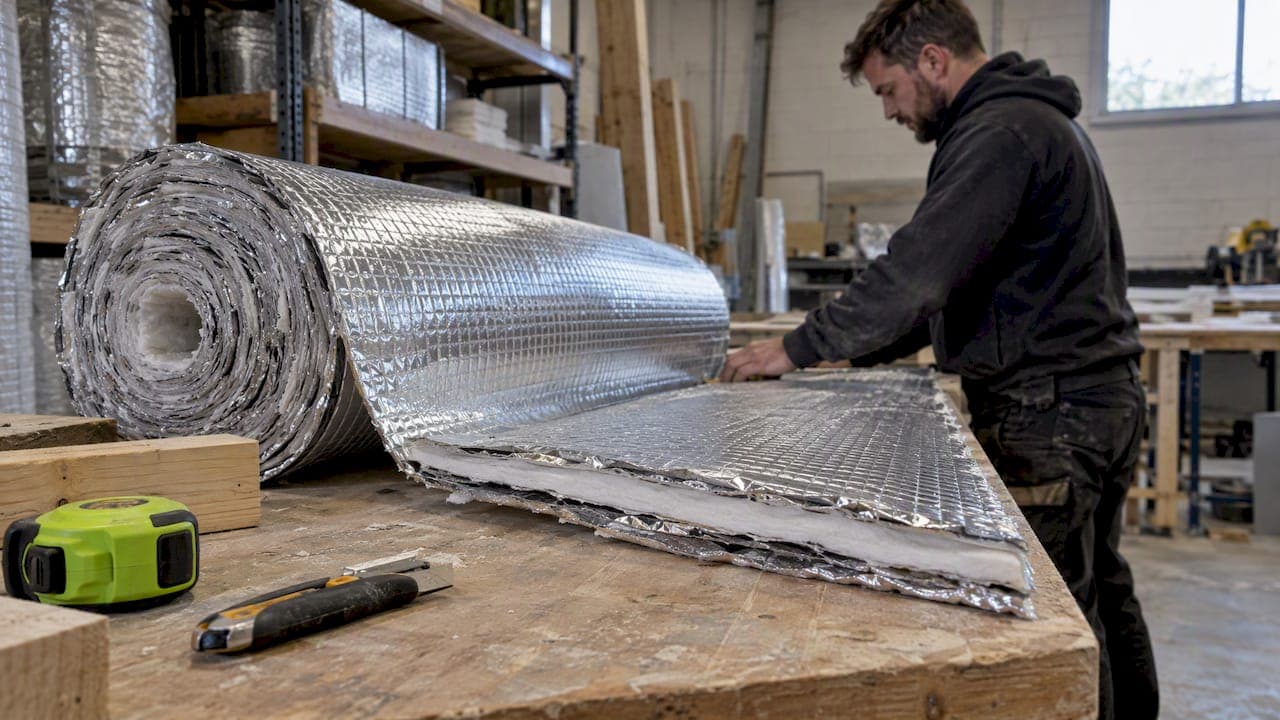
Hybrid multifoil insulation is a thin, multi-layer reflective system that combines foil facings with an integrated vapour-control or thin thermal layer, useful where space is limited but certification and correct sealing determine real performance. It suits loft overlays, shallow cavities and internal wall insulation where depth is tight. Before buying, we always recommend asking for certified test data rather than relying on headline performance claims.
TL;DR:
- Certified test data from accredited standards like BR 443, ETA, or Agrement certificates is crucial for verifying hybrid multifoil performance claims.
- Proper installation requires adequate air gaps facing reflective surfaces and sealed vapor-control layers to ensure thermal and moisture protection.
- Hybrid multifoil is most suited for shallow cavity or limited space situations, but often needs additional PIR or mineral wool layers for standard U-values.
- Independent hot-box testing typically shows lower R-values than manufacturer claims, emphasizing the importance of verified testing over marketing figures.
- Thorough pre- and post-installation surveys, along with written U-value calculations, are essential to ensure proper sealing and optimal performance.
Table of Contents
- How hybrid multifoil systems are built and where they go
- How performance is measured and what certifications actually matter
- Installation essentials: air gaps, vapour control and ventilation
- Weighing hybrid multifoil against PIR and mineral wool
- Buying checklist, pack sizes and brands to look for
- What goes wrong on site and why a survey matters
- Why certificates matter more than marketing copy
- How we can help with surveys, insulation and safe removal
- FAQ
- Sources
How hybrid multifoil systems are built and where they go
Hybrid multifoil products stack several thin layers rather than relying on a single thick material. A typical roll or panel includes outer reflective foils, a reinforcing scrim for strength, and often a thin foam or fibre core that adds genuine thermal resistance rather than relying purely on reflectivity. Many hybrid versions also build in a vapour-control layer, which removes the need for a separate membrane on site.
These products come as rolls, semi-rigid panels or composite boards, with roll widths commonly around 1.5 metres and panel thickness varying by manufacturer and product line.
Builders reach for hybrid multifoil in a handful of recurring situations:
- Pitched roof refurbishments where rafter depth cannot accommodate thick mineral wool.
- Loft overlays laid above existing insulation to boost performance without raising floor levels significantly.
- Internal wall insulation (IWI) in period properties with shallow cavities or solid walls.
- Timber frame builds where a slim, multi-function layer simplifies the build-up.
Getting continuity right at junctions, maintaining correct orientation, and checking compatibility with adjoining insulation layers all matter more with these products than with a single conventional material, because each thin layer depends on the next doing its job properly.
How performance is measured and what certifications actually matter
Any U-value claim for a hybrid multifoil product should be calculated using the BR 443 methodology, which Approved Document L requires for thermal elements and which prefers accredited, tested evidence over manufacturer-only figures. Products holding an ETA or similar certificate carry a presumption of correctness under this guidance, which is why we treat certification as the first filter when assessing a product.
The testing method matters as much as the number itself. Independent hot-box testing to BS EN or ISO standards measures heat flow through a full assembly under controlled conditions. Manufacturers' own comparative testing, by contrast, has drawn scrutiny: Ofgem's Technical Advisory Panel minutes record concerns that some multifoil performance claims rely on non-standard comparative methods, and that installation detail such as sealing at junctions directly affects real-world performance.
Independent hot-box testing has produced notably lower R-values compared with some manufacturers' comparative claims, according to LABC technical guidance, which advises relying on accredited testing or Agrement and ETA certificates rather than headline figures. That gap is the single most useful thing to check before you buy.
Before trusting any claimed figure, ask for:
- the specific standard the test was conducted under (BS EN/ISO hot-box, not a comparative in-house method)
- a valid BBA, ETA or Agrement certificate number you can verify independently
- a BR 443-compliant U-value calculation for your specific build-up, not a generic figure
Installation essentials: air gaps, vapour control and ventilation
Reflective performance in multifoil systems depends on an air gap facing the foil, typically on at least one side, because the reflective effect only works across an unobstructed space. Skip the gap and much of the claimed benefit disappears regardless of what the certificate says.

Where a hybrid product includes an integrated vapour-control layer, that layer is only as good as its sealing. LABC guidance and industry scrutiny both stress that gaps at ceilings, floors, reveals and service penetrations undermine both thermal performance and moisture control, because an incomplete vapour-control layer can trap moisture inside the build-up rather than keeping it out.
Adding insulation almost always increases airtightness, and Approved Document F sets out when that triggers a ventilation response. Follow these steps on any project:
- Classify the works as minor or major under Part F guidance before you start.
- Carry out an air-permeability test before works begin where the scale of the job justifies it.
- Assess moisture risk, particularly in older solid-wall or timber-frame properties.
- Decide, using the Part F simplified method or a full PAS 2035 assessment, whether mechanical ventilation such as MVHR or continuous extract is needed.
- Use an installer registered under PAS 2035 or TrustMark, especially where funded schemes require it.
BEAMA guidance confirms that funded retrofit schemes link ventilation compliance directly to eligibility, and that installers often need PAS 2030 compliance alongside TrustMark registration.
Pro Tip: Photograph every junction and penetration before boarding it over. It is the cheapest insurance against a disputed condensation claim later.
Weighing hybrid multifoil against PIR and mineral wool
Hybrid multifoil earns its place where depth is the binding constraint. Its advantages are specific rather than universal:
- Very slim build-up compared with mineral wool or standard PIR boards of equivalent claimed performance.
- Easier retrofit fit in shallow rafters, stud cavities or solid-wall battens.
- Some products integrate vapour control, cutting one trade from the installation sequence.
The disadvantages are equally specific. Independent testing has repeatedly disputed comparative R-value claims, as LABC notes, and real performance depends entirely on correct air gaps and sealing rather than the product alone. Many hybrid multifoil assemblies also need a complementary layer of PIR or mineral wool to hit standard U-value targets, which Ofgem's TAP minutes flag as a recurring issue in modelling assumptions.
Prefer PIR or mineral wool instead when depth is not constrained and you want a straightforward, well-understood U-value calculation with fewer installation-dependent variables.
Before specifying, check: is there room for the required air gap, does the product carry an accredited certificate, and does the manufacturer's own U-value calculation already assume a complementary insulation layer?
Buying checklist, pack sizes and brands to look for
Before ordering, ask suppliers four things: can they provide a certified test report (not just a comparative figure), do they offer written installation guidance for your specific junction details, do they recommend a complementary insulation layer, and what warranty covers the product once fitted.
Coverage calculations depend on roll width and overlap allowance, typically an extra 10 to 15% for laps and waste, so measure the actual area rather than relying on a rough estimate.
Names you are likely to see in UK merchants and specialist suppliers include:
- Actis HControl: a hybrid multifoil roll aimed at pitched roof and loft applications.
- Actis Hybris: a composite board combining reflective layers with a thicker core.
- Superfoil: a long-established UK multifoil brand used across roof, wall and floor applications.
Whichever brand you consider, confirm the specific certificate covers the exact product variant you are buying, since ranges within one brand can carry different test evidence. Source supplies through builders' merchants, specialist insulation suppliers, or through a certified installer who can also check suitability for your build.
What goes wrong on site and why a survey matters
The most common failure we see reported is not the material itself but how it meets other surfaces. Gaps at ceiling perimeters, loft hatches and service penetrations let moisture track into the build-up, and once an integrated vapour-control layer is breached, condensation risk rises rather than falls.
A pre-installation survey catches these risks before boarding goes up, and a post-installation airtightness or junction check confirms the detailing actually matches the design. We built our service model around direct communication between homeowners and the technicians doing the work, with certified staff and a 10-year insurance-backed warranty, having supported many homeowners with insulation and remediation work.
If you are uncertain about an existing or planned installation, book a survey and ask for a written U-value calculation alongside the product's certificate rather than taking a sales sheet at face value.
Why certificates matter more than marketing copy
The industry argument around hybrid multifoil has never really been about whether the products work. It is about whether the number on the packet matches the number a hot-box test would produce. We think too many buying decisions still get made on comparative claims that Ofgem's own technical panel has questioned, rather than on accredited evidence.
Conventional retrofit advice tends to focus on which product to buy. We think the more useful question is which installer you trust to seal every junction correctly, because the same roll of multifoil performs very differently in careful hands versus rushed ones. A certificate tells you what the product can achieve under laboratory conditions. It tells you nothing about whether your loft hatch was sealed properly.
If we had one priority to give a homeowner or builder starting this project, it would be this: get the written U-value calculation and certificate before you buy, and get a post-installation check before you sign off the job. Everything else is secondary to those two documents.
— jessica
How we can help with surveys, insulation and safe removal
If you are weighing up a hybrid multifoil upgrade, or you have inherited a problematic spray foam job that needs sorting first, we handle both ends of that process. Our team works direct with homeowners, no call centres or middlemen, with fixed transparent pricing throughout.

Services we offer include:
- Basic Visual Survey and Full Roof Report (with photos) to assess your existing insulation and roof condition.
- Superfoil SF40 and Superfoil SF60 Installation for homeowners who want a certified multifoil system fitted correctly the first time.
- Spray Foam Removal, covering both open cell and closed cell spray foam, where old insulation needs clearing before new work can go ahead.
Every job comes with PCA-certified technicians and a 10-year insurance-backed warranty. Visit our service overview page to book a survey or request a quote for Superfoil installation.
FAQ
Is multifoil better than PIR insulation?
Neither is universally better: multifoil suits shallow spaces where depth is the main constraint, while PIR gives a more straightforward, well-tested U-value calculation. Independent testing has disputed some multifoil comparative claims, so accredited certificates matter more than brand reputation when comparing the two.
What are the pros and cons of multifoil insulation?
The main advantage is a slim build-up that fits where thicker materials cannot, with some products integrating vapour control. The main drawback is that real performance depends heavily on correct air gaps and sealing, and many assemblies need a complementary layer of PIR or mineral wool to meet standard U-value targets.
What is the disadvantage of foil insulation?
The biggest disadvantage is the gap between comparative manufacturer testing and independent hot-box results, which LABC guidance warns can overstate real-world performance. Performance also collapses if the required air gap is missing or junctions are not sealed properly.
Do you need an air gap for foil insulation?
Yes, reflective foil layers rely on an unobstructed air gap, usually on at least one face, to achieve their stated performance. Without it, the reflective effect is largely lost regardless of the certificate the product holds.