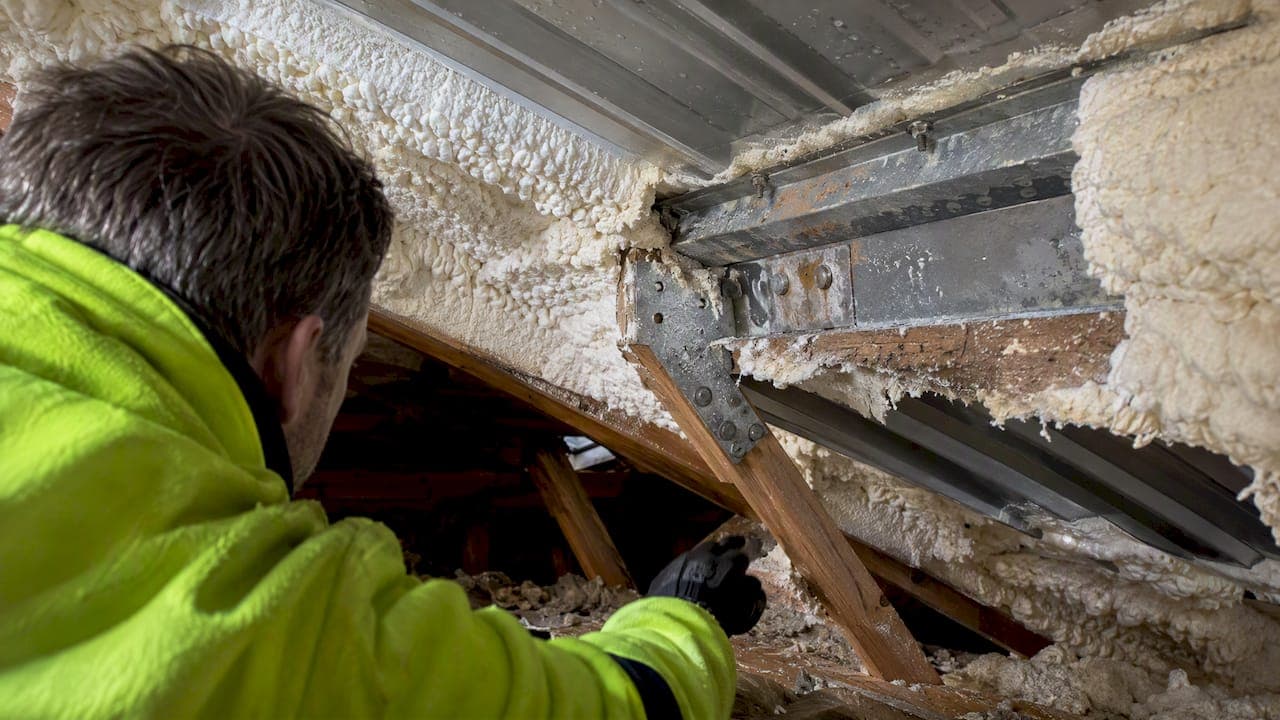
Spray foam on a metal roof can trap moisture against timber and metal fixings, accelerating corrosion and hiding decay until it becomes serious. The severity depends on three things: whether the foam is open or closed cell, whether a proper underlay and air and vapour control layer (AVCL) are present, and how well the job was installed in the first place.
TL;DR:
- Trapped moisture from spray foam can accelerate corrosion of metal fixings and cause hidden decay, especially if ventilation or vapor control layers are missing.
- Open-cell foam presents a lower risk of moisture entrapment than closed-cell foam, which can seal moisture against the roof deck when installation is not properly managed.
- Visible signs of problems include persistent damp smells, mould, rust streaks, and sagging roofing materials, but early decay often goes unnoticed.
- Removal of spray foam is complex and costly, involving potential damage, disposal issues, and re-roofing, especially if active decay or corrosion are detected.
- Mortgageability and property sales are often hindered by spray foam, as it conceals structural details, requiring independent inspections and proper documentation to reassure lenders.
Table of Contents
- Common problems spray foam causes in roof assemblies
- Why metal fixings and assemblies are vulnerable
- How a proper inspection and hygrothermal assessment works
- Remedial choices: ventilation, targeted fixes, removal and re-roofing
- How spray foam affects mortgages, remortgages and property sales
- Spotting rogue installers and removers, and vetting a tradesperson
- A short action plan to follow now if you suspect problems
- Why independent inspection should always come first
- How a specialist removal and survey service can help
- FAQ
- Sources
- Links to the authoritative reports and guidance mentioned
Common problems spray foam causes in roof assemblies
Once spray foam is applied, it bonds to the roof structure and seals the space from view. That is precisely the problem: a slow leak that would once have shown up as a damp patch can instead sit trapped against timber or metal for months, with nowhere to evaporate to.
Open-cell and closed-cell foams behave differently where moisture is concerned. Open-cell foam is more permeable and allows some vapour movement, while closed-cell foam forms a denser, more airtight barrier that can trap moisture against the roof deck when ventilation or an AVCL is missing. Gov shows the risk depends heavily on foam type, underlay resistance and whether an AVCL is correctly specified, with the highest risk occurring when foam is sprayed directly onto tiles or slates with no ventilation path.
Homeowners rarely spot a problem until it is well advanced. Warning signs worth acting on include:
- Damp or musty smells in the loft that persist after ventilation
- Dark staining or mould on exposed timber near the foam line
- Rust streaks appearing on visible fixings or flashings
- Sagging felt or underlay visible at the roof edges
Why metal fixings and assemblies are vulnerable
Metal roofs rely on a chain of small components, truss clips, fasteners, flashings, that are usually galvanised or zinc coated to resist rust. Spray foam changes the environment around these parts. When moisture becomes trapped by the foam rather than drying out, sustained humidity sits directly against metal that was never designed to stay wet.
Reporting on spray foam defects raised with the energy department found that closed-cell spray foam has been linked to accelerated corrosion of zinc-plated fixings, where trapped moisture reacts with certain foam chemistries and speeds up rust on truss clips, flashings and fasteners.

A large number of UK homes have spray foam installed, according to a House of Commons Library briefing, which also notes that surveyors frequently cannot assess concealed timbers once foam is in place. Corrosion that develops behind a sealed foam layer stays invisible until a fixing fails or a survey forces the issue, by which point remediation is far more disruptive than it would have been at an early stage.
How a proper inspection and hygrothermal assessment works
A visual check from the loft hatch tells you very little once spray foam covers the roof structure. A competent inspection goes further, and often needs to combine several methods:
- A visual survey of accessible areas, checking for staining, mould and obvious fixing corrosion
- Moisture probing of timber members where the foam allows partial access
- Hygrothermal assessment, modelling how moisture moves through the specific roof build-up, climate and ventilation regime
- Opening-up works in a representative sample area where visual and moisture checks cannot resolve the concern
GOV.UK's hygrothermal modelling underpins much of this approach, and the Property Care Association's customer guidance sets out an inspection protocol that surveyors use to decide what evidence is needed before reaching a conclusion. A credible report should include installation certificates, product data sheets, evidence of the original underlay and ventilation design, and photographic documentation from before the foam went in.
Pro Tip: Ask any installer or previous owner for the original product certificate and installation date before you commission a survey. It saves the surveyor time and often narrows down the likely risk factors immediately.
Remedial choices: ventilation, targeted fixes, removal and re-roofing
Not every spray foam roof needs the foam stripped out. Where moisture readings are low and the roof build-up includes a working AVCL and ventilation path, improving airflow or adding a secondary vapour barrier can sometimes be enough to manage the risk going forward.
Where there is evidence of active decay, concealed corrosion or a build-up never designed to carry foam, removal becomes the more realistic option. The Property Care Association's information paper notes that removal may be necessary once decay is confirmed, though it is disruptive and can require re-roofing work rather than a simple strip-out.
Removing bonded foam from a metal roof is harder than it sounds:
- Closed-cell foam adheres tightly to metal and timber, so removal risks damaging the deck or coating beneath it
- Disposal of removed foam has its own cost and handling requirements
- Re-roofing or recoating is often needed once the foam is gone, adding to the overall bill
- Timing matters too: insurers may ask about fire-safety ratings of the foam product used, so check your policy before scheduling any work
How spray foam affects mortgages, remortgages and property sales
Lenders and surveyors tend to treat spray foam as a red flag rather than a selling point, mainly because it conceals the roof timbers they would normally inspect. The Commons Library briefing confirms that this difficulty in assessing concealed structure can directly hinder mortgageability, affecting remortgaging as much as new purchases.
When a property has spray foam, lenders commonly ask for:
- An independent specialist report, not one from the original installer
- Product certificates confirming what foam type was used and when
- Evidence of any remediation already carried out, with dates and scope
- Confirmation of ventilation and AVCL provision in the original design
Removing the foam does not automatically resolve a lender's concerns. Without clear documentation proving the roof structure is sound, a lender may still ask questions, even after the foam itself has gone.
Spotting rogue installers and removers, and vetting a tradesperson
Spray foam has attracted its share of pressure-selling. Cornwall Council Trading Standards warns that cold-calling and removal scams are increasing, often targeting homeowners who have just discovered a problem and want a fast fix.
Before agreeing to anything, run through these checks:
- Confirm PCA or RICS membership for the surveyor or installer, not just a generic trade body
- Ask for proof of insurance and a written scope of works before any quote is finalised
- Request independent references from recent, comparable jobs
- Get an independent survey before accepting any removal quote, never from the firm offering to do the work
A short action plan to follow now if you suspect problems
If you think your roof might have a problem, work through this order rather than reacting to the first quote you receive:
- Gather every document you have: installation certificates, product data, any previous survey reports
- Commission an independent RICS or PCA-registered survey before contacting a removal firm
- Get two or three written quotes once you have an independent assessment in hand
- Report any high-pressure sales tactics to Trading Standards if you believe you were mis-sold the original installation
Pro Tip: A credible remediation quote should state the exact foam type being removed, the expected timetable, disposal arrangements and whether re-roofing is included, not just a single lump sum.
Why independent inspection should always come first
Having looked at enough of these cases, the pattern is consistent: the roofs that end up costing the most are the ones where removal happened before anyone established what was actually wrong. Certified technicians and clear paperwork are not box-ticking, they are what lets a surveyor or lender sign off on the work afterwards.
Removal is not always the first or correct step. Sometimes the roof needs ventilation improvements and monitoring, not a full strip-out, and knowing which situation you are in starts with an inspection, not a quote.
— jessica
How a specialist removal and survey service can help
If you need clarity rather than guesswork, an independent survey is the place to start, and that is the service we built our business around. We offer a range of survey options, from a basic visual check to a full drone survey with detailed report, so you get evidence before committing to any remediation plan.

Where removal genuinely is the right answer, our spray foam removal service covers both open and closed cell foam, carried out by PCA-certified technicians with mortgage-compliant documentation at the end of the job. Our offer includes clear pricing, direct communication with the team doing the work, a warranty on completed removals, and replacement insulation where removal leaves a gap.
Get in touch to book a survey and find out exactly what is happening behind your roof before you decide on next steps.
This article is general information, not a substitute for advice from a qualified financial advisor. Consult a qualified financial professional about your own circumstances before acting on anything here.

FAQ
What is the problem with spray foam roof insulation?
Spray foam can trap moisture against timber and metal roof components, preventing them from drying out and allowing decay or corrosion to develop unseen. The GOV.UK hygrothermal modelling shows this risk depends on foam type, underlay resistance and whether an AVCL is correctly installed.
Can I spray foam directly on a metal roof?
Applying spray foam directly to the underside of metal roofing without proper ventilation or a vapour control layer significantly raises the risk of trapped moisture and corrosion. RICS consumer guidance advises that retrofitting foam onto a roof not originally designed as a warm roof commonly introduces moisture-management problems.
Is spray foam banned in the UK?
Spray foam insulation is not banned, but trade bodies including RICS and the Property Care Association advise caution and recommend professional assessment before installation or removal. Lenders and surveyors often treat properties with spray foam cautiously because it conceals structural timbers from inspection.
Why can't you sell a house with spray foam insulation?
Selling is not impossible, but surveyors frequently cannot give a confident opinion on roof timbers hidden by foam, which can delay or complicate a sale. The Commons Library briefing notes that around 250,000 UK homes have spray foam installed, and difficulty assessing concealed structure is a recurring reason lenders hesitate.
How much does spray foam removal cost?
Removal costs vary by scope: open cell spray foam removal typically runs from £1,000 to £5,000, while closed cell removal runs from £1,500 to £7,000, depending on roof size and access.
Sources
- Gov
- Spray foam customer guidance (Property Care Association)
- Spray foam insulation and domestic property (House of Commons Library briefing)
- Concerns about spray foam defects raised with energy and net zero department
- Spray foam insulation advice (Cornwall Council Trading Standards)
Links to the authoritative reports and guidance mentioned
For readers who want to go further, these are the core sources behind the guidance above: GOV.UK's hygrothermal modelling report, the Property Care Association's customer guidance and inspection protocol, RICS's consumer guide, and the Commons Library briefing on spray foam and domestic property.