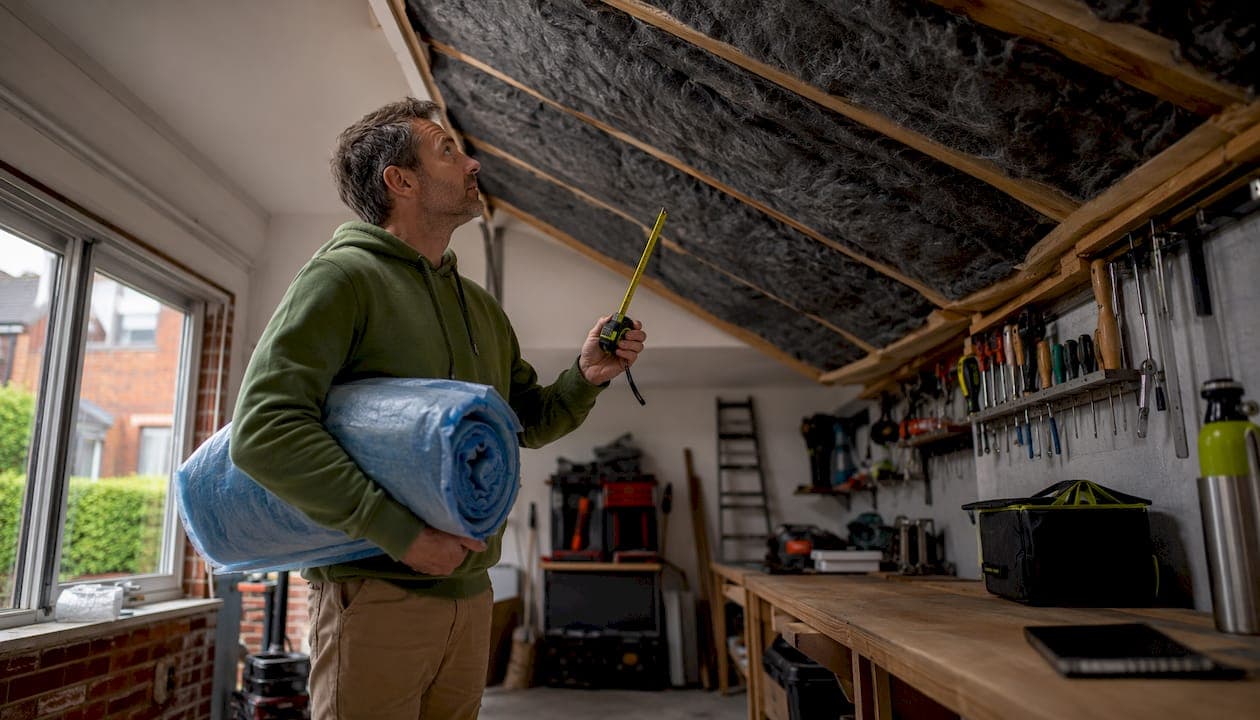
For most UK loft top-ups on a budget, fibreglass (glass wool) is the practical choice. For party walls, fire-rated cavities, damp lofts, or anywhere acoustic performance matters, stone mineral wool (rockwool) is the stronger specification. The right answer depends on your project, not a single universal ranking.
Key deciding dimensions at a glance:
- Thermal lambda / R-value: fibreglass typically 0.032–0.040 W/mK; mineral wool typically 0.035–0.045 W/mK
- Fire reaction class: both can achieve Euroclass A1; mineral wool withstands higher temperatures
- Acoustic performance: mineral wool generally denser; glass wool competitive in low-frequency partitions
- Moisture resistance: mineral wool is hydrophobic; fibreglass loses R-value when damp
- Installation: fibreglass rolls are lighter and faster to fit; rockwool requires more cutting and handling
- Typical UK material cost: fibreglass £5–15/m²; mineral wool £5–30/m²
Under Approved Document B (fire) and Approved Document L (energy), the specific product specification matters, not just the material category. Always confirm compliance with your building control body.
Table of Contents
- How do rockwool vs fibreglass compare side by side?
- Does fibreglass really outperform rockwool on thermal efficiency?
- Why does fire performance matter under Approved Document B?
- When should you choose rockwool for acoustic performance?
- How does moisture affect fibreglass in older London lofts?
- What should you know about installation and retrofit?
- What do rockwool and fibreglass cost in the UK?
- Which material has better environmental credentials?
- How do you decide which insulation is right for your project?
- How does insulation choice affect your property sale or mortgage?
- Sprayfoamremovalhelp: certified removal when spray foam is the problem
- FAQ
- Key takeaways
How do rockwool vs fibreglass compare side by side?
| Dimension | ROCKWOOL (stone mineral wool) | ISOVER (glass wool, Saint-Gobain) | KNAUF (mineral & glass wool) |
|---|---|---|---|
| Thermal lambda | Typical values in range around 0.035–0.045 W/mK | Slightly lower values typically for fibreglass | Both material types offer products covering similar ranges |
| Fire classification | Euroclass A1; withstands high temperatures | A1/A2 achievable; fibreglass softens at lower temperatures | Various classifications across ranges |
| Acoustic | Dense; strong mid/high frequency | Competitive in low-frequency partitions | Glass wool rolls suit partitions; slabs for floors |
| Moisture resistance | Hydrophobic; retains R-value when damp | Loses efficiency if wet; mould risk | Depends on product line |
| Installation | Semi-rigid; more cutting, heavier | Lightweight rolls; fast loft coverage | Both formats available |
| Durability | Performance retained over decades per product data | Can settle or degrade if damp | Varies by density |
| Material cost (UK) | Generally higher cost range | Lower cost range | Costs overlap depending on product |
| Environmental | Recycled rock content; BBA-certified ranges | Up to 80% recycled glass content; lower embodied carbon | Glass wool range: Declare Red List Free |
| Best for | Fire-rated cavities, party walls, damp lofts | Budget loft top-ups, large area coverage | Standard domestic lofts, retrofit |
Quick selection rules for London and South East properties:
- HMOs and party walls: specify stone mineral wool for acoustic and fire compliance
- Damp or poorly ventilated lofts: mineral wool's hydrophobic properties protect long-term R-value
- Budget loft top-up on a dry, well-ventilated loft: fibreglass rolls from ISOVER or KNAUF are cost-effective
- Cavity barrier applications: ROCKWOOL Full Fill Cavity Batt holds a BBA certificate for use in walls up to 25 metres
Pro Tip: If your loft has any cold bridging or inadequate ventilation, fibreglass is a risk. Damp air displaces the air pockets that give fibreglass its insulating effect, and R-value can fall markedly. Fit a vapour control layer and confirm ventilation before specifying glass wool in older London properties.
Does fibreglass really outperform rockwool on thermal efficiency?
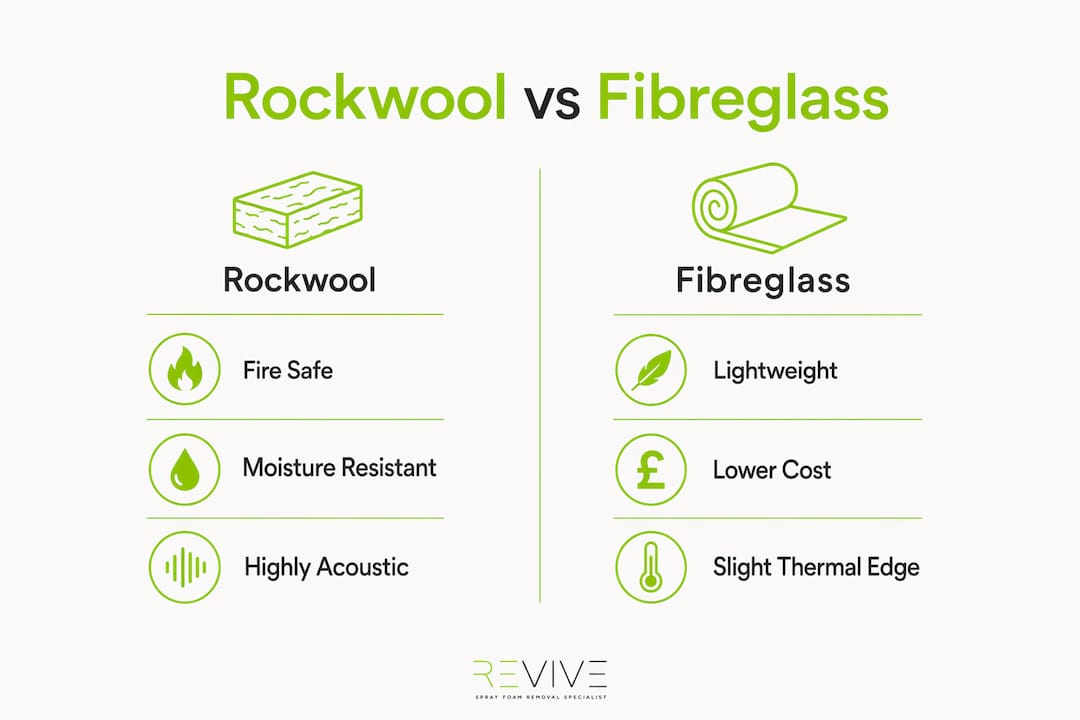
On paper, fibreglass has a slight edge. Products from ISOVER commonly achieve lambda values at the lower end of the 0.032–0.040 W/mK range, meaning you need marginally less thickness to hit a target U-value. Mineral wool typically sits at 0.035–0.045 W/mK depending on density and product line.
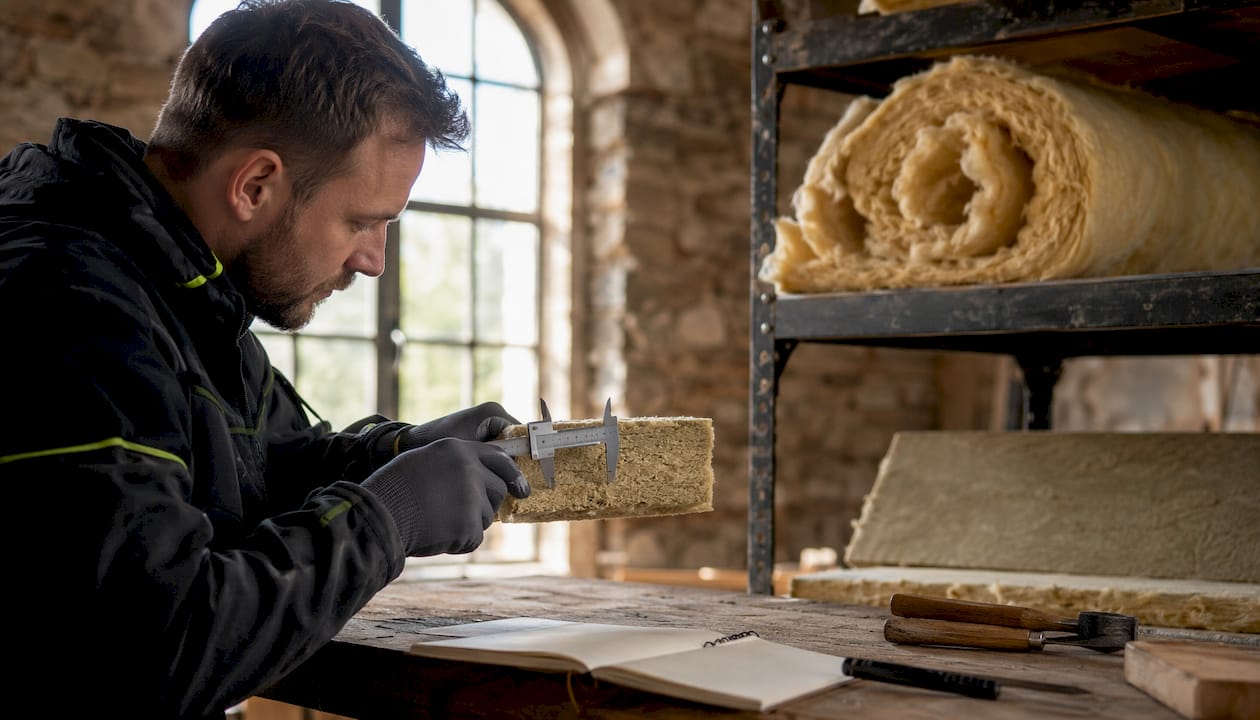
In practice, that gap narrows quickly. Mineral wool retains thermal performance in humid conditions because it is non-hygroscopic. Fibreglass depends on dry, undisturbed air pockets to insulate. In a London terrace with a cold roof void, that theoretical lambda advantage can disappear entirely once moisture enters the equation.
For Approved Document L compliance, both materials can meet the required U-values at appropriate thicknesses. The product datasheet and UKCA/CE marking confirm the declared lambda value. Always use the manufacturer's declared value, not a generic category figure, when calculating U-values for building control submissions.
Why does fire performance matter under Approved Document B?
Both material types can achieve Euroclass A1 non-combustibility, but the temperature threshold separates them in practice. Mineral wool withstands very high temperatures without losing structural integrity without losing structural integrity; fibreglass products may soften or lose form at lower temperatures compared to mineral wool.
Under Approved Document B, cavity barriers must restrict the unseen spread of fire and smoke. ROCKWOOL's rigidity means it can act as a cavity barrier when tightly fitted, and the Full Fill Cavity Batt achieves an A1 reaction-to-fire classification. For landlords managing HMOs or blocks of flats, this distinction is not academic. A surveyor or building control officer will ask for evidence of the tested system, not just the material category.
KNAUF also offers glass wool party wall products, such as the Masonry Party Wall Slab, that are tested within specific wall assemblies. The key point: always verify the tested system, not just the product in isolation.
When should you choose rockwool for acoustic performance?
Stone mineral wool's density makes it the default specification for party walls and separating floors in UK building projects. Its mass absorbs mid and high-frequency sound effectively, which matters in terraced houses and purpose-built flats across London.
Glass wool is not acoustically weak, though. Knauf's acoustic glass wool rolls can outperform rock mineral wool in the low-frequency range, making them a legitimate choice for internal stud partitions where weight and ease of fitting matter. The deciding factor is the full built element, not the insulation alone. Specify by the tested system's Rw (weighted sound reduction index) rather than material density alone.
How does moisture affect fibreglass in older London lofts?
Mineral wool is water-repellent by nature. Stone wool products shed moisture rather than absorbing it, so thermal performance holds even in a poorly ventilated roof void. Fibreglass relies on trapped air for its insulating effect. When fibreglass becomes damp, those air pockets are displaced and R-value falls. Damp fibreglass also creates conditions that support mould growth.
For older London properties with cold bridges at eaves or ridge details, this is a real risk. Mineral wool is the safer specification in any loft where ventilation cannot be guaranteed.
What should you know about installation and retrofit?
Fibreglass rolls are lighter, compress for transport, and unroll quickly between joists. For a straightforward loft top-up, an installer can cover a large area in a fraction of the time it takes to fit semi-rigid mineral wool batts. ISOVER and KNAUF both offer glass wool rolls in standard 100 mm and 170 mm depths suited to the two-layer loft method.
Rockwool's semi-rigid nature means more precise cutting, heavier handling, and sometimes mechanical fixings in sloped rafter applications. Installers report higher labour input for mineral wool, which feeds into total project cost. For cavity wall work, the rigidity is an advantage: batts stay in position during construction and maintain contact with both leaves of the wall.
Both materials require appropriate PPE during installation. Fibres from either product can irritate skin and airways. Wear gloves, a dust mask rated to at least FFP2, and eye protection.
What do rockwool and fibreglass cost in the UK?
Material costs overlap but fibreglass sits at the lower end. Expect to pay roughly £5–15/m² for glass wool products from ISOVER or KNAUF; mineral wool ranges from £5–30/m² depending on density, product grade, and whether you need a BBA-certified cavity batt or a standard loft roll.
Labour adds significantly to the total. Fibreglass rolls are faster to fit, so labour costs are lower for straightforward loft work. Mineral wool in cavities or party walls takes longer, and that time difference shows up in contractor quotes. For London and South East properties, get itemised quotes that separate material and labour so you can compare like for like.
Which material has better environmental credentials?
Both are manufactured with recycled content. KNAUF's glass mineral wool contains up to 80% recycled content, including household glass waste, and benefits from compression packaging that reduces transport emissions. ROCKWOOL uses recycled rock and slag. Knauf's glass wool range carries a Declare Red List Free label, confirming the absence of harmful chemicals listed under the Living Building Challenge's Red List.
For landlords or developers with sustainability targets, Environmental Product Declarations (EPDs) are the most reliable comparison tool. Both ROCKWOOL and KNAUF publish EPDs for their main product lines.
How do you decide which insulation is right for your project?
Choose stone mineral wool when:
- The project involves a party wall, separating floor, or fire-rated cavity
- The loft or void has known damp, cold bridges, or poor ventilation
- You need a BBA-certified cavity barrier product for building control sign-off
- Long-term performance with minimal maintenance is the priority
Choose fibreglass when:
- The goal is a budget loft top-up on a dry, well-ventilated roof
- Speed of installation and lower labour cost are the deciding factors
- The acoustic and fire specification is met by a tested glass wool system
Questions to ask your installer before signing off:
- What is the declared lambda value on the product datasheet, and does it carry UKCA or CE marking?
- Is the product tested as part of the wall or floor system, or only as a standalone material?
- For cavity work: does the product hold a BBA certificate for the specific wall construction?
- What PPE and site conditions are required during installation?
Red flags: any installer who cannot provide a product datasheet, quotes a generic "mineral wool" without specifying the product, or cannot confirm the reaction-to-fire classification for a party wall or cavity barrier application.
How does insulation choice affect your property sale or mortgage?
The insulation type itself rarely blocks a sale or mortgage. What does cause problems is spray foam insulation, which many lenders and surveyors flag as a material concern. If a surveyor finds spray foam in a roof void, the lender may retain funds, reduce the loan offer, or decline entirely until the foam is removed and a mortgage-compliant certificate is provided.
For estate agents and landlords, the practical implication is straightforward. Mineral wool or glass wool insulation, correctly installed and documented, will not trigger a lender's concern. Spray foam will. If you are assessing a property and find spray foam where you expected mineral wool, that is a separate issue requiring specialist attention before exchange.
Sprayfoamremovalhelp: certified removal when spray foam is the problem
If you have lifted the loft hatch and found spray foam rather than mineral wool, the insulation comparison becomes secondary. Spray foam in a roof void can prevent structural timber inspection, trap moisture, and block your sale or remortgage until it is professionally removed and certified.

Sprayfoamremovalhelp provides specialist spray foam removal across London and the South East, with PCA-certified technicians, transparent pricing, and a 10-year insurance-backed warranty. There are no middlemen: you deal directly with the team doing the work. Same-day emergency removal is available for urgent sale or remortgage situations, and the service includes a mortgage-compliant certificate accepted by lenders and conveyancers. Estate agents can access referral support through the Estate Agent Dashboard. Book a free inspection to get a clear picture of what you are dealing with before committing to any work.
FAQ
Is rockwool better than fibreglass for UK lofts?
It depends on the loft. Mineral wool is the stronger choice where damp, cold bridges, or acoustic performance are concerns; fibreglass is cost-effective for dry, well-ventilated loft top-ups.
Does insulation type affect a property mortgage or sale?
Mineral wool and glass wool do not typically concern lenders. Spray foam insulation is the material that triggers mortgage retention or refusal, and requires specialist removal and certification before a sale can proceed.
What fire classification should cavity insulation have under Approved Document B?
Products used as cavity barriers should achieve Euroclass A1 non-combustibility. ROCKWOOL Full Fill Cavity Batt carries an A1 classification and a BBA certificate for use in walls up to 25 metres.
Can fibreglass match rockwool on acoustic performance?
In some applications, yes. Knauf glass wool products can outperform rock mineral wool in the low-frequency range for internal partitions. For party walls requiring compressive strength, stone mineral wool is typically specified.
Key takeaways
Stone mineral wool outperforms fibreglass on fire resistance, moisture resilience, and acoustic control; fibreglass wins on upfront cost and installation speed for standard loft coverage.
| Point | Details |
|---|---|
| Thermal lambda | Fibreglass typically achieves 0.032–0.040 W/mK; mineral wool 0.035–0.045 W/mK, but moisture closes the gap. |
| Fire performance | Mineral wool withstands very high temperatures without losing structural integrity; fibreglass may soften at 400–600°C, critical for cavity barriers. |
| Moisture risk | Fibreglass loses R-value when damp; mineral wool is hydrophobic and retains performance in humid lofts. |
| Material cost | Fibreglass runs £5–15/m²; mineral wool £5–30/m² depending on product grade and certification. |
| Sprayfoamremovalhelp | If spray foam is present instead of mineral wool, Sprayfoamremovalhelp provides certified removal across London and the South East. |