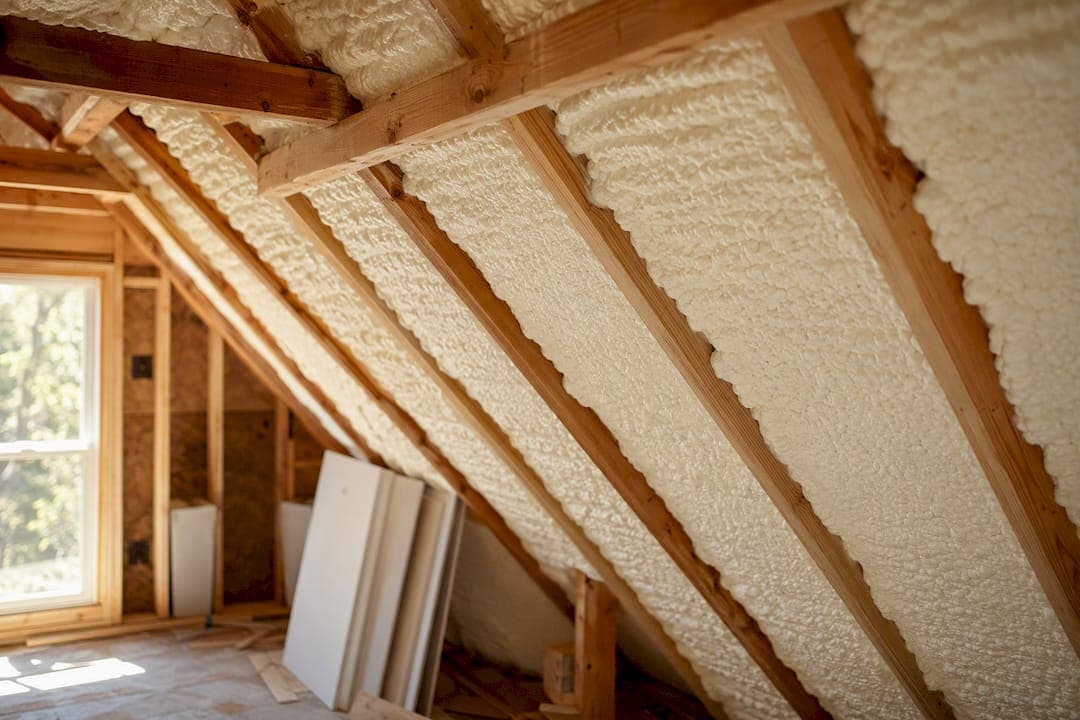
Yes, spray foam off-gasses. It happens during and shortly after application, as the two-part chemical reaction cures. In a correctly applied installation, emissions drop sharply within 24 to 48 hours; if the foam was mixed off-ratio, sprayed in poor ventilation, or applied over the wrong substrate temperature, that release can drag on for weeks or longer. Ventilate the space, stay out until curing finishes, and get air quality tested if symptoms persist beyond a few days.
TL;DR:
- Properly applied spray foam typically off-gasses for only 24 to 48 hours, but off-ratio mixing or poor ventilation can extend emissions for weeks or months.
- High levels of flame retardants like TCPP can persist inside the foam structure for years, making complete off-gassing unpredictable and not always detectable in labs.
- Symptoms such as headaches and chemical odours that start within days of installation and worsen with heat are strong indicators of ongoing off-gassing.
- Contractors handling spray foam must follow strict safety protocols, including certified training and proper protective equipment, to minimize installer and occupant risks.
- Targeted testing for VOCs and isocyanates is the most reliable way to confirm ongoing off-gassing before considering removal or remediation.
Table of Contents
- What causes spray foam off-gassing?
- Which chemicals does spray foam release?
- How long does off-gassing last?
- Signs your spray foam might still be off-gassing
- What are the health risks of spray foam off-gassing?
- What should you do immediately if you suspect off-gassing?
- When does spray foam need professional removal?
- Why credentials and track record matter when choosing a specialist
- An honest view on spray foam and off-gassing
- Need an inspection or removal? Here's how we help
- Sources
- FAQ
What causes spray foam off-gassing?
Spray foam insulation is made from two liquid components, an isocyanate and a polyol resin, that react on contact and expand into solid foam within seconds. That chemical reaction is exothermic. It generates heat, and as the foam cures, unreacted and partially reacted compounds escape into the air. That's off-gassing in its most literal sense: the by-products of a reaction still finishing its work.
Installers talk about foam being sprayed "on-ratio", meaning the two components arrive at the nozzle in the correct 1:1 volume balance. Get that ratio wrong, and the reaction never completes properly, leaving excess isocyanate or amine catalyst trapped in the cell structure. That foam keeps releasing chemicals long after a correctly mixed batch would have gone quiet.
Open-cell and closed-cell foams behave differently here. Open-cell foam has a more porous, breathable structure, which means trapped compounds can migrate to the surface and evaporate over a longer period. Closed-cell foam is denser and more rigid, so it tends to hold volatile residues inside the cell matrix rather than releasing them quickly, which changes the shape of the emissions curve rather than the ultimate outcome.
Installation errors are the biggest driver of prolonged off-gassing, and they're avoidable:
-
- Off-ratio mixing, usually from equipment miscalibration or a rushed job
- Spraying onto a substrate that's too cold, which slows the chemical reaction
- Trimming or cutting foam before it has fully cured, which physically breaks open cells and releases trapped chemicals
- Applying foam in thicker passes than the manufacturer specifies, trapping heat and unreacted material inside
Correctly applied foam, following the manufacturer's substrate temperature and lift-thickness guidance, is the difference between a two-day nuisance and a months-long problem. Our spray foam insulation guide covers what proper application actually looks like on site.
Which chemicals does spray foam release?
Spray polyurethane foam (SPF) is not one substance releasing one gas. It's a cocktail of several chemical families, each behaving differently once the foam is in your loft or wall cavity.
Isocyanates (usually MDI or pMDI) are the primary hazard during spraying and the first hours of cure. They're respiratory sensitisers, meaning they can trigger an immune response that makes future exposures worse, and the HSE identifies spraying as the highest-risk application method for this reason.
Catalysts and amines speed up the curing reaction and are the usual source of the "fishy" or ammonia-like smell people associate with fresh spray foam. That odour is unpleasant but typically fades faster than other emissions.
Flame retardants, particularly TCPP (tris(1-chloro-2-propyl) phosphate), are added to meet fire safety standards. They behave as semi-volatile organic compounds (SVOCs) rather than fast-evaporating VOCs, which changes their persistence profile entirely.
| Chemical group | Role in foam | Typical emission pattern |
|---|---|---|
| Isocyanates (MDI/pMDI) | Core reactive component | Sharp spike during spraying, falls fast with ventilation |
| Catalysts/amines | Speed the cure reaction | Source of "fishy" odour, decays within days |
| Flame retardants (TCPP) | Fire safety compliance | Slow, diffusion-limited release over months to years |
| Blowing agents | Create the foam structure | Rapid initial release, largely gone within 48 hours |
The VOC/SVOC distinction matters more than most homeowners realise. VOCs evaporate quickly and their concentration drops off in a predictable curve. SVOCs like TCPP release far more slowly, governed by airflow and surface area rather than simple time. NIST testing found measurable TCPP from open-cell foam in a full-scale test home up to two years after installation in one case study, a finding that surprised even researchers used to modelling emissions decay. That doesn't mean every installation behaves this way, but it does mean "off-gassing has stopped" and "off-gassing is undetectable in a lab" are not always the same claim.
How long does off-gassing last?
For foam sprayed on-ratio, at the correct substrate temperature, with adequate ventilation during application, the sharpest drop in emissions happens within 24 to 48 hours. That's the window manufacturers typically specify for safe re-entry, and it holds true for the vast majority of jobs completed by a competent installer.
The exceptions are what generate the calls we get at Sprayfoamremovalhelp. Several factors extend the timeline well beyond that initial window:
- Off-ratio application, leaving unreacted isocyanate or amine trapped in the foam matrix
- Low ambient or substrate temperature during spraying, which slows the cure reaction and leaves more residual chemistry behind
- Poor ventilation during and immediately after application, allowing emissions to build up rather than disperse
- Open-cell foam's porous structure, which can release SVOCs like flame retardants over a longer, flow-dependent curve
- Thick single-pass application, trapping heat and unreacted material deep inside the foam
Airflow, temperature, and foam chemistry together determine the shape of the decay curve, and NIST's own research is explicit that micro-chamber lab results don't always scale directly to real buildings, which is exactly why field testing matters more than manufacturer data sheets when there's a genuine concern.
Our practical guidance: treat 48 hours as the minimum re-entry window, not the guaranteed endpoint. If odour or symptoms persist past 72 hours, that's no longer a curing smell. It's a signal worth investigating.

Signs your spray foam might still be off-gassing
Not every unpleasant smell in a loft conversion is spray foam, and not every headache after installation is chemical exposure. Telling the difference starts with pattern recognition.
- Timing matches installation. Symptoms or odour that began within days of spraying, rather than appearing weeks later after new furniture or cleaning products arrived, point towards the foam.
- The smell has a specific character. A persistent chemical, ammonia-like, or "fishy" odour concentrated near the sprayed area is more consistent with SPF than a generic musty or damp smell.
- Symptoms cluster by room or floor. If headaches, throat irritation, or breathing discomfort correlate with time spent in the sprayed space and ease elsewhere, that's a meaningful clue rather than a coincidence.
- Odour intensifies with heat. Warm weather or heating systems can reactivate dormant emissions, particularly with SVOCs like flame retardants, because heat increases the rate at which trapped compounds migrate to the surface.
Before assuming spray foam is the culprit, rule out obvious alternatives: new carpets, fresh paint, flat-pack furniture, and some cleaning products all release their own VOCs in the weeks after installation.
If the pattern still points to the foam, targeted testing is the only way to move from suspicion to fact. Ask an indoor air quality (IAQ) professional for VOC/SVOC sampling alongside isocyanate-specific analysis, since standard VOC panels don't reliably capture MDI or pMDI. Surface wipe sampling can also detect flame retardant residue on nearby materials.
Pro Tip: Always ask a testing company for their chain-of-custody documentation. If a sample isn't handled and logged correctly between the loft and the laboratory, a mortgage lender or solicitor may not accept the result later, which matters enormously if you're selling or remortgaging.
What are the health risks of spray foam off-gassing?
The clearest, best-documented risk sits with installers, not occupants. The HSE's isocyanate guidance treats spraying as a high-risk task requiring supplied-air respirators or well-fitted filtering respiratory protective equipment, because aerosolised isocyanate at close range can exceed safe exposure limits within minutes. That's precisely why a properly run job clears the site of chemical hazard before you're allowed back in.
Sensitisation is the risk that deserves more attention than it usually gets. Once a person becomes sensitised to isocyanates, often through repeated or high-level exposure, their reaction threshold to future exposure drops. Symptoms that wouldn't have troubled them before, mild throat irritation or breathlessness, can appear at much lower concentrations. This is one of the reasons installers rotate roles and wear protection even for "small" jobs.
Isocyanate exposures during spraying can exceed legal limits without proper controls, and while catalysts and flame retardants clearly affect indoor air quality, researchers still lack enough data to establish long-term health outcomes with confidence. That gap between "we know it's present" and "we know what it does over years" is the honest state of the evidence.
That's the position a systematic review of polyurethane insulation and household products lays out, and it's a more careful statement than either extreme you'll find online, "spray foam is perfectly inert" on one side, "spray foam will poison your family" on the other.
Vulnerable groups deserve specific caution: infants, pregnant women, people with asthma or existing respiratory sensitivity, and anyone with a prior chemical sensitisation. For these occupants, err towards extended ventilation, earlier testing, and a lower threshold for calling a GP or occupational health specialist if symptoms don't resolve within a few days of proper airing.
What should you do immediately if you suspect off-gassing?
Act on the assumption that ventilation, not panic, solves most short-term cases. Open windows, run extractor fans, and if the affected space is served by central heating or air conditioning, switch that system off rather than let it circulate air from the sprayed area through the rest of the house.
- Ventilate continuously with extraction where possible, not just an open window
- Turn off shared HVAC systems serving the affected room until you're confident emissions have settled
- Relocate temporarily if anyone in the household reports moderate or worsening symptoms
- Keep a written log: dates of installation, symptom onset, weather conditions, and which rooms are affected
- Avoid disturbing the foam surface, no cutting, sanding, or heating it, since this releases trapped chemicals the same way premature trimming does during installation
- Photograph the installation and keep any paperwork from the installer, including the product data sheet if you have it
Seek medical attention if anyone experiences breathing difficulty, chest tightness, or symptoms that worsen rather than improve after 48 hours of ventilation. For persistent odour or unresolved concerns beyond that point, the next call should be to an IAQ specialist or a certified spray foam removal team, not a general handyman. Resist any temptation to remove or disturb the foam yourself. DIY removal without containment and extraction can aerosolise more material than the original installation ever did.
When does spray foam need professional removal?
Persistent odour beyond 48 to 72 hours, symptoms that don't resolve with ventilation, or a positive result from targeted VOC/isocyanate testing are the three clearest triggers for calling in a specialist rather than waiting it out.
Remediation isn't one-size-fits-all. Depending on what testing and inspection reveal, options range from:
- Selective removal, targeting only the areas showing off-ratio application or contamination
- Full removal and replacement, where misapplication is widespread or the foam is obstructing a mortgage sale
- Contained removal with active dust control, using negative pressure and HEPA extraction to stop chemical residue and particulates spreading to unaffected rooms during the work itself
The US EPA is candid that removal doesn't always fully resolve occupant complaints, because some contaminants can migrate into surrounding timber, plasterboard, or insulation before removal even begins. That's precisely why containment and post-remediation air testing matter as much as the removal itself, and why we recommend verification testing after any job rather than assuming a clean-looking loft means a clean atmosphere.
Cost drivers worth knowing before you request quotes: the scope of contamination, access difficulty (a tight loft costs more to work in safely than an open one), and the containment level required. A detailed breakdown of removal costs is worth reading before comparing quotes, since the cheapest price often reflects a shortcut on dust control rather than genuine efficiency. Certified teams follow documented protocols precisely because uncontrolled removal creates the secondary exposure risk the EPA warns about.
Why credentials and track record matter when choosing a specialist
Choosing who inspects or removes problem spray foam is not a decision to make on price alone. The technicians doing this work are handling a respiratory sensitiser in an occupied home, and their training, insurance, and process discipline directly affect your family's exposure and your ability to sell or remortgage afterwards.
Look for these proof points before booking any assessment:
- PCA-certified technicians, trained specifically in spray foam identification and safe removal, not general insulation fitters
- A 10-year insurance-backed warranty, giving you recourse if a problem resurfaces after the work is done
- A direct-team model, meaning the people who inspect your loft are the same people who carry out the removal, with no subcontracting gaps in accountability
- Track record at scale, our team at Sprayfoamremovalhelp has assessed and remediated spray foam issues in more than 1,000 homes across London and the Southeast
- Specialism in both closed-cell and open-cell removal, since the two require different tools, containment approaches, and disposal routes
A proper inspection includes diagnostic sampling where warranted, a written containment plan before any work starts, and a mortgage-compliant report at the end, the document a lender or solicitor will actually accept.
An honest view on spray foam and off-gassing
Correctly applied spray foam is a genuinely good insulation product, and most of the anxiety circulating online overstates the risk from a properly installed job. The real problem in this industry has never been the chemistry itself; it's how often that chemistry gets applied badly, then sold to a homeowner who has no way of checking the ratio, the substrate temperature, or the cure time before the loft hatch goes back on.
My practical counsel is to test before you commit to remediation, not the other way round. A targeted VOC and isocyanate sample costs a fraction of a full removal, and it turns guesswork into evidence, which is exactly what a lender, a solicitor, or your own peace of mind requires. Certified removal, done properly with containment and post-job verification, resolves the genuine cases without the drama.
— jessica
Need an inspection or removal? Here's how we help
Sprayfoamremovalhelp gives you a direct line to the certified technicians actually doing the work, with no call centre and no subcontracted crew you've never spoken to. That matters when you're deciding whether an odour needs monitoring or urgent action, because you're getting a straight answer from the person who'll be in your loft, not a sales script.

If you suspect off-gassing, start with a free inspection to establish whether what you're smelling is a curing job settling down or a genuine off-ratio application. For anyone with persistent symptoms or an odour that's gone on too long, our emergency spray foam removal service covers same-day assessment across London and the Southeast. Every job comes with a 10-year insurance-backed warranty and, where sale or remortgage is the goal, a mortgage-compliant certificate at completion. If you're still weighing up whether removal is even necessary, our guide on whether you need to remove spray foam is a sensible next read before you book anything.
Sources
For readers who want to go straight to the primary sources: the HSE's isocyanate guidance covers installer controls, NIST's technical note details emissions testing and TCPP persistence, the UCL systematic review summarises polyurethane's indoor air quality impacts, and the UK government's timber roof report addresses installation and moisture risk specifically. If contamination is confirmed, Pest Control 24 London's loft removal service also handles related insulation removal work.
This article is general information, not a substitute for advice from a qualified doctor. Consult a qualified healthcare professional about your own circumstances before acting on anything here.
- HSE — Isocyanates (construction guidance)
- NIST technical note — Characterization of emissions from spray polyurethane foam
- Polyurethane insulation and household products — systematic review (Build Environ)
- US EPA — Potential chemical exposures from spray polyurethane foam
FAQ
How long does spray foam off-gassing last?
Correctly applied foam typically sees emissions fall sharply within 24 to 48 hours, though NIST testing found measurable flame retardants from open-cell foam in a test home up to two years after installation in one case study.
How do you know if spray foam is off-gassing?
Look for a persistent chemical or fishy odour concentrated near the sprayed area, combined with symptoms like headaches or throat irritation that ease when you leave that space; targeted VOC and isocyanate testing confirms it.
Can spray foam cause off-gassing after it's fully cured?
Correctly cured, on-ratio foam should not off-gas significantly, but off-ratio application, poor ventilation during spraying, or disturbing the foam (cutting, heating) can trigger renewed or extended emissions.
What happens if you inhale spray foam fumes?
Short-term inhalation of isocyanates and other curing by-products can cause throat and eye irritation, coughing, or headaches, and repeated exposure can lead to respiratory sensitisation, which lowers your tolerance to future exposure; the HSE requires respiratory protection for installers for exactly this reason.