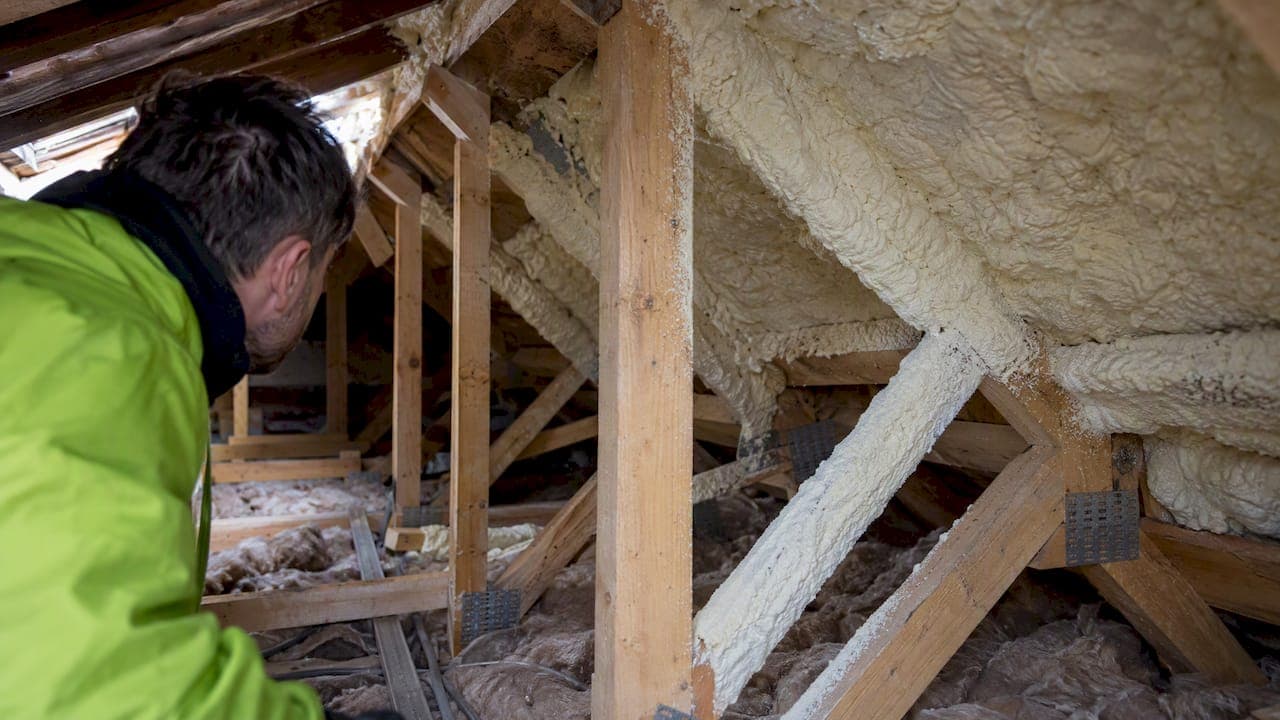
Spray foam can perform well on a trussed roof when it's correctly specified, matched to the right substrate and backed by proper ventilation design, but incorrect installation brings three serious risks: trapped moisture and timber decay, a higher internal fire load, and health hazards during application. If foam is already in your roof, or you're buying a property that has it, the sensible first move is a competent, independent inspection before anyone talks about removal.
TL;DR:
- Poor spray foam installation can trap moisture against timber, increasing decay risk, especially if applied directly onto roof coverings without proper ventilation or vapor control layers.
- High relative humidity inside the roof during winter, caused by inadequate ventilation, promotes mold and fungal decay, mainly where foam covers joints and connector plates.
- Spray foam raises fire load inside the roof, with foam itself being combustible, which can lead to faster internal fire spread despite passing external fire resistance tests.
- Effective inspection before removal includes requesting original condition reports, hygrothermal assessments, third-party certification, and detailed installation documentation.
- Partial or full removal should be carried out by certified specialists, with pre-removal visual surveys recommended to prevent unnecessary work and costly future issues.
Table of Contents
- How spray foam interacts with trussed timber roofs
- Moisture, condensation and timber decay: what the evidence shows
- Structural and material risks for trussed roofs
- Fire performance: how sprayed foam changes roof fire loads
- Health and installer safety risks
- Survey, mortgage and sale implications
- Fixing the problem: monitoring, remediation or removal
- An evidence-led view on spray foam decisions
- How we can help if removal turns out to be the answer
- FAQ
- Sources
How spray foam interacts with trussed timber roofs
Trussed roofs rely on timber members staying dry and visible so that any decay, movement or fixing failure gets spotted early. Spray foam changes that picture in two ways: it alters how moisture moves through the roof, and it covers up the timber so you can't see what's happening underneath.
Open-cell foam is vapour-permeable, letting some moisture pass through, while closed-cell foam is far denser and largely vapour-resistant. That difference matters because a trussed roof was originally designed to ventilate and dry out through gaps and breathable layers. Spraying a vapour-resistant closed-cell foam onto the underside of tiles or felt, without an adequate air and vapour control layer (AVCL), can trap moisture against timber that was never meant to stay damp.
Hygrothermal assessment, referenced to BS 5250:2021, is the recognised method for checking whether a particular roof build-up will create condensation risk once foam is added. A pre-installation assessment should model the existing underlay, covering and ventilation before anyone sprays anything.
- Open-cell foam allows some vapour movement but offers less structural rigidity and lower insulation value per inch.
- Closed-cell foam insulates more effectively but can seal moisture against timber if there's no AVCL.
- Foam sprayed directly onto rafters or truss faces hides joints, plates and fixings from view, which is exactly where decay tends to start.
Once foam is in place, a surveyor can no longer run a torch along the truss and see timber condition directly, which is why documentation from the installation stage becomes so important later.
Moisture, condensation and timber decay: what the evidence shows
This is where trussed roofs run into real trouble, and it's backed by government modelling rather than guesswork.
Modelling by the Building Safety Regulator and HSE found that relative humidity at the outer foam interface can reach very high levels during winter in roofs with low external ventilation and high ceiling-level ventilation, conditions that are common in older trussed roofs retrofitted with foam. That level of sustained humidity against timber is enough to support mould growth and, over time, fungal decay.
The same research identified the installation details that push risk up sharply:
- Foam sprayed directly onto the underside of roof tiles or slates, with no air gap or underlay between foam and covering.
- A high vapour-resistance underlay present beneath the foam, which blocks moisture escaping outward.
- No AVCL at ceiling level, allowing warm, moist internal air to migrate into the roof void.
- A roof covering that was already damaged or failing before the foam went in, letting water ingress continue unseen.
If you're checking an existing installation, look for the practical warning signs rather than relying on assumptions. Watch for mould or dark staining on exposed timber near the foam line, a musty or damp odour in the loft, raised moisture-content readings taken with a timber moisture meter at truss joints and plates, and any softening or discolouration where foam meets a wall plate or valley. These signs cluster at connection points because that's where water tends to collect and where ventilation was most likely to be disrupted.
Structural and material risks for trussed roofs
Moisture problems don't stay cosmetic for long. Trapped dampness against timber, sustained over months or winters, leads to loss of section in the wood itself as fungal decay eats away at structural fibres. In a trussed roof, that's a problem because the design depends on every member and joint carrying load exactly as calculated, so even localised decay at a truss plate can undermine the wider structure.

The metal connectors are their own concern. Zinc-plated gang-nail plates, the toothed connectors that hold truss joints together, are vulnerable to corrosion when kept in persistently damp conditions, and corrosion weakens the grip they have on the timber long before it's visible from below.
Electrical cables routed through foam-filled voids face a different issue: foam restricts heat dissipation around the cable, which can mean the circuit needs de-rating to stay within safe operating limits, a detail that's easy to miss once everything is sprayed over.
- Trapped moisture causes slow timber decay at joints, often starting where plates meet rafters.
- Corrosion of zinc gang-nail plates reduces joint strength over time in persistently damp conditions.
- Cables encased in foam may need de-rating because foam limits normal heat loss.
- Any sign of movement, staining or a damp smell near a truss joint usually means that section needs opening up for a proper look.
Pro Tip: If a visual check from below raises doubts about even one truss joint, ask for a small, localised foam removal at that point rather than guessing, it's far cheaper than discovering a bigger problem later.
Fire performance: how sprayed foam changes roof fire loads
Fire behaviour is one of the more technical risks, and it's easy to misread the test results if you only look at the headline pass.
Government and BRE fire-safety testing on roof assemblies found that sprayed foam increases the combustible load within a roof, with pyrolysis and charring observed in the foam during testing. Some of the assemblies tested still met the Broof(t4) classification, the standard measure of how well a roof covering resists fire penetrating from outside.
That's an important nuance: Broof(t4) measures penetration resistance from an external fire source hitting the roof covering. It doesn't tell you how severe a fire would become internally if the foam itself ignites, say from an electrical fault in the roof void. Because foam adds combustible material directly against the timber structure, a fire that does take hold inside the roof space may burn hotter and spread faster than in an unfoamed roof.
- Foam adds combustible fuel load inside the roof void, separate from how the outer covering performs.
- Passing Broof(t4) tells you about external fire penetration, not internal fire severity once foam is involved.
- Compartmentation between a loft and the rooms below becomes more important when foam has been added, since it affects how a fire inside the void might spread.
For roofs with foam already installed, especially where cabling or older electrics run through the void, it's worth asking a specialist to assess fire risk alongside any moisture survey, rather than treating them as separate questions.
Health and installer safety risks
Spray foam application isn't just a structural issue, it's an occupational health one too, and it affects anyone in or near the property during spraying.
HSE guidance flags isocyanates as a significant hazard during polyurethane spraying: the process generates aerosols that can cause respiratory irritation and, with repeated exposure, occupational asthma. That's why HSE guidance calls for specialist respiratory protective equipment, proper ventilation and, for operatives who spray regularly, medical surveillance.
For homeowners, the practical takeaway is re-entry timing and ventilation. Rooms and roof voids need adequate time and airflow to clear off-gassing before anyone spends extended time near freshly sprayed foam.
- Spraying generates isocyanate aerosols that need RPE, fit testing and ventilation controls for installers.
- Off-gassing continues for a period after spraying, so ventilation and re-entry timing matter for occupants.
- DIY spray foam kits or inexperienced installers raise both health exposure risk and the chance of a poor-quality, high-risk installation.
Choosing an installer with the right training and certification reduces both risks at once, since the controls that protect workers from isocyanate exposure tend to go hand in hand with a properly specified, documented job.
Survey, mortgage and sale implications
Lenders and surveyors treat spray foam in a trussed roof as a substantial alteration, and the paperwork gap is usually what causes problems, not the material itself.
- Ask for the pre-installation condition report, which should describe the roof's state before foam went in.
- Request the hygrothermal evaluation, the condensation risk assessment referenced to BS 5250:2021 that models whether the installed system creates long-term moisture risk.
- Check for third-party product certification, such as BBA or Kiwa approval for the specific foam used.
- Collect the installer's full handover pack, including foam type, depth, and application method recorded at the time.
The PCA inspection protocol sets out what a competent surveyor should record during a non-invasive inspection: foam type, substrate condition, foam depth and timber moisture readings taken at accessible points. Without this information, a surveyor often can't rule out future decay, which is precisely why lenders hesitate.
RICS consumer guidance makes a similar point: foam can hide problems and affect ventilation, so surveyors are advised to look at the whole property rather than the insulation in isolation. If you're trying to resolve a stalled sale or remortgage, commissioning an independent PCA or RICS-competent inspection before accepting any removal quote is the step that actually moves things forward.
Fixing the problem: monitoring, remediation or removal
Not every foam-insulated trussed roof needs tearing out, but knowing which category yours falls into makes the next decision much easier.
Monitoring and ventilation upgrades can be appropriate where the installation has full documentation, a recognised hygrothermal assessment confirming low condensation risk, and no visible signs of moisture or decay. In that scenario, periodic re-inspection and improved loft ventilation may be enough.
Partial or full removal becomes the likely route where foam was sprayed directly onto the primary roof covering with no air gap, where documentation is missing entirely, or where moisture meter readings and visual signs point to active decay. According to PCA and RPSA joint guidance, closed-cell foam applied directly to primary roofing without underlay is often best scheduled for early removal, since the inability to inspect timber leaves too much uncertainty over how it will perform going forward.
Removal itself is specialist work. Technicians use mechanical extraction, abrasive methods or chemical softening depending on the substrate, and it can be staged, tackling localised defect areas first, to manage cost where a full strip isn't yet justified.
- Monitoring suits documented, low-risk installations with no signs of moisture.
- Removal becomes necessary where foam sits directly on the covering, documentation is missing, or decay signs are already present.
- A competent specialist should hold PCA-recognised competence, carry insurance, and provide an independent written report, not just a verbal opinion.
Pro Tip: Get the survey done before you get a removal quote. A written report gives you a basis to compare quotes fairly and avoids being steered toward removal you may not need.
An evidence-led view on spray foam decisions
Most of the trussed roof problems we see trace back to a poor original installation: wrong foam type for the substrate, no pre-installation assessment, or foam sprayed over a roof covering that was already failing. Plenty of valid installations exist too, where a proper hygrothermal evaluation was carried out and the documentation survives.
That distinction is exactly why an independent inspection, using the checklist of documents and protocol items covered earlier, is the most cost-effective first step. It stops you being pressured into removal you may not need, and it gives you solid ground to challenge removal you do.
— jessica
How we can help if removal turns out to be the answer
If a survey confirms your trussed roof needs attention, we offer the full range of assessment and removal work in one place: a basic visual survey, full roof report or drone survey to establish exactly what's happening in your roof, and certified open and closed cell spray foam removal once you know it's needed.

Our technicians work to recognized industry standards and every removal is backed by an insurance-backed warranty, so the work is designed to be mortgage-compliant. You deal directly with the team doing the work, with transparent pricing and no hidden fees added later.
Before accepting any removal quote, commission a visual survey or full roof report so you're deciding from evidence rather than a sales pitch at the door.
FAQ
Is spray foam bad for your roof?
Not inherently: spray foam can perform safely when the substrate, ventilation and AVCL are correctly specified and a hygrothermal assessment confirms low condensation risk. Problems arise mainly from poor installation, particularly foam sprayed directly onto roof coverings without an air gap, which Building Safety Regulator and HSE modelling links to high humidity and decay risk.
Is spray foam banned in the United Kingdom?
Spray foam insulation is not banned. Lenders and surveyors have simply grown more cautious because missing documentation makes it hard to rule out hidden decay, which is a lending concern rather than a legal prohibition.
Why can't you sell a house with spray foam insulation?
Selling isn't blocked outright, but a sale can stall if the mortgage valuer can't confirm the roof's condition behind the foam. PCA guidance notes that a competent inspection and a full handover pack often resolve a lender's query without needing removal at all.
What is the problem with spray foam roof insulation?
The core issues are moisture becoming trapped against timber when there's no proper ventilation or AVCL, metal truss plates corroding in persistent damp, and foam concealing timber so decay can't be spotted early. Fire testing has also found that sprayed foam adds combustible load inside the roof, which matters for internal fire severity even where the outer covering still passes standard penetration tests.