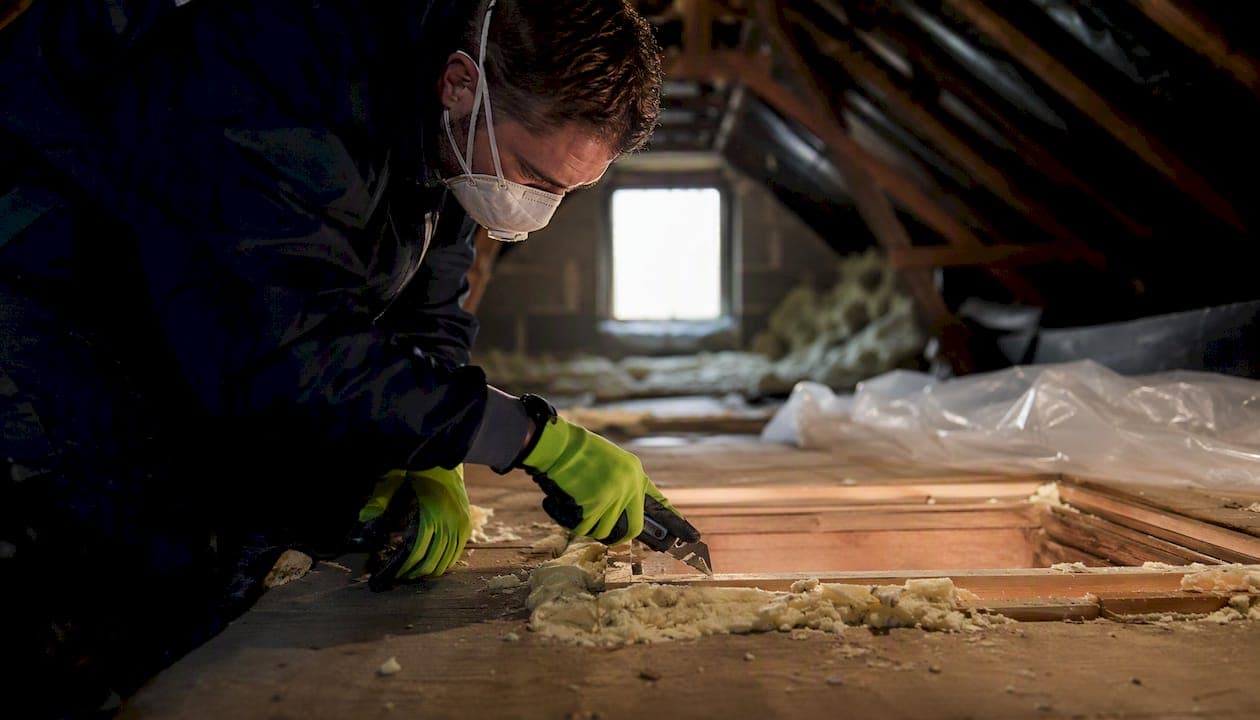
Do not force a jammed loft hatch. If spray foam is holding it shut, the single most important next step is to book a professional survey before you touch anything. Attempting to lever or chisel the hatch open without knowing what is behind it risks snapping timber, cracking tiles, and creating the kind of damage that will cost far more to fix than the removal itself.
Two things you can do right now:
- Photograph the hatch frame and any visible foam from below, noting the approximate date of installation if you know it.
- Contact a PCA-certified removal specialist to arrange a site inspection, ideally before you speak to your mortgage lender or estate agent.
Typical professional removal costs for a loft with spray foam vary depending on foam type, coverage area, and whether structural repairs are needed. Targeted hatch clearance alone can sit at the lower end of that range, but only a survey will confirm which applies to your property.
Pro Tip: If you are selling or remortgaging, tell your solicitor or broker about the foam before the surveyor visits. Proactive disclosure with a specialist report in hand is far better than a surveyor flagging it as an unknown risk.
Key takeaways
A loft hatch blocked by spray foam requires professional survey and removal to satisfy UK mortgage lenders, with costs typically ranging from £500 for targeted trimming to £5,000 or more for full removal with reinstatement.
| Point | Details |
|---|---|
| Do not force the hatch | Forcing a foam-bonded hatch risks timber and tile damage; photograph it and book a survey first. |
| Foam type determines risk | Closed-cell foam on tiles creates sustained moisture risk; open-cell is lower risk but still needs assessment. |
| Lenders need documentation | A written inspection report, 10-year IBG, and before/after photos are the minimum lenders expect. |
| No government grant available | Remediation costs fall to the homeowner; pursue the installer or IBG before paying for removal. |
| Sprayfoamremovalhelp covers London and the Southeast | Revive Maintenance provides PCA-certified removal, written reports, and a 10-year IBG on every job. |
Table of Contents
- Why does spray foam block a loft hatch and why does it matter?
- What does a professional pre-inspection cover?
- How professionals remove foam to regain hatch access
- What does removal typically cost and how long does it take?
- How does spray foam affect remortgage and house sale in the UK?
- What can you safely do right now if the hatch is jammed?
- Full removal, targeted trimming, or survey only: which do you need?
- How do you choose a qualified removal specialist?
- How Revive Maintenance handles blocked hatches and mortgage-compliant removal
- What technicians find when they arrive on site
- Revive Maintenance is ready to help you regain access
- Sources
- FAQ
Why does spray foam block a loft hatch and why does it matter?
Spray foam is applied as a liquid that expands rapidly and bonds to whatever surface it contacts. When installers spray the underside of roof rafters and tiles, they often work right up to the hatch frame. The foam cures hard against the timber surround, effectively gluing the hatch shut. With closed-cell foam in particular, the bond can be strong enough that a homeowner pulling on the hatch risks pulling the frame away from the ceiling rather than opening the door.
The problem goes well beyond inconvenience. A loft hatch blocked by spray foam means no one can inspect the roof structure without first removing the obstruction. That matters enormously to lenders and surveyors.
RICS warns that the primary concern for lenders is lack of transparency: spray foam can conceal the condition of structural timbers, making it impossible for a surveyor to assess rot or damp without first damaging the foam. Independent inspection and documentary evidence are therefore essential before a lender will proceed. (RICS consumer guide: spray foam insulation)
Open-cell vs closed-cell: why the distinction matters
The two main foam types behave very differently once installed.
Open-cell foam is softer and vapour-permeable. It is generally easier to remove mechanically and poses a lower moisture-trapping risk, though it can still block access and conceal defects.
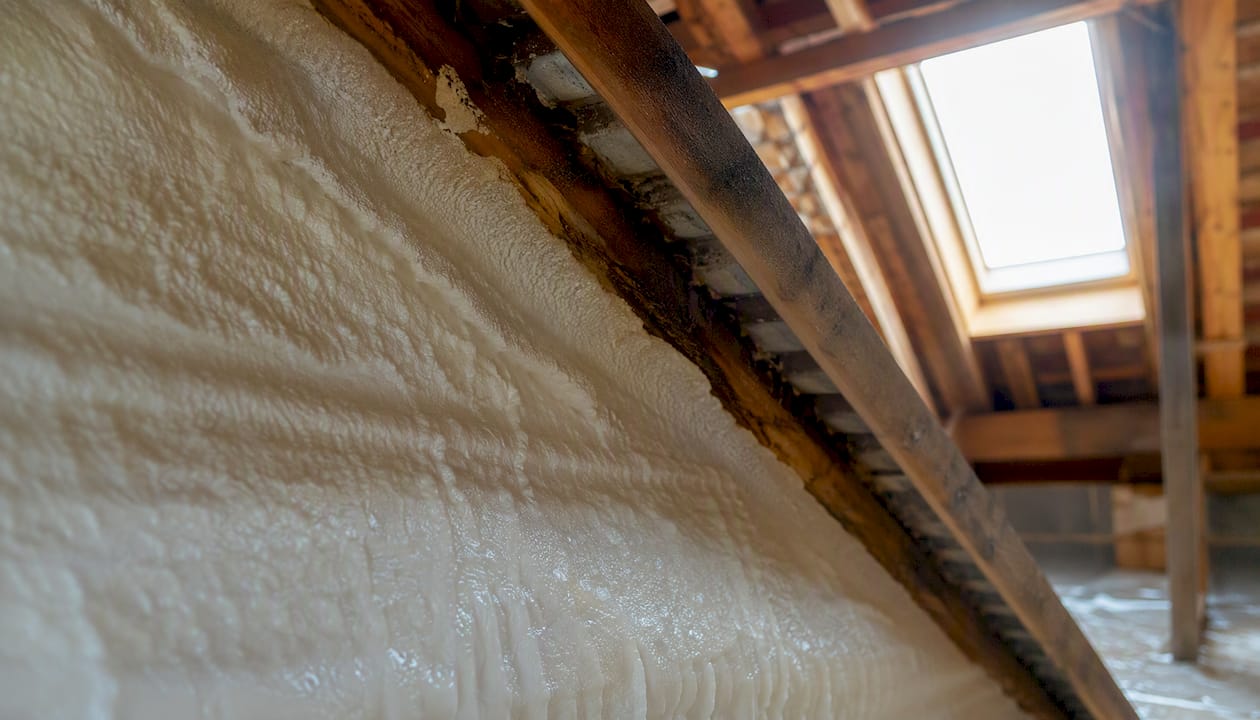
Closed-cell foam is rigid, dense, and largely vapour-impermeable. Applied directly to roof tiles or underlay, it can trap moisture against the timber. A UK technical hygrothermal study found that certain build-ups, especially where foam is applied directly to tiles without an appropriate control layer or ventilation gap, can create sustained high relative humidity in the outer insulation zone and raise a risk of timber decay over several years. The same foam product can be low risk in one roof build-up and high risk in another, depending on underlay type, ventilation, and whether an air and vapour control layer is present.
| Foam type | Vapour permeability | Removal difficulty | Moisture risk to timbers | Lender concern level |
|---|---|---|---|---|
| Open-cell | High (breathable) | Moderate | Lower, but still present | Significant |
| Closed-cell | Very low (impermeable) | High | Higher, especially on tiles | High |
Pro Tip: Ask your removal specialist to identify the foam type before quoting. Closed-cell foam on rafters almost always requires full removal rather than trimming, which changes both the cost and the documentation lenders will expect.
The House of Commons Library notes that incorrectly installed foam can trap moisture and lead to timber decay, which is precisely why lenders worry about surveyors being unable to inspect the roof structure. British Board of Agrément (BBA) certificates and original installer paperwork, where they exist, give surveyors a starting point, but they do not substitute for a physical inspection.
What does a professional pre-inspection cover?
A survey is required before any decision is made about trimming, partial removal, or full removal. Without it, neither you nor a lender can know the true condition of the timbers behind the foam.
A qualified specialist will typically carry out the following on site:
- External roof check: visual inspection of tiles, ridge, and verges for signs of movement, cracking, or water ingress.
- Moisture meter readings: taken at accessible points around the hatch frame and any exposed timber to flag elevated moisture content.
- Timber probe or borescope: where the hatch is fully blocked, a borescope camera can be inserted through a small gap or adjacent vent to assess rafter condition without destructive opening.
- Ventilation assessment: checking whether ridge vents, soffit vents, or other ventilation paths remain clear or have been blocked by foam.
- Foam type identification: a small test cut or visual assessment to confirm open-cell or closed-cell, which determines the removal method.
- Written survey report: a document recording findings, moisture readings, foam type, and recommended action, structured to satisfy lender and RICS-style inspection requirements.
Before the surveyor arrives, gather:
- Any installer warranty or guarantee documents.
- BBA or other technical certificates supplied at installation.
- The approximate installation date and the name of the installer if known.
- Photographs you have already taken of the hatch and any visible foam.
- Correspondence with the installer, including any complaints already raised.
Pro Tip: If you still have the original installer's paperwork, photograph it and email it to the removal specialist before the site visit. It can halve the time spent on-site identifying the product and speeds up the written report.
How professionals remove foam to regain hatch access
The sequence professionals follow is: survey, then containment, then controlled removal, then structural check and documentation. Skipping any stage is what leads to tile damage, timber splitting, and reports that lenders will not accept.
The main removal methods
- Mechanical removal: Hand tools and oscillating cutters work along the rafter line to slice and peel foam away from timber. Suitable for open-cell foam and for targeted hatch clearance where the surrounding structure is sound.
- Dry-ice blasting: Pellets of CO₂ are fired at the foam surface, causing rapid thermal contraction that breaks the bond. Effective on closed-cell foam and leaves no chemical residue, though it requires specialist equipment and is typically more expensive.
- Chemical softening and abrasion: A solvent or softening agent is applied to the foam surface to reduce rigidity before mechanical removal. Used where mechanical tools alone risk timber damage.
- Targeted trimming at the hatch: Where only the hatch frame is bonded, a specialist can cut a clean line around the frame perimeter to free the hatch without disturbing the wider foam installation. This is the least disruptive option but only appropriate where the surrounding foam is otherwise compliant and the timber is sound.
- Full removal: Required where moisture damage is found, where closed-cell foam covers the entire rafter bay, or where lenders specifically require a clear roof void. Full removal involves stripping all foam, inspecting and treating timbers, reinstating ventilation, and fitting replacement insulation such as Superfoil.
Safety and containment controls
Spray foam removal generates fine particulate and, with some products, chemical fumes. Professionals use:
- Dust-proof zipped entrance covers to isolate the loft from living spaces.
- HEPA-filtered extraction units running continuously during removal.
- FFP3 respiratory masks and eye protection for all operatives.
- Careful bagging and removal of underlying loose-fill insulation that may be contaminated.
- Isolation of electrical circuits in the loft before work begins.
Specialist removal guidance consistently recommends HEPA extraction and respiratory protection as non-negotiable site controls, noting that DIY chiselling frequently causes tile or timber damage that adds significantly to the final cost.
All waste foam is classified as construction waste and must be disposed of at a licensed facility. Ask your specialist to confirm their waste transfer documentation before work begins.
What does removal typically cost and how long does it take?
Professional spray foam removal in the UK typically costs between £1,500 and £5,000 for a standard semi-detached or terraced house, with larger or more complex properties running higher. Targeted hatch clearance, where only the frame area is bonded and the surrounding structure is sound, can fall below £1,000. Full removal with structural repairs and reinstatement of insulation sits at the upper end or beyond. See the removal costs page for a more detailed breakdown.
Cost drivers include:
- Foam type: Closed-cell foam costs more to remove than open-cell due to its density and bond strength.
- Coverage area: A fully sprayed roof void costs more than a partially treated one.
- Access difficulty: A low-pitch roof or a blocked hatch that requires borescope work before entry adds time and cost.
- Structural repairs: Decayed or split rafters discovered during removal require treatment or replacement.
- Certification and reporting: A lender-acceptable written report, insurance-backed guarantee (IBG), and before/after photographs add to the quote but are non-negotiable for mortgage compliance.
Pro Tip: Any quote that does not explicitly include a written survey report, before/after photographs, and an IBG is incomplete for mortgage purposes. Request these in writing before signing anything.
There is no central government grant available for spray foam removal. As the House of Commons Library confirms, where installation is incorrect, remediation is expected through the installer or via an insurance-backed guarantee.
How does spray foam affect remortgage and house sale in the UK?
A loft with spray foam can delay or prevent remortgage or sale unless surveyor and lender conditions are met. This is the most pressing reason to act before you list a property or approach a lender.
BBC News reporting found that some major lenders will not lend on properties where spray foam is present, while others assess cases individually and may require specialist reports or documentation. There is no single industry-wide policy, which means the outcome depends heavily on which lender is involved and what evidence you can provide.
The House of Commons Library notes that homeowners have found it difficult to remortgage or sell properties with spray foam insulation, and that remediation is expected via the installer or an insurance-backed guarantee where the installation is problematic. (Spray foam insulation and mortgages)
What surveyors and lenders want to see
- A written inspection report from a qualified specialist confirming foam type, timber condition, moisture readings, and ventilation status.
- An insurance-backed guarantee (IBG) or warranty covering the removal work, typically for 10 years.
- BBA product certificates or equivalent technical data for the original foam product.
- Before-and-after photographs showing the roof void before removal and after reinstatement.
- Confirmation that ventilation has been restored to Building Regulations standards.
When installers are unresponsive
If the original installer is no longer trading or refuses to engage, you have several escalation routes:
- Check whether the installation was covered by a TrustMark-registered contractor. TrustMark provides a complaint route and can assist with IBG claims where the installer is unresponsive.
- Contact the IBG provider directly if a guarantee was issued at installation.
- Raise a formal complaint through the installer's trade body if they are a member.
- Commission an independent removal and obtain a fresh IBG, then present the full documentation pack to your lender.
Present your paperwork to the lender as a complete pack: survey report, IBG, BBA certificates, before/after photos, and waste disposal records. Lenders respond better to a complete file than to piecemeal submissions.
What can you safely do right now if the hatch is jammed?
Two safe actions you can take immediately, and three things to avoid.
Safe actions:
- Photograph the hatch from below, capturing the frame, any visible foam squeeze-out, and the ceiling surround.
- Note the approximate installation date, installer name, and any reference numbers from paperwork you hold.
Avoid these:
- Do not use a chisel, screwdriver, or lever to force the hatch. Uncontrolled chiselling frequently splits the hatch frame, damages ceiling plasterboard, and can crack roof tiles above.
- Do not apply WD-40, acetone, or any chemical solvent to the foam. Solvents can soften foam temporarily but do not break the structural bond, and some react with foam to produce fumes that are harmful in an enclosed space.
- Do not attempt to cut the foam with a Stanley knife without knowing what is immediately behind it. Electrical cables and water pipes sometimes run close to hatch frames.
If you need temporary ventilation while waiting for removal, a passive humidity monitor placed in the room below can flag rising damp before it becomes a structural problem. A vented trapdoor surround is a short-term option if the hatch can be freed safely by a specialist without full removal.
Pro Tip: Spray foam fumes during any cutting work can cause respiratory irritation. Even for a brief inspection cut, wear an FFP2 mask and open windows in the room below before starting.
Spray foam removal generates fine particulate that can settle on surfaces throughout the home if containment is not in place. This is one of the clearest reasons why professional containment, not DIY access attempts, is the right first step.
Full removal, targeted trimming, or survey only: which do you need?
Three signals indicate that full removal is likely required rather than a targeted fix:
- Moisture readings above 20% in accessible timbers adjacent to the foam.
- Closed-cell foam applied directly to roof tiles with no ventilation gap or underlay between foam and tile.
- Visible or suspected timber decay, staining, or fungal growth anywhere in the roof void.
Where none of these apply, a risk-based approach is appropriate:
- Low risk: Open-cell foam, good ventilation, dry timbers, hatch bonded but no structural concerns. Targeted trimming at the hatch frame is likely sufficient, with a written report confirming timber condition.
- Medium risk: Closed-cell foam present but timbers dry and ventilation partially intact. Partial removal of the most problematic sections, ventilation reinstatement, and a full written report with IBG.
- High risk: Any moisture damage, closed-cell on tiles, inaccessible rafters, or evidence of decay. Full removal, structural treatment, ventilation reinstatement, and a complete documentation pack for lenders.
The PCA guidance is clear that blanket removal is not required in every case. Risk-based professional assessment determines the appropriate scope. A survey-only approach, where a specialist inspects and documents but recommends no removal, can be an accepted remedy when the foam is compliant, the timbers are sound, and the lender accepts the report.
How do you choose a qualified removal specialist?
The single most important credential to insist on is an independent written report structured to satisfy lender requirements. A verbal assurance or a basic invoice is not sufficient for remortgage or sale.
Hire checklist:
- PCA membership or equivalent professional body affiliation.
- Confirmed ability to produce a written inspection report acceptable to RICS-registered surveyors and mortgage lenders.
- 10-year insurance-backed guarantee (IBG) included in the written quote.
- Before-and-after photographs as a standard deliverable.
- HEPA extraction and FFP3 PPE confirmed as site controls.
- Waste disposal method and transfer documentation provided.
- Public liability and professional indemnity insurance confirmed in writing.
Questions to ask on the first call:
- Can you confirm the foam type before quoting, and will the quote change if the type differs from your initial assessment?
- Will the written report be structured to satisfy mortgage lender requirements?
- Is the IBG issued by an independent insurer, and can I see the policy wording before I sign?
- Who carries out the work on site, and are they employed directly by your company?
- Can you provide references or case studies from properties where removal enabled a successful remortgage or sale?
Red flags:
- No formal written report offered, only a certificate of removal.
- Vague warranty language ("guaranteed for life") with no named insurer.
- Prices significantly below market rate with no explanation of method or exclusions.
- Refusal to provide references or before/after photographs from previous jobs.
- No mention of HEPA extraction or PPE in the method statement.
Pro Tip: Ask specifically whether the IBG is backed by an FCA-regulated insurer. Some guarantees are backed only by the contractor's own business, which offers no protection if the company ceases trading.
How Revive Maintenance handles blocked hatches and mortgage-compliant removal
Revive Maintenance, trading as Sprayfoamremovalhelp, offers a complete service from initial survey through to mortgage-compliant removal and reinstatement across London and the Southeast. Every job begins with a site inspection: moisture meter readings, foam type identification, timber assessment, and a written report structured to satisfy lender and surveyor requirements.
What the service includes:
- PCA/RICS-style inspection with written survey report.
- Identification of foam type (open-cell or closed-cell) before any removal begins.
- Controlled removal using mechanical methods, dry-ice blasting, or targeted trimming depending on foam type and risk level.
- HEPA extraction and full PPE throughout.
- Ventilation reinstatement and, where required, Superfoil insulation installation to replace removed foam.
- Before-and-after photographs provided as standard.
- 10-year insurance-backed guarantee included in every removal job.
- Direct communication with the team carrying out the work, no middlemen.
Pro Tip: Before your free inspection, gather any paperwork from the original installation: installer name, date, any BBA certificates or warranty documents. Even partial records speed up the survey and reduce the time before you receive your written report.
To book a free inspection or get an instant estimate, visit the loft services page.
What technicians find when they arrive on site
The first thing a technician does on site is not remove foam. It is to assess what is actually there, because what homeowners describe over the phone and what exists in the loft are often quite different.
Most homeowners expect the worst. In practice, a significant proportion of blocked hatches turn out to involve open-cell foam that has bonded only to the hatch frame surround, with dry timbers and intact ventilation behind it. In those cases, targeted trimming frees the hatch in a few hours, and the written report confirms the roof void is sound. That report, combined with an IBG, is usually sufficient for the lender to proceed.
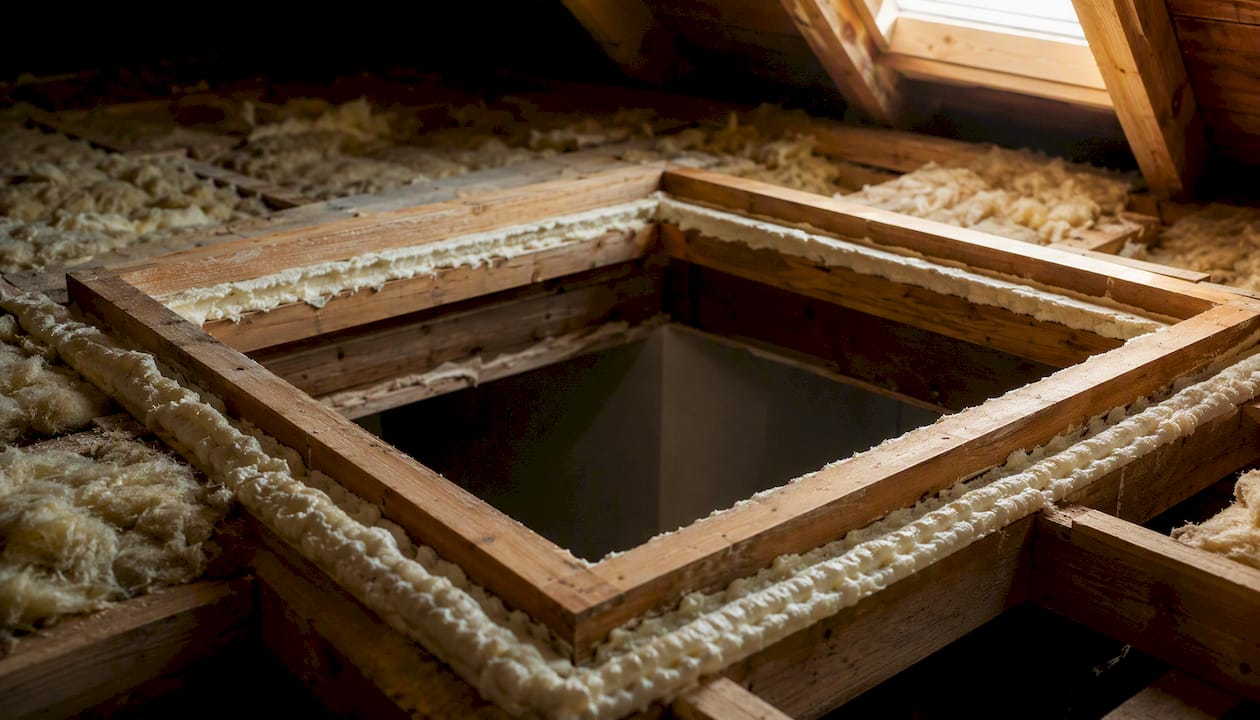
Where things are more serious, typically closed-cell foam applied directly to tiles with no underlay, the technician's job is to document everything clearly before removal begins. Photographs of moisture readings, rafter condition, and ventilation gaps taken before any foam is disturbed are what give the final report its credibility with surveyors and lenders. The removal itself is methodical and contained. Most homeowners are surprised by how little disruption reaches the living space when proper containment is in place.
Revive Maintenance is ready to help you regain access
If your loft hatch is blocked by spray foam and you need to sell, remortgage, or simply regain safe access to your roof void, Sprayfoamremovalhelp offers a direct route to resolution. Revive Maintenance's PCA-certified technicians cover London and the Southeast, arriving with moisture meters, a borescope, and the experience to identify your foam type and risk level on the first visit.
The initial inspection produces a written survey report and a clear quote covering method, exclusions, before/after photographs, and a 10-year IBG. There are no hidden fees and no pressure. You speak directly with the team doing the work.
For homeowners facing an urgent sale or remortgage deadline, emergency removal is available. For those planning ahead, the removal guide covers every stage in detail. Book your free inspection today and arrive at your lender conversation with the documentation already in hand.
Sources
These are the primary references surveyors, lenders, and solicitors draw on when assessing spray foam properties. Save them alongside your own survey report.
- Spray foam insulation and mortgages
- RICS consumer guide: spray foam insulation
- Spray foam insulation applied to timber sloped roofs in dwellings (technical study)
- Major lenders reject homes with spray foam insulation - BBC News
This article is general information, not a substitute for advice from a qualified financial advisor. Consult a qualified financial professional about your own circumstances before acting on anything here.
FAQ
What is the main problem with spray foam in a loft?
Spray foam bonds to roof timbers and can block access, trap moisture, and conceal structural defects. RICS warns that lenders' primary concern is the inability to inspect timber condition without damaging the foam.
How do you open a jammed loft hatch safely?
Do not force it. A PCA-certified specialist can cut a clean line around the hatch frame using controlled mechanical tools, freeing the hatch without damaging surrounding timbers or tiles.
How much does spray foam removal from a loft cost in the UK?
Targeted hatch trimming typically costs an amount at the lower end of removal costs; full loft removal for a standard house can cost substantially more, depending on foam type, coverage, and whether structural repairs are required.
Does WD-40 remove expanding foam?
No. WD-40 does not break the structural bond of cured spray foam. Solvents can soften the surface temporarily but will not free a bonded hatch frame and may produce harmful fumes in an enclosed loft space.
Will spray foam stop me from selling my house?
It can delay or prevent a sale if lenders decline to lend on the property. BBC News reporting confirmed some major lenders refuse outright; others require a specialist inspection report and IBG before proceeding.