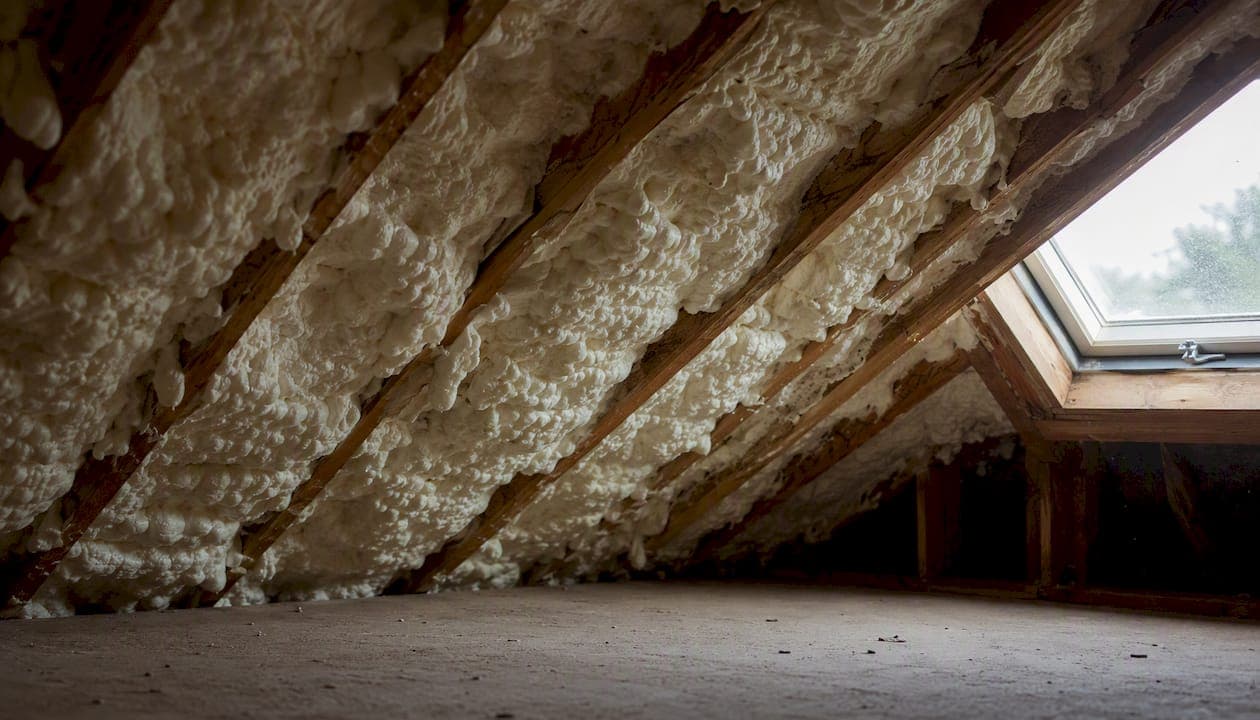
If you are selling, remortgaging, or have just discovered spray foam in your loft, you need a spray foam assessment. Specifically, you need an independent condition evaluation that checks moisture levels, ventilation, and timber integrity, then produces a written report a lender or valuer can actually use. Without one, many lenders will simply decline your application.
Here is what to do right now:
- Gather your documents. Find the original installation contract, any BBA or Kiwa product certificates, and before/after photographs if the installer provided them.
- Contact an independent assessor. Look for a Property Care Association (PCA) spray foam assessor or a RICS-registered surveyor with relevant experience. RICS advises that the assessor must be commercially separate from whoever installed or might remove the foam.
- Tell your lender or valuer early. Flag the spray foam before the formal valuation. Last-minute surprises cause delays; early disclosure gives you time to commission a report before the mortgage clock starts ticking.
Key takeaways
A spray foam assessment is the single most important step a homeowner or buyer can take when spray foam is present, because without an independent written report, most lenders cannot proceed.
| Point | Details |
|---|---|
| When you need an assessment | Book one if you are selling, remortgaging, or lack original installation documentation. |
| What lenders require | An independent written report covering moisture readings, timber condition, and ventilation adequacy. |
| Assessor independence | The assessor must be commercially separate from any installer or removal contractor; RICS and PCA both require this. |
| Scam awareness | Reject cold callers and anyone who combines assessment and removal in a single visit without a third-party check. |
| Sprayfoamremovalhelp | Provides PCA/RICS-competent assessments and mortgage-compliant removal across London and the Southeast, with transparent pricing and a 10-year warranty. |
Table of Contents
- What is spray foam insulation, and why does the type matter?
- What problems can spray foam cause in a home?
- How spray foam affects your mortgage and ability to sell
- What industry guidance and protocols govern a credible assessment?
- What does a spray foam assessment actually involve?
- How to choose a genuinely independent spray foam assessor
- What happens if problems are found: remediation and removal options
- Typical costs and timelines: what to budget and plan for
- Paperwork to gather before you book an assessment
- What a credible PCA/RICS-competent assessor's report looks like
- What we actually see on the ground: a practical perspective
- Sprayfoamremovalhelp: assessments, removal, and mortgage-compliant certification
- Sources
- FAQ
What is spray foam insulation, and why does the type matter?
Spray polyurethane foam (SPF) is a two-component liquid that expands and hardens on contact, forming a rigid or semi-rigid layer. Installers apply it to the underside of roof rafters, to walls, or to floor joists, most commonly as a retrofit measure to improve thermal performance. The government's technical note on spray foam applied to timber pitched roofs sets out the moisture, ventilation, and structural design changes that must be considered before and after installation.
There are two distinct product types, and the difference shapes almost every risk and inspection decision that follows.
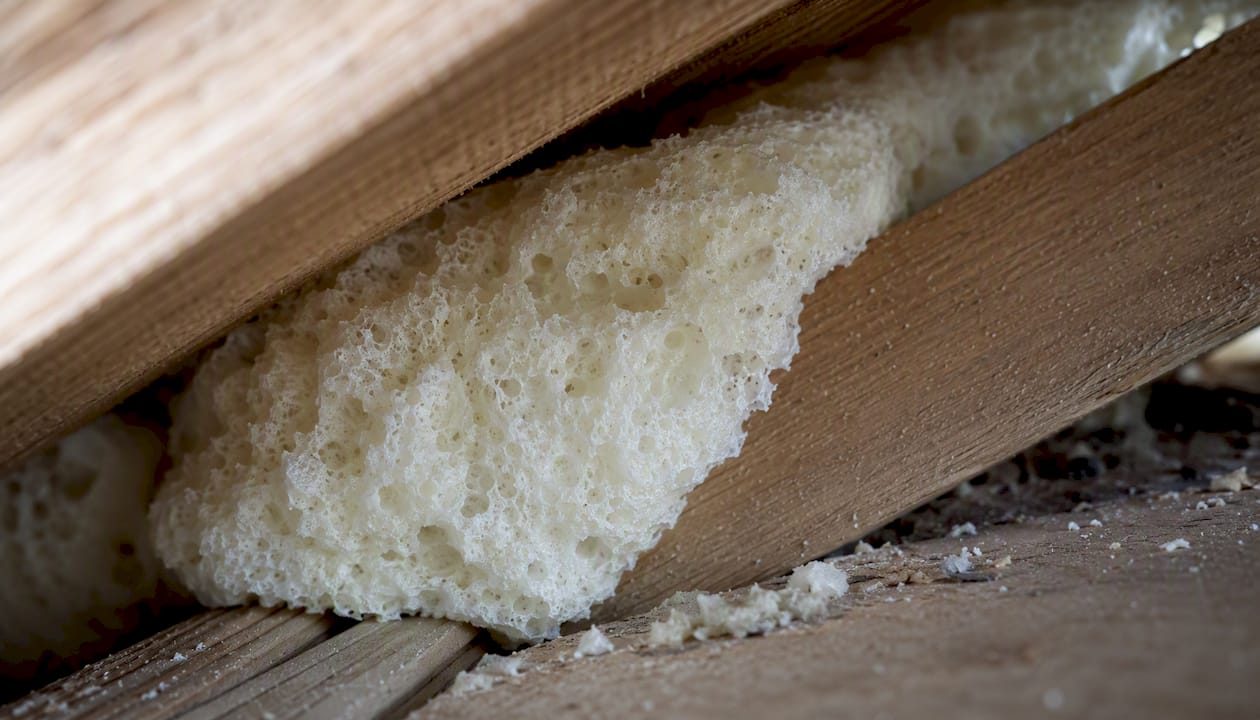
Open-cell foam is soft and spongy, with a lower density. It is vapour-permeable, which means moisture can move through it. That sounds safer, but it also means the foam can absorb and hold water against timber, accelerating decay without any visible sign on the surface. Open-cell foam is also less rigid, so it rarely bonds aggressively to roof tiles, making removal somewhat more straightforward.
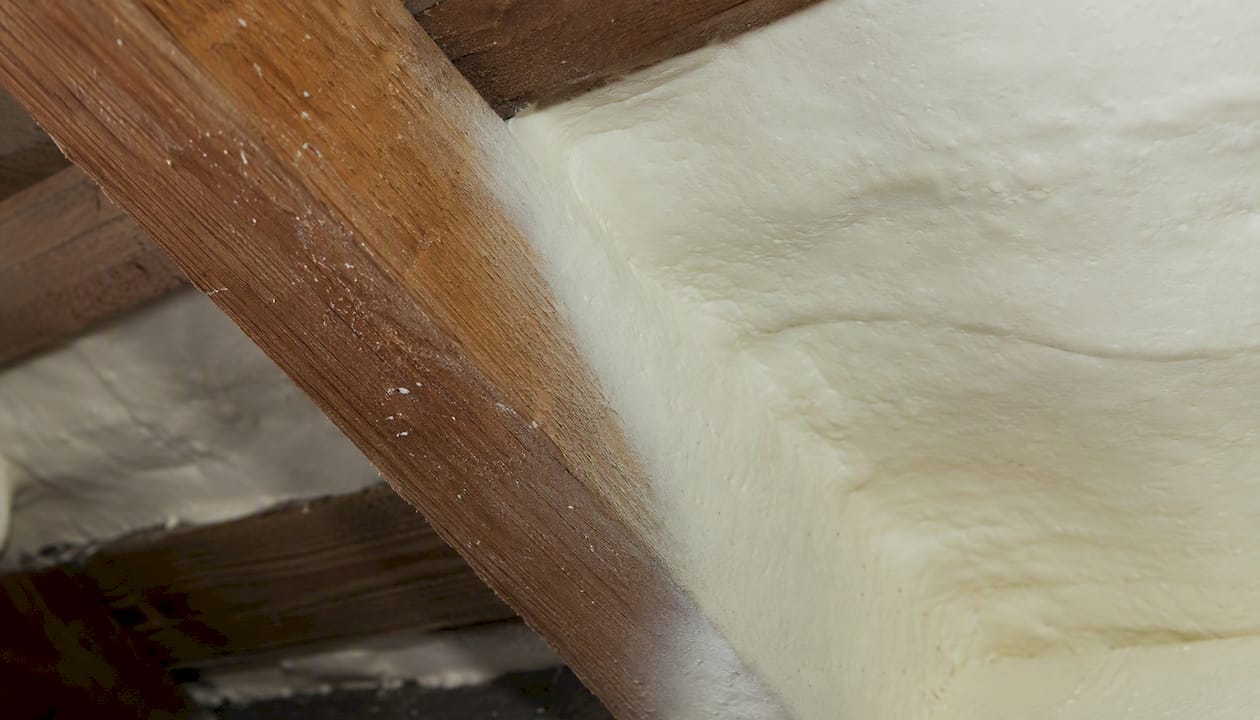
Closed-cell foam is dense, rigid, and virtually impermeable to moisture. It provides a higher insulation value per centimetre and can add structural rigidity to a rafter. The problem is that it creates a near-perfect vapour barrier. Moisture that would previously have escaped through the roof void is now trapped. Closed-cell foam also bonds tenaciously to tiles and timber, which makes removal far more disruptive and costly. You can read a detailed technical comparison in our open-cell vs closed-cell guide.
The application position matters too. Foam sprayed to the underside of rafters converts a cold loft into a warm roof void. That changes the building physics entirely: the dew point shifts, condensation patterns alter, and the ventilation strategy that the original roof relied upon no longer applies. Foam applied at ceiling level, by contrast, sits above the insulation layer and leaves the roof void cold and ventilated as designed. The warm-roof configuration is where most of the serious problems originate.
What problems can spray foam cause in a home?
Not every spray foam installation causes problems. Correctly specified, properly installed foam with full documentation can perform well for years. The difficulties arise when the product is wrong for the roof type, the application is uneven, or the installer cut corners on ventilation and hygrothermal design. The PCA's customer guidance identifies several recurring failure modes.
The most serious risk is hidden timber decay. Foam seals moisture against rafters and joists, and because the foam covers the timber surface, early-stage rot is invisible to a standard visual survey. By the time a homeowner notices a musty smell or ceiling staining, the decay can be advanced.
Other problems assessors commonly find include:
- Condensation within the roof structure. Changing the ventilation regime without recalculating the hygrothermal balance creates conditions where warm, moist air meets cold surfaces and condenses.
- Blocked or restricted ventilation paths. Foam applied carelessly can seal eaves vents, ridge vents, or the gaps between rafters that allow air movement.
- Obscured inspection access. A surveyor carrying out a standard mortgage valuation cannot assess rafter condition through a layer of foam. Many will simply note "spray foam present" and decline to comment further, which is enough for a lender to refuse.
- Fire and combustibility concerns. Some spray foam products are combustible. Without a product certificate confirming fire performance, a lender or insurer may treat the installation as an unknown risk.
- Adhesion damage on removal. Closed-cell foam bonded to the underside of tiles can pull tiles apart or crack them during removal, requiring partial or full re-roofing.
Signs you might notice at home: a persistent musty or damp smell in the loft, visible mould on rafters or the underside of tiles, water staining on ceilings, or a loft that feels unusually warm and stuffy. Any of these warrants a professional risk review before you list the property or approach a lender.
How spray foam affects your mortgage and ability to sell
This is where the practical stakes are highest. BBC research found roughly a quarter of the UK's biggest mortgage providers would not lend on properties with spray foam installed. Others consider applications individually and request specialist reports before deciding. The result is a fragmented lender landscape where the same property can be accepted by one bank and declined by another on the same day.
The core lender concern is not the foam itself. It is the inability to assess what is underneath it. A mortgage valuer's job is to confirm that the property is adequate security for the loan. If the roof structure cannot be inspected, the valuer cannot sign off. That uncertainty translates directly into a declined application or a heavily caveated valuation.
The House of Commons Library research briefing on spray foam and mortgages makes an important distinction: where installations meet relevant standards, removal should not be necessary. The problem is demonstrating that the installation meets those standards, which requires documentation and an independent survey.
Lenders commonly ask for:
- The original installation contract and specification
- BBA (British Board of Agrément) or Kiwa product certificates for the foam used
- Hygrothermal or condensation risk calculations
- An independent surveyor's report confirming timber condition and ventilation adequacy
Pro Tip: Commission your spray foam assessment before you instruct an estate agent or approach a lender. A clean report in hand from day one prevents the scenario where a buyer's mortgage offer collapses at week eight because the valuer flagged the foam and no report exists. Timing the assessment early costs the same but saves weeks of delay.
For remortgaging, the same logic applies. If your existing lender's panel valuer flags spray foam during a product transfer or remortgage valuation, you may find yourself unable to switch to a better rate without first resolving the foam question. Our mortgage problems guide covers the most common lender scenarios in detail.
Statistic: BBC reporting confirmed that around a quarter of the UK's largest mortgage providers apply a blanket policy of refusing to lend on properties with retrofitted spray foam, regardless of condition or documentation.
What industry guidance and protocols govern a credible assessment?
Two organisations set the standards that lenders and surveyors rely on: the Property Care Association and the Royal Institution of Chartered Surveyors.
The PCA published an inspection protocol in 2023, developed specifically to give surveyors a structured, evidence-based method for assessing spray foam risk. Before this protocol existed, many surveyors simply noted "spray foam present" and declined to assess further, leading to blanket lender refusals. The PCA's professional guidance for surveyors sets out the methodology, training requirements, and the register of qualified spray foam assessors. An assessor who follows this protocol gives a lender something concrete to evaluate rather than a gap in the valuation.
RICS consumer guidance emphasises three things above all else: independence, documentation, and scepticism towards unsolicited approaches. RICS is explicit that the assessor must be commercially separated from the installer and from any removal contractor. A report produced by someone who also stands to profit from the remediation work will not satisfy most lenders.
The HomeOwners Alliance (HOA) echoes this position and advises homeowners to treat any unsolicited contact about spray foam with caution. The PCA has issued a specific warning about rogue traders cold-calling householders to sell unnecessary removal work, sometimes claiming access to a fictitious "national database" of problem installations.
Key certificates and accreditations to check:
- BBA certificate for the specific foam product used (confirms the product has been independently tested)
- Kiwa certificate as an alternative or equivalent product approval
- PCA spray foam assessor membership for the individual carrying out your survey
- RICS membership for a chartered surveyor undertaking the assessment
- Professional indemnity (PI) insurance held by the assessor, with adequate limits
What does a spray foam assessment actually involve?
A competent assessment is considerably more than a loft visit with a torch. The PCA's professional guidance describes a structured process that combines document review, physical inspection, and measured data collection. Here is what a thorough assessment covers:
| Stage | What the assessor does | Why it matters |
|---|---|---|
| Document review | Checks installation contract, product certificates (BBA/Kiwa), hygrothermal calculations | Establishes whether the installation was specified correctly |
| External roof inspection | Examines tiles, ridge, verges, gutters, and flashings | Identifies pre-existing defects that may have caused or worsened moisture problems |
| Internal loft inspection | Visual survey of rafters, joists, and foam coverage; checks ventilation paths | Assesses timber condition as far as visible; identifies blocked vents |
| Moisture measurement | Uses calibrated moisture meters on accessible timber | Provides objective data on current moisture content |
| Hygrothermal or thermal imaging | Calculates condensation risk or uses thermal camera where indicated | Identifies hidden moisture accumulation not visible to the eye |
| Photographic record | Systematic photographs of all findings | Provides lenders with visual evidence rather than written description alone |
The resulting report should include: the scope and limitations of the inspection, the methodology used, clear findings on timber condition and moisture readings, a hygrothermal commentary where relevant, photographic evidence, recommended remedial actions with priority, and a signed statement of the assessor's independence from any commercial interest in the outcome.
What lenders want from a report differs from a standard domestic survey. A mortgage valuer needs to see that a qualified, independent professional has physically inspected the structure, measured moisture levels, and reached a conclusion about whether the installation poses a structural or moisture risk. A report that says "foam present, condition unknown" is useless. A report that says "moisture readings within acceptable limits, rafters in sound condition, ventilation adequate, no remedial action required" is what moves a mortgage forward.
Our property assessments page explains what a Sprayfoamremovalhelp assessment report contains and how it is structured for lender use.
How to choose a genuinely independent spray foam assessor
The assessor you choose will determine whether your report is accepted or rejected by a lender. Getting this decision wrong is expensive.
Credentials to require:
- PCA spray foam assessor category membership, verifiable on the PCA "Find a Member" register
- Or a RICS-registered surveyor with demonstrable experience in spray foam assessments
- Current professional indemnity insurance with adequate limits (ask for the certificate, not just a verbal assurance)
- Evidence of relevant training, particularly familiarity with the PCA inspection protocol
Red flags that should stop you booking:
- The assessor contacted you by cold call or unsolicited text
- They offer to assess and remove in the same visit, with no third-party check between the two
- They cannot name their PI insurer or provide a certificate
- They reference a "national database" of problem properties (this does not exist)
- They cannot provide a sample report or explain their methodology
- They are unwilling to confirm in writing that they have no commercial interest in the remediation outcome
Questions to ask before you book:
- "Are you listed on the PCA 'Find a Member' register as a spray foam assessor?"
- "Can you send me a sample report so I can see the format and depth?"
- "What is your PI insurance limit and who is your insurer?"
- "Do you have any commercial relationship with spray foam removal contractors?"
- "Have you worked with lenders or valuers on cases like mine before?"
The PCA's June 2025 warning is worth reading before you make any calls. Scammers in this space are sophisticated and their pitches are convincing.
What happens if problems are found: remediation and removal options
An assessment that finds problems does not automatically mean full removal. The realistic options depend on what the foam is, how it was applied, and the condition of the timber beneath it.
Remediation short of full removal
Where the foam product is correctly manufactured and the installation is broadly sound, a staged approach often makes more sense than immediate removal. Options include:
- Improving or reinstating roof ventilation (eaves vents, ridge vents, or mechanical extraction)
- Targeted repairs to roof defects that allowed water ingress
- Monitoring with periodic moisture checks to confirm stability
- Applying a remedial layer or decoupling membrane where the foam has partially failed
This approach works best when moisture readings are borderline rather than critical, the timber shows no active decay, and the foam product has a valid BBA or Kiwa certificate. The House of Commons Library briefing notes that where foam meets relevant standards, removal is not necessary.
Full removal
Full removal becomes the right answer when moisture readings are high, timber decay is confirmed, the foam is bonded to tiles in a way that prevents inspection, or the lender specifically requires a foam-free roof. Closed-cell foam removal from a tiled roof is a specialist operation: the foam must be cut away carefully to avoid tile damage, and in many cases the roof covering needs to be stripped and relaid. Our spray foam removal process guide explains the safe removal methodology in detail.
Pros and cons at a glance:
- Remediation: lower cost and disruption, but may not satisfy all lenders; requires ongoing monitoring; does not restore full visual inspection access
- Full removal: resolves the lender concern definitively, restores the roof to a standard inspectable condition, but carries higher cost and short-term disruption; may require re-roofing
Whichever route is chosen, the work should be carried out by a specialist with relevant insurance, not a general builder. The dangers of incorrect removal are real: aggressive removal of bonded closed-cell foam without proper technique causes tile cracking, rafter damage, and in some cases structural instability.
Typical costs and timelines: what to budget and plan for
Cost ranges vary significantly based on property size, foam type, roof condition, and whether hygrothermal testing is needed. The figures below are indicative ranges based on typical market rates; always obtain written quotes from at least two specialists.
Assessment costs:
- A specialist spray foam assessment typically falls in the range of £300–£600 for a standard semi-detached or terraced house
- Larger properties or those requiring hygrothermal modelling will sit at the higher end or above
- Timeline: most assessors can attend within one to two weeks of booking; the written report usually follows within three to five working days
Remediation costs (short of full removal):
- Ventilation improvements and targeted repairs: typically £500–£2,000 depending on access and scope
- Timeline: usually completable within one to two days once materials are sourced
Full removal costs:
- Open-cell foam removal: generally less disruptive and less expensive than closed-cell
- Closed-cell foam removal with re-roofing: costs can range from several thousand pounds upward depending on roof size and tile condition
- Timeline: a typical terraced house removal takes two to five days; re-roofing adds further time
For detailed current pricing, our spray foam removal costs page provides up-to-date cost bands and the main drivers.
Main factors that push costs higher:
- Difficult roof access (steep pitch, no scaffold anchor points, high eaves)
- Extensive foam coverage or multiple coats applied
- Confirmed timber decay requiring structural repairs
- Requirement for hygrothermal modelling or specialist thermal imaging
- Emergency or same-day attendance
Note on timing: if you are mid-sale, the clock matters. An assessment booked today can typically produce a report within two weeks. Full removal, if required, adds further weeks. Factor this into your completion timeline and tell your solicitor immediately so they can manage buyer expectations.
Paperwork to gather before you book an assessment
The quality of your documentation directly affects how quickly a lender accepts the assessment report. Assessors can work without paperwork, but the report will carry more caveats and lenders will be less comfortable with it.
Core documents to locate:
- Installation contract: confirms who installed the foam, when, and to what specification
- BBA or Kiwa product certificate: confirms the specific product has been independently tested and approved; check that the certificate matches the product actually used
- Before/after photographs: if the installer provided these, they show the original roof condition and the coverage applied
- Hygrothermal or thermal calculations: not all installers provide these, but they are valuable evidence that condensation risk was assessed at the time of installation
- Installer contact details and company registration: useful if documents are missing and you need to request copies
If documents are missing:
Contact the original installer first. If the company no longer trades, approach the foam manufacturer directly using the product name from any available paperwork. Some manufacturers maintain records and can reissue certificates. Our spray foam certificate page explains what certificates look like and how to verify their authenticity.
How to present documents to surveyors and lenders:
Compile everything into a single PDF or folder, ordered chronologically. Label each document clearly (e.g. "BBA Certificate — [Product Name] — [Date]"). Send it to your assessor before the inspection visit so they can review it in advance. When submitting to a lender, attach the assessor's report as the cover document and the installation paperwork as supporting evidence. This presentation signals organisation and reduces the chance of a lender requesting further information.
What a credible PCA/RICS-competent assessor's report looks like
A well-structured report removes ambiguity for lenders. Here is what the sections typically contain and what the findings mean in practice.
Sample report outline:
- Scope and limitations: states what was and was not inspected, and why (e.g. "moisture meter readings taken at accessible rafter positions; areas obscured by foam not directly measurable")
- Methodology: references the PCA inspection protocol and any additional tests used
- Visual findings: describes foam coverage, colour, adhesion, and any visible defects
- Moisture readings: lists actual meter readings at named locations, compared against acceptable thresholds
- Hygrothermal commentary: addresses whether the installation creates a condensation risk given the roof construction
- Photographs: systematic images of each finding, labelled and dated
- Recommendations: prioritised list of remedial actions, or a clear statement that no action is required
- Statement of independence: signed confirmation that the assessor has no commercial interest in the remediation outcome
What findings mean for a mortgage decision:
- Low-risk finding: "Moisture readings within acceptable limits. Rafters in sound condition. Ventilation adequate. No remedial action required." Most lenders will proceed on this basis.
- Borderline finding: "Moisture readings elevated in two locations. Timber shows surface staining but no active decay. Recommend ventilation improvement and re-inspection in six months." Some lenders will proceed with conditions; others will wait for the re-inspection.
- High-risk finding: "Moisture readings significantly elevated. Active decay confirmed in three rafter positions. Foam bonded to tiles preventing full inspection. Removal recommended before mortgage can proceed." Most lenders will require removal before lending.
Deliverables the assessor must provide:
- Signed written report (PDF, not a verbal summary)
- Photographic appendix with labelled images
- Moisture reading log with locations and values
- Clear statement of independence and PI insurance details
What we actually see on the ground: a practical perspective
The worst outcomes we encounter at Sprayfoamremovalhelp are almost never caused by the foam itself. They are caused by missing paperwork, rushed decisions, and homeowners who accepted the first assessor who called them.
The scenario that creates the most damage is this: a homeowner receives an unsolicited call, agrees to an "assessment" that takes twenty minutes and produces a one-page letter recommending immediate removal, then pays a four-figure sum to a contractor who leaves the roof in worse condition than the foam did. The PCA's June 2025 warning exists precisely because this pattern is common enough to warrant a trade body press release.
What actually helps:
- Preserve your evidence. Do not let anyone remove foam before an independent assessor has documented the existing condition. Once it is gone, so is the baseline.
- Get the report before you agree to anything. A legitimate assessor will always provide a written report before any remediation is discussed. If someone wants you to sign a removal contract on the day of the assessment, walk away.
- Stage the work sensibly. If removal is genuinely needed, get at least two written quotes from PCA-registered specialists. The gap between the cheapest and most expensive quote for the same job is often significant.
- Tell your solicitor and lender what is happening. Keeping them informed prevents the situation where a buyer's solicitor raises a spray foam query at exchange and nobody has an answer ready.
To minimise cost and disruption when follow-up work is needed:
- Clear the loft before the assessment visit to give the assessor full access
- Have your documents ready so the assessor does not need to return for a second visit
- If ventilation improvement is recommended, address it before commissioning a re-inspection
- Ask the assessor to confirm in writing which specific lenders they have successfully submitted reports to
Sprayfoamremovalhelp: assessments, removal, and mortgage-compliant certification
If you need a spray foam assessment that a lender will actually accept, Sprayfoamremovalhelp offers PCA/RICS-competent inspections across London and the Southeast, carried out by in-house specialists with no commercial interest in pushing unnecessary removal. You speak directly with the team doing the work, not a call centre, and pricing is transparent from the first conversation.

Services available include independent property assessments with full written reports, mortgage-compliant certification, partial remediation, and full closed or open-cell foam removal where required. Every removal job carries a 10-year insurance-backed warranty. Where assessment findings do not require removal, we say so clearly in writing. That independence is what makes the report useful to your lender.
If you are mid-sale or facing an urgent remortgage deadline, our emergency removal service can attend same-day in many cases across our service area. For everything else, book a free inspection and we will confirm availability and a fixed price within 24 hours. You can also review our full removal guide to understand exactly what the process involves before you commit.
Sources
The following sources underpin this guide and are worth bookmarking if you need to present evidence to a lender or solicitor.
- Spray foam insulation consumer guide (RICS) — March 2023 (updated)
- Spray foam insulation and mortgages — House of Commons Library research briefing
- Major lenders reject homes with spray foam insulation — BBC News
- Spray foam insulation applied to timber sloped roofs in dwellings — government technical document
This article is general information, not a substitute for advice from a qualified financial advisor. Consult a qualified financial professional about your own circumstances before acting on anything here.
FAQ
Is spray foam insulation illegal in the UK?
Spray foam insulation is not illegal in the UK. The issue is that poorly documented or incorrectly applied retrofit installations create mortgage and structural problems, not a legal prohibition.
What certification do you need for spray foam insulation?
The foam product should carry a BBA (British Board of Agrément) or Kiwa certificate confirming it has been independently tested. The assessor inspecting an existing installation should hold PCA spray foam assessor membership or be a RICS-registered surveyor with relevant experience.
Do you have to disclose spray foam insulation when selling?
Yes. Sellers are required to disclose material facts about a property, and spray foam insulation is a material fact that affects mortgageability and saleability. Failing to disclose it can expose a seller to legal liability after completion.
Which mortgage lenders accept spray foam insulation?
Lender policies vary. BBC research confirmed that roughly a quarter of the UK's largest providers apply a blanket refusal. Others consider cases individually and may accept a property where an independent specialist report confirms the installation is sound and meets relevant standards. Always check your specific lender's current policy before commissioning work.
How do I know if my spray foam assessor is genuinely independent?
Verify their PCA spray foam assessor membership on the PCA "Find a Member" register, ask for their PI insurance certificate, and confirm in writing that they have no commercial relationship with any removal contractor. A legitimate assessor will provide all three without hesitation.