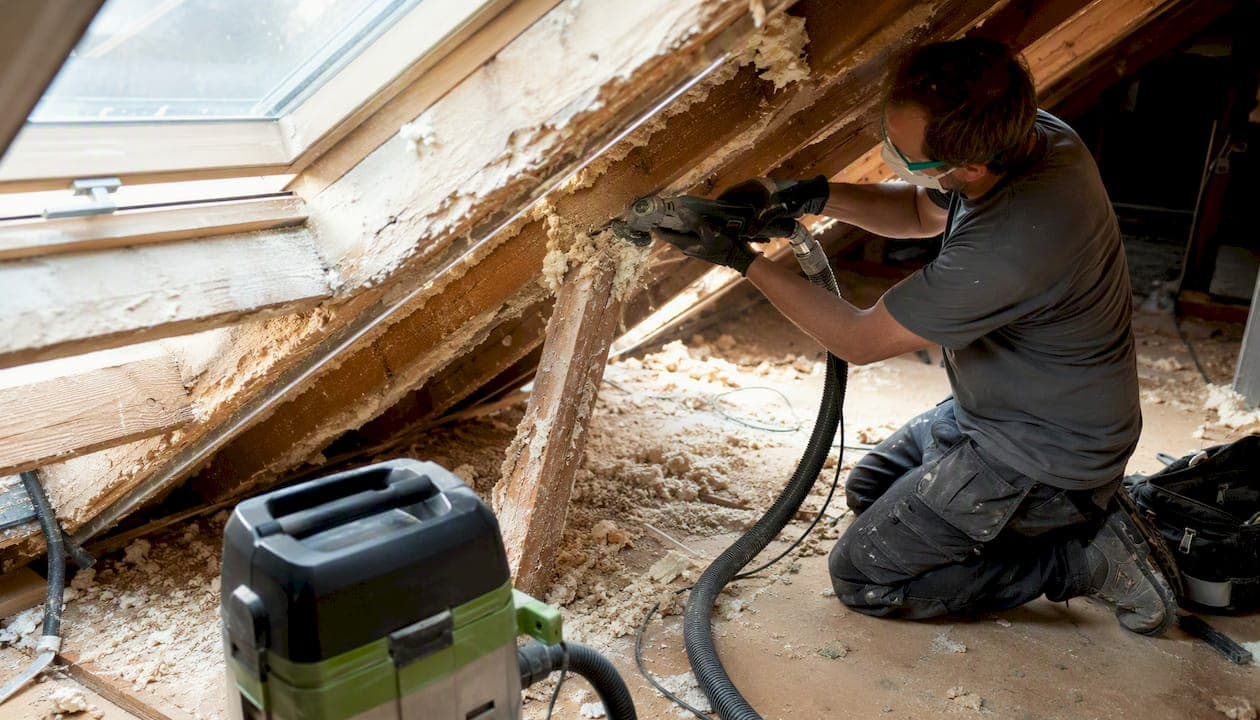
Spray foam removal is a specialist, mechanical process. When your mortgage, sale, or structural safety depends on it, the work must be carried out by certificated contractors using containment, HEPA extraction, and independent post-removal timber inspection. That is the short answer. The longer one is below.
Your immediate next step is to arrange an independent survey from a professional working to PCA or RICS protocols. That survey will confirm whether full removal is needed or whether documentation alone satisfies your lender. The three methods that keep foam dust removal under control during the job itself are:
- Mechanical cutting with local HEPA extraction — the most widely accepted approach, generating low to moderate dust that is captured at source.
- Dry-ice (CO2) blasting — used by contractors such as Ice Blasters for rapid stripping with very low secondary waste, suitable for some closed-cell scenarios.
- Whole-loft negative-pressure containment — a site-wide measure that prevents airborne particles migrating into living areas, used alongside either method above.
Key takeaways
Dust-controlled, lender-compliant spray foam removal requires certified contractors, mechanical methods with HEPA extraction, and an independent post-removal timber certificate — the documentation is as important as the physical work.
| Point | Details |
|---|---|
| Get an independent survey first | A PCA/RICS-aware survey confirms whether full removal or documentation alone satisfies your lender. |
| Avoid DIY removal | DIY work risks respiratory harm, timber damage, voided insurance, and lender rejection. |
| Require HEPA and negative pressure | Insist on a written method statement specifying the HEPA model and negative-pressure plan before work starts. |
| Budget £2,500–£6,000 for a typical job | Closed-cell foam and timber repairs push costs toward the higher end; the job typically takes 3–5 working days. |
| Sprayfoamremovalhelp | Revive Maintenance provides PCA/RICS-aware removals with a 10-year warranty and independent lender-facing certification across London and the South East. |
Table of Contents
- Can you remove spray foam yourself?
- Which removal methods give you the best dust control?
- How do specialists keep dust under control on site?
- What does a professional removal job look like, step by step?
- What does dust-controlled spray foam removal cost in the UK?
- What do lenders and surveyors need after removal?
- How do you choose the right removal specialist?
- What happens after the foam is removed?
- How Revive Maintenance delivers mortgage-compliant removals
- An honest perspective on what actually matters here
- Revive Maintenance: free inspection and transparent quotes
- Sources
- FAQ
Can you remove spray foam yourself?
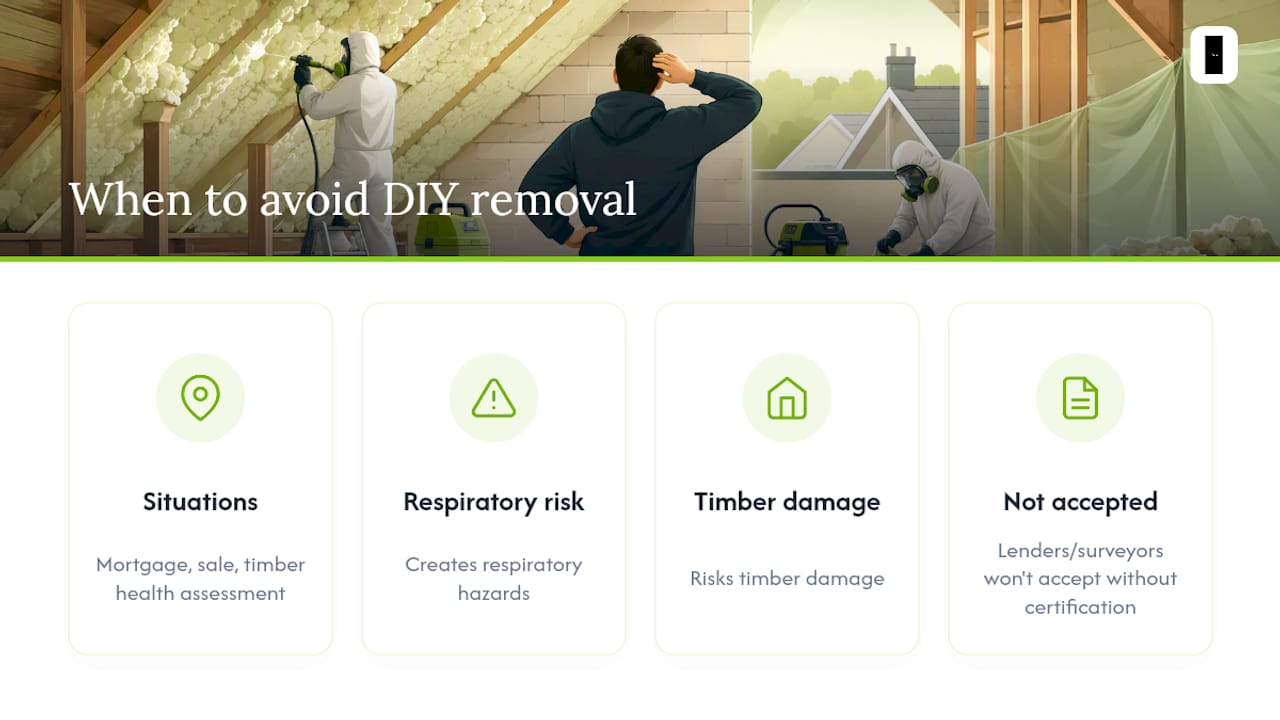
The direct answer is: no, not when a mortgage, surveyor sign-off, or timber health assessment is at stake. DIY removal is unsafe, and the result is almost always unacceptable to lenders.
The specific risks are concrete, not theoretical:
- Respiratory hazard. Cured polyurethane foam generates fine particulate dust when cut or scraped. Without P3/P100 respirators and HEPA extraction, you are breathing in material that causes respiratory sensitisation.
- Timber damage. Aggressive manual cutting without proper technique splits or gouges roof timbers, creating structural problems that cost far more to repair than the original removal.
- Ventilation disruption. Spray foam in a cold roof often bridges ventilation channels. Removing it incorrectly can leave those channels blocked or create new air paths that increase condensation risk.
- Voided warranties and insurance. Many home insurance policies and any remaining installer warranty are voided the moment an unqualified person starts work on the roof structure.
- Lender rejection. Without a certified, documented removal by a qualified contractor, most lenders will not accept the property as security.
The House of Commons Library briefing confirms that incorrectly installed spray foam can reduce ventilation, increase condensation risk, and place timber-framed roofs at risk of decay. There is also no public funding to remove it, so the cost falls entirely on the homeowner.
RICS advises homeowners to seek independent expertise from professionals who are not commercially tied to the original installer. An impartial assessment is the only way to get an objective picture of timber condition and to produce documentation that lenders will trust.
Which removal methods give you the best dust control?
Lender-acceptable removals use mechanical techniques combined with extraction. Dry-ice blasting can work with very low secondary waste in certain closed-cell scenarios, but it is a specialist option, not a universal one. No solvent dissolves cured polyurethane safely enough for timber inspection purposes, and chemical or heat-based approaches increase both risk and the likelihood of lender rejection.
According to TrustATrader's safety guidance, the accepted route is manual and mechanical: bulk cut-back, scraping, wire brushing, and HEPA vacuuming, followed by independent post-removal timber inspection.
| Method | Dust level | Closed-cell suitability | Open-cell suitability | Lender acceptance |
|---|---|---|---|---|
| Mechanical cutting + HEPA extraction | Low to moderate (captured at source) | Yes | Yes | Yes, with documentation |
| Oscillating multi-tool + manual scraping | Low when contained | Yes | Yes | Yes, with documentation |
| Dry-ice (CO2) blasting | Very low secondary waste | Yes (preferred for hard foam) | Limited | Yes, where appropriate |
| Thermal or chemical methods | High risk, uncontrolled | No | No | No |
A note on dry-ice blasting: contractors using CO2 pellets strip foam rapidly without introducing water or chemical residue. The pellets sublimate on contact, leaving only the foam debris itself. This makes spray foam dust management significantly simpler on the right job, though the equipment cost means it is not always the most economical choice for smaller roofs.
How do specialists keep dust under control on site?
Effective foam dust removal on a professional job requires airtight containment, negative-pressure exhaust, localised HEPA extraction, and sealed access routes before a single cut is made. The measures work as a system, not individually.
The standard controls a reputable contractor deploys:
- Sealed loft hatch with polythene sheeting and a zipped access panel to prevent dust migrating downstairs.
- Room-to-room protection using dust sheets and tape on all adjacent openings.
- HEPA-filtered vacuums and extraction units positioned at the cutting point to capture particles at source.
- External negative-pressure units where roof geometry allows, exhausting filtered air outside the building.
- Isolated electrical fittings and sealed downlights to prevent particulate ingress into the electrical system.
- Immediate double-bagging of waste and removal from site under a waste transfer note.
On the crew side, P3/P100 respirators (or equivalent), sealed goggles, and disposable coveralls are the minimum. Decontamination protocols — removing coveralls before leaving the loft, bagging them immediately — prevent cross-contamination of the rest of the property.
Pro Tip: Ask any contractor for a written method statement before they start. It should specify the HEPA model and extraction rate, the negative-pressure strategy, and whether air-quality testing is carried out before and after the job. If they cannot produce one, that is a red flag.
What does a professional removal job look like, step by step?
The professional workflow runs from inspection through to certification. Here is what a well-run job looks like, and what you should receive at each stage.
- Pre-removal survey. A qualified assessor identifies the foam type (open or closed cell), checks roof structure and timber condition, notes any hazards such as asbestos or damaged felt, and confirms the removal method. You receive a written survey report.
- Method statement and quotation. The contractor produces a written method statement covering containment, extraction, removal sequence, waste handling, and post-removal inspection. The quote is fixed and transparent.
- Containment and safety setup. The loft hatch is sealed, negative-pressure units are positioned, and all electrical fittings in the work zone are isolated. No removal work starts until containment is verified.
- Staged mechanical removal. The sequence is bulk cut-back first, then manual scraping, then wire brushing, then HEPA vacuuming. Each stage is photographed. Closed-cell foam requires more passes than open-cell because it bonds more firmly to timber.
- Interim checks and photographic record. The team documents timber condition at each stage. Any rot or structural damage found is flagged immediately, with photographs, before work continues.
- Full HEPA clean and waste removal. Once all foam is removed, the entire loft space is HEPA-vacuumed. All waste is double-bagged, weighed, and removed under a waste transfer note.
- Independent timber inspection and certification. An independent surveyor, not the removal contractor, inspects the timbers, takes moisture readings, and issues a post-removal certificate. This is the document your lender needs.
The full package of deliverables you should receive: pre-removal survey report, written method statement, staged photographs, waste transfer notes, and an independent post-removal timber inspection certificate acceptable to mortgage lenders.
For a typical three-bedroom detached house, the process commonly takes 3–5 working days: survey first, then one to three days on site depending on foam type and the extent of any damage found.
What does dust-controlled spray foam removal cost in the UK?
Expect a typical range of £2,500–£6,000 for a three-bedroom detached property, with closed-cell removals sitting toward the higher end of that range. Larger or more complex roofs, or those with significant timber damage, can go higher. You can find a detailed cost breakdown on the spray foam removal costs page.
The main cost drivers are:
- Foam type and depth. Closed-cell foam is denser and bonds more firmly to timber, requiring more labour and more passes.
- Roof complexity and access. A hipped roof with multiple valleys costs more to work in than a simple gable end.
- Contamination and asbestos. If asbestos is present in the roof structure, specialist disposal adds cost and time.
- Volume of waste. More foam means more bagging, more waste transfer notes, and more disposal fees.
- Timber repairs. Rot discovered during removal requires localised splicing or replacement, which adds to the final bill.
- Emergency call-out. Same-day or next-day assessments carry a premium.
- Independent certification. The post-removal timber inspection and certificate is a separate cost, though many contractors include it in their package price.
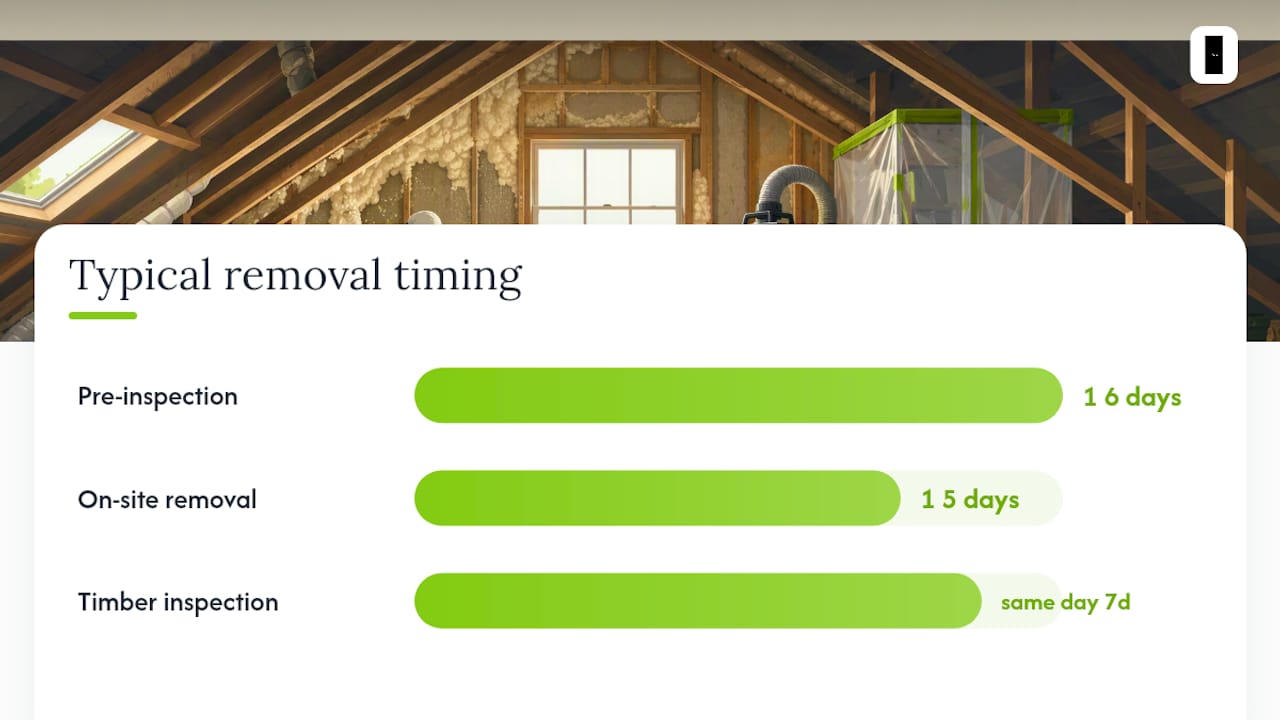
On timing:
- Pre-inspection: typically scheduled within 1–7 days of enquiry.
- On-site removal: 1–5 working days, depending on foam type, roof area, and damage found.
- Independent timber inspection and report: same day to 7 days after clearance, depending on surveyor availability.
Understanding how lenders assess mortgage risk helps explain why the independent certification step is non-negotiable: valuers need documented evidence, not just a contractor's word.
What do lenders and surveyors need after removal?
Most lenders will accept a property after independent removal and a timber report that follows PCA/RPSA and RICS inspection protocols. Some lenders, however, maintain a blanket refusal regardless of what documentation you produce.
According to BBC News, A notable portion of the largest UK mortgage lenders explicitly refuse to lend on properties with retrofitted spray foam, while the remainder assess applications case-by-case and commonly request specialist documentation. Lenders such as Santander, HSBC, Lloyds, and Nationwide vary in their approach, with many asking for specialist reports rather than imposing outright bans.
The documents lenders typically want:
- Independent PCA/RPSA-compliant inspection report confirming foam type and condition.
- Post-removal timber inspection certificate with moisture readings, signed by an independent surveyor.
- Staged photographs from the removal process.
- Waste transfer notes confirming proper disposal.
- The removal contractor's written method statement.
- Original installation paperwork: BBA product certificates and any installer warranty.
For further guidance on the mortgage side, the spray foam mortgage guide covers what to present to a valuer and how to handle lenders who are sitting on the fence. The House of Commons Library briefing also notes that there is no government funding for removal, so gathering any remaining installer guarantee is worth doing before you commission a removal.
How do you choose the right removal specialist?
Hire a contractor who works to PCA/RPSA protocols, uses independent surveyors for post-removal certification, and provides written method statements with HEPA and negative-pressure details. That is the non-negotiable baseline.
Credentials to require:
- PCA-approved evaluators or members with documented training records.
- RICS-aware independent surveyors for timber sign-off, separate from the removal team.
- TrustMark registration or equivalent insurance-backed guarantee (a 10-year warranty is the benchmark).
- Proof of public liability insurance and waste carrier licence.
Questions to ask before signing anything:
- Can you provide a written method statement before work starts?
- What HEPA model and extraction rate will you use?
- How will you manage negative pressure in the loft?
- Who carries out the post-removal timber inspection, and are they independent of your company?
- Can you provide evidence of an insurance-backed warranty?
- Will you liaise directly with my surveyor or mortgage valuer?
Red flags to walk away from:
- Contractors proposing chemical solvents or heat-based removal.
- Refusal to allow an independent surveyor to inspect after the job.
- No written method statement offered.
- Cash-only pricing with no formal quote.
- No waste transfer documentation.
You can verify credentials through the Property Care Association member directory. For a direct-service model where you deal with the technicians doing the actual work, rather than a middleman, see the specialist removal team page.
What happens after the foam is removed?
Once the foam is gone, an independent timber inspection confirms whether the roof structure is sound or whether remedial work is needed. This is not a formality. Spray foam, particularly closed-cell, can trap moisture against timber for years, and decay is not always visible until the foam comes off.
The typical post-removal repair checklist:
- Replace or repair damaged roofing felt or underlay where the foam has degraded it.
- Remediate any timber rot through localised splicing or, where decay is extensive, section replacement.
- Reinstate ventilation channels that the foam had blocked, particularly in cold roof constructions.
- Re-insulate appropriately at ceiling level or using a breathable alternative such as Superfoil, which avoids the bonding and ventilation problems associated with spray foam.
Documents to keep permanently:
- Independent post-removal timber inspection report with moisture readings.
- Removal contractor's written method statement.
- Staged photographs from the removal process.
- Waste transfer notes.
- Any warranty or insurance-backed certificate issued.
These are exactly what lenders, valuers, and future buyers will request. Losing them means commissioning a fresh inspection, which costs time and money.
How Revive Maintenance delivers mortgage-compliant removals
Revive Maintenance conducts PCA/RICS-aware surveys, performs contained mechanical removals using HEPA extraction, and issues independent post-removal timber inspection certificates accepted by most lenders. Every job is carried out by the in-house team directly, with no subcontracting, so you deal with the people doing the work from first call to final certificate.
A typical job includes:
- Free pre-removal inspection and written survey report.
- Written method statement specifying HEPA model, negative-pressure plan, and removal sequence.
- Full containment setup: sealed loft hatch, negative-pressure units, isolated electrical fittings.
- Staged mechanical removal (bulk cut-back, scraping, wire brushing, HEPA vacuuming) with photographic records at each stage.
- Full HEPA clean and waste removal under transfer notes.
- Independent post-removal timber inspection and a lender-facing certificate.
The 10-year insurance-backed warranty covers the removal work itself. Transparent, fixed pricing means the quote you receive is the price you pay. Over 1,000 homeowners across London and the South East have used Revive Maintenance to restore their properties to mortgageability.
To book a free inspection or a certification assessment, visit the free inspection page or the certification booking page.
An honest perspective on what actually matters here
The thing most homeowners underestimate is how much the documentation matters relative to the physical removal itself. A perfectly clean roof with no certificate is still a problem for a lender. A roof with minor residual marks but a full independent timber report, waste transfer notes, and a method statement is, in most cases, mortgageable.
That asymmetry is worth sitting with. The removal is the means; the paperwork is the end. Contractors who rush the certification stage, or who offer to handle the independent inspection themselves, are cutting the corner that matters most. Independence in the post-removal survey is not a bureaucratic nicety. It is what separates a document a lender will accept from one they will question.
The practical advice is simple: get the survey first, avoid DIY entirely, and treat the documentation package as the deliverable you are actually paying for. With the right certificated removal, most homes can be returned to full mortgageability and structural safety.
Revive Maintenance: free inspection and transparent quotes
Removing spray foam residue and getting your property back to mortgage-ready does not have to be a drawn-out process. Revive Maintenance offers a free pre-removal inspection across London and the South East, with same-day emergency assessments available for urgent cases.
The first visit covers a full pre-removal survey, a written method statement, photographic records, and a clear written plan for lender-facing certification if required. Fixed, transparent quotes mean no surprises on the final invoice. The 10-year insurance-backed warranty gives you documented protection long after the job is done.
For a full overview of what the removal process involves, visit the spray foam removal guide. If your situation is urgent, the emergency removal service can arrange a same-day assessment. To request a free inspection and written quote, visit the free inspection page.
Sources
- Major lenders reject homes with spray foam insulation - BBC News
- Spray foam insulation
- Sprayed foam insulation guidance — Property Care Association
- Spray foam insulation and mortgages - House of Commons Library
- Removing Spray Foam Insulation: UK Homeowner Guide 2026
FAQ
Can you remove spray foam yourself?
DIY removal is not recommended when a mortgage, sale, or timber health assessment is involved. It creates respiratory hazards, risks timber damage, and produces results that lenders and surveyors will not accept without certified documentation.
How much does spray foam removal cost in the UK?
A typical three-bedroom detached property costs between £2,500 and £6,000, with closed-cell foam removals sitting toward the higher end. Larger roofs, significant timber damage, or asbestos presence can push costs beyond that range.
Does WD-40 or any solvent dissolve cured spray foam?
No solvent dissolves cured polyurethane foam safely enough for use on a roof where timber inspection is required. Chemical approaches are not accepted by lenders and increase the risk of timber damage and lender rejection.
What paperwork do lenders need after spray foam removal?
Lenders typically require an independent PCA/RPSA-compliant inspection report, a post-removal timber certificate with moisture readings, staged photographs, waste transfer notes, and the contractor's written method statement.
How long does professional spray foam removal take?
For a typical three-bedroom detached house, the on-site removal takes 1–3 working days, with the full process from survey to independent certification commonly completing within 3–5 working days.