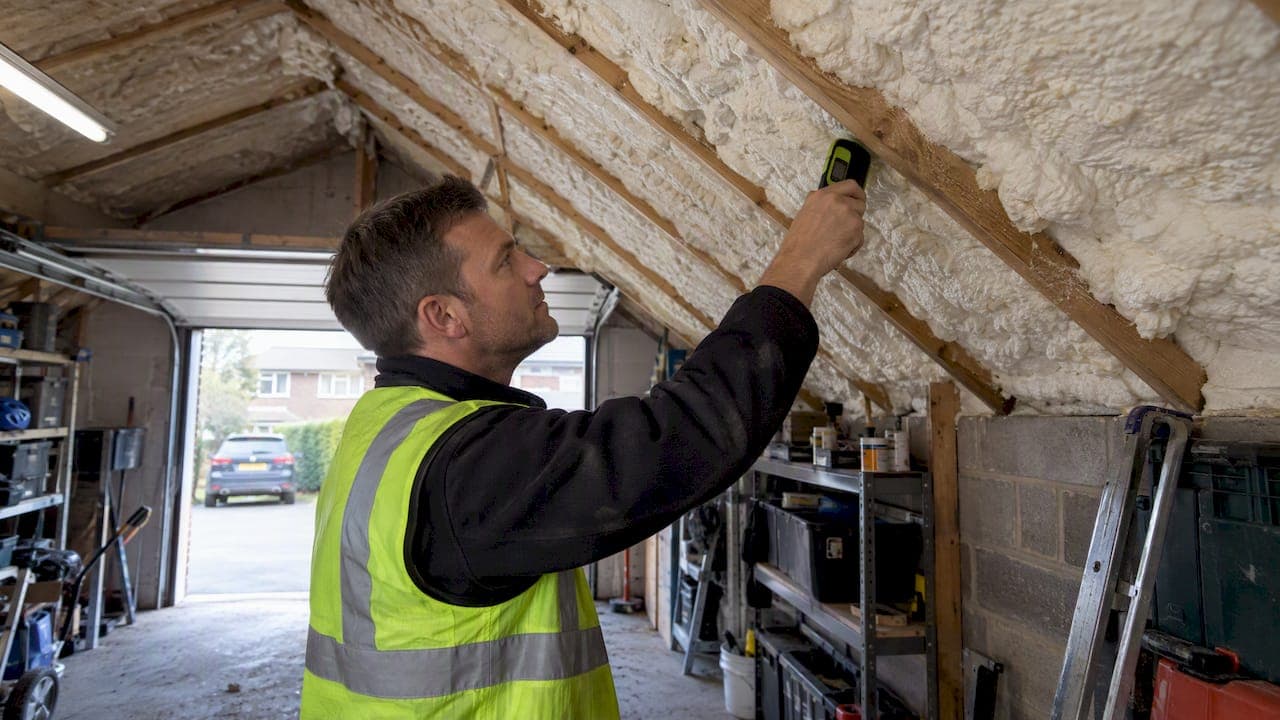
Garage spray foam problems are common enough to take seriously, but not every installation needs tearing out. The usual issues are lingering odour, trapped moisture, hidden timber decay and complications at survey or remortgage stage. Our first recommendation is always the same: arrange an independent, certified inspection before you commit to any remedial work, because a proper survey tells you whether you are dealing with a minor fix or a structural problem.
TL;DR:
- Moisture risk peaks when foam is sprayed onto tiles or slates without underlay; high resistance underlay also raises risk without an AVCL.
- Lenders commonly request an independent report, photographs, and a scoped remediation plan; gather them before sale or remortgage discussions instead of relying on installer paperwork.
- Record odours, humidity readings, staining, and dated photographs, but do not cut or pull foam yourself because removal can damage timber and destroy evidence.
- Removal is warranted for spreading timber decay, foam applied directly to tiles or slates without underlay, or a lender's refusal to proceed without it.
Table of Contents
- Common spray foam problems found in garages and roof spaces
- How to check and gather evidence: a safe diagnostic checklist
- What to do if the inspection finds problems
- Prevention and best practice for insulating garages or lofts
- Specialist inspection and removal: what certified technicians deliver
- A measured view on spray foam panic
- When to choose a professional inspection or removal service
- FAQ
- Sources
Common spray foam problems found in garages and roof spaces
Spray foam problems tend to fall into a handful of recognisable categories, and knowing which one you are looking at changes what you do next.
Off-gassing and persistent odour is usually the first sign something is wrong. Fresh spray foam releases volatile organic compounds as it cures, and in a well-ventilated space that smell fades within days. In a sealed garage or loft with poor airflow, the odour can linger for weeks or months, which points to inadequate curing conditions or incorrect mixing during application.
Health effects are mostly short-term: eye and throat irritation, headaches, or a tight chest when spending time near freshly applied foam. People with asthma or other respiratory sensitivities tend to notice symptoms sooner and more sharply. If symptoms persist beyond the expected curing period or worsen with exposure, that warrants medical advice rather than waiting it out.
Moisture and condensation are where the real structural risk sits. Gov shows that moisture risk rises sharply when spray foam is applied directly to a high-resistance underlay without an air and vapour control layer (AVCL), and the highest risk of all occurs where foam is sprayed straight onto roof tiles or slates with no underlay at all. Moisture that can't escape gets trapped against timber, and that is the direct route to decay.
Hidden structural and timber damage follows from the same cause. Foam bonds to timber and conceals it from view, so rot, splitting or insect damage can progress unseen for years. This is precisely why lenders and surveyors treat foam-insulated roofs cautiously: they cannot verify what condition the timber is in without removing foam or commissioning specialist checks.
Mould and mildew typically appear where humidity has nowhere to go, often around roof junctions, eaves or anywhere ventilation has been inadvertently blocked by the foam application itself.
Fire risk is a less-discussed but real concern. Government fire-safety testing notes that polyurethane spray foam can increase the fuel load in a roof space, and compliance with building-regulation fire-spread requirements needs to be demonstrated through certified testing rather than assumed from the product alone.
Mortgage and sale issues are often how people first discover a problem. RICS guidance explains that surveyors frequently flag spray foam because it hides timber from inspection, prompting lenders to request specialist reports before they will proceed. Some lenders still lend with the right paperwork in place; others decline until remediation is complete.
Scams and mis-selling add another layer of risk. Common red flags include:
- Cold calls or doorstep offers promising free or heavily discounted insulation.
- Pressure to sign on the day with no written scope of works.
- No certificates, datasheets or insurance-backed guarantee provided.
- Installers who become unreachable once the job is finished.
How to check and gather evidence: a safe diagnostic checklist
Before calling anyone out, there is a useful amount you can check yourself, provided you stay within safe limits.
What to do:
- Note any persistent odour and how long it has lasted, including whether it's stronger in warm or humid weather.
- Look for visible mould, dark staining or discolouration around roof timbers, eaves or loft hatches.
- Press gently on any accessible timber (joists, rafters) to check for softness, which can indicate decay.
- Record loft or garage humidity with a simple hygrometer over a few days, noting any readings consistently above normal indoor levels.
- Take dated photographs of anything unusual, building a simple visual log over time.
What to avoid: do not attempt to cut into or pull away foam yourself. This risks damaging sound timber, releasing dust or fibres, and destroying evidence a surveyor would otherwise need intact. Avoid prolonged exposure to strong odours, and ventilate the space before spending extended time in it.
Pro Tip: Keep a simple diary of smells, humidity readings and anything you notice, dated and with photos. It makes a world of difference when a surveyor or lender asks for evidence later.
A professional inspection goes further than anything you can do alone. It typically includes moisture mapping across the roof or garage structure, photographic or drone-based documentation of hard-to-reach areas, and a written report in the style RICS and the Property Care Association (PCA) recommend. Lenders commonly ask for exactly this: an independent surveyor's report, supporting photographs and a clearly scoped remediation plan, because that combination gives them something concrete to assess rather than a verbal assurance.
What to do if the inspection finds problems
Once you have a written report, the path forward depends on what it says, and it is rarely as drastic as full removal.
Non-destructive remedies cover a good proportion of cases:
- Improving loft or garage ventilation to let trapped moisture escape.
- Adding an AVCL where the original installation omitted one.
- Targeted repairs to affected timber sections rather than a full strip-out.
- Ongoing humidity monitoring to confirm the fix is working.
Removal becomes necessary when timber decay is active and spreading, when foam was applied directly to tiles or slates with no underlay (the highest-risk combination the GOV.UK research identifies), or when a lender simply won't proceed without it. Removal approaches range from careful mechanical stripping to full roof strip and re-cover where structural repair is also needed.
As a rough and indicative guide only, a basic survey typically costs from £100, with more detailed drone and photographic reports running higher, while removal work itself spans a wide range depending on scope and foam type, and full roof repairs following removal add further cost and time. Treat any figure you're quoted as specific to your property rather than a fixed industry number.
To prepare paperwork for a lender, gather the independent inspection report, your photographic evidence, and a written remediation plan showing what has been done or proposed. Citizens Advice notes that many homeowners only discover problems when trying to sell or remortgage, by which point original installers are often unreachable, so having your own documentation matters more than relying on the original paperwork. It's worth getting more than one quote for remedial work and resisting pressure to agree to anything on the spot, since rushed decisions rarely produce the best outcome.
Prevention and best practice for insulating garages or lofts
If you are planning new insulation work, or managing an existing installation, a few design and procurement choices make the biggest difference to long-term risk.
- Ask your installer to confirm the underlay type and whether an AVCL is included, since the combination of foam type and these two factors drives most of the moisture risk identified in the GOV.UK roof assembly research.
- Request confirmation the design follows BS 5250:2021 condensation control guidance, and keep a copy of any manufacturer datasheets or certificates provided.
- Insist on a written scope of works, a test certificate for the completed job, and an insurance-backed warranty before any payment is finalised.
- Check ventilation channels are specified and maintained, since blocked airflow is one of the most common causes of condensation failure in foam-insulated roofs.
- Set a simple annual check, looking at loft humidity and any visible staining, so a developing problem gets caught early rather than at the point of sale.
Specialist inspection and removal: what certified technicians deliver
A PCA-certified inspection is built around exactly what lenders and surveyors want to see: moisture readings, photographic evidence and a written scope that distinguishes between sound and affected timber. We carry out this work directly, with no call centre or subcontracted crew between you and the person doing the inspection.
- Clear, itemised scope and pricing agreed before any work begins, with nothing hidden in the small print.
- Open cell and closed cell removal carried out by the same team that surveyed the property, so the report and the remediation match.
- Warranty covering completed removal and repair work.
- Written reports formatted for remortgage, sale or insurance purposes, so you're not starting from scratch if a lender asks questions.
Always verify an installer's or inspector's certification and ask to see a sample report before booking, whoever you choose to use.
A measured view on spray foam panic

We see the same pattern repeatedly: a homeowner is sold spray foam with confident promises, forgets about it for years, then discovers at survey or remortgage stage that a lender wants evidence before proceeding. The shock usually isn't the foam itself, it's the lack of paperwork to answer the question.
Panic removal rarely helps. A documented, independent assessment nearly always produces a better outcome than an immediate strip-out, both for your wallet and for your negotiating position with a lender. Get the evidence first, then decide.
— jessica
When to choose a professional inspection or removal service
If your garage or loft foam has raised any of the issues covered here, the simplest next step is an independent survey rather than guessing at the problem's scale. We carry out PCA-certified inspections, open cell and closed cell removal, and produce reports built for lenders, surveyors and estate agents.

- Basic Visual Survey, Full Roof Report, and Drone Survey options to match how much detail you need.
- Open Cell Spray Foam Removal and Closed Cell Spray Foam Removal carried out by our own in-house team.
- Warranty on completed removal and repair work.
| Service | Price |
|---|---|
| Basic Visual Survey | from £100 |
| Full Roof Report (with photos) | from £200 |
| Open Cell Spray Foam Removal | £1,000 to £5,000 |
| Closed Cell Spray Foam Removal | £1,500 to £7,000 |
You can request a home visit quote and get a clear, direct answer on what your property needs.
FAQ
Is spray foam insulation banned anywhere?
Spray foam insulation is not banned outright, but it faces significant scrutiny from lenders and surveyors because of the moisture and inspection issues covered above. RICS recommends independent inspection before buying, selling or remortgaging a property with foam present, and some mortgage lenders decline to lend until a specialist report confirms the installation is sound.
What are the main drawbacks of spray foam insulation?
The main drawbacks are trapped moisture leading to timber decay, concealed structural damage that's hard to detect, persistent odour from poor curing conditions, and complications at survey or remortgage stage. Citizens Advice found that about 1 in 3 homeowners with loft spray foam report problems such as damp, timber damage and ventilation failures, with some remediation costs potentially very high.
Should I avoid spray foaming my garage?
Spray foam can work well in a garage when the underlay, AVCL and ventilation are correctly specified for the assembly, so the decision rests on installation detail rather than the product itself. Before committing, ask your installer to confirm the design follows recognised condensation control guidance and to provide written certification.
Why do some buyers struggle to get a mortgage on a house with spray foam insulation?
Lenders often hesitate because spray foam conceals roof timbers, making it impossible for a surveyor to visually confirm their condition. An independent specialist report with moisture readings and photographic evidence frequently resolves this, since it gives the lender concrete evidence rather than an unverified assumption about what lies beneath the foam.
What should I check before paying for spray foam removal?
Before agreeing to removal, confirm the installer holds relevant certification, provides a written scope of works, and offers an insurance-backed warranty on completed work. Get more than one quote, since Citizens Advice notes that mis-selling and a lack of proper paperwork are common complaints in this market.
Sources
- A foamidable challenge: Tackling the impact of the mis‑selling of spray foam insulation (Citizens Advice)
- Gov
- Spray foam insulation (RICS consumer guide)