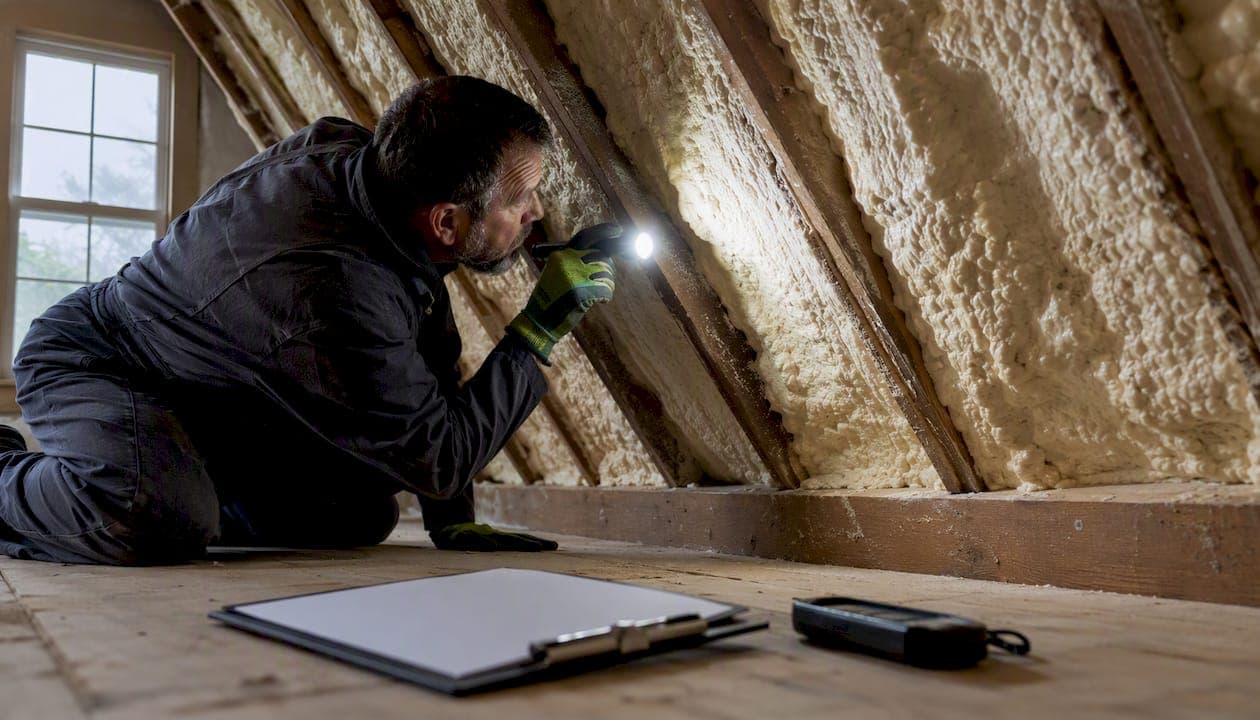
The PCA inspection protocol is the UK's recognised framework for assessing sprayed polyurethane foam (PUF) in pitched roofs. It is not a removal contractor accreditation. The Property Care Association (PCA) maintains a register of qualified Sprayed Foam Assessors — independently audited surveyors who follow this protocol to produce evidence-based reports that many lenders will accept. Your three immediate steps: contact an assessor from the PCA register (or an equivalent independent surveyor); gather any installation paperwork, including BBA or KIWA product approval certificates; and be cautious of any contractor who claims to be "PCA certified" for removal work, because no such accreditation exists. A properly evidenced, independent assessor report can often resolve lender concerns without removal ever being necessary.
Table of Contents
- What will an assessor check, and what paperwork should you provide?
- How do PCA protocol findings affect your mortgage and resale?
- When is removal necessary, and what are the alternatives?
- What timescales and costs should you expect?
- Industry response and the case for a quality-assurance scheme
- Key takeaways
- The mistake most homeowners make before calling anyone
- Sprayfoamremovalhelp: independent assessments and removal across London and the Southeast
- Useful sources
- FAQ
What will an assessor check, and what paperwork should you provide?
Preparation makes a real difference to inspection outcomes. Surveyors working to the PCA protocol need both physical access and documentary evidence. Missing paperwork is one of the most common reasons an assessor cannot reach a firm conclusion.
What the assessor records on site
- Foam adhesion and coverage across the roof pitch
- Evidence of bridging across rafter bays (which can restrict ventilation)
- Condition of the interface between foam and roof boarding or felt
- Ventilation pathways and any signs of condensation or moisture
- Visible timber condition, including any staining, discolouration, or softness
- Photographic evidence of all the above, referenced to a roof plan
Red flags that typically prompt further investigation
- Visible moisture staining or wet timbers at the foam/rafter interface
- Foam applied directly over degraded or damaged felt without documented approval
- No product approval certificate and no installer records
- Evidence that the foam has delaminated or pulled away from the structure
- Signs of previous repair attempts without documentation
Pro Tip: Supply your own photographs of the loft space before the assessor arrives. Clear, dated photos showing the foam coverage, any visible timbers, and the eaves detail give the assessor a baseline and can speed up report preparation.
How do PCA protocol findings affect your mortgage and resale?
Lenders' concerns about spray foam are well documented. The House of Commons Library summarises the position clearly: independent documentation and assessor reports can determine whether removal is required and directly influence mortgage outcomes. A May 2025 letter from the PCA and others reported that inspections across more than 500 properties found defects in roughly 35% of cases, which means the majority of inspected properties did not require removal.
The documents lenders commonly request are:
- An independent assessor report following the PCA protocol (or equivalent evidence-based framework)
- The product approval certificate (BBA or KIWA)
- The installer handover file and completion records
- Photographic evidence referenced in the report
- Any testing or curing records supplied at installation
The key shift the protocol enables is moving lenders away from a binary "foam present = decline" position. A well-evidenced report that concludes the foam poses no current risk to the structure, supported by a valid product approval certificate and a complete handover file, gives an underwriter something to work with. A report that simply states "spray foam is present" does not.
There are three typical outcome scenarios:
Report supports safe retention. The assessor finds the foam is correctly installed, the product is BBA/KIWA approved, documentation is complete, and there is no evidence of moisture or timber damage. Many lenders will proceed, sometimes with a retention or condition. You can review what a mortgage-compliant report should contain before commissioning one.
Report indicates remedial action. The assessor identifies specific concerns, such as inadequate ventilation or minor moisture risk, that can be addressed without full removal. Targeted repairs, improved ventilation, or a follow-up intrusive inspection may satisfy the lender once evidenced.
Report recommends removal. Where timber decay is present, moisture is trapped, or the installation is unsafe, the assessor will recommend removal. At that point, a full removal and timber restoration is the route to a clean lender outcome.
An installer's completion certificate is not the same as an independent condition assessment. Lenders want a commercially separate assessor report that references product approval certificates and addresses moisture and rot risk directly. Confusing the two is one of the most common and costly homeowner mistakes.
When is removal necessary, and what are the alternatives?
Full removal is not always the right answer. The House of Commons Library guidance notes that a staged approach, starting with inspection and moving to targeted remediation where needed, often avoids full removal and reduces cost while still allowing lenders to proceed.
Circumstances that commonly point towards removal:
- Confirmed timber decay at the foam/rafter interface
- Trapped moisture where no product documentation exists to assess the original risk
- An installation method that demonstrably increases rot risk (e.g., foam applied over damaged felt with no ventilation provision)
- A product that was not BBA or KIWA approved for the application used
| Approach | Scope | Invasiveness | Lender impact | Typical next step |
|---|---|---|---|---|
| Inspection only | Visual, photographic, documentary review | Non-invasive | Report may satisfy lender if evidence is complete | Retain with conditions, or escalate |
| Remedial measures | Targeted repairs, ventilation improvement, timber treatment | Minimal to moderate | Lender may proceed once remediation is evidenced | Follow-up report confirming works |
| Full removal | Complete foam removal and timber restoration | High | Clean outcome for lender once completion report issued | Completion report and mortgage-compliant certificate |
When the assessor's evidence points to a specific, addressable problem, remediation is worth exploring before committing to full removal. Partial removal to inspect and treat a localised area of concern, combined with improved ventilation and a follow-up report, has resolved lender objections in many cases. The decision should always rest on the assessor's evidence, not on a contractor's recommendation.
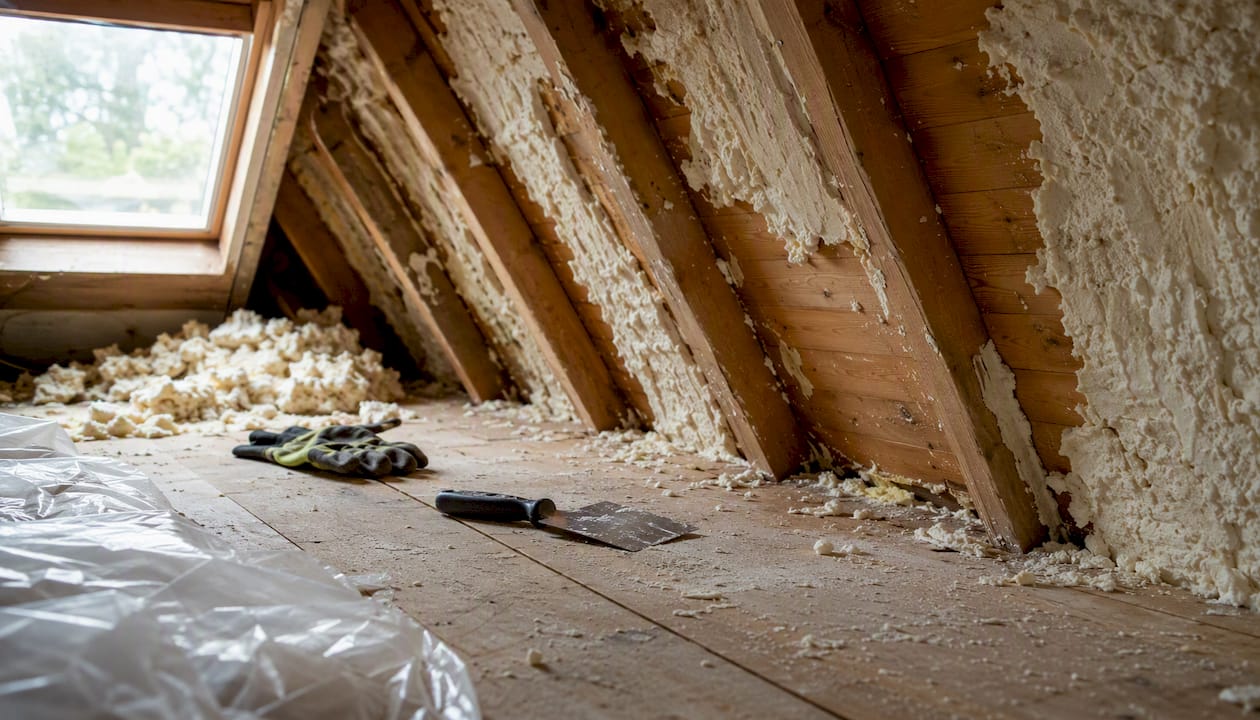
Pro Tip: Never commission removal work before you have an independent assessor report in hand. A removal contractor quoting without an assessor's findings has no evidential basis for the recommendation, and you have no protection if the work turns out to be unnecessary.
Red flags to watch for
- A company that offers to assess and remove as a single package, with no independent report stage
- Claims of "PCA certification" for removal work (this does not exist)
- Pressure to commit to removal before the inspection is complete
- Reluctance to share a sample report or PI insurance details
- No mention of BBA or KIWA product approval in their process
The PCA has warned explicitly that fraudsters have used fake PCA branding to push unnecessary removal work. If a company cannot name the PCA course they completed or provide verifiable PI insurance, walk away.
What timescales and costs should you expect?
Realistic expectations help you plan and avoid being rushed into decisions. Costs vary by property size, access, and the severity of any issues found, so treat the categories below as a planning framework rather than fixed prices. For a detailed breakdown, the spray foam removal costs guide gives current indicative ranges.
Industry response and the case for a quality-assurance scheme
The PCA inspection protocol, published in March 2023, was a significant step forward. But the broader industry response has made clear that the protocol alone is not sufficient to resolve all the uncertainty homeowners and lenders face.
Key developments since 2022:
- The PCA and RPSA collaborated with lenders and industry bodies to produce the inspection protocol and the associated training course
- The Insulation Manufacturers' Association (IMA) published its own companion inspection guidance and a consumer guide to help homeowners navigate the process
- The PCA has called for an independently administered quality assurance scheme to give assurance that installations match product approval certificates and to help lenders and purchasers assess risk
- A May 2025 letter from the PCA and others to government reported findings from inspections of more than 500 properties, with defects found in roughly 35% of cases
The gap the QA scheme would fill is real. There is currently no independently audited trade body representing spray foam removal contractors, which has contributed to uneven standards and created the conditions for scams. An independently administered scheme covering both installation verification and removal standards would give lenders a traceable chain of evidence from product approval through to completion.
For homeowners, the practical implication is that the current framework, while much improved since 2022, still places the burden of evidence-gathering on the property owner. Retaining all installation paperwork, including BBA and KIWA product approval certificates, remains the single most effective thing a homeowner can do to protect their position.
Key takeaways
The PCA inspection protocol gives surveyors a consistent, evidence-based framework for assessing spray foam, and a properly evidenced independent assessor report remains the most reliable route to a mortgage-compliant outcome.
| Point | Details |
|---|---|
| PCA register is the starting point | Find a Sprayed Foam Assessor via the PCA register; confirm PCA course attendance and PI insurance before booking. |
| Paperwork is critical | Gather BBA/KIWA product approval certificates and the installer handover file before the inspection takes place. |
| Defect rate context | Inspections found defects in roughly 35% of more than 500 properties inspected, meaning most properties did not require removal. |
| Removal is not always necessary | An evidence-based assessor report may support safe retention or targeted remediation rather than full removal. |
| Sprayfoamremovalhelp | Provides PCA-aware independent assessments, mortgage-compliant reports, and full removal across London and the Southeast. |
The mistake most homeowners make before calling anyone
The most common error is treating the installer's paperwork as an independent assessment. They are not the same thing, and lenders know the difference. An installer's completion certificate tells you the job was done; it says nothing about whether the roof structure is currently sound, whether the product was appropriate for your specific roof, or whether moisture has been trapped in the years since installation.
The second mistake is calling a removal contractor before calling an assessor. Removal contractors have a commercial interest in recommending removal. That does not make them dishonest, but it does mean their recommendation is not independent. The PCA's position on this is unambiguous, and lenders share it: the assessment must come first, from someone with no stake in what happens next.
What reassures me about the direction the industry has taken since 2023 is that the protocol gives homeowners something concrete to point to. You can ask an assessor exactly which framework they follow, request a sample report, and verify their credentials against a published register. That transparency did not exist a few years ago. The protocol is not perfect, and the absence of an independently administered QA scheme for removal contractors remains a genuine gap. But the assessment side of the process is now well-defined, and a measured, evidence-led approach will serve most homeowners far better than a rushed removal decision made under pressure.
Sprayfoamremovalhelp: independent assessments and removal across London and the Southeast
If you have spray foam in your roof and need clarity before your next sale, purchase, or remortgage, Sprayfoamremovalhelp offers exactly the kind of independent, mortgage-compliant service the PCA protocol calls for. The team carries out PCA-aware property assessments, produces lender-ready reports, and where removal is genuinely necessary, handles the full process including timber restoration, with a 10-year insurance-backed warranty and transparent pricing from the outset.

What sets Sprayfoamremovalhelp apart is the direct service model: you speak to the technicians doing the work, not a call centre. No middlemen, no hidden fees, and no pressure to commit to removal before the evidence supports it. The service covers London and the Southeast, and a free initial inspection is available for homeowners who want a no-obligation starting point. For those already at the removal stage, the spray foam removal guide sets out the full process clearly. Book your assessment today and get the evidence your lender needs.
Useful sources
The following authoritative documents and pages are worth bookmarking. Each one serves a specific purpose in the assessment and decision-making process.
| Source | What it covers | Why it matters |
|---|---|---|
| PCA Sprayed Foam Inspection Protocol (March 2023) | The full non-invasive inspection framework for surveyors | The primary standard assessors should follow; download it to understand what a compliant report should cover |
| PCA Sprayed Foam Assessor membership page | Assessor criteria: training, PI insurance, experience | Use this to verify what a legitimate assessor must demonstrate before joining the register |
| PCA professional guidance on sprayed foam | PCA's position on QA, assessment, and industry standards | Explains the PCA's role and its call for an independently administered quality assurance scheme |
| IMA Inspection Protocol (March 2023) | IMA's companion inspection guidance for lenders and surveyors | Reinforces the non-prescriptive framework and helps lenders understand acceptable evidence |
| IMA Consumer Guide to Spray Foam Insulation | Plain-language homeowner guidance on paperwork and assessment | Explains what documents to retain and why independent assessment matters |
| House of Commons Library: spray foam and mortgages | Parliamentary summary of lender positions and inspection findings | Covers the 35% defect rate finding and explains how assessor reports influence mortgage decisions |
| PBCToday: new protocol for sprayed foam inspections | Industry news coverage of the protocol's launch and aims | Useful context on the cross-party working group and the policy goal of reducing blanket lender refusals |
| The Intermediary: PCA warns on removal scams | PCA's public warning about fraudulent removal companies | Read this before engaging any contractor who claims "PCA certification" for removal work |
FAQ
What is PCA spray foam certification?
The term refers to the PCA's inspection protocol and register of Sprayed Foam Assessors, not a removal contractor accreditation. Assessors must complete the PCA course 'Evaluating Sprayed Polyurethane Foam in Domestic Roofs', hold Professional Indemnity insurance, and demonstrate relevant surveying experience.
Is spray foam insulation illegal in the UK?
Spray foam insulation is not illegal in the UK. The concern is not legality but whether the specific product was BBA or KIWA approved for the application used, and whether the installation affects the roof structure's condition and mortgageability.
Why can't you get a mortgage with spray foam insulation?
Many lenders have declined properties with spray foam because they cannot assess the condition of concealed roof timbers without documentation. An independent assessor report following the PCA protocol, supported by product approval certificates and a complete installer handover file, can give lenders the evidence they need to proceed.
Why are homeowners removing spray foam?
Removal is typically prompted by evidence of timber decay, trapped moisture, or an installation that lacks product approval documentation. Where an independent assessor report identifies these issues, removal may be the only route to a clean mortgage outcome. However, inspections of more than 500 properties found defects in roughly 35% of cases, meaning the majority did not require removal.
Is there a government grant to remove spray foam insulation?
No dedicated government grant for spray foam removal is currently available in the UK. Some homeowners have explored whether their original installation was funded through a government energy efficiency scheme, but removal costs are generally borne by the property owner. Sprayfoamremovalhelp offers transparent pricing and a free initial inspection to help you understand your options before committing to any expenditure.