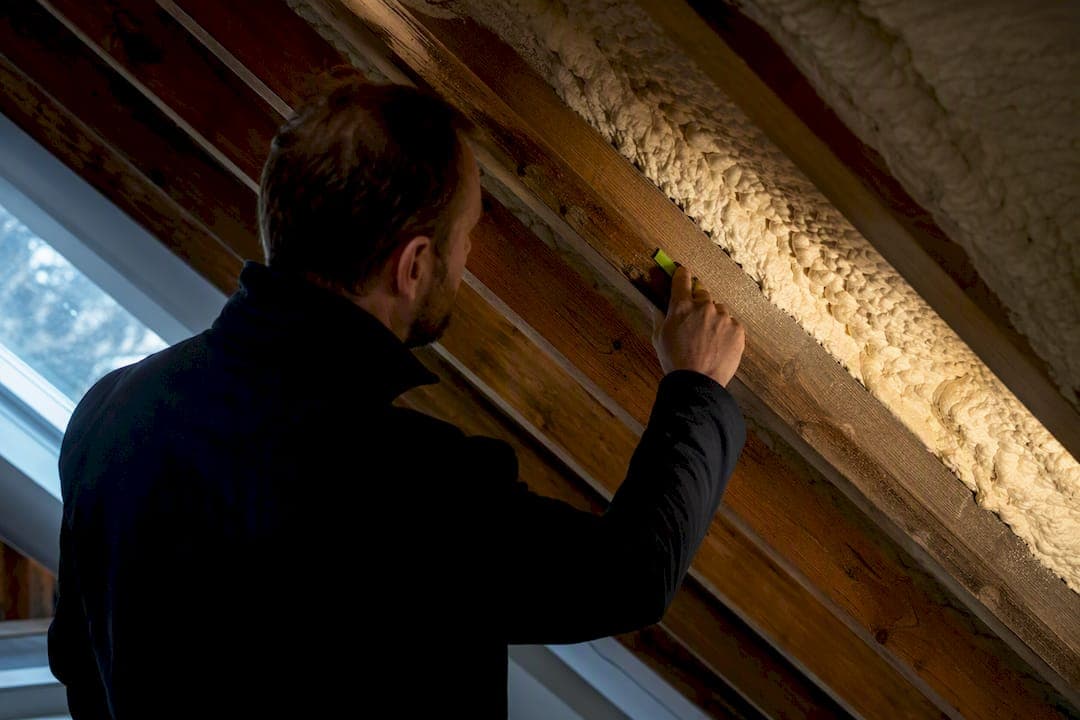
Spray foam does not have to sink a sale. The verdict is simple: disclose it the moment you know it's there and commission an independent RICS or PCA-aligned inspection before a buyer's surveyor finds it first. Most lenders will assess a case on its evidence rather than refuse outright, and this article walks through the checklists, paperwork, and specialist options that turn a red flag into a manageable condition report.
TL;DR:
- Most lenders assess spray foam insulation case-by-case, with approximately 25% maintaining a strict no-lend policy, so proper documentation can influence mortgage decisions.
- Independent, credentialed inspections that specify foam type, installation date, timber condition, and ventilation status are crucial for lender acceptance and risk assessment.
- Sellers should gather all relevant paperwork before listing and consider commissioning an independent report to streamline the mortgage and survey process.
- Removal costs can range from around £1,000 to £7,000, and quotes must include disposal, felt repair, and access costs, along with a guarantee backed by insurance.
- Proper disclosure, alongside clear evidence, prevents legal risks for sellers and agents, especially regarding listed buildings or potential liabilities with insurance policies.
Table of Contents
- Checklist for estate agents: identify, disclose and qualify early
- What sellers and buyers should do: documentation, surveys and negotiation options
- How does spray foam affect mortgage valuations and lender decisions?
- What surveys and paperwork do lenders actually accept?
- Remediation and repair options, likely costs and risk management
- How specialist, mortgage-compliant services help
- Health and safety considerations related to spray foam in properties
- Legal implications and compliance issues for sellers and estate agents regarding spray foam
- Impact of spray foam on insurance policies and premiums
- Common problems and defects associated with spray foam installations
- Guidance on selecting qualified professionals for inspection and remediation of spray foam issues
- Author's perspective for estate agents and buyers
- How to get a mortgage-ready survey or removal from Sprayfoamremovalhelp
- Sources
- FAQ
Checklist for estate agents: identify, disclose and qualify early
Spray foam hides in plain sight. It's usually applied to the underside of roof timbers or rafters, so unless you climb into the loft with a torch, you won't spot it from the landing hatch. Ask sellers directly at valuation: "Has any spray foam insulation ever been installed here, even by a previous owner?" Many sellers genuinely don't know, especially if it was fitted by a previous occupant chasing an energy grant years ago.
How to spot it during a valuation visit:
- Look for a yellowish or white rigid coating sprayed directly onto the underside of the roof felt or rafters.
- Check for a lack of visible timber, since spray foam often coats joists and purlins completely, obscuring wood that a surveyor would normally inspect.
- Ask about any past insulation grants, cavity wall top-ups, or "free loft insulation" schemes, which are common routes by which spray foam ends up in a property.
- Request any paperwork left by previous owners, including installer invoices, guarantees, or certification stickers inside the loft.
Once you know it's there, disclosure isn't optional. Property particulars should state plainly that spray foam insulation is present in the roof space, without editorialising about whether it's "a problem." A single line does the job: "The property has spray foam insulation to the loft roof space, installed in [year if known]. Buyers are advised to seek independent specialist advice." Say the same thing verbally at every viewing. Agents who bury this detail, or only mention it when a buyer asks directly, are storing up complaints and potential comeback under estate agency conduct rules if a sale later collapses because a surveyor flags it as undisclosed.
Paperwork to request and file immediately:
- Original installer invoice and date of installation.
- Manufacturer product certification (BBA or Kiwa where available).
- Any insurance-backed guarantee documentation.
- Photographs of the loft before and after installation, if the seller has them.
Qualify buyers early rather than late. When a serious offer comes in, ask straight away whether the buyer needs a mortgage or is proceeding with cash, because this changes the urgency of getting independent evidence together. A cash buyer might proceed on a surveyor's report alone; a mortgage buyer's lender will often want to see a specific product certificate before instructing a valuation. For higher-value or listed properties, it's worth recommending a pre-listing specialist report before the property even goes on the market, since trade commentary on estate agent concerns suggests sales move faster and collapse less often when the evidence is ready in advance rather than assembled in a panic after a survey flags an issue.
Pro Tip: Keep a standard spray foam disclosure paragraph saved in your CRM template. Sellers forget to mention it, buyers forget to ask, and a pre-written line stops it slipping through the cracks on a busy Saturday of viewings.
What sellers and buyers should do: documentation, surveys and negotiation options
If you're selling a property with spray foam, your job before marketing starts is to build a paper trail, not to hide the loft hatch. Lenders and surveyors respond to evidence, not reassurance.
Seller actions before going to market:
- Locate every scrap of paperwork: installer invoices, manufacturer data sheets, guarantee certificates, and the installer's contact details.
- Contact the original installer to confirm whether the product used carries current BBA or Kiwa certification.
- Consider commissioning an independent RICS or PCA-aligned inspection before listing, particularly if the property is likely to attract mortgage buyers.
- Brief your estate agent fully so the disclosure in the particulars matches what a survey will later confirm.
Buyers have their own homework. If you like a property but notice, or are told, that it has spray foam insulation, ask about it before you book a viewing, not after you've fallen for the kitchen. Once you're seriously interested, instruct a RICS or PCA specialist survey rather than relying on the standard mortgage valuation, which typically won't go far enough to satisfy a cautious lender.
If a survey flags a problem, your negotiation options include:
- Asking the seller to reduce the price to reflect removal or remediation costs.
- Requiring the seller to arrange and pay for removal before completion, with the sale made conditional on that work.
- Making an offer conditional on a satisfactory independent report, with a clear deadline.
- Agreeing an escrow arrangement or retention, where funds are held back at completion until remedial work is finished and signed off.
If removal becomes the agreed route, get more than one quote. A single quote tells you nothing about whether the price is fair or the scope is complete. When comparing quotes, check that each contractor's scope explicitly covers disposal of the removed foam, any necessary roof felt repair, and scaffold or access costs, since these are the line items that turn a tidy quote into a nasty surprise halfway through the job. Ask each contractor whether they carry Property Care Association membership and whether the work comes with an insurance-backed guarantee, because that guarantee is often exactly what a lender wants to see before releasing funds on a remortgage.
How does spray foam affect mortgage valuations and lender decisions?
Lender policy on spray foam is not uniform, and that inconsistency is the root of most agent headaches. Around 25% of UK lenders maintain a strict no-lend policy on properties with retrofit spray foam in the roof, according to RICS guidance, while many major lenders will assess an application case-by-case if the seller or buyer supplies independent specialist evidence.
A significant number of UK homes currently have spray foam loft insulation, and a portion of lenders decline outright, while others look at the evidence before deciding. That gap between "automatic no" and "let's see the report" is precisely why the paperwork matters so much.
Surveyors flag spray foam because it obscures the very thing they're trained to inspect: timber condition. Closed cell foam bonded to the underside of roof timbers hides rot, woodworm, and historic leaks that would otherwise be visible. Open cell foam, meanwhile, is more permeable but can still trap moisture against timber if ventilation is inadequate, and government technical guidance on spray foam applied to timber sloped roofs sets out exactly why condensation risk rises when ventilation paths are blocked. A valuer who can't see the timber, and can't be certain the roof is ventilating properly, has every reason to raise a query rather than sign off a clean valuation.
Documents lenders and surveyors commonly ask for:
- A RICS Level 2 or Level 3 building survey report specifically addressing the roof space.
- A Property Care Association inspection following their standard protocol.
- Manufacturer product certification, ideally BBA or Kiwa approved.
- Original installation records showing date, product type, and installer details.
Timelines matter here. Once a mortgage valuer flags spray foam, most lenders pause the application pending further evidence rather than declining immediately, but that pause can run to several weeks if the seller has no paperwork ready. Agents who've already assembled the file at the checklist stage can often turn a stalled application around within days instead of losing the buyer to frustration. Broker commentary on spray foam and mortgages backs this up, noting that a clear independent report frequently converts an initial refusal into a conditional acceptance.
What surveys and paperwork do lenders actually accept?
Not every inspection carries equal weight with a lender. A cousin's opinion or the installer's own reassurance won't move the needle; independent, credentialed evidence will.
Credible inspection types include:
- A RICS-accredited surveyor's report, ideally a Level 3 building survey where the roof space is a specific concern.
- A Property Care Association member inspection following their published protocol for insulation defects.
- Moisture and thermal readings taken with proper equipment, not just a visual look.
- A drone photographic survey where physical access to the roof space is difficult or the roof pitch is steep.
A report that will actually satisfy a lender or a conveyancing solicitor needs to state the type of foam (open or closed cell), the installation date if known, the current condition of any visible timber, a condensation and ventilation risk assessment, and clear recommendations, whether that's "no action required," "monitor," or "remove." Vague reassurance without these specifics tends to get bounced back by underwriters.
Procurement matters as much as the report itself. Always use an inspector who is independent of the original installer. A report commissioned from, or influenced by, the company that fitted the foam carries far less weight with a lender, since Commons Library guidance specifically recommends expertise that is commercially separate from the installer and manufacturer.
Pro Tip: Ask your specialist to format the report for both the valuer and the conveyancing solicitor, not just the homeowner. A report written in consumer-friendly language often reads as vague to an underwriter, so request one with the technical detail a lender's surveyor expects.
Turnaround for a proper inspection typically runs from a few days to two weeks depending on demand and property access. Build that into your marketing timeline rather than discovering it the week before exchange.
Remediation and repair options, likely costs and risk management
Removal isn't always necessary. If an independent report confirms the timber is sound, ventilation is adequate, and there's no evidence of condensation damage, many lenders will proceed on that evidence alone, particularly for cash-adjacent purchases or remortgages with a cautious but not outright hostile lender. Removal becomes the sensible route when the report flags active moisture problems, when the lender in question operates a strict no-lend policy regardless of evidence, or when a buyer simply won't proceed without it.
Removal itself carries its own risks worth planning for. Roof felt often tears during extraction, since the foam bonds tightly to whatever it touches, and scaffold access is frequently required for anything beyond a simple loft hatch job. A responsible contractor's quote should include a repair contingency for felt damage, not just the foam removal cost, because a quote that looks cheap on paper and excludes repairs tends to end up more expensive once the real scope emerges.
When evaluating removal quotes, check for:
- Property Care Association membership as a baseline credential.
- An insurance-backed guarantee covering the work, ideally running for several years.
- A written scope that explicitly includes disposal, felt repair contingency, and scaffold or access costs.
- A clear timeline and confirmation of who supplies replacement insulation once the foam is gone.
If a job goes wrong, know your escalation routes. Check whether the original installer offered a guarantee that's still valid, look for TrustMark registration, and Trading Standards can intervene where a contractor has misrepresented their work. Small claims court remains an option for cost recovery on jobs under the relevant limit, though a written contract with a clear scope, as industry guidance on removal contracts recommends, makes any dispute far easier to resolve before it gets that far.
How specialist, mortgage-compliant services help
A mortgage-ready file needs specific deliverables: a basic visual survey to establish the scale of the issue, a full roof report with photographs documenting timber condition and foam type, and where removal happens, an insurance-backed guarantee proving the work is covered long-term.
When briefing a specialist, agents should confirm:
- Whether the deliverable includes photographic evidence suitable for a lender or solicitor.
- Whether the inspector is independent of any installer with a financial interest in the outcome.
- Turnaround time against your marketing or completion deadline.
- Whether a PCA-aligned protocol underpins the inspection findings.
Specialist services structure their survey and removal deliverables around lender expectations, giving agents evidence they can hand straight to a valuer.
Health and safety considerations related to spray foam in properties
Spray foam insulation itself is not classed as a health hazard once fully cured, but the concerns around it are real and worth explaining to sellers plainly. During installation, the chemicals involved, typically isocyanates, release fumes that require proper ventilation and protective equipment. That's one reason cowboy installers working without training or extraction equipment cause genuine problems, not just poor workmanship.
The bigger long-term concern is what spray foam hides rather than what it emits. Trapped moisture against timber can encourage mould growth in the loft space over time, and mould spores are a recognised respiratory irritant, particularly for anyone with asthma or allergies. A loft that can no longer "breathe" because foam has sealed every gap tends to run warmer and damper than a ventilated one, which changes the air quality throughout the property, not just in the roof space.
If a survey identifies active condensation or mould in a spray-foamed roof, treat it as a health and comfort issue for whoever lives there next, not purely a lending obstacle. Sellers should mention any known damp or mould history alongside the insulation disclosure. Buyers moving into a property with sealed spray foam should ask specifically whether loft ventilation was assessed as part of any inspection, since inadequate airflow is the mechanism behind most of the problems that follow.
Legal implications and compliance issues for sellers and estate agents regarding spray foam
Failing to disclose known spray foam is a genuine legal exposure, not just a courtesy issue. Under the Consumer Protection from Unfair Trading Regulations, misleading a buyer by omission, including staying silent about a material defect you knew about, can expose both seller and agent to a claim after completion. Estate agents carry additional professional exposure through their governing conduct rules, since failing to pass on known material information to a prospective buyer is exactly the kind of complaint that ends up with a redress scheme.
Listed and protected buildings carry a stricter rule again. RICS guidance is explicit that spray foam counts as a significant alteration to a roof, and it must not be installed in a listed building without prior consent from the local planning authority. If you're valuing or marketing a listed property, ask directly whether any insulation work, spray foam included, happened without listed building consent. Retrofitting foam without that consent isn't just a lending problem, it's a potential enforcement issue for the current owner, and it needs disclosing to any buyer before they commit.
Agents should also keep a clear written record of when and how disclosure was made, whether that's the particulars wording, an email to a buyer's solicitor, or notes from a viewing. If a dispute arises later, that paper trail is what protects you.
Impact of spray foam on insurance policies and premiums
Buildings insurance and spray foam interact in ways many homeowners don't consider until a claim is refused. Some insurers now ask directly on renewal or new business forms whether a property has spray foam insulation in the roof, and an inaccurate answer, even an innocent one, can void cover entirely if a claim later arises from a roof-related issue such as timber decay or a leak the foam concealed.
The core insurer concern mirrors the lender's: spray foam obscures the roof structure, making it harder to assess pre-existing condition or ongoing risk. If a claim for water damage or timber rot emerges and the insurer discovers foam was present but undisclosed, they may argue the property was misrepresented at the point of taking out the policy. That's a good reason for sellers to be just as forthcoming with their own insurer as they are with buyers and agents.
Premiums themselves don't move in a fixed, predictable direction because of spray foam alone. Some insurers may load a premium slightly to reflect the harder-to-assess roof condition, others decline cover for a specific risk type until an independent report is provided, and some proceed without any adjustment at all if the foam was professionally installed with documentation. The safest approach for any homeowner, whether selling or staying put, is to declare spray foam to their insurer proactively and keep a copy of that correspondence alongside the installation paperwork. It's one more document that strengthens the file when a buyer's solicitor or a lender comes asking.
Common problems and defects associated with spray foam installations
Most spray foam problems trace back to one of a small number of root causes, and recognising them helps agents and buyers judge how serious a given case really is.
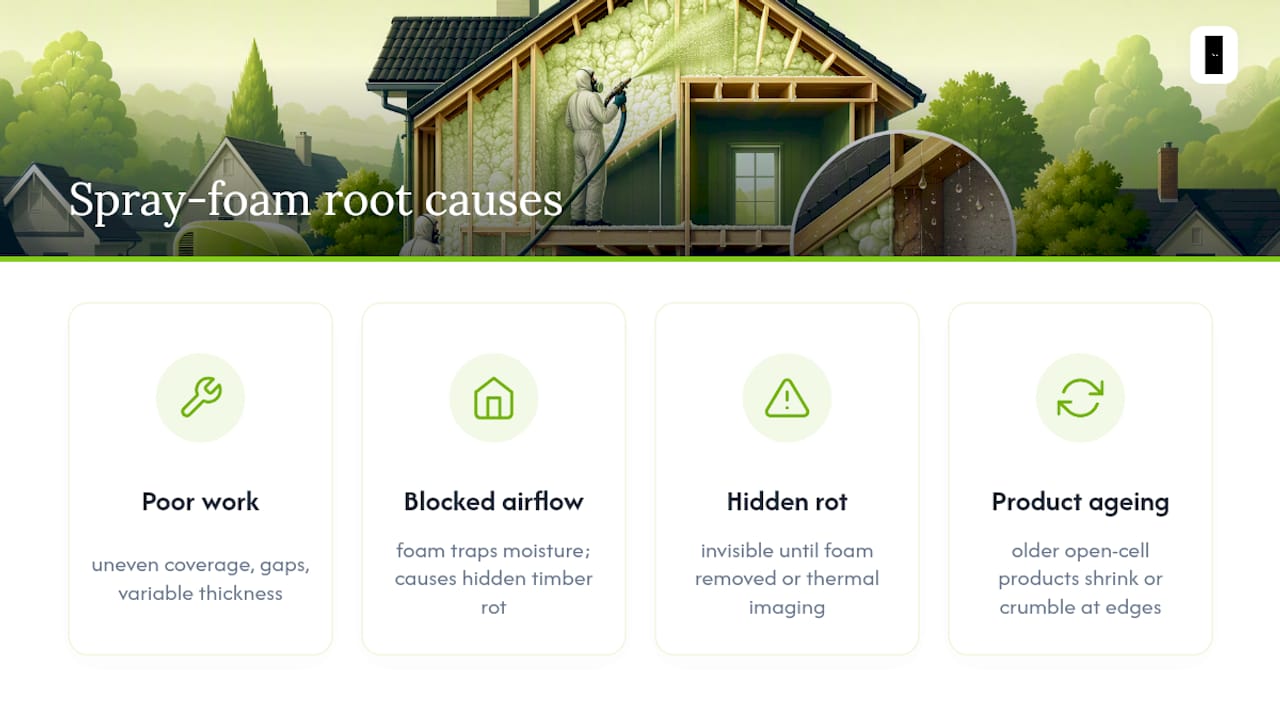
Poor application is the most frequent defect. Uneven coverage, gaps that let cold air bridge through, and foam sprayed too thick in some areas and too thin in others all point to an installer working quickly rather than carefully. This tends to happen with cowboy installers pushing free grant-funded schemes, where volume mattered more than quality.
Inadequate ventilation is the second major issue. Closed cell foam applied directly to the underside of roof felt without maintaining proper airflow paths traps moisture with nowhere to go. Over months and years, that moisture condenses against cold timber, and rot or fungal decay can set in unnoticed because the foam hides the very surface where it's happening.
Hidden timber decay is the defect surveyors worry about most, precisely because it's invisible until the foam is removed or a specialist uses thermal imaging to infer a problem beneath the surface. A roof that looks fine from below can conceal years of slow decay.
Product degradation over time affects some older installations, particularly early open cell products that weren't as robust as current BBA-certified versions, leading to shrinkage, gaps, or crumbling at the edges.
None of these defects are automatically present in every spray-foamed roof. Plenty of professionally installed jobs, using certified products with proper ventilation, cause no issues at all. The problem is that from the outside, a good installation and a bad one look identical, which is exactly why independent inspection matters more than a visual guess.
Guidance on selecting qualified professionals for inspection and remediation of spray foam issues
Choosing the right professional at each stage protects both the transaction and your wallet. For inspection, look specifically for a RICS-accredited surveyor or a Property Care Association member who follows their published inspection protocol. Ask whether they've inspected spray foam roofs before, since this is still a specialist niche and a generalist surveyor may lack the specific experience to spot the subtler risk indicators.
Independence from the installer is non-negotiable. Never accept an inspection or a "free assessment" offered by the same company that installed the foam or that's trying to sell you a removal contract, because the incentive to find a problem, or to downplay one, sits in entirely the wrong place. A lender or solicitor will treat that report with far less confidence too.
For remediation, verify Property Care Association membership as a baseline, then ask for evidence of an insurance-backed guarantee covering the completed work, not just a verbal promise. Request references or examples of comparable jobs, and always get the scope of work in writing before signing anything, including who's responsible for felt repair and scaffold costs if the job runs into complications. A contractor who resists putting the scope in writing is telling you something about how the job will go.
Author's perspective for estate agents and buyers
Agents who treat spray foam as an embarrassing secret lose sales; agents who treat it as a checklist item close them. Buyers doing proper due diligence, rather than panicking at the word "foam," usually find the property is fine, or fixable, once the evidence is in hand.
— jessica
How to get a mortgage-ready survey or removal from Sprayfoamremovalhelp
Sprayfoamremovalhelp is the direct alternative to chasing an installer for a "second opinion" they have every incentive to soften. You get an independent specialist, not the person who sold you the foam in the first place, producing exactly the paperwork a lender or conveyancing solicitor wants to see.

The service list maps straight onto what agents and lenders ask for at each stage of a sale. A Basic Visual Survey starts from £100 and gives you a quick first read on scope. A Full Roof Report (with photos) starts from £200 and provides the documented timber condition and foam type assessment that valuers expect. If access is difficult, a Drone Survey + Report starts from £250, or a Full Drone + Detailed Report runs £350 to £450 for the most thorough evidence file. Full details on formats and turnaround sit on the services page.
Where removal is the agreed route, open and closed cell spray foam removal is priced from £1,000 up to £7,000 depending on scope, with PCA-aligned technicians and a 10-year insurance-backed warranty backing the completed work. Whether you're an agent briefing a seller or a buyer weighing up a property, request a survey now and get the evidence moving before your next lender conversation.
Sources
- RICS consumer guide: spray foam insulation
- Spray foam insulation and mortgages — Commons Library briefing
- Spray foam insulation: what it means for your mortgage | Clearview Mortgage Solutions
FAQ
Is spray foam insulation illegal in the UK?
No, spray foam insulation is not illegal, and it remains a legitimate insulation product when installed correctly with proper certification. It cannot, however, be fitted in listed buildings without prior consent, since RICS guidance treats it as a significant alteration to roof performance.
Can you sell a house that has spray foam insulation?
Yes, you can sell a house with spray foam insulation, but you must disclose it clearly in the property particulars and at viewings. Sales proceed most smoothly when the seller has an independent specialist report ready before marketing, rather than waiting for a buyer's surveyor to flag it.
Can I get a mortgage if I have spray foam insulation?
Often, yes. Around 25% of lenders maintain a strict no-lend policy on retrofit spray foam, according to RICS, but many major lenders will assess an application case-by-case if you provide an independent RICS or PCA-aligned report showing no timber decay or condensation risk.
Is it a good idea to buy a house with spray foam insulation?
It can be, provided you instruct an independent specialist survey before committing rather than relying on the standard mortgage valuation alone. If the report confirms sound timber and adequate ventilation, many buyers proceed with confidence, and if it flags problems, you can negotiate a price reduction or require removal before completion.
What does a lender-acceptable spray foam report need to include?
It needs the foam type, installation date if known, current timber condition, a ventilation and condensation risk assessment, and clear recommendations. Reports from providers such as Sprayfoamremovalhelp's Full Roof Report service are built specifically around these lender and solicitor expectations.