Spray foam does not automatically fail a mortgage application, but it often complicates one. Lenders assess these properties case by case, and the RICS consumer guide on spray foam insulation confirms most will ask for product certification, installer paperwork, or an independent specialist survey before agreeing terms. If you're buying, selling, or remortgaging a home with spray foam, gather that documentation now, or book a specialist Level 3 inspection before it stalls your transaction.
TL;DR:
- Most lenders assess properties with spray foam on a case-by-case basis, often requiring product certification, installation proof, or specialist surveys before approving a mortgage.
- Closed-cell spray foam applied directly to roof tiles or slates carries a high hygrothermal risk, especially if it seals timber without proper ventilation.
- A thorough RICS Level 3 survey, including sample testing and hygrothermal modelling, is necessary to accurately assess moisture risks and potential decay.
- The key to mortgage approval is a complete handover pack with certificates, warranties, and photographic evidence, not just the foam or its condition.
- If issues arise, remediation options range from improving ventilation or localized repairs to full removal and re-roofing, with costs and timescales varying accordingly.
Table of Contents
- What spray foam is and why the type applied changes the risk
- Why lenders and surveyors are cautious about mortgage approval
- What a RICS Level 3 spray foam survey actually inspects
- The paperwork checklist that decides most mortgage outcomes
- Pass, conditional pass, or fail: what happens next
- What surveys, remediation and removal typically cost
- Preparing your property and briefing a surveyor properly
- When a specialist diagnostic or removal service becomes necessary
- A homeowner's honest priority list for dealing with spray foam
- Get a clear diagnosis before you spend a penny on remediation
- Where to check the guidance yourself
- Sources
- FAQ
What spray foam is and why the type applied changes the risk
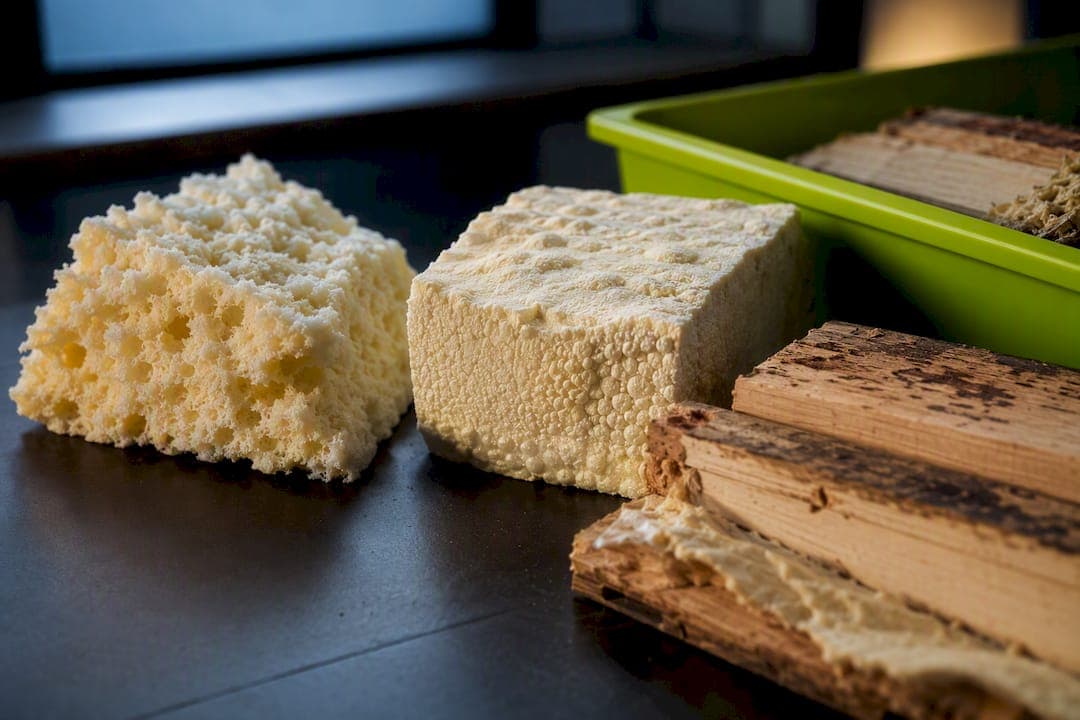
Spray polyurethane foam (SPF) is sprayed as a liquid that expands into a solid layer, usually across roof rafters, the underside of roof decking, or loft slopes. It has been fitted in UK homes for decades, often through government-backed efficiency schemes, and it comes in two forms that behave very differently once they're in place.
Open-cell foam is soft, light, and lets moisture vapour pass through it fairly freely. Closed-cell foam is denser, rigid, and largely impermeable to moisture. That distinction matters more than most homeowners realise, because it determines whether trapped damp can escape a roof structure or gets sealed against the timber indefinitely.
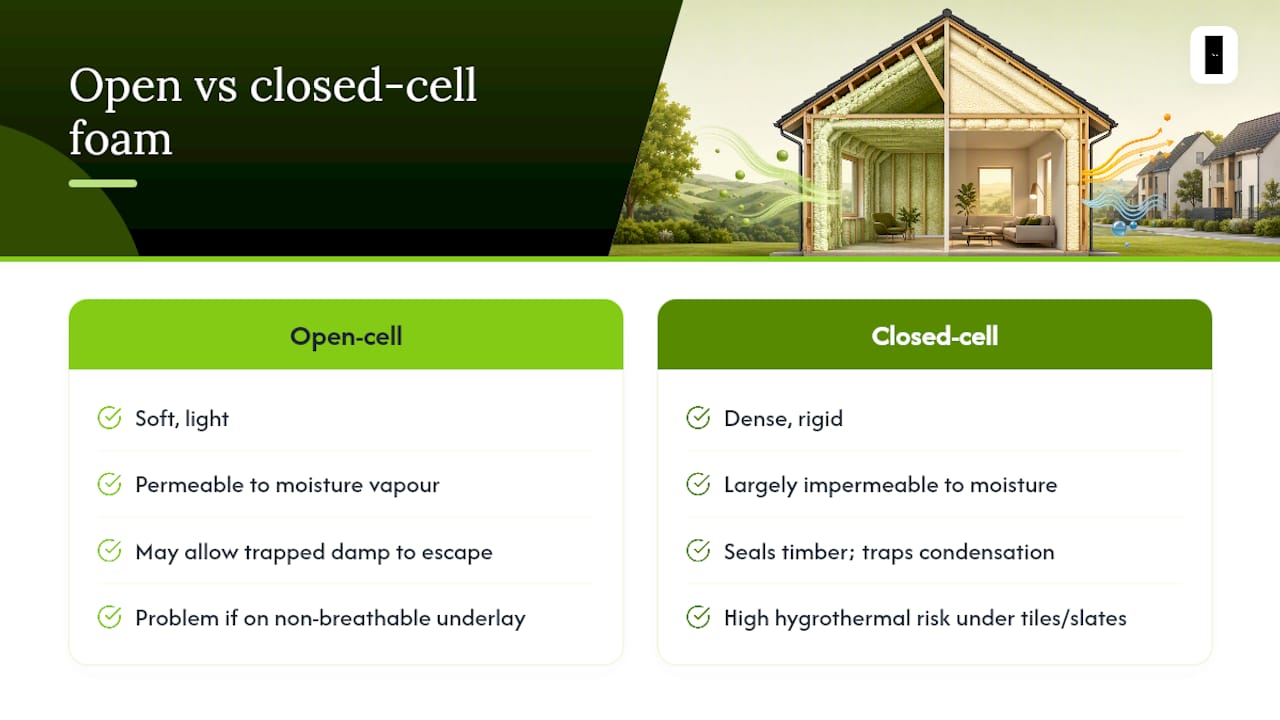
The PCA's technical information paper on sprayed foam sets out a specific concern: closed-cell foam applied directly to the underside of roof tiles or slates tends to carry the highest hygrothermal risk, because it stops the timber breathing while still allowing condensation to form against it. Open-cell foam sprayed directly onto a non-breathable underlay causes a similar problem in reverse.
A traditional cold roof relies on a ventilated gap between the insulation and the roof covering, letting moisture escape before it condenses, and understanding how to properly insulate windows for energy savings complements these moisture management principles. Filling that gap with foam converts it into an unventilated warm roof. That change alters how moisture moves through the structure entirely, and it's precisely why a surveyor can't simply glance at a loft and confirm everything is fine. Understanding this distinction also matters for anyone weighing up spray foam insulation benefits against the practical risks before installation, not just after the fact.
Why lenders and surveyors are cautious about mortgage approval
Several major lenders have refused to lend on properties with spray foam altogether, according to the House of Commons Library's briefing on spray foam and mortgages, which found some major lenders surveyed would not offer a mortgage where spray foam was present. Others assess it case by case, weighing up the foam type, its condition, and whether the seller can prove it was installed and maintained properly.
A standard homebuyers report was never designed to answer these questions. It's a visual, non-invasive inspection, and once foam covers rafters and sarking felt, a valuer simply cannot see the timber underneath to check for decay. The joint PCA/RICS position statement on spray foam inspections confirms that when a surveyor cannot reasonably rule out concealed decay, they're expected to flag the limitation rather than guess, and that flag alone is often enough to make a lender hesitate.
BBC reporting has documented real cases where a sale or remortgage collapsed because the lender demanded documentation the homeowner simply didn't have, or a longer warranty than the one on file, as detailed in coverage of a spray foam sale falling through. That's the scenario worth avoiding, and it usually comes down to paperwork rather than the foam itself.
To satisfy a lender, you'll typically need to produce:
- Product certification confirming the foam meets a recognised standard.
- Installer documentation, including the date and method of application.
- An independent specialist survey report, separate from whoever installed the foam.
- Evidence of an insurance-backed warranty, ideally still valid.
Without these, most lenders default to caution, and caution usually means a conditional offer or an outright decline. Our guide on what UK homeowners need to know about lender stances covers how different banks and building societies currently approach these cases.
What a RICS Level 3 spray foam survey actually inspects
A standard RICS Level 2 homebuyers report is a walk-round assessment. It's fine for a conventional house with no unusual insulation, but it stops short where spray foam is concerned. That's why lenders increasingly expect a RICS Level 3 building survey, or a dedicated specialist spray foam inspection, before they'll commit.
A proper specialist survey typically works through the following stages:
- Loft access and general condition check, confirming how much of the roof structure is covered and whether the foam appears original or has been added to over time.
- Ventilation assessment, checking whether any gap remains between the foam and the roof covering, or whether the roof has effectively been sealed into a warm roof.
- Probing and sample removal, where the surveyor takes small foam samples to check thickness, adhesion, and, where necessary, sends them for identification.
- Timber inspection, looking for visible decay, staining, or softness at every point the foam can be safely lifted or the timber can be reasonably accessed.
- Hygrothermal or condensation risk assessment, a more technical modelling step that estimates how moisture is likely to behave within the roof build-up over time.
- Documentation review, cross-checking any installer paperwork or certificates against what the surveyor actually finds on site.
The PCA's sprayed foam inspection protocol, published in March 2023, is the reference document most reputable surveyors now work to. It specifies exactly what should be recorded, including foam type, the substrate it was sprayed onto, ventilation provision, the extent of timber coverage, and foam depth at multiple points.
Even a thorough Level 3 survey has limits. It's still largely non-invasive, so if early findings raise concern, further opening-up works or laboratory testing of foam and timber samples may be needed before anyone can give a firm answer.
Pro Tip: Ask any surveyor upfront whether their report follows the PCA inspection protocol. A report structured around that framework is far more likely to satisfy a lender's underwriter than a generic write-up, because it uses language and findings the lender's surveyor already recognises.
The report itself will land in one of three places: a pass (no concerns, documentation and condition both check out), a conditional pass (acceptable subject to specific remedial work), or a fail (typically triggering a lender decline unless remediation happens first).
The paperwork checklist that decides most mortgage outcomes
The single biggest factor in whether a lender says yes or no is rarely the foam itself. It's whether you can produce a complete "handover pack" proving what was installed, when, and to what standard. The RICS consumer guide is blunt about this: holding a contemporaneous handover pack is often the most effective way to overcome lender concern without any physical work to the roof at all.
A complete pack should include:
- A pre-installation condition assessment, showing the roof timbers were sound before the foam went in.
- A hygrothermal or condensation risk evaluation carried out at the time of installation, not retrospectively.
- BBA or Kiwa product certification, confirming the specific foam product used meets UK technical standards.
- Installer credentials, including any TrustMark registration if the work was done under a government efficiency scheme.
- An insurance-backed warranty, still within its term where possible.
- Before and after photographs of the roof structure taken during installation.
If any of this is missing, your first call should be to the installer, if they're still trading, or the foam manufacturer directly, since many keep records tied to batch numbers or job references. TrustMark also maintains records for work registered under government efficiency schemes, which can help trace an installation that predates your ownership.
Where paperwork genuinely cannot be recovered, an independent specialist report can substitute for it, provided the inspection is thorough enough to answer the same questions the missing documents would have covered. Our PCA spray foam certification guide walks through what that certification process involves in practice.
Pass, conditional pass, or fail: what happens next
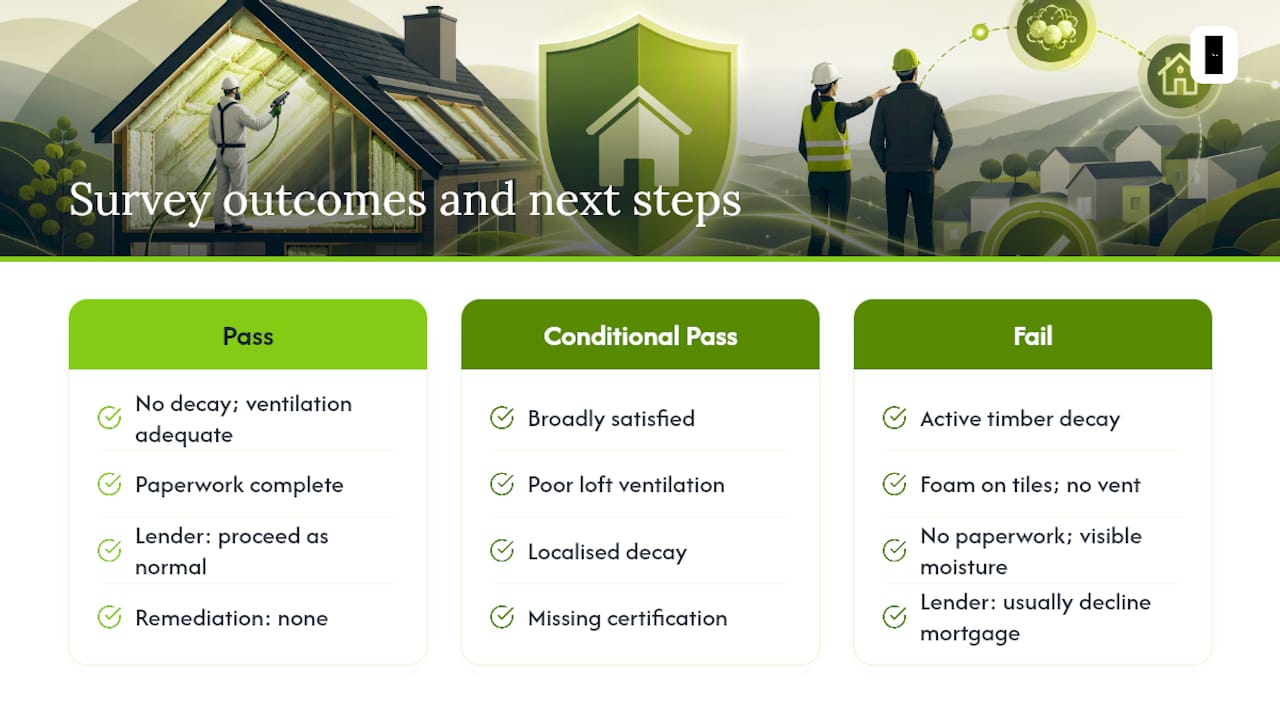
A pass means the surveyor found no evidence of decay, ventilation is adequate, and the paperwork stacks up. You proceed as normal.
A conditional pass is the outcome most homeowners actually get. It means the surveyor is broadly satisfied but wants specific remedial work completed first, commonly improving loft ventilation, addressing a small area of localised decay, or obtaining missing certification before completion. Lenders will often still proceed on this basis, sometimes retaining a sum from the mortgage advance until the work is done.
A fail is more serious. It usually follows evidence of active timber decay, closed-cell foam sprayed directly onto tiles with no ventilation path at all, or a complete absence of any paperwork combined with visible moisture problems. This is where lenders most often decline outright.
Remediation options vary by severity. Improving ventilation alone can resolve a conditional pass cheaply if the foam itself is sound. Partial removal targets only the affected area, useful where decay is localised. Full removal and re-roofing is the most expensive route but gives you a clean survey and a fresh warranty, which matters if you're planning to sell again within a few years. Our guide to disposing of spray foam with mortgage-ready paperwork sets out how each option is typically documented for a lender.
When negotiating with a buyer or estate agent, present the surveyor's findings alongside a written remediation quote and a realistic timeline, not just a verbal promise. Lenders and buyers alike respond far better to a costed plan with a start date than to a vague assurance that "it'll be sorted."
What surveys, remediation and removal typically cost
Costs vary considerably depending on roof size, foam type, and how much has to be opened up to inspect timber properly, so treat the following as broad UK guidance rather than a fixed quote.
A specialist spray foam survey, including a hygrothermal assessment where needed, is generally a modest fixed fee compared with the wider transaction costs of buying a house, and it's almost always cheaper than the delay a failed mortgage valuation causes. Targeted remediation, such as improving ventilation or repairing a small area of decayed timber, sits in the low-to-mid hundreds of pounds range for straightforward jobs. Full removal and re-roofing across an entire property is a significantly larger undertaking, reflecting the scaffolding, foam extraction, and roof covering replacement involved.
Timescales follow a similar pattern. A survey can usually be booked within a couple of weeks and completed on-site in a single visit. Any follow-up laboratory testing of samples adds a further one to two weeks before a final report lands. Remediation timelines depend entirely on scope, from a single day for ventilation improvements to several weeks for full removal and re-roofing.
Get at least two independent quotes before committing to remedial work. Check that any contractor carries professional indemnity insurance and holds recognised membership, such as PCA affiliation, and treat unsolicited cold calls or suspiciously low quotes with real scepticism. This is a category where corners cut on paperwork now cost far more later.
Preparing your property and briefing a surveyor properly
Getting a smooth outcome starts long before the surveyor arrives. Assemble every document you have, even partial ones, and present them in a logical order rather than as a loose pile of paperwork.
- Gather what exists first: installer invoices, any certificates, warranty documents, and photographs from the original installation.
- Contact the installer or manufacturer if records are incomplete, quoting any job reference or batch number you can find.
- Brief the surveyor before the visit, specifically requesting familiarity with the PCA inspection protocol and confirming whether they intend to carry out a hygrothermal assessment.
- Photograph roof access points and any visible foam yourself beforehand, which helps the surveyor plan the visit efficiently and gives you a record if disputes arise later.
- Note the roof's history, including any known re-roofing, extensions, or previous repairs, since this affects how the surveyor interprets what they find.
A well-briefed surveyor working from good paperwork can often complete an assessment in a single visit. One working from scratch, with no documentation and no advance notice, is far more likely to recommend further investigation, which adds weeks to your timeline. Our homebuyer inspection checklist for RICS guidance has a fuller version of this preparation list if you want to work through it in detail.
When a specialist diagnostic or removal service becomes necessary
Certain findings should push you straight to an independent specialist rather than waiting on a standard survey alone. Active timber decay, a complete absence of installation paperwork, closed-cell foam sprayed directly onto roof tiles with no ventilation gap, or moisture readings that come back elevated during inspection are all strong signals that a general homebuyers report has reached its limit.
A reputable specialist provides an independent diagnosis separate from whoever originally installed the foam, which matters because RICS and PCA guidance both stress that impartiality is often decisive for lender acceptance. Beyond diagnosis, expect a clear explanation of removal methods appropriate to the foam type, mortgage-compliant certification once work is complete, and an insurance-backed guarantee covering the work itself.
When vetting any specialist, check for PCA or RICS-aligned knowledge, confirm they hold professional indemnity insurance, and ask about their case history with lenders specifically, not just general roofing experience. Specialist providers have worked with many homeowners across London and the South East, providing PCA-certified inspection and removal work designed to meet lender requirements.
A homeowner's honest priority list for dealing with spray foam
Most homeowners jump straight to removal when they hear a lender is nervous about spray foam. That's usually the wrong first move, and often the most expensive one. Paperwork resolves more mortgage problems than a skip on the driveway ever will.
Start by gathering whatever documentation exists, then commission an independent inspection before deciding anything else. Removal should be the outcome of what that inspection finds, not a panic response to a lender's initial caution.
Be wary of anyone who cold-calls offering "guaranteed" removal at a price that sounds too low. Reputable, insured specialists don't need to chase work that way. A free inspection from an established provider is a reasonable, low-risk way to find out where you actually stand before spending a penny on remediation.
— jessica
Get a clear diagnosis before you spend a penny on remediation
Sprayfoamremovalhelp gives homeowners a direct route to the paperwork and physical evidence a lender actually asks for, without the guesswork of chasing quotes through third parties. As a specialist working right across London and the South East, our PCA-certified technicians deal exclusively with spray foam, so you speak directly with the people doing the diagnostic work and the removal itself, not a call centre passing your case along.

Every job comes with transparent pricing agreed upfront and a 10-year insurance-backed warranty once work is complete, the same kind of documentation this article has explained lenders now expect to see. If you're facing a conditional pass, a lender request for evidence you don't have, or simply want to know where you stand before listing your home, book a free inspection and get a written diagnostic report covering condition, risk, and your realistic options. If removal turns out to be the right route, our spray foam removal guide sets out exactly how the process works from first visit to certification.
Where to check the guidance yourself
- The RICS consumer guide to spray foam insulation explains lender expectations and the documentation homeowners should hold.
- The PCA's sprayed foam inspection protocol sets the technical standard most specialist surveyors now follow.
- The PCA consumer guide on spray foam covers vetting specialists and understanding insurance-backed warranties.
- The House of Commons Library briefing on spray foam and mortgages summarises lender caution and the political response to the issue.
- Gov explains installer registration requirements relevant to older government-funded installations.
- BBC News coverage of a stalled house sale illustrates what happens in practice when documentation falls short.
Sources
- RICS consumer guide: spray foam insulation
- Spray foam insulation and mortgages - Commons Library
- Spray foam insulation ruined our house sale - BBC News
FAQ
Is spray foam insulation illegal in the UK?
No. Spray foam insulation is legal and widely available in the UK, but poor installation practice and missing documentation have made many lenders cautious rather than the material itself being restricted.
Can I sell my house if I have spray foam insulation?
Yes, though the buyer's mortgage lender may ask for product certification, installer paperwork, or an independent specialist survey before approving their loan, so preparing that evidence in advance speeds up the sale considerably.
Should I buy a house with spray foam?
You can, provided you commission a specialist inspection following the PCA protocol first and confirm the seller can produce a proper handover pack, since a clean report and complete paperwork remove most of the risk lenders worry about.
Is spray foam insulation available in the UK?
Yes, spray polyurethane foam has been fitted in UK homes for decades, often through government-backed efficiency schemes, and remains a legitimate insulation option when installed and documented correctly.