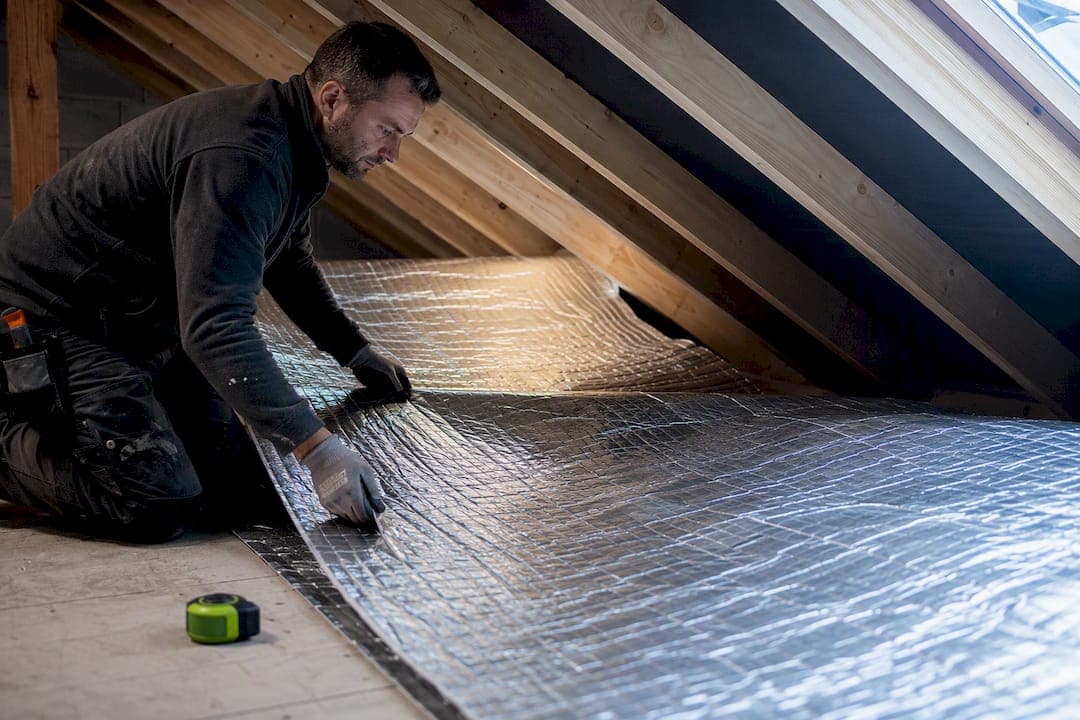
Foil insulation under rafters works best as a thin, reflective add on to bulk insulation, not as a standalone fix, and it only performs when installed with a proper air gap. For most DIY projects, the strongest options are the under rafter insulation kit from multifoil-insulation.com, the EcoPro under rafter kit sold via multifoilsdirect, and SuperFOIL as a well established brand. If you are unsure whether your roof will hit current targets, get a U-value check before you buy.
TL;DR:
- Foil insulation under rafters must be paired with bulk insulation and installed with a proper air gap to be effective.
- Most DIY kits include foil rolls, staples, tape, and installation guides, with some offering video support to simplify the process.
- Correct installation requires overlapping seams, sealing with foil tape, and maintaining ventilation and clearance around chimneys and downlights.
- Foil insulation alone usually cannot meet building regulation U-values and should be combined with mineral wool or PIR insulation.
- Calling a specialist is recommended if the property is listed, shows condensation issues, or involves complex roof structures.
Table of Contents
- What is foil insulation under rafters and what's in the kit?
- How do the main under-rafter foil kits compare?
- How do you choose the right foil kit for your rafters?
- How do you install foil insulation under rafters?
- What do Building Regulations say about insulating at rafter level?
- Where does foil insulation fall short, and what goes wrong?
- When should you call in a specialist instead of DIY?
- Book a professional inspection with Sprayfoamremovalhelp
- Why multifoil gets oversold, and what actually matters
- Sources
- FAQ
What is foil insulation under rafters and what's in the kit?
Foil insulation under rafters, more accurately called multifoil or reflective foil insulation, is a multi layer product made of thin aluminium foil sandwiched around layers of foam or wadding. Installers staple it directly to the underside of the rafters, on top of any insulation already fitted between them, to reduce radiant heat loss through the roof.
The "foil insulation under rafters" phrase is what most homeowners search, but manufacturers and building control officers call it multifoil or reflective roof insulation. Both terms describe the same product, and this article uses them interchangeably.
A typical kit includes:
- A roll or rolls of multifoil, usually 1.5 metres wide
- Galvanised staples or a compatible staple gun cartridge
- Aluminium foil tape for sealing seams
- An installation guide, and increasingly a supplier how-to video
- Sometimes counter battens, though these are often bought separately
EcoQuilt Expert, sold as the core product inside the EcoPro under rafter kit, is a good example of how these kits are packaged: the foil itself, tape, and a printed guide, with battens and staples as optional extras depending on the kit size you choose.
How do the main under-rafter foil kits compare?
Before choosing a kit, check what the supplier actually states about installed thickness and air gap requirements. Below is how the main options stack up on the details that matter for a DIY buyer.
| Kit | Best for | Kit sizes / coverage | Installed thickness / battens | DIY difficulty | UK availability / price band |
|---|---|---|---|---|---|
| Under rafter insulation kit (multifoil-insulation.com) | DIY homeowners wanting a thin, reflective layer with clear guidance | Sold by roll and multi roll packs, various roof areas | Thin foil layer, air gap and battens usually required either side | Moderate, staple gun and basic tools | Widely available online, mid price band |
| EcoPro under rafter kit (EcoQuilt Expert) | Homeowners who want step-by-step video support | Several kit sizes matched to typical loft areas | Similar thin profile, supplier documents battens and gap needs | Moderate, video guidance reduces guesswork | Available via multifoilsdirect, mid price band |
| SuperFOIL | Buyers comparing against a recognised brand name | Sold in rolls, coverage varies by product line | Multifoil layers, typically fitted with counter battens for the required gap | Moderate | Widely stocked through UK merchants, mid to upper price band |
| SuperQuilt | Homeowners wanting a well known multifoil for like for like comparison | Rolls sized for standard rafter spacings | Comparable thin profile with battened air gap | Moderate | Common at UK builders' merchants |
What each one gets right varies. The multifoil-insulation.com kit is straightforward if you want a no-frills staple-up job with a printed guide in the box. The EcoPro kit leans on video instruction, which helps if you have never handled a staple gun on a roof before. SuperFOIL and SuperQuilt both trade on brand recognition, which matters if you want a product your local building control officer has likely seen before.
Whichever kit you shortlist, check three things on the supplier's product page: the declared emissivity of the foil face, whether an installation video exists, and what installed thickness the U-value claim assumes. A kit that skips the last point is one you should question closely.
How do you choose the right foil kit for your rafters?
Picking a kit is less about brand and more about whether it suits your specific roof. Work through these points before you buy:
- Measure your rafter depth and note what insulation, if any, already sits between the rafters
- Decide your target U-value, since this determines whether foil alone will ever be enough
- Check you can maintain a continuous air gap from eaves to ridge without blocking soffit vents
- Confirm safe clearances around downlights, chimneys, and flue pipes
- Ask what certification the product carries, and whether the claimed performance has independent test backing
When you contact a supplier, ask directly whether their product holds British Board of Agrément (BBA) certification or an equivalent, what emissivity value they declare, and what installed thickness their U-value figure assumes. A vague answer to any of these is a warning sign.
Most standard semi-detached lofts need one to three kit rolls depending on roof area, and DIY kits are priced for exactly that scale of job. Anything larger, oddly shaped, or involving a loft conversion is worth getting a professional U-value calculation for, rather than guessing.
Pro Tip: Ask the supplier for their installed thickness assumption in writing before you buy. If they can't give you a number, assume the worst case: a compressed layer treated as having almost no insulating value once battened down.
How do you install foil insulation under rafters?
Getting the sequence right matters more with multifoil than with most insulation products, because a sagging, gapless, or poorly sealed install can undo most of the benefit.
- Gather your tools: a stable ladder or roof platform, gloves, eye protection, a heavy duty staple gun, foil tape, a tape measure, and counter battens if your kit needs them.
- Start at the ridge and work down towards the eaves, unrolling the foil with the reflective face pointing down into the room.
- Staple loosely enough to leave a slight sag between rafters. This preserves the air gap that the reflective surface depends on to work.
- Overlap each roll by the amount stated in your kit's guide, then seal every seam with foil tape so the reflective surface stays continuous.
- Fit counter battens if your kit specifies them, creating the cavity the U-value claim relies on.
- Fit baffles at the eaves to keep a clear, continuous ventilation path from soffit to ridge. Blocked vents are one of the most common causes of loft condensation.
- Leave clear space around downlights, chimneys, and flue pipes according to the manufacturer's fire clearance guidance. Call a qualified electrician if rewiring or moving fittings is involved.
Pro Tip: Keep the reflective face clean and free of dust before fitting it. A layer of dust or grime on the foil noticeably reduces its ability to reflect heat, which is one detail installers flag repeatedly.
What do Building Regulations say about insulating at rafter level?
Significant work to a roof, including adding insulation at rafter level, usually falls under Building Regulations and energy efficiency rules, so it is worth checking before you start rather than after.
England and Wales commonly reference a U-value target for refurbished pitched roofs, with Scotland typically expecting a lower value. Where that target genuinely cannot be met, a higher minimum threshold may apply instead, and building control still needs to be satisfied for major works.
Multifoil alone rarely reaches these figures. The British Board of Agrément's own guidance notes that compressed multifoil thickness is often treated as zero for calculation purposes unless the supplier provides tested evidence otherwise, which is exactly why most competent installers pair foil under rafters with PIR or mineral wool between them. If you are unsure where your roof stands, run the build up through a proper U-value calculator or ask Sprayfoamremovalhelp's guide to loft insulation regulations for the background before committing to a kit.
Where does foil insulation fall short, and what goes wrong?
Foil earns its place in a thin profile roof build up, particularly where rafter depth is too shallow for thick bulk insulation. It cuts radiant heat loss when there's a clear air gap beside the reflective face, and it adds relatively little weight or bulk compared with mineral wool.
The trade off is that it is not a substitute for bulk insulation on its own, and Historic England's guidance on insulating at rafter level is blunt about how much careful detailing this method demands. Performance drops fast if the foil is compressed, dusty, or fitted without the intended cavity.
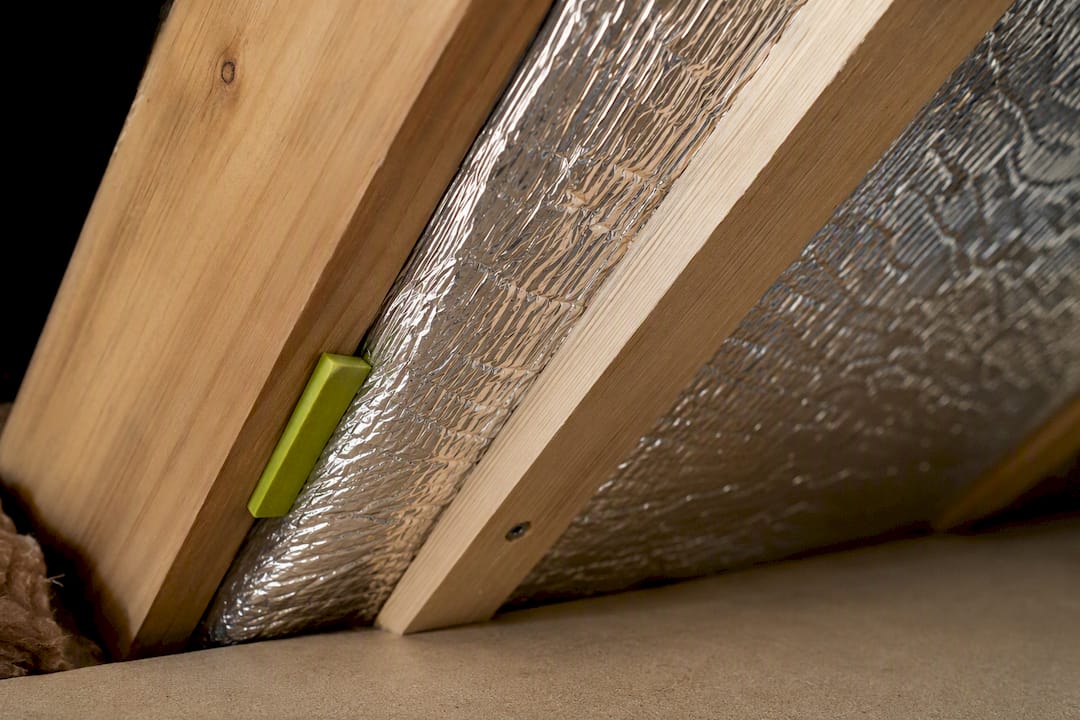
Condensation is the pitfall that catches most DIYers out. Sandwiching an impervious foil layer against another impervious surface, with no ventilation path between them, traps moisture where you can't see it. Keep vapour control on the warm side, maintain ventilation from eaves to ridge, and read Sprayfoamremovalhelp's note on multifoil condensation risk before you seal anything up permanently.
When should you call in a specialist instead of DIY?
Some jobs are genuinely beyond a weekend DIY project. Call a specialist if any of these apply to your roof:
- The property is listed or historic, where insulation choices carry extra planning and heritage constraints
- You already see signs of mould, damp staining, or condensation in the loft
- There's existing spray foam insulation that looks degraded, discoloured, or is affecting mortgage approval
- Ventilation or fire safety details around flues, chimneys, or downlights look complicated
A specialist company works with PCA-certified technicians, offering property assessments and mortgage-compliant certification alongside removal work, backed by an insurance-backed warranty. Before a contractor visits, Take photos of your roof void, sketch a rough plan of the rafters and any existing insulation, and have your target U-value and any BBA certificates from prospective kits ready to discuss.
Book a professional inspection with Sprayfoamremovalhelp
If your loft already has spray foam that's causing mortgage headaches, or you'd rather have a certified technician confirm your roof build up before you spend money on a DIY kit, that's a different job entirely and one you don't need to guess your way through.

The company deals directly with homeowners, estate agents, and landlords, with no middlemen and transparent pricing from the outset. Jobs are carried out by PCA-certified technicians and backed by an insurance-backed warranty, and the team has experience with closed and open cell spray foam removal, property assessments, and Superfoil installation. Booking a free inspection gets you a written assessment of your roof void, a clear recommendation on whether removal or a fresh insulation approach makes sense, and mortgage-compliant certification where it's needed. If you'd rather understand the removal process first, the spray foam removal guide walks through exactly what to expect.
Why multifoil gets oversold, and what actually matters
The multifoil industry has a marketing problem: kits are frequently pitched as a one-layer replacement for proper roof insulation, when the honest picture is closer to a useful supplement. That gap between promise and performance is where most DIYers end up disappointed, not because the product is dishonest, but because the installation convention behind the U-value claim gets lost between the product page and the loft ladder.
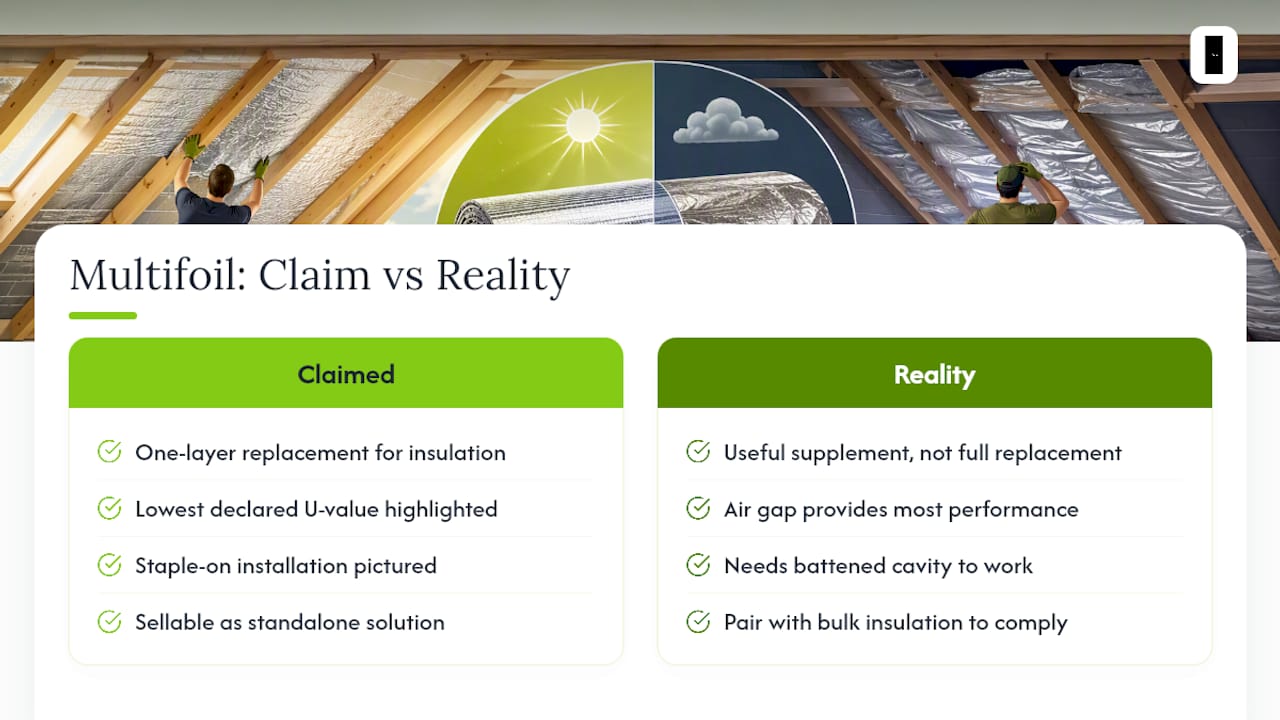
What's underappreciated is how much the air gap does the actual work. A perfectly good multifoil, stapled tight with no cavity behind it, performs closer to a vapour barrier than an insulator. The kits that build a proper battened gap into their instructions, and say so plainly, are worth more than ones chasing the lowest declared U-value on the box.
If you take one thing from the local authority guidance on multi-foil insulation, it's that regulation compliance almost always means pairing foil with bulk insulation, not choosing between them. Anyone selling multifoil as a standalone route to modern U-value targets is quietly setting you up to fail a building control check later.
— jessica
Sources
- Insulating pitched roofs at rafter level (Historic England)
- BBA datasheet: multifoil/reflective insulation guidance (British Board of Agrément)
FAQ
Can I insulate loft rafters with foil?
Yes, foil can be stapled to the underside of rafters as part of a roof insulation upgrade, but it should be paired with bulk insulation such as mineral wool or PIR to meet current U-value targets rather than used alone.
Do you need an air gap for foil insulation?
Yes, an air gap is essential. Multifoil only reflects radiant heat effectively when a clear cavity sits beside the reflective face, which is why counter battens are usually part of the installation.
What is the disadvantage of foil insulation?
Its main disadvantage is that it is not a substitute for bulk insulation on its own, and performance drops sharply if the foil is compressed, dusty, or installed without the required air gap.
Can you just lay insulation across rafters?
Laying bulk insulation loosely across rafters without maintaining ventilation paths or the correct air gap risks trapping moisture and reducing performance; foil in particular needs to be stapled with a slight sag and taped seams, not simply draped in place.