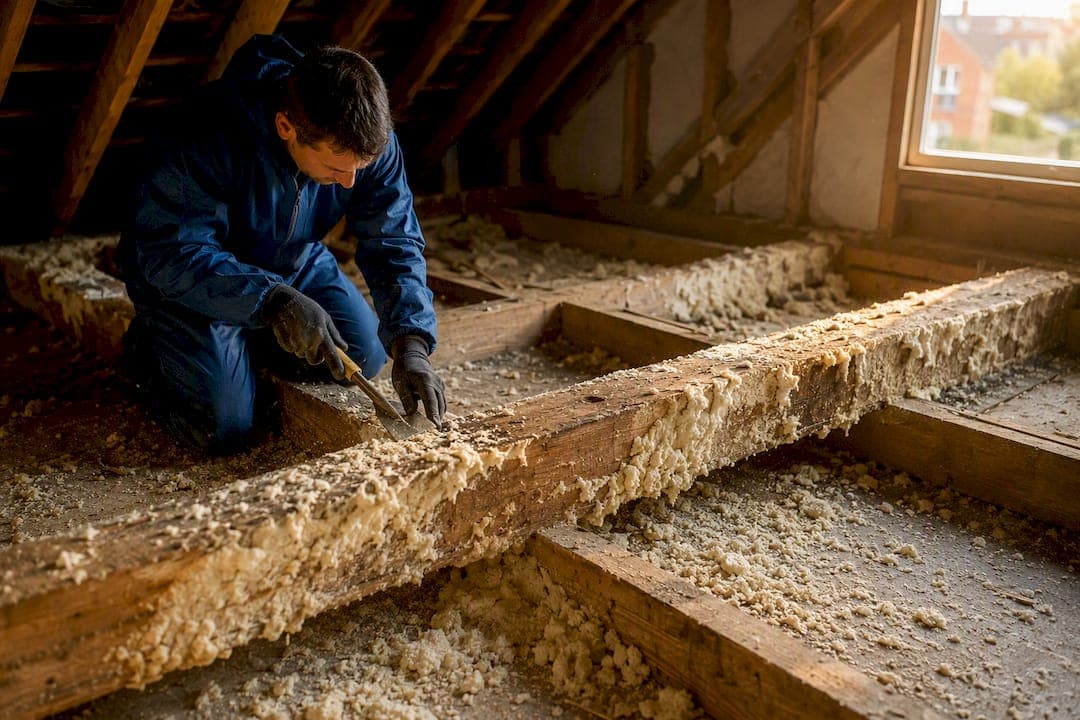
If a survey has flagged spray foam insulation in your loft, or a lender has already refused a mortgage on it, the answer is almost always yes: you need a professional inspection before you go any further. Removing spray foam insulation to a mortgage-compliant standard is the one route back to a clean valuation, and it is worth ruling out before you pay for anything else. RICS, the Property Care Association (PCA), and TrustMark all point the same way: get independent advice, separate from whoever installed the foam, before agreeing to any removal or remedial work.
- Book a pre-removal survey with an independent inspector, not the original installer
- Confirm foam type (open-cell or closed-cell) before asking for quotes
- Contact a certified specialist such as Revive Maintenance if removal looks likely
Key Takeaways
Mortgage-compliant spray foam removal depends on independent certification, mechanical removal methods, and documented proof that satisfies lenders rather than the contractor alone.
| Point | Details |
|---|---|
| Get an independent inspection first | Never rely on the original installer's opinion before deciding on removal. |
| Insist on mechanical removal only | Solvents, heat, or DIY methods won't produce a lender-accepted result. |
| Prioritise the certificate's source | A certificate needs independent, PCA or RICS-aligned sign-off to satisfy most lenders. |
| Budget realistically | Full removal typically costs £2,200 to £6,000 depending on property size and foam type. |
| Choose a specialist with proof points | Revive Maintenance offers PCA certification, a 10-year insurance-backed warranty, and over 1,000 completed jobs. |
This article is general information, not a substitute for advice from a qualified financial advisor. Consult a qualified financial professional about your own circumstances before acting on anything here.
Table of Contents
- Does your spray foam actually need removing?
- What does the removal and certification process involve?
- How do you choose the right removal specialist?
- What does removal cost and how long does it take?
- What paperwork does a lender actually want to see?
- Where can spray foam not be removed or installed?
- How should you prepare before the inspection?
- Why lender-first thinking beats cosmetic fixes
- How Revive Maintenance handles removal and certification
- Sources
- FAQ
Does your spray foam actually need removing?
Not every loft with spray foam is a mortgage dead end, but several signs mean you should stop weighing it up and get someone qualified to look. Lenders have a documented habit of refusing mortgages outright on spray-foamed properties, and the House of Commons Library's briefing confirms there is currently no government financial assistance for removal, so the cost sits with the homeowner either way.
Watch for these red flags:
- Visible damp staining or a musty smell in the roof space
- Soft, spongy, or discoloured rafters and joists under the foam
- Blocked or covered ventilation vents, soffits, or eaves gaps
- A survey report that specifically flags spray foam as a mortgage barrier
- No installation certificate, guarantee, or manufacturer paperwork on file
Run through a quick decision path: inspect the loft, confirm the foam type and thickness, check what paperwork exists, then bring in an independent surveyor. From there, it is either targeted remediation or full removal, and that decision should never be made by the person who fitted the foam.
What does the removal and certification process involve?
A lender-compliant job follows a set sequence, and knowing it helps you judge whether a quote is doing the whole task or just part of it. This is the workflow Revive Maintenance and other specialist contractors follow for jobs that need to survive a mortgage valuation:
- Pre-removal survey to confirm foam type, coverage, and any visible timber damage
- Risk assessment and containment, sealing off the work area to control dust and debris
- Mechanical removal, cutting, scraping, and brushing the foam away by hand
- Timber inspection, checking every rafter and joist the foam was covering
- Remedial work, where needed, replacing or treating damaged timber
- Waste disposal, following standard construction waste regulations
- Independent post-removal certificate, issued separately from the removal contractor
Removal has to be mechanical. Solvents, heat guns, and DIY shortcuts do not fully strip the foam and will not satisfy a surveyor's checklist, which means the mortgage problem stays unresolved even after you have spent the money.
Pro Tip: Keep dated photographs of the loft before, during, and after the work, alongside any manufacturer paperwork and the final certificate. Surveyors and mortgage lenders move faster when the evidence trail is complete.
How do you choose the right removal specialist?
Picking a contractor for this job is not the same as picking a general builder. The certificate they help you obtain is the entire point of the exercise, so the credentials behind it matter more than the price on the quote.
Look for:
- PCA membership or equivalent trade accreditation
- Access to an independent RICS-aligned surveyor for the post-removal certificate
- Public liability, employer's liability, and professional indemnity insurance
- A 10-year insurance-backed warranty on completed work
- A genuine track record, ideally 1,000 or more completed jobs
- Prior experience with lender acceptance, not just removal itself
Ask direct questions before booking: how many removals have they completed in the last 12 months? Who actually issues the certificate, and can they show sample wording? What happens to the waste foam? What are their insurance limits? A specialist confident in their process will answer all of this without hesitation, as Revive Maintenance's own contractor guidance sets out.
Reject anyone who quotes over the phone without seeing the loft, who offers to write their own certificate with no independent sign-off, or whose price sits well below everyone else's. A cheap removal that a lender still won't accept has cost you twice.
What does removal cost and how long does it take?
Costs vary mainly by property size and foam type, and 2026 market estimates put a typical three-bedroom home's full removal somewhere between £2,200 and £6,000. Open-cell foam is generally quicker and cheaper to strip out than closed-cell foam, which bonds more tightly to timber and takes longer to remove cleanly.
| Property type | Typical cost range | Removal time |
|---|---|---|
| Mid-terrace | Lower end of range | 1 to 2 days |
| Semi-detached | Mid range | 2 to 3 days |
| Detached / bungalow | Mid to upper range | 3 to 4 days |
| Listed or large property | Upper end, case by case | 4 days or more |
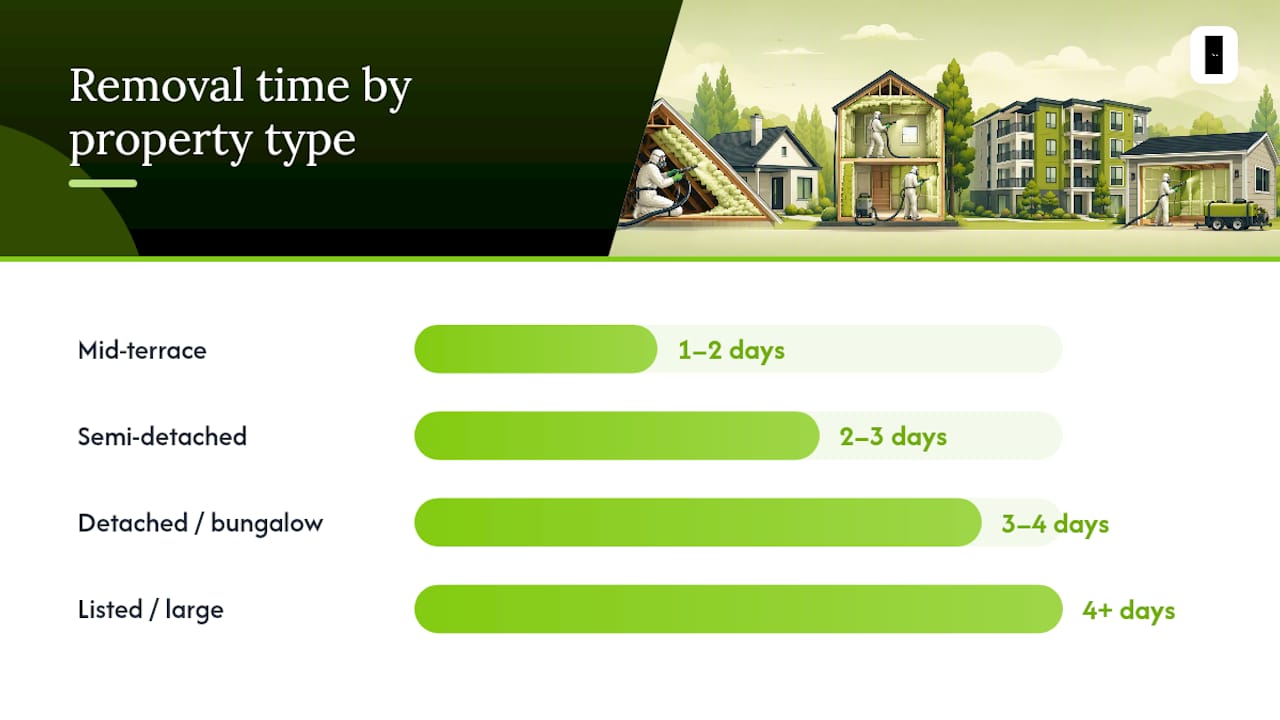
Timber remediation and the independent inspection typically add extra days on top of the removal itself. Before accepting a quote, check it explicitly includes: a pre-survey, full mechanical removal, timber inspection, photographic evidence, the independent certificate, and waste disposal. Missing any one of those items usually means a second invoice later.
What paperwork does a lender actually want to see?
Mortgage valuers are not being difficult when they ask for documentation. Spray foam's ability to trap moisture and hide timber defects is exactly why RICS built a dedicated consumer guide around it, and lenders now routinely request specific evidence before they'll lend or remortgage.
The Commons Library's research briefing found lenders have refused mortgages on properties with spray foam present, while confirming the government currently offers no direct financial help towards removal costs.
Documents worth having ready:
- The independent post-removal certificate
- A timber inspection report confirming no remaining damage
- Moisture readings alongside labelled before and after photographs
- Original installation paperwork, or manufacturer/BBA documentation if it still exists
If a mortgage application stalls, the action plan is straightforward: commission an independent survey, get the removal certificate, then ask the lender or broker to request an updated valuation. Where the original installer is disputing responsibility, TrustMark and Trading Standards are the right escalation points, not a second opinion from the same firm.
Where can spray foam not be removed or installed?
Some properties carry constraints that change the entire approach, and it pays to know them before work starts, not after a planning enforcement letter arrives.
- Do get independent advice before any removal or remedial work begins
- Do not accept cold-call offers or unsolicited "free inspection" visits, a tactic RICS and Trading Standards both warn against repeatedly
- Do not install spray foam in a listed or protected building without prior consent, since the material is often effectively irreversible once fitted
- Do insist on proper PPE and dust containment during removal, since disturbed foam particles are not something to breathe in
- Do not attempt DIY removal with solvents or heat, which is both unsafe and unlikely to satisfy a lender
Listed status changes everything about what's permissible, which is part of why RICS treats consent as a precondition rather than a formality on older or protected housing stock.
How should you prepare before the inspection?
A little preparation before the surveyor or removal team arrives keeps the day running smoothly and the paperwork clean.
- Gather any installation certificates, guarantees, or manufacturer documents you still hold
- Clear loft access and remove stored items blocking the hatch
- Secure pets away from the work area for the day
- Protect furniture and flooring on the route to the loft
- Have a list of on-site contacts ready, including anyone who needs to grant access
Surveyors will also want any previous inspection notes and photographs to hand, and if electrical isolation is needed near the loft space, arrange that in advance rather than on the day.
Why lender-first thinking beats cosmetic fixes
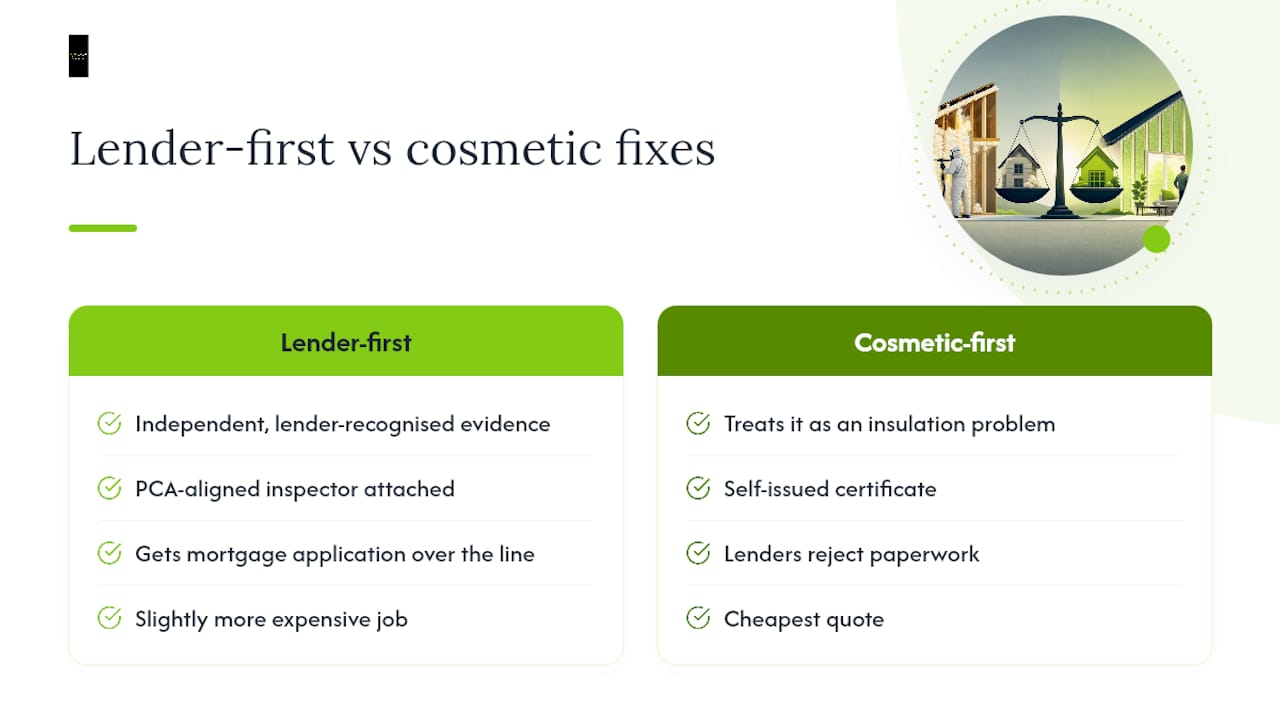
The conventional advice on spray foam removal still treats it as an insulation problem, when for most homeowners today it has become a paperwork problem. The foam itself might be performing perfectly well thermally. What actually blocks a sale or remortgage is the absence of independent, lender-recognised evidence that it has gone and the timber underneath is sound.
That reframing changes what "good work" looks like. A contractor who strips the loft beautifully but hands you a self-issued certificate has solved the wrong problem. Homeowners and estate agents alike underestimate how often lenders reject paperwork not because the removal was poor, but because the sign-off wasn't independent enough to trust.
My honest read: prioritise the certificate's credibility over the removal price every time. A slightly more expensive job with a PCA-aligned inspector attached to the certificate will get a mortgage application over the line faster than the cheapest quote in your inbox. That's the whole game here, not the foam.
How Revive Maintenance handles removal and certification
Sprayfoamremovalhelp works with Revive Maintenance, whose PCA-certified technicians run the full process end to end across London and the South East, with no subcontractors and no middlemen between you and the people doing the work. That direct model means transparent, itemised pricing from the first quote, not a figure that grows once the loft hatch is open.

The service covers the parts that actually satisfy lenders: a pre-removal survey, full mechanical removal of open-cell and closed-cell foam, independent timber inspection, and a post-removal certificate built to be accepted by mainstream mortgage lenders. Every job carries a 10-year insurance-backed warranty, and the team has now completed more than 1,000 jobs across the region, with PCA membership and RICS-aligned certification behind every one of them.
If a survey has already flagged spray foam, or you're stuck mid-remortgage waiting on paperwork, book a free inspection or start with the spray foam removal guide to see exactly what your property needs before committing to a contractor.
Sources
- Spray foam insulation
- Spray foam insulation and mortgages - House of Commons Library
- Removing Spray Foam Insulation: UK Homeowner Guide 2026
- How to Choose a Spray Foam Removal Company: A UK Homeowners Guide 2026
FAQ
Can I sell my house with spray foam insulation still in place?
It's possible but often difficult, since many mortgage lenders decline to lend on properties with spray foam present until an independent removal certificate is provided.
How long does mortgage-compliant removal take?
A mid-terrace property typically takes one to two days, while detached homes or those needing timber remediation can take four days or longer.
Does the government offer grants for spray foam removal?
No. The House of Commons Library confirms there is currently no direct government financial assistance for spray foam removal costs.
Who should issue my post-removal certificate?
An independent, PCA or RICS-aligned inspector separate from the removal contractor, since lenders generally will not accept a certificate the same company both removed the foam and self-certified.
Is DIY spray foam removal ever acceptable to lenders?
No. Lenders and specialist guidance both require full mechanical removal carried out by a qualified contractor, since solvents, heat, or DIY methods rarely satisfy a post-removal inspection.