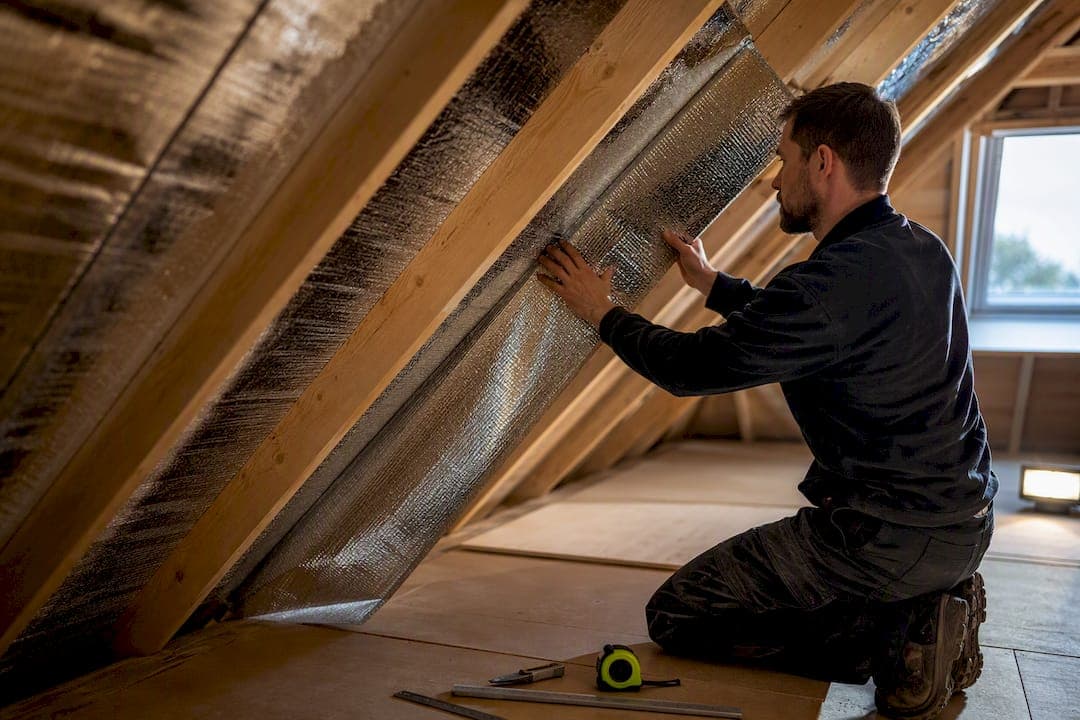
Multifoil works well in most roof retrofits, but only when it's fitted as a complete, tested assembly rather than a quick fix. It suits space-constrained rafter cavities better than most bulk insulation, provided the installer works to BR443-based U-value calculations, keeps the specified air gaps, and can produce BBA or Agrément evidence. Skip any of that, and you risk a roof that fails building control or worse, traps moisture in your rafters.
TL;DR:
- Multifoil insulation is effective only when installed as a complete, tested assembly with proper air gaps, fixings, and documented U-value calculations based on BR443.
- Its performance can be significantly reduced if compressed under battens or installed without maintaining the specified air cavities, especially in shallow rafters.
- BR443’s 30/70 ballooning convention prevents unrealistically optimistic U-value claims, emphasizing the importance of independent testing and proper calculations.
- Installation quality, including sealing joints and maintaining air gaps, is critical to prevent moisture buildup and condensation risks in older roofs.
- Proper surveys and documented evidence from BBA, Agrément, or ETA are essential for compliance and avoiding issues with building control.
Table of Contents
- What is multifoil insulation and how does it work in a roof?
- How does BR443 change the U-value maths for multifoil?
- What are the installation requirements for multifoil at rafter level?
- Will multifoil cause condensation problems in an older roof?
- Is multifoil better than PIR or mineral wool for a retrofit?
- What paperwork should building control expect for a multifoil roof?
- What goes wrong in practice, and when do you need a specialist?
- When multifoil earns its place in your retrofit
- Getting a survey or removal quote sorted before you insulate
- Sources
- FAQ
What is multifoil insulation and how does it work in a roof?
Multifoil is not one product. It's a family of insulation types built from multiple layers of reflective foil sandwiched around a core of wadding, foam, or bubble film, usually ranging from 10 to 30 layers depending on the manufacturer.
The reflective surfaces reduce radiant heat loss, while the trapped air between layers slows conductive transfer. This only works if those air gaps stay intact once the product is installed.
- Wadding-core multifoils use a fibrous filling between foil layers for slightly better bulk insulation alongside the reflective effect.
- Bubble-core multifoils use thin plastic bubble film, which is lighter but compresses more easily under fixings.
- Compressed thickness matters more than quoted thickness because battens and counter-battens squeeze the product, shrinking the cavities that make it work.
A multifoil that measures 40mm on the shelf might perform closer to a much thinner layer once compressed under battens, which is exactly why manufacturer claims need checking against independent test data rather than taken at face value.
How does BR443 change the U-value maths for multifoil?

BR443, the BRE's official convention for U-value calculations, treats multifoil differently from mineral wool or PIR boards. Rather than assigning it a simple thickness and thermal conductivity, BR443's 2019 edition splits the product notionally into three layers, with 30% of its thickness assumed to balloon into the rafter cavity and 70% into the batten or plasterboard void.
That split materially changes the numbers a calculation spits out, and it's why two installers quoting the same product can arrive at different U-values.
- The 30/70 ballooning convention exists specifically to stop unrealistically generous readings creeping into compliance paperwork.
- Hot-box testing and BBA-issued datasheets remain the benchmark; in-situ comparative claims from manufacturers carry far less weight with building control.
- Multifoil alone rarely meets typical U-value targets commonly set for rafter-level warm roofs when rafter depth is shallow, which is often the case in older UK roofs.
- It earns its keep as a thin, space-saving layer rather than a standalone solution in those cases.
Ask any installer for a BR443-compliant U-value calculation before signing off, not just a manufacturer brochure figure.
What are the installation requirements for multifoil at rafter level?
Getting multifoil to perform as designed comes down to workmanship, not the product spec sheet. The BBA datasheet sets out dimensional conventions for exactly this reason: air cavities either side of the foil are what make it work, and they're the first thing lost to sloppy fixing.
- Fix with continuous counter-battens rather than intermittent clips, maintaining the air gap specified on the product's certificate on both faces.
- Keep joints taped and overlapped as instructed. A gap in the foil is a gap in performance, full stop.
- Check the compressed thickness against the manufacturer's stated figure once battens are in place, not before.
- Where an AVCL (airtight vapour control layer) is specified, confirm it's continuous and sealed at penetrations before boarding.
Pro Tip: Take photos of the cavity depths and taped joints before the plasterboard goes up. If building control or a future buyer's surveyor ever questions the installation, that record is worth more than any brochure.
Limited rafter depth is the most common retrofit headache. Rather than compressing multifoil hard against the rafters to squeeze in a bit extra, most competent installers add counter-battens to preserve the cavity properly, even if that means losing a few extra millimetres of headroom.

Will multifoil cause condensation problems in an older roof?
Insulating at rafter level changes how a roof breathes, and that's where things go wrong if nobody thinks it through. BS 5250 and government retrofit guidance are unambiguous: any warm roof build-up needs a clear moisture strategy, not just a thermal one.
- An air barrier or AVCL on the warm side of the insulation stops warm, moist internal air reaching cold surfaces where it condenses.
- Low-resistance (vapour-open) underlays generally cope better with occasional moisture drive than high-resistance felt, which needs a ventilated void to release trapped vapour.
- Sealed detailing at eaves, ridges, and penetrations matters as much as the insulation itself. Modelling of insulated timber roofs shows ventilation and air barrier placement significantly affect decay risk in the rafters.
- Watch for warning signs on older roofs before you insulate: blocked soffit vents, black mould on sarking felt, or a previous spray foam job hiding damp timber underneath.
If any of those signs are present, get a proper survey before adding another insulation layer. Check installer certificates carefully for condensation risk before signing off on the job.
Is multifoil better than PIR or mineral wool for a retrofit?
Neither wins outright. Multifoil earns its place through what it saves you, not necessarily through raw thermal performance per millimetre.
Where it genuinely helps:
- Thin profile suits shallow rafters where PIR boards simply won't fit without losing headroom.
- Straightforward to fit around cables, pipes, and other services without cutting rigid boards.
- Reversible in a way that sprayed foam never is, which matters if you might alter the roof again.
Where it falls short:
- Performance depends entirely on the assembled cavities being correct. Get the installation wrong and you lose most of the benefit.
- Building control wants BBA, Agrément, or ETA evidence behind the claimed figures, not marketing thickness alone.
- Rarely meets rafter-level targets unaided on older, shallower roofs.
The practical rule of thumb: treat multifoil as a supplementary layer where depth is tight, then pair it with a thin run of PIR or mineral wool where the calculation still falls short of target. Ask yourself one question before committing: does the installer's own paperwork show a BR443 figure that actually meets 0.18 W/m²K, or does it just look impressive on the box?
What paperwork should building control expect for a multifoil roof?
Building control officers see plenty of multifoil claims that don't survive scrutiny, which is precisely why LABC's technical guidance tells inspectors to lean on recognised test evidence over manufacturer assertions.
- A BR443-based U-value calculation for the specific assembly, including rafter depth, batten depth, and the 30/70 ballooning convention.
- BBA certificates, Agrément approval, or ETA documentation confirming the tested performance of the exact product specified.
- An installation method statement showing fixing centres, cavity depths, and how the moisture strategy is being handled.
- Evidence of installer competency, since LABC guidance flags workmanship as the biggest variable in whether the claimed figures hold up.
If building control queries the numbers, the honest next step is commissioning a proper Retrofit Coordinator or approved inspector review rather than arguing the manufacturer's brochure figures. On listed or unusual older roofs, Historic England's guidance on rafter-level insulation is worth a look too, since standard assemblies don't always apply.
What goes wrong in practice, and when do you need a specialist?
Plenty of the roofs we get called out to weren't badly designed on paper. They went wrong because of what was hiding underneath: legacy spray foam sprayed directly onto sarking felt years ago, damp timber nobody noticed until the ceiling started staining, or a multifoil job installed with no air gap at all.
- Legacy spray foam often needs removing before any new insulation strategy makes sense, since it can trap moisture against rafters and mask timber decay.
- Non-compliant historic installations sometimes fail a mortgage survey outright, which stalls a sale or remortgage until sorted.
- A proper professional survey should include photos or a drone report, a clear written quote with no hidden extras, and ideally a warranty backing the work.
Specialist technicians carry out certified and mortgage-compliant spray foam removal directly, without middlemen, and back jobs with a 10-year insurance-backed warranty, providing service to many satisfied homeowners. If your roof involves old spray foam or a survey has flagged concerns, that's when a specialist beats DIY every time.
When multifoil earns its place in your retrofit
Multifoil suits homeowners fighting shallow rafters or awkward roof pitches where every millimetre counts. If your roof has generous depth, bulk insulation usually gets you to target for less hassle and lower risk. Whichever route you choose, ask for the BR443 calculation, check the certificates, and get a survey done if anything about the existing roof looks off.
— jessica
Getting a survey or removal quote sorted before you insulate
Sprayfoamremovalhelp offers expert assistance for complex roof retrofit cases involving legacy spray foam, hidden damp, or previous installation issues, providing direct communication, transparent quotes, and written reports for building control or mortgage surveyors.

If you're not sure what's under your existing insulation, start with a Full Roof Report with photos, from £200, or a drone survey and report from £250 for harder-to-reach roofs. Where legacy spray foam turns up, removal costs typically run between £1,000 and £7,000 depending on cell type and access, all backed by our 10-year insurance-backed warranty. Book a survey today and get a clear, fixed quote before you commit to any retrofit insulation.
Sources
- New Part L convention makes U-value calculations clearer for users
- LABC technical guidance note: Use of multi-foil insulation
- Reflective foil insulation – Conventions for U value calculations (BBA datasheet)
- Retrofit room-in-roof insulation: best practice
FAQ
Is multifoil better than PIR for roof retrofits?
Neither is universally better; multifoil suits shallow rafters where boards won't fit, while PIR generally reaches target U-values in less depth on its own. Many retrofits combine a thin multifoil layer with a slim run of PIR or mineral wool to hit BR443-compliant targets without losing headroom.
Does multifoil need an air gap to work properly?
Yes. Multifoil relies on maintained air cavities on one or both faces to achieve its reflective and insulating effect, as set out in the BBA datasheet conventions. Compressing it flat against rafters or battens without that gap significantly cuts its real-world performance.
What are the disadvantages of foil insulation?
Performance is highly dependent on correct installation, meaning a poorly fitted job can fall well short of manufacturer claims. Building control also generally requires BBA, Agrément or hot-box test evidence rather than accepting brochure figures alone, and multifoil alone rarely meets rafter-level U-value targets on shallower older roofs.
Is multifoil insulation any good for older roofs?
It can work well as a space-saving layer in older roofs with limited rafter depth, provided the assembly is correctly detailed with air gaps and a moisture strategy. Where a roof shows signs of damp, blocked ventilation, or legacy spray foam, get it surveyed first. Sprayfoamremovalhelp offers roof reports and drone surveys to check the existing build-up before any new insulation goes in.
How much does removing old spray foam before a retrofit cost?
Spray foam removal typically costs between £1,000 and £7,000, depending on whether it's open or closed cell and how accessible the roof is. Getting a written quote after a survey avoids surprises once work starts.