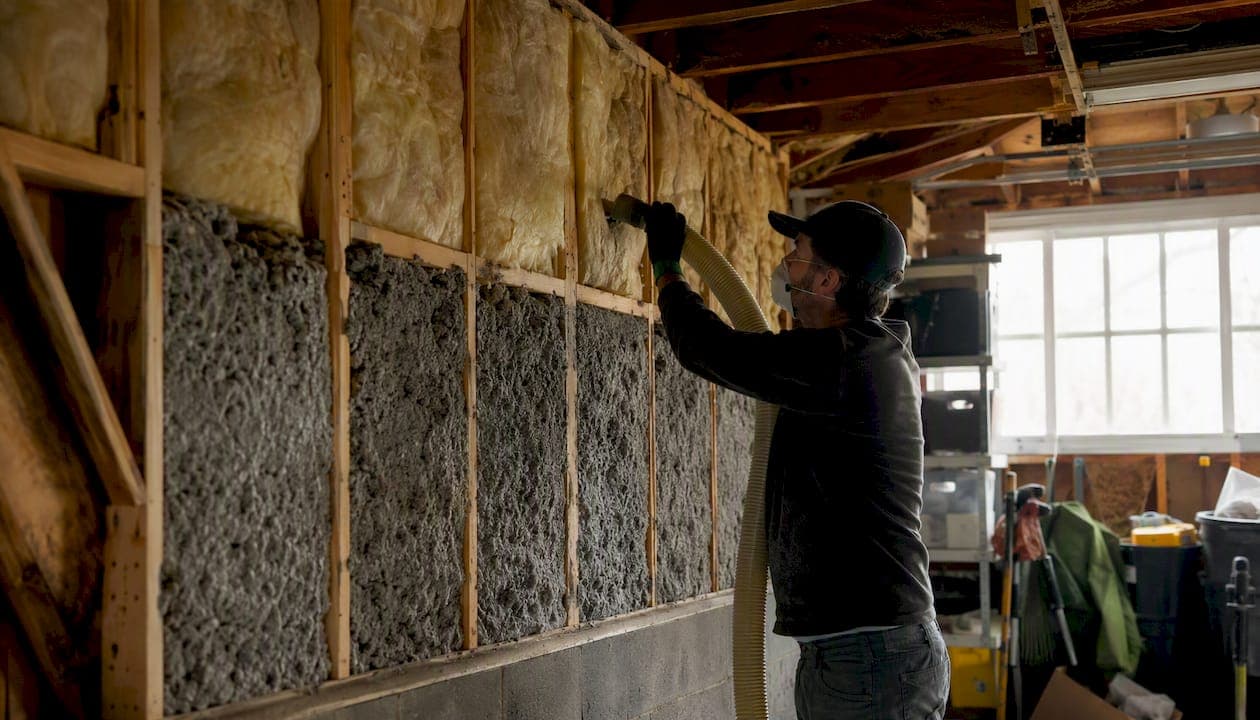
For most UK loft top-ups where you want a quick, affordable DIY fix, fibreglass batts are the practical choice. For irregular lofts, timber frames, or any retrofit where airtightness genuinely matters, blown cellulose tends to outperform because it fills gaps that batts simply cannot reach.
Here is a quick verdict by common scenario:
- Eco-minded homeowners: Cellulose wins on recycled content (typically 75–85% recycled fibre) and lower embodied carbon.
- Tight budget, simple rectangular loft: Fibreglass quilts from a builders' merchant are the most cost-effective option and straightforward to lay yourself.
- Irregular or complex loft spaces: Blown cellulose fills awkward voids and around joists far more completely than pre-cut batts.
- Moisture-prone or older breathable buildings: Fibreglass dries faster after a leak; cellulose buffers humidity well but is vulnerable to persistent liquid water.
- Cavity fills or dense-pack timber frames: Both materials need specialist blowing equipment; call a certified installer rather than attempting DIY.
- Sound attenuation is a priority: Neither is a dedicated acoustic product; consider acoustic mineral wool for party walls or between floors.
Practical immediate recommendation: For blown cellulose in cavities or complex lofts, always use a professional with a PAS 2030 competency. For a simple loft top-up with fibreglass batts, confident DIY is realistic with the right PPE.
Table of Contents
- Quick side-by-side comparison: cellulose vs fibreglass at a glance
- How do cellulose and fibreglass compare on thermal performance?
- Does installation method affect draught control and airtightness?
- Fire performance and safety: what you need to know
- Moisture, mould, pests and long-term durability
- Sustainability: how do the two materials compare on environmental impact?
- Installation methods, equipment and DIY practicality
- Which material suits which part of your home?
- How to tell if your existing insulation is cellulose or fibreglass
- When should you get a professional assessment or installer?
- A short decision checklist for UK homeowners comparing quotes
- Is spray foam already in your roof space? Here is what to do
- Key takeaways
- The practical trade-off most homeowners miss
- Useful sources and further reading
- FAQ
Quick side-by-side comparison: cellulose vs fibreglass at a glance
| Dimension | Cellulose | Fibreglass (glass wool) |
|---|---|---|
| Thermal (λ value) | ≈0.039–0.042 W/mK | ≈0.032–0.044 W/mK (grade-dependent) |
| Air sealing | Excellent when blown; fills gaps and voids | Good in open lofts; gaps at edges and around joists with batts |
| Fire safety | Borate-treated; meets BS 476 class requirements | Inherently non-combustible; no treatment needed |
| Moisture behaviour | Buffers humidity; vulnerable to liquid water saturation | Inorganic; dries faster after leaks; needs correct VCL |
| Acoustic performance | Moderate; density helps with sound absorption | Moderate; similar to cellulose at comparable density |
| Installation / DIY | Blown: professional with specialist equipment | Batts/rolls: realistic DIY with PPE |
| Typical installed cost | Higher (specialist equipment and labour) | Lower (widely available; DIY possible) |
| Environmental impact | 75–85% recycled content; lower embodied carbon | Virgin glass fibre; higher embodied carbon |
| Best applications | Irregular lofts, timber frames, dense-pack cavities | Simple loft top-ups, rafter fills, DIY projects |
Note: performance in any application depends heavily on installation quality, correct depth, and airtightness detailing — not just the material's laboratory λ value.
How do cellulose and fibreglass compare on thermal performance?
The λ value (thermal conductivity) tells you how well a material resists heat flow per millimetre of thickness. Lower is better. In practice, the difference between cellulose and fibreglass is smaller than many homeowners expect.
| Material | Typical λ range (W/mK) | Depth needed for ≈0.16 W/m²K loft U-value |
|---|---|---|
| Blown cellulose | 0.038–0.042 | 270–300 mm |
| Standard glass wool quilt | 0.038–0.044 | 270–300 mm |
| High-performance glass wool | ≈0.032 | ≈200 mm |
Blown cellulose and blown mineral wool require similar depths of approximately 270–300 mm to meet common loft U-value targets, which aligns with the conventions referenced in Building Regulations Part L (Approved Document L1B for existing dwellings). A 0.16 W/m²K ceiling U-value is a commonly cited retrofit target; your specific property may require a SAP calculation to confirm the right specification.
What matters more than the λ number on the datasheet is what happens during installation. Fibreglass batts compressed into a space lose thermal resistance because compression reduces the air pockets that do the insulating work. A batt rated at 0.040 W/mK at its design thickness performs noticeably worse if it is squashed by 20%. Blown cellulose does not compress in the same way during installation, but it can settle by a small percentage over time, which is why a professional installer should account for settling depth when specifying the job.
Cold bridging through timber joists is another real-world factor. Neither material eliminates bridging through the structural elements, but a blown product that fully surrounds joists reduces the bridge effect compared to batts laid between them.
Does installation method affect draught control and airtightness?
Yes, significantly. Airtightness is often the single biggest gap between laboratory performance and what you actually feel in a cold house in January.
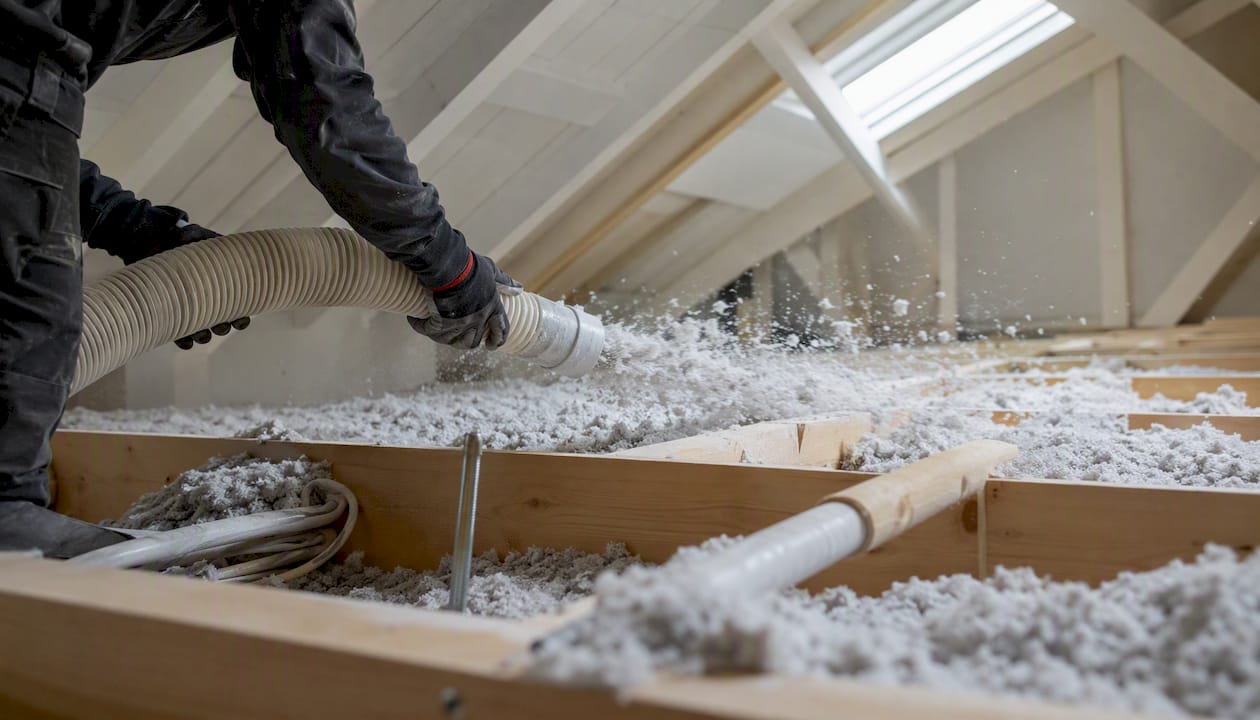
Fibreglass batts in a loft floor sit between joists but rarely seal perfectly at the edges, around pipes, or at the eaves. Air can circulate through and around the material, creating convective loops that carry heat out of the building even when the insulation depth looks correct on paper.
A cellulose-filled loft tends to produce lower air permeability readings than batt installations because the blown material fills gaps that batts simply cannot reach. This is particularly valuable in older UK homes where loft floors are irregular, joists are not evenly spaced, and there are penetrations for pipes, cables, and hatches.
Practical checks to request on any insulation quote:
- Ask for a depth gauge record confirming installed depth at multiple points across the loft.
- Request an installation certificate (required for ECO4 and GBIS-funded works).
- For a major retrofit, ask whether a blower door test is included or available as an add-on.
- Check that the loft hatch is insulated and draught-stripped as part of the job.
Pro Tip: Pair any new loft insulation with a draught-proofing check of the loft hatch, ceiling penetrations, and any gaps around pipes or cables before the insulation goes in. Sealing those gaps first costs very little and measurably improves the real-world performance of whichever material you choose.
Fire performance and safety: what you need to know
Fibreglass has a clear advantage here on paper: it is inherently non-combustible because it is made from inorganic glass fibres. It will not ignite, does not contribute fuel to a fire, and does not require any chemical treatment to meet fire performance requirements.
Cellulose is a different story. Paper-based materials are combustible by nature, which is why borate treatment is not optional but a fundamental part of every cellulose insulation product sold for building use. When correctly treated and installed, cellulose meets the fire performance requirements set out in British Standards, including BS 476 classifications for spread of flame and fire propagation. BBA (British Board of Agrément) certification and manufacturer datasheets will confirm the specific fire classification for any product you are quoted.
Borate-treated cellulose, when installed correctly and kept dry, meets the same practical fire safety requirements as standard fibreglass for loft and wall applications. The key phrase is "kept dry" — waterlogged cellulose can lose some of its borate concentration over time if exposed to persistent liquid water.
Practical safety points for loft work, regardless of material:
- Keep insulation at least 75 mm clear of recessed downlights unless they are fire-rated and insulation-compatible (IC-rated) fittings.
- Never cover eaves ventilation with insulation; blocked ventilation causes condensation and accelerates timber decay.
- Ensure contractors provide a product datasheet confirming fire classification before work begins.
- For fibreglass, wear FFP2 dust mask, goggles, and gloves throughout installation.
- For cellulose, borate dust requires similar respiratory protection; follow the product safety data sheet.
Moisture, mould, pests and long-term durability
Neither material is immune to moisture problems, but they fail in different ways.
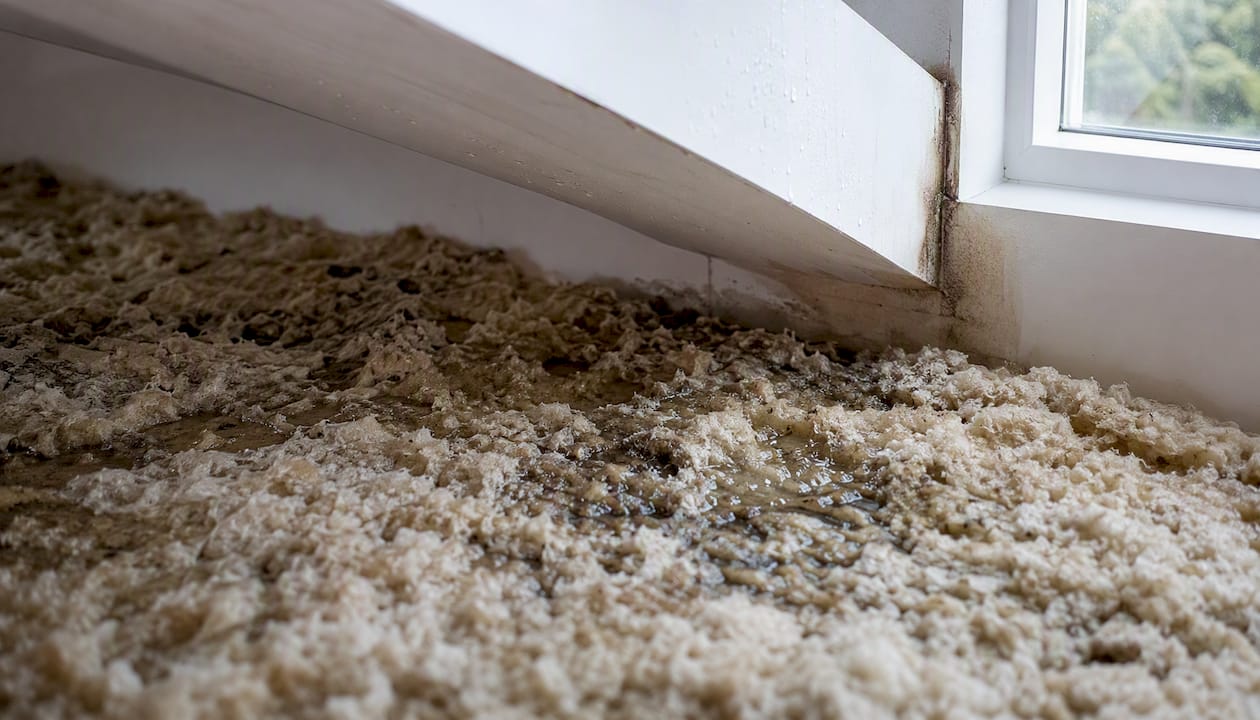
Cellulose is hygroscopic, meaning it absorbs and releases moisture vapour as humidity changes. In a well-ventilated loft, this buffering effect is benign and even slightly beneficial. The problem arises when liquid water enters, whether from a roof leak, a burst pipe, or condensation from an incorrectly specified vapour control layer. Saturated cellulose loses thermal performance, can compact under its own weight, and takes a long time to dry out. Borate treatment reduces mould and pest risk when the material stays dry, but borates do not speed up drying after a flood.
Fibreglass is inorganic and does not absorb water in the same way. After a roof leak, glass wool dries faster and does not compact permanently. However, fibreglass in a wall cavity still requires a correctly specified vapour control layer on the warm side of the insulation. Without it, warm moist air from inside the house can condense within the insulation layer, leading to hidden damp and timber decay over years.
Signs that your insulation needs a professional assessment:
- Visible staining, discolouration, or a musty smell when you open the loft hatch.
- Insulation that looks thin or patchy compared to when it was installed.
- Evidence of roof leaks, water marks on rafters, or damp patches on ceilings below.
- Pest activity (droppings, nesting material) within the insulation layer.
- Any insulation that has been in contact with spray foam that has since been removed.
If you find spray foam in your loft alongside existing insulation, that is a separate issue requiring specialist assessment. Sprayfoamremovalhelp offers free property inspections for homeowners who need to understand what is in their roof space before specifying new insulation.
Sustainability: how do the two materials compare on environmental impact?
This is where cellulose has the clearest advantage. Cellulose insulation is made from 75–85% recycled newspaper and cardboard, materials that would otherwise go to landfill or incineration. Its production energy is low compared to glass wool, which requires melting raw silica sand at high temperatures.
| Environmental factor | Cellulose | Fibreglass (glass wool) |
|---|---|---|
| Recycled content | 75–85% | Typically around 20% (some products higher) |
| Embodied carbon | Lower (low-energy production) | Higher (high-temperature manufacturing) |
| End-of-life | Compostable if uncontaminated; landfill otherwise | Not biodegradable; specialist recycling limited |
| Global Warming Potential | Lower | Higher |
BRE Green Guide ratings and Environmental Product Declarations (EPDs) from manufacturers provide the most reliable embodied carbon figures for specific products. When comparing quotes, ask each supplier for their product's EPD or BRE Green Guide rating if embodied carbon is a priority for you.
Key sustainability points:
- Cellulose's borate treatment is a mineral compound with low toxicity and does not significantly affect its end-of-life profile.
- Glass wool that has been contaminated with spray foam or other chemicals cannot be recycled and goes to landfill.
- Both materials can be reclaimed and reused if removed carefully and kept dry, though this is rarely done in practice.
- Transport distance from manufacturer to site affects lifecycle carbon for both materials; UK-manufactured products reduce this impact.
Installation methods, equipment and DIY practicality
The gap between the two materials on DIY practicality is real and worth understanding before you decide.
Fibreglass batts and rolls:
- Sold in standard widths (typically 400 mm and 600 mm) to fit common joist spacings.
- No specialist equipment needed; a sharp knife or scissors, a tape measure, and PPE are sufficient.
- Common installation errors: compressing the material to fit (reduces R-value), leaving gaps at the edges of joists, and failing to insulate the loft hatch.
- Always wear FFP2 mask, goggles, and gloves; wash work clothes separately after.
Blown cellulose:
- Requires a blowing machine (some hire companies offer these, but achieving correct density without training is difficult).
- For cavity fills and dense-pack applications, professional installation is not optional; incorrect density leads to settling, voids, and poor performance.
- Look for installers registered under PAS 2030 (the competency standard for energy efficiency measures) and check whether they carry BBA-certified product datasheets.
- Ask for a depth gauge record and an installation certificate on completion; these are required for ECO4 and GBIS-funded works.
For a comparison of mineral wool variants and when to prefer one over another, the rockwool vs fibreglass guide on the Sprayfoamremovalhelp blog covers the practical differences in detail.
Which material suits which part of your home?
The right choice depends on where you are insulating, not just which material has the better λ value on paper.
- Loft floor (accessible, rectangular): Fibreglass quilts are the default choice for DIY. Blown cellulose is worth the extra cost if the loft is irregular, has lots of penetrations, or you want better airtightness.
- Loft floor (irregular, complex, or with many penetrations): Blown cellulose. It fills around joists, pipes, and cables in a way that batts cannot replicate.
- Pitched rafter fill (warm roof): Fibreglass batts or rigid insulation boards between and below rafters. Dense-pack cellulose is an option for timber frame rafters but requires professional installation.
- Cavity wall fill: Neither standard fibreglass batts nor loose cellulose is typically used here; blown mineral wool or EPS beads are more common. Confirm with a cavity wall specialist.
- Timber frame walls (new build or retrofit): Dense-pack cellulose is well-suited and widely specified; fibreglass batts are also used but require careful detailing to avoid gaps.
- Solid wall retrofit (internal or external): Neither blown cellulose nor fibreglass batts is the primary solution here; rigid insulation boards or specialist systems are more appropriate.
- Buildings with persistent damp or breathable historic construction: Fibreglass dries faster after moisture ingress. For breathable lime-based constructions, seek specialist advice; neither standard cellulose nor fibreglass is automatically appropriate without a moisture assessment.
- Where fire performance is a priority (e.g. near party walls or in a flat): Fibreglass has the inherent advantage of non-combustibility. Borate-treated cellulose meets standard requirements but check the specific fire classification on the datasheet.
How to tell if your existing insulation is cellulose or fibreglass
Before ordering any work or applying for a grant, it helps to know what is already in your loft. Here is a simple identification checklist.
Visual cues:
- Fibreglass: Pale yellow, pink, or white; fluffy and fibrous; looks like cotton wool or candy floss. When probed, fibres separate and can float in the air.
- Cellulose: Grey or dark grey; looks like shredded paper or fine fluff; denser and heavier than fibreglass when you press it. May have visible paper fragments.
Practical identification steps:
- Open the loft hatch carefully and use a torch before entering.
- Wear an FFP2 mask and gloves before touching or disturbing any insulation.
- Take a photograph in good light from the hatch before entering; the colour and texture are usually clear in a photo.
- Press gently with a gloved hand: cellulose feels denser and slightly heavier; fibreglass springs back more readily.
- Check for a depth gauge or installation certificate left by the previous installer; these often identify the product.
- If the insulation is wet, stained, or has a musty smell, do not disturb it further. Request a professional inspection.
When to call a professional:
- You suspect the insulation is damp or has been affected by a roof leak.
- There is evidence of spray foam in the roof space alongside the insulation.
- The insulation looks contaminated, discoloured, or has pest activity.
When should you get a professional assessment or installer?
Some insulation jobs are straightforward DIY. Others carry real risks if you get them wrong, whether that is poor thermal performance, moisture damage, or failing a mortgage survey. Here are the clear triggers for calling a certified professional.
Call a professional when:
- Your loft is irregular, has many penetrations, or requires dense-pack installation.
- You are applying for ECO4, GBIS, or any other grant-funded scheme (installers must be PAS 2030-certified for funded works).
- There is evidence of settling, moisture damage, or pest activity in existing insulation.
- You have spray foam in the roof space that needs assessment or removal before new insulation goes in.
- A mortgage lender or surveyor has flagged the insulation as a concern.
- You are insulating a cavity wall, timber frame, or any enclosed void.
What to expect from a professional process:
- Site survey to assess existing insulation, loft access, and any moisture or structural issues.
- U-value check or calculation to confirm the required depth for your specific property.
- Written specification identifying the product, λ value, installed depth, and any associated works (draught-proofing, ventilation).
- Installation with depth gauges placed to verify coverage.
- Installation certificate and product datasheet provided on completion.
- Installer warranty (check whether it is insurance-backed).
If you discover spray foam in your roof space during an insulation inspection, that is a separate issue that needs specialist attention before any new insulation is specified. Sprayfoamremovalhelp's team can arrange a home visit quote to assess the situation and advise on the right sequence of works.
A short decision checklist for UK homeowners comparing quotes
Before you commit to a material or an installer, run through these five checks.
- Budget: Can you fund the job privately, or are you eligible for ECO4/GBIS grant support? If grant-funded, confirm the scheme accepts your chosen material before specifying.
- Building type: Is the loft rectangular and accessible (fibreglass DIY is realistic) or irregular with penetrations (blown cellulose by a professional is more appropriate)?
- Moisture risk: Has the roof leaked recently, or is there evidence of damp? Resolve the source of moisture before installing any insulation.
- Environmental priorities: If embodied carbon and recycled content matter to you, cellulose has a clear advantage; ask for the product EPD.
- Access and installation method: Can a blowing machine reach the loft easily? If access is difficult, discuss this with the installer before agreeing a price.
Questions to ask any installer on a quote:
- What is the product's λ value and BBA certification number?
- What installed depth are you specifying, and does that account for settling?
- Will you provide a depth gauge record and installation certificate?
- Are you PAS 2030-certified for this type of work?
- What is included in the warranty, and is it insurance-backed?
Pair any new insulation with a draught-proofing check of the loft hatch, ceiling penetrations, and eaves before the material goes in. Sealing those gaps first costs very little and improves real-world performance regardless of which material you choose.
Is spray foam already in your roof space? Here is what to do

If your loft inspection reveals spray foam alongside or instead of conventional insulation, the situation needs specialist attention before you proceed with any new insulation work. Spray foam in a roof space can cause mortgage problems, mask structural issues, and complicate any future insulation upgrade.
Sprayfoamremovalhelp's PCA-certified team specialises in safe, mortgage-compliant spray foam removal across London and the Southeast. We work directly with homeowners, estate agents, and landlords, with transparent pricing and a 10-year insurance-backed warranty. If you are unsure what is in your roof space, a free inspection is the right first step.
Key takeaways
Blown cellulose and fibreglass batts both meet Building Regulations Part L when installed correctly; the decisive factor is almost always installation quality and depth, not the small difference in λ value between the two materials.
| Point | Details |
|---|---|
| Thermal performance is similar | Both materials need roughly 270–300 mm in a loft to approach a 0.16 W/m²K U-value target. |
| Cellulose seals gaps better | Blown cellulose fills irregular voids and reduces air permeability more effectively than fibreglass batts. |
| Fibreglass is cheaper for DIY | Rolls and batts are widely available; no specialist equipment is needed for a simple loft top-up. |
| Cellulose leads on sustainability | Typically 75–85% recycled content and lower embodied carbon than standard glass wool. |
| Installation quality is decisive | Compressed batts, edge gaps, and incorrect depth reduce performance regardless of material chosen. |
The practical trade-off most homeowners miss
The debate between cellulose and fibreglass insulation tends to focus on λ values and recycled content, which are both real considerations. What gets less attention is how rarely the material itself is the limiting factor in real-world performance.
The homes I see most often underperforming on insulation are not using the wrong material. They have fibreglass batts that were compressed to fit, or blown cellulose that was installed too thin because the installer did not account for settling, or a loft hatch that was never draught-stripped. The gap between what insulation should deliver and what it actually delivers in a cold January is almost always an installation and detailing problem, not a material problem.
My honest recommendation: if you are doing a simple rectangular loft top-up yourself, fibreglass rolls are perfectly adequate and significantly cheaper. If you are paying a professional anyway, the extra cost of blown cellulose in an irregular loft is usually worth it for the airtightness improvement alone. And if you find spray foam in your roof space when you go up to inspect, stop, close the hatch, and get a specialist in before you do anything else. Sprayfoamremovalhelp handles exactly that situation across London and the Southeast.
Useful sources and further reading
When comparing quotes or verifying installer claims, these authoritative UK sources are worth bookmarking:
- Cellulose vs glass wool vs sheep wool insulation | Axiom Eco Homes
- Loft insulation types: mineral wool vs cellulose vs spray foam — Squote
- Cellulose insulation UK suppliers and pros cons | Axiom
- Fast Build Supplies — general guidance on insulation costs and DIY practicality
- Cellulose vs mineral wool: choosing the best insulation — Home & Energy
- Comparing sustainable insulation materials: fibreglass, cellulose and spray foam — ABC Home Ltd
What to check on any product datasheet: λ value (W/mK) at the specified density, product density (kg/m³), BBA or equivalent certification number, fire classification (BS 476 or Euroclass), and the manufacturer's recommended installed depth for your target U-value.
FAQ
Is cellulose better than fibreglass insulation?
Neither material is universally better. Cellulose outperforms fibreglass batts on airtightness in irregular lofts and has a stronger environmental profile (75–85% recycled content); fibreglass is cheaper, widely available, and realistic for DIY loft top-ups in straightforward rectangular spaces.
What are the disadvantages of cellulose insulation?
Cellulose costs more than fibreglass because it requires specialist blowing equipment and professional installation to achieve correct density. It is also vulnerable to persistent liquid water: saturation causes compaction and slow drying, which can reduce thermal performance and, over time, affect the borate treatment that provides fire and pest resistance.
What is the healthiest attic insulation?
No single insulation material is definitively the healthiest option. Cellulose uses borates rather than synthetic chemical binders and has high recycled content, which appeals to many homeowners on health and environmental grounds. Fibreglass requires careful PPE during installation to avoid skin and lung irritation from glass fibres. Both are safe in a completed, undisturbed installation.
How can you tell if insulation is cellulose or fibreglass?
Fibreglass is pale yellow, pink, or white, fluffy, and springs back when pressed. Cellulose is grey, denser, and looks like shredded paper or fine fluff. Wear an FFP2 mask and gloves before touching either material, and take a photograph in good light from the loft hatch before entering.