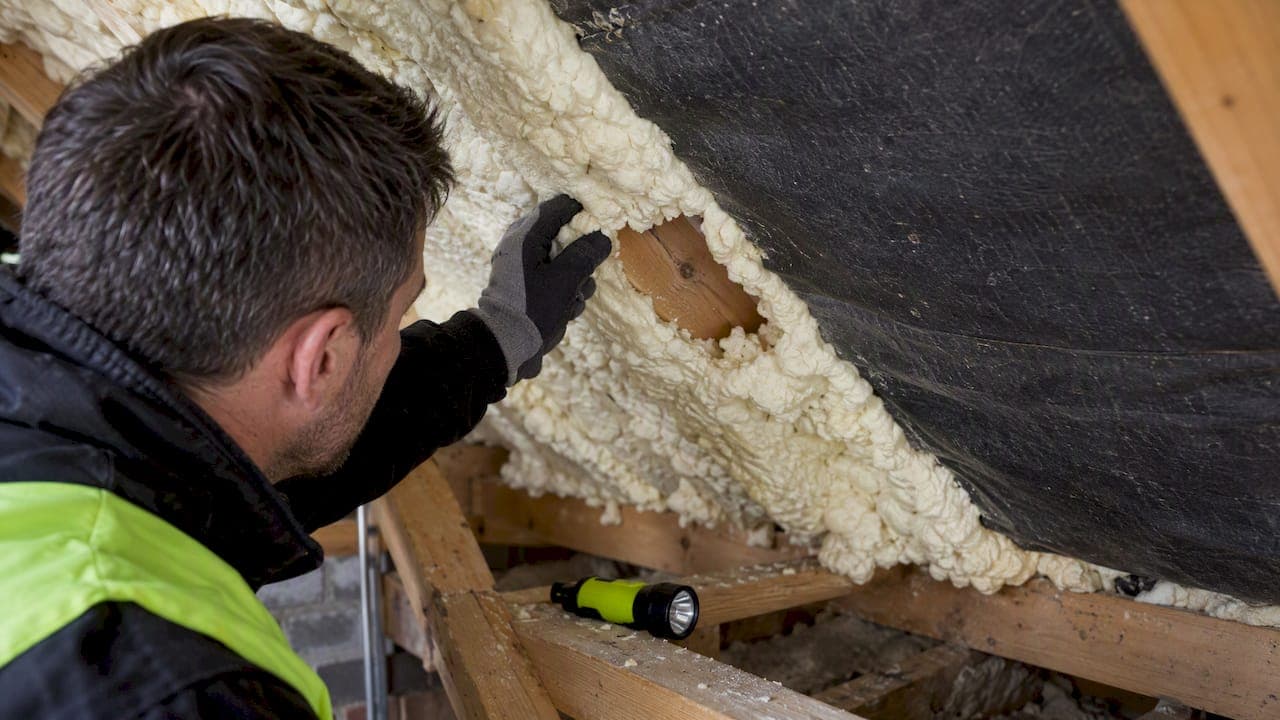
Spray foam applied directly to felt underlay can trap moisture against timber and hide the roof structure from view, and that combination is what causes most of the survey and mortgage problems homeowners run into. If you cannot find installation certificates, product details or installer records for your roof, the safest next step is an independent assessment before you list your property or apply for a remortgage.
TL;DR:
- Government modelling found the highest moisture risk when open cell foam sits directly on bitumen felt without an air and vapour control layer.
- Keep product and installer certificates, photographs, and independent reports; lenders may decline applications or assess properties individually when installation evidence is missing.
- Ask an independent assessor to identify the foam and underlay in writing, then use humidity logging or a small trial opening before considering full removal.
- Check ceilings and roof coverings every 6 to 12 months, and arrange a specialist review if staining, musty odors, sagging, or high humidity readings appear.
Table of Contents
- Why spray foam changes how your roof breathes
- Condensation and timber decay: what the evidence and modelling show
- How foam hides damage from normal inspection
- Mortgages, surveys and selling: what lenders actually want to see
- Which roofs carry the most risk
- Common faults reported and what usually causes each
- What a proper assessment actually involves
- What can be done once problems are confirmed
- Keeping an eye on a roof that already has foam
- Step-by-step process of identifying and diagnosing felt underlay issues
- Case studies or examples illustrating felt underlay problems
- Health and safety considerations during inspection and removal
- Long-term consequences of leaving problems unaddressed
- Industry perspective: why careful, evidence-based decisions matter
- How we help resolve survey and lender concerns
- FAQ
- Sources
Why spray foam changes how your roof breathes
A traditional "cold roof" relies on airflow between the insulation and the roof covering to carry moisture vapour away before it condenses. A "warm roof" design moves the insulation layer up against the rafters and seals the structure, which only works safely when the whole build-up is designed for it.
Spray foam, once cured, forms a continuous layer that can close off the ventilation gaps a cold roof depends on. Vapour that would normally escape gets trapped between the foam and the felt, with nowhere to dry out.
- A cold roof needs clear airflow paths at eaves and ridge to stay dry.
- A continuous foam layer can block that airflow and change the roof into a sealed warm roof by accident.
- An air and vapour control layer (AVCL), fitted on the warm side of the insulation, helps manage this risk but is often missing in retrofit jobs.
Condensation and timber decay: what the evidence and modelling show
Government modelling published in 2024 found that the highest moisture risk occurs when spray foam is applied directly onto high-resistance underlays, such as bitumen felt, with no AVCL in place. In these set-ups, winter relative humidity at the timber surface can climb and stay high for extended periods, which is exactly the condition that drives decay in the outer layers of rafters and battens.
Open-cell foam applied directly to felt without an AVCL produces the highest modelled moisture risk of the scenarios tested, according to government hygrothermal modelling. That single finding explains why felt underlay roofs feature so heavily in removal and dispute cases.
The same modelling shows outcomes improve when an AVCL is correctly installed or when closed-cell foam is used instead of open-cell, since closed-cell products are less permeable and interact differently with the underlay beneath them. Results still vary by climate and roof orientation, so no single foam type is risk-free on every felt roof.
How foam hides damage from normal inspection
Once foam is sprayed onto the underside of a roof, it typically covers the rafters, the battens and the purlin ends completely. These are the exact timbers a surveyor would normally check for damp staining, soft spots or active decay during a routine inspection.
RICS warns in its consumer guidance that spray foam can conceal wet rafters, and that without evidence of a compliant installation, a surveyor may simply be unable to comment on the condition of timbers hidden beneath it. That uncertainty is often what triggers a cautious valuation or a retention on a mortgage offer, rather than any confirmed fault.
Homeowners and buyers can still watch for a few practical clues even when the timber itself is out of sight:
- Damp patches or discolouration on ceilings below the roof space.
- A musty smell in the loft that was not there before insulation.
- Visible mould or dark staining at the edges of the foam layer.
- Sagging or uneven felt visible from outside, which can point to trapped moisture beneath.
Mortgages, surveys and selling: what lenders actually want to see
A House of Commons Library briefing reports that many mortgage providers either decline to lend on affected properties outright or assess each case individually, and it recommends that homeowners keep hold of installation paperwork to support any future valuation or lending decision. That case-by-case approach means two nearly identical roofs can get very different outcomes depending purely on what Texas roof age and home insurance evidence exists.
The paperwork that tends to reduce friction with lenders and surveyors includes:
- Product certification from a recognised body such as BBA or Kiwa, confirming what was actually installed.
- Installer certification showing the work was carried out by a qualified, insured contractor.
- Before-and-after photographs documenting the roof structure, the underlay type and the foam application.
- An independent survey or report commissioned separately from the original installer.
Where this evidence does not exist, surveyors sometimes adjust a valuation downward to account for the likely cost of future removal and repair, which can reduce what a seller actually receives at completion. A complete paper trail, by contrast, lets a surveyor comment with confidence instead of defaulting to caution.
Which roofs carry the most risk
Felt underlay roofs are not all equal. Bitumen felt is a high-resistance material, so when foam goes straight onto it with no ventilated gap, local vapour pressure at that junction tends to rise faster than it would under a breathable membrane.
- Older roofs with felt that has started to degrade are more exposed, since the underlay's own performance has already declined.
- Roofs with poor eaves or ridge ventilation before the foam was fitted carry extra risk, since airflow was already restricted.
- Properties in regions with harsher winter moisture cycles see the condensation risk play out more severely across a season.
Common faults reported and what usually causes each
Most disputes trace back to a small number of recurring faults rather than foam itself being inherently unsafe.
- Wrong product for the roof type: open-cell foam used where a closed-cell product (or no spray foam at all) would have suited the underlay better.
- Incorrect thickness: too little foam fails to insulate properly, while excessive depth can mask gaps that would otherwise be visible.
- Overspray and gaps: foam applied onto tile undersides or with inconsistent coverage leaves cold spots where condensation concentrates.
- Pre-existing defects: slipped tiles or already-damaged felt let rain in before the foam is even applied, and the foam then traps that moisture against the timber.
What a proper assessment actually involves
A credible assessment moves through clear stages rather than jumping straight to removal.
- Basic visual survey: photographs of the roof covering, a check of felt and tile condition where visible, and a review of any available documentation.
- Document audit: confirming whether product certificates, installer records and prior inspection reports exist.
- Foam and underlay identification: working out whether the foam is open or closed cell, and whether the underlay is bitumen felt or a breathable membrane, as set out in the PCA/RPSA inspection protocol.
- Targeted checks: humidity logging, drone imaging of the roof exterior, or small trial openings to expose a sample area without full removal.
- Independent verification: where doubt remains, a removal and post-removal inspection confirms the timber's actual condition.
Pro Tip: Ask any assessor to confirm foam type and underlay material in writing before they give a verdict on your roof, since both of the PCA protocol's first two checks hinge on exactly that information.
What can be done once problems are confirmed
The right remedy depends on how severe the moisture risk turns out to be, not on a single standard fix.
- Remedial ventilation: adding or restoring eaves and ridge airflow can be enough where moisture levels are modest and timber is still sound.
- Targeted repairs: replacing a damaged section of felt or timber without disturbing the rest of the roof suits isolated faults.
- Full removal: necessary where the foam prevents any reliable inspection or where decay is suspected across a wider area, though it is more disruptive and costly than a partial repair.
- Post-removal verification: a detailed report confirming timber condition after removal is usually what finally satisfies a lender, according to PCA commentary on the removal market.
Keeping an eye on a roof that already has foam
If your roof already has spray foam fitted and it has not caused problems so far, a few simple habits keep it that way.
- Check external coverings and internal ceilings for damp or staining every 6 to 12 months.
- Commission humidity logging or a repeat specialist check if you notice any new staining, smell or sagging.
- Keep every piece of installation paperwork, and pass it on to any future buyer or surveyor.
Step-by-step process of identifying and diagnosing felt underlay issues
Diagnosing a suspected problem under felt underlay follows a fairly consistent sequence in practice. It starts with gathering whatever documentation exists: product data sheets, installer invoices, building control records and any prior survey. Missing paperwork does not confirm a fault, but it does mean the next steps carry more weight.
From there, a visual check of the loft space looks for staining, mould, a musty smell or visible gaps in the foam coverage. External checks follow, looking at the tile or slate covering for slipped units, sagging felt or unusual discolouration that might point to trapped moisture beneath.
Where visual checks raise concern, the next step is identifying the foam type and underlay material, since this single fact drives the risk assessment under the PCA inspection protocol. Humidity logging over several weeks, particularly through winter, can show whether relative humidity at the timber surface is staying unusually high.
If logging or visual signs point to a real problem, a small trial opening lets an assessor examine a section of timber directly without committing to full removal. Only when that sample shows decay, or when the underlay and foam combination matches the highest-risk scenario in the government modelling, does full removal and inspection typically follow. Each stage is designed to give just enough evidence to decide whether the next, more invasive, step is justified.

Case studies or examples illustrating felt underlay problems
A typical case starts with a homeowner applying for a remortgage years after an open-cell foam installation, only to find the lender's surveyor cannot confirm the condition of the rafters because the foam covers them completely and no installation paperwork survives. The valuation is adjusted downward to reflect the cost of a future removal and inspection, even though the roof may well be sound.
Another common pattern involves a felt underlay roof where tiles had slipped slightly before the foam was fitted. Rain had already been getting in intermittently, and once the foam sealed the loft space, that trapped moisture had nowhere to evaporate. A musty smell eventually led the owner to commission a humidity log, which showed sustained high readings through a single winter, prompting a trial opening that confirmed localised decay in two rafters.
A third pattern involves closed-cell foam fitted correctly with an AVCL and full certification. When that property came up for sale, the surveyor was able to review the installer's records and product certificate, note the AVCL in the loft, and confirm the roof structure without any retention or price adjustment. The contrast between these cases is rarely about the foam itself. It is almost always about whether the installation can be evidenced and inspected.

Health and safety considerations during inspection and removal
Inspecting or removing spray foam from beneath felt underlay involves working in a confined, poorly ventilated loft space, often for extended periods, so basic precautions matter regardless of who carries out the work. Dust and small foam particles are released during cutting and removal, which is why PCA-aligned removal teams use appropriate respiratory protection and eye protection throughout the job.
Timber that has been exposed to prolonged damp can harbour mould, and disturbing decayed sections during inspection or removal can release spores into the air. Good ventilation during the work, along with protective clothing, reduces exposure for anyone working in the space.
Electrical cabling often runs through loft spaces alongside the roof structure, so any trial opening or removal work needs to account for wiring before cutting into foam near it. Structural stability is another factor: removing a continuous foam layer can occasionally reveal that the foam itself was contributing some incidental support to loose battens or damaged sections, so removal is best sequenced carefully rather than stripped out in one pass. These are among the reasons a PCA-certified, insured team carrying out the work tends to produce a safer, more thoroughly documented result than an ad hoc approach.
Long-term consequences of leaving problems unaddressed
Leaving a suspected felt underlay and spray foam problem unexamined does not make the underlying risk disappear. Where the modelling conditions for high moisture risk are present, decay in rafters and battens tends to progress slowly over several winters rather than announcing itself suddenly, which means a roof can look fine from inside the house for years while timber condition deteriorates out of sight.
The practical cost of waiting tends to show up at the worst possible moment: during a sale or remortgage, when a surveyor flags the uninspected foam and a lender either retains funds, refuses the loan, or both. At that point, the homeowner is often working under time pressure to commission a survey, gather paperwork that may no longer exist and potentially fund removal and repair, rather than addressing it on their own schedule.
There is also a structural dimension. If decay has been developing undetected, the eventual repair scope and cost tend to grow the longer it continues, since affected timber needs replacing rather than simply drying out. Addressing a suspected problem early, while the issue may still be limited to remedial ventilation or a targeted repair, is consistently the less disruptive and less expensive path compared with discovering extensive decay years later during a sale.
Industry perspective: why careful, evidence-based decisions matter
Spray foam is a substantial alteration to a roof, not a cosmetic upgrade, and it deserves the same formal scrutiny as any structural change. We have watched the removal market grow quickly, which makes independent verification, rather than a quick opinion, the detail that actually protects homeowners. Keep every certificate you are given, and choose a certified assessor before you choose a remover.
— jessica
How we help resolve survey and lender concerns
We carry out assessments and removals starting with a basic visual survey or full roof report that gives you the documented evidence a surveyor or lender is looking for.

Where removal is the right path, our team handles open cell and closed cell spray foam removal directly, with transparent fixed pricing and a warranty on completed work. You deal directly with the team doing the job, from quote to post-removal verification. Book a home visit and quotation to get a clear picture of your roof's condition and what, if anything, needs doing next.
This article is general information, not a substitute for advice from a qualified financial advisor. Consult a qualified financial professional about your own circumstances before acting on anything here.
FAQ
Are there problems with spray foam insulation?
Spray foam can cause problems when it is applied to high-resistance underlays such as bitumen felt without an air and vapour control layer, since government modelling shows this combination carries the highest risk of trapped moisture and timber decay. Correctly specified installations with an AVCL or closed-cell product show lower modelled risk, so outcomes depend heavily on how the job was done.
What surfaces does spray foam not bond well to?
Spray foam generally needs a clean, dry surface to bond properly, and it performs poorly over damp, dusty or contaminated materials. Pre-existing damage such as slipped tiles or already-wet felt can leave uneven or gapped coverage, which is one of the common faults linked to later condensation spots.
What are the symptoms of an allergic reaction to spray foam?
Reported reactions to uncured or disturbed spray foam typically include irritation of the eyes, skin, nose or throat, and sometimes breathing difficulty, which is why protective equipment is standard during installation and removal. Anyone experiencing persistent symptoms after exposure should seek medical advice rather than relying on general guidance.
Can you spray foam under a roof?
Spray foam can be applied under a roof, but RICS guidance stresses that it changes how the roof manages moisture and can conceal timber from future inspection if done without proper ventilation detailing and documentation. Whether it is appropriate for a specific roof depends on the underlay type, existing ventilation and whether an AVCL is included.
What documents should I keep if I already have spray foam installed?
Keep product certification, installer certification, before and after photographs and any survey reports, since a Commons Library briefing notes this paperwork directly supports future lending and valuation decisions. Without it, surveyors and lenders often default to a cautious assessment regardless of the roof's actual condition.
Sources
- RICS consumer guide: spray foam insulation
- Sprayed foam insulation inspection protocol (Property Care Association)
- Spray foam insulation and mortgages (House of Commons Library)