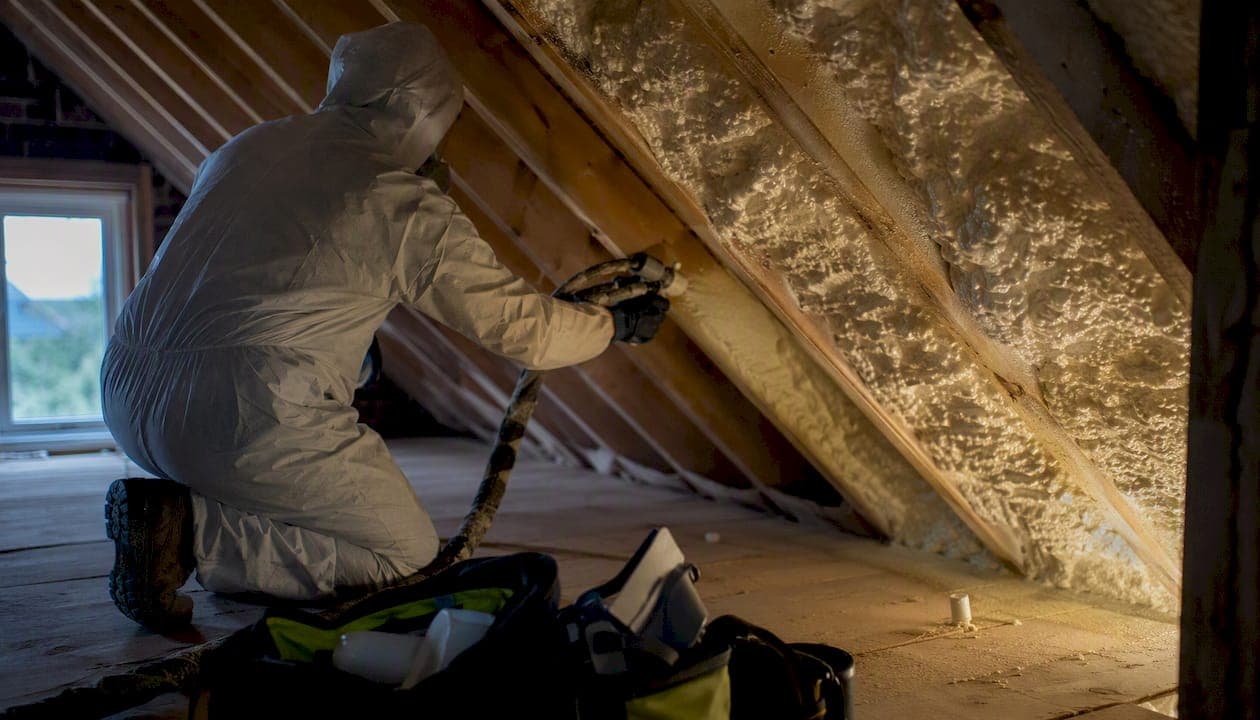
Open cell spray foam is a low-density insulation that expands in place to seal air gaps and dampen sound, but it carries lower thermal performance per millimetre than closed cell and behaves very differently around moisture. The single biggest decision hinge is installation quality against BS 5250:2021: get it wrong and you risk timber decay and a property that mortgage lenders won't touch.
Before you go further, act on this:
- Locate any paperwork from the original installation, including product certificates.
- Ask the installer (or previous owner) whether an air and vapour control layer (AVCL) and ventilated air gap were fitted.
- Book a specialist inspection if you can't confirm either of those.
Key Takeaways
Open cell spray foam performs well for air sealing and sound damping but depends entirely on BS 5250:2021 compliant installation to avoid moisture risk and mortgage refusal.
| Point | Details |
|---|---|
| Check for AVCL and air gap | Confirm both were fitted; their absence is the leading cause of moisture risk. |
| Understand lender caution | A significant portion of major lenders refuse foam-insulated roofs outright; others need specialist reports. |
| Gather paperwork early | Product certificates and installer warranties are what move stalled mortgage applications forward. |
| Watch for red flags | Foam on tiles, no AVCL, soft or damp foam all signal an incorrect installation. |
| Get specialist inspection | A PCA or RICS report gives lenders and buyers the certainty a visual check can't. |
Where to read more
- House of Commons Library: lender policy background.
- GOV.UK modelling report: technical moisture risk detail.
- RICS consumer guide: valuation and surveyor context.
- HomeOwners Alliance: finding PCA-approved specialists.
This article is general information, not a substitute for advice from a qualified financial advisor. Consult a qualified financial professional about your own circumstances before acting on anything here.
Table of Contents
- What is open cell spray foam and how does it work?
- Open cell vs closed cell foam: which one actually fits your roof?
- Where does open cell spray foam work well, and where doesn't it?
- What are the real benefits and drawbacks of open cell foam?
- Does open cell foam cause damp and timber rot?
- What does installation or removal cost, and how long does it take?
- How do you check if your spray foam was installed correctly?
- What warranty should you expect on open cell foam?
- Does open cell foam settle or lose performance over time?
- Is open cell spray foam environmentally sound?
- Get a mortgage-ready inspection before it costs you a sale
- Sources
- FAQ
What is open cell spray foam and how does it work?
Open cell spray foam is a lightweight, low-density insulation that expands on application and cures into a soft, flexible material. Unlike closed cell foam, its cell structure stays open, which makes it more vapour permeable, lighter and flexible than its denser counterpart, though it needs a thicker layer to match the same insulation value.
That permeability is exactly why it seals air leaks so effectively. Air movement through gaps and cracks accounts for a large share of unwanted heat loss in older roofs, and foam expanding into every void closes those pathways in a way that mineral wool laid loosely never quite manages.
Picture the cross-section of a well-built roof: rafters, then the sprayed foam filling the cavity, then a maintained air gap, then a breathable membrane or underlay, with the AVCL sitting on the warm side of the insulation. Get that sequence wrong and the whole assembly's drying path disappears.
- Low density, soft after cure, vapour-open structure.
- Reduces draughts by filling irregular gaps mineral wool can't reach.
- Requires a paired AVCL and ventilated gap to manage moisture correctly.
Open cell vs closed cell foam: which one actually fits your roof?
Neither product is "better" in the abstract. The right choice depends on the assembly, the climate and whether the build can dry out if moisture ever gets in, a point Energy Saving Trust makes clear when comparing the two materials.
Closed cell is denser, more rigid, and delivers a higher R-value per millimetre, which suits tight spaces where depth is limited. Open cell is softer, lighter, and better at absorbing sound, which makes it useful in stud walls between rooms. Where the two diverge most sharply is vapour behaviour: closed cell acts almost like a vapour barrier itself, while open cell relies entirely on a correctly detailed AVCL and ventilated gap to stay safe long term.
When you're talking to an installer or surveyor, these are the questions worth asking:
- Which product suits this specific roof pitch, ventilation setup and moisture load?
- Is there a maintained drying path, or does the assembly rely solely on the foam's permeability?
- Will this choice affect future inspection access to the timbers?
- Has either product been sprayed directly onto anything that blocks a vapour path?
If you want a fuller technical breakdown, our open cell vs closed cell comparison covers suitability by roof type in more depth.
Where does open cell spray foam work well, and where doesn't it?
Open cell earns its keep in internal stud partitions, where its acoustic damping cuts noise transfer between rooms, and in between-rafter loft applications where an AVCL and ventilated air gap can genuinely be built in.
It's a poor fit anywhere that drying path can't exist: sprayed directly onto the underside of roof tiles, onto non-ventilated high-resistance underlays, or in persistently damp environments such as unventilated crawl spaces. In every one of those situations, moisture gets trapped rather than released.
- Good fit: stud walls for sound reduction, rafters with a proper AVCL and gap.
- Poor fit: direct-to-tile spraying, high-resistance underlays, damp crawl spaces.
Pro Tip: Ask your installer how they're maintaining the air gap. Reputable teams use card spacers or counter-battens fixed before spraying to hold a consistent ventilated void between the foam and the underlay. If nobody can describe this step, that's a red flag before work even starts.
What are the real benefits and drawbacks of open cell foam?
Done properly, open cell delivers genuine air sealing, decent thermal performance, and noticeably better acoustic damping than mineral wool, all while weighing far less than closed cell equivalents. Those are the wins homeowners actually notice: quieter rooms, fewer draughts, warmer lofts.
The drawbacks are just as concrete. It needs a thicker layer than closed cell to hit the same R-value, and because it's vapour-permeable, moisture and timber rot risks are only low when the assembly follows BS 5250:2021. Once sprayed, it also makes visual inspection of rafters and battens far harder, which becomes a real headache at survey stage.
- Benefits: air sealing, sound damping, low weight, good thermal contribution when correctly applied.
- Drawbacks: lower R-value per mm, thicker layers required, moisture liability without a drying path, harder to inspect once installed.
During installation and cure, ventilation matters for the people doing the work too. Off-gassing occurs while the foam cures, and installers typically require the property to be vacated for a period and properly ventilated afterwards, a standard safety step reputable contractors will explain unprompted.
Does open cell foam cause damp and timber rot?
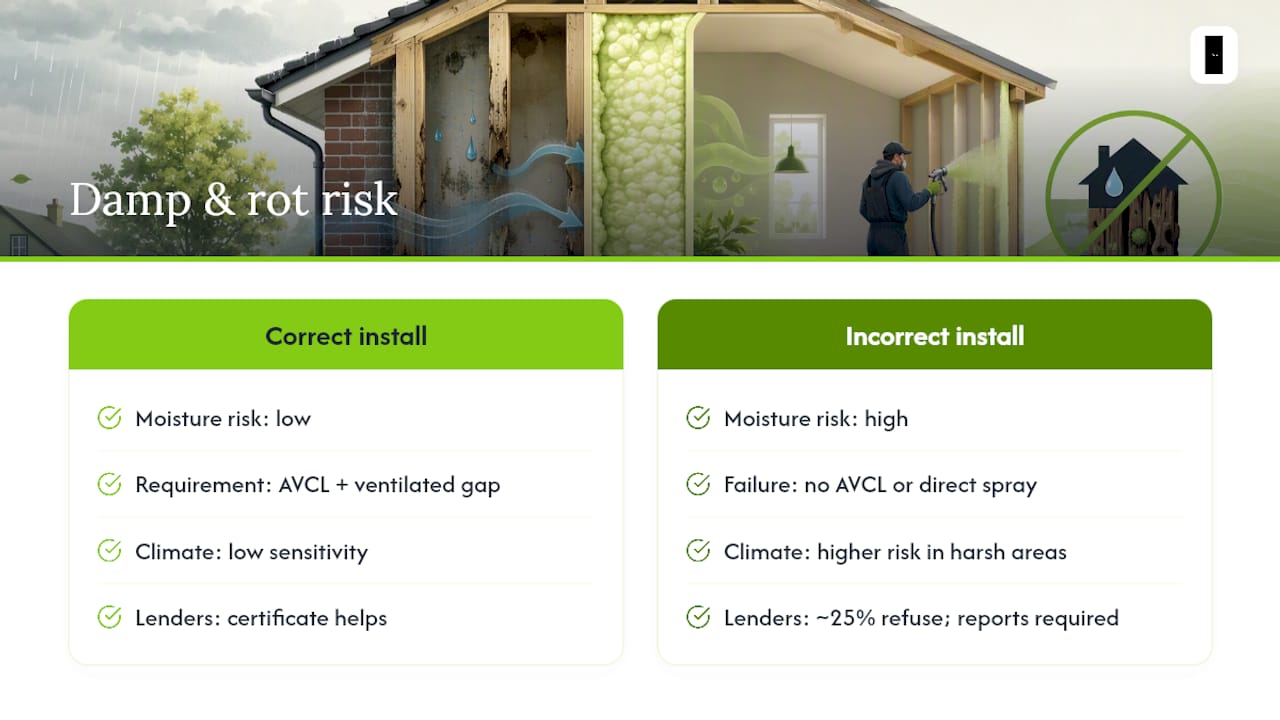
Only when it's installed incorrectly. The UK government's own guidance is unambiguous: moisture and rot risks stay low provided the installation includes an AVCL on the warm side and a ventilated air gap between the insulation and the roof underlay, in line with BS 5250:2021.
Hygrothermal modelling backs this up in detail. Researchers ran one-dimensional simulations comparing London and Newcastle climates and found low risk when foam follows the prescriptive construction, with risk rising sharply where foam is sprayed directly onto high-resistance underlays or fitted without an AVCL, especially in harsher regional climates.
The moisture risk in these constructions isn't really about the foam itself. It's about whether the roof still has somewhere for trapped vapour to go once the foam is in place.
This is where lenders come in. Surveyors can't see timbers hidden under sprayed foam, so around a quarter of the UK's largest mortgage lenders refuse outright to lend against properties with any spray foam in the roof space, while the rest review case by case and typically demand specialist reports.
Pro Tip: The single document that moves a stalled mortgage application forward fastest is a product certificate paired with an independent PCA or RICS inspection report confirming correct installation. Without it, most lenders default to caution.
What does installation or removal cost, and how long does it take?
A typical domestic loft or rafter job runs through a site survey, substrate preparation, spraying itself, and a cure and ventilation period before final checks, usually completed within one to two days for an average loft.
New open cell installation and problematic foam removal both sit on wide cost ranges depending on roof size, access and the extent of remedial work needed. Always get a site-specific quote rather than relying on a headline figure, since spray depth, timber condition and access all move the price significantly. Our removal process guide breaks down what a certified removal job actually involves.
- Survey and quote: confirm roof type, ventilation, and suitability.
- Preparation: fit AVCL and spacers, protect surrounding areas.
- Spraying and cure: apply foam, allow full cure with ventilation.
- Sign-off: certification, warranty documents, aftercare advice.
- Ask at survey stage: is this roof suitable for open cell at all?
- Ask at sign-off: what warranty and certificate will I receive?
How do you check if your spray foam was installed correctly?
Work through this before speaking to a lender or buyer:
- Gather every piece of paperwork: installer details, product name, date of installation.
- Request the original product certificate and any warranty documentation.
- Take clear photos of the foam from what access you have.
- Book a PCA or RICS-accredited spray foam specialist if paperwork is missing or incomplete.
Watch for these red flags, which suggest the installation didn't follow BS 5250:2021:
- Foam sprayed directly onto the underside of roof tiles with no visible gap.
- No evidence of an AVCL anywhere in the loft.
- Foam that feels saturated, soft, or shows staining when pressed.
- Visible dripping or damp patches on ceilings below the loft.
The right order of action is inspection first, then certification, then a removal estimate if the inspection flags a genuine problem. Our mortgage guide covers exactly what documentation lenders expect at each stage.
Pro Tip: Don't wait until you're mid-sale to check any of this. A pre-emptive inspection costs far less in time and stress than discovering a problem when a buyer's surveyor flags it.
What warranty should you expect on open cell foam?
A properly installed job should come with two separate layers of cover: a product warranty from the foam manufacturer, and an installer's workmanship guarantee. These aren't the same thing, and confusing them causes problems later.
Manufacturer warranties typically cover material defects for a set number of years but rarely extend to consequential damage like timber rot if the installation itself was faulty. Installer guarantees are what actually matter for you as a homeowner, since they're what get invoked if the workmanship was substandard. A serious specialist will offer a warranty that's insurance-backed rather than simply a company promise on paper, because a company promise is worthless if that company folds.
Ask specifically whether the warranty transfers to a new owner on sale. Many older spray foam warranties were written loosely or not designed with resale in mind, which is part of why so many homeowners discover gaps in cover only once a buyer's solicitor starts asking questions. A transferable, insurance-backed warranty is one of the strongest pieces of paperwork you can hand a lender or buyer, alongside the product certificate and any PCA or RICS inspection report already mentioned. If your current documentation doesn't tick these boxes, that's worth addressing well before you need it.
Does open cell foam settle or lose performance over time?
Open cell foam is generally stable once cured, but it isn't immune to long-term change. Its soft, flexible structure means it can compress slightly in areas subject to repeated physical contact or where it was under-cured at installation, though this is far less common than moisture-related degradation.
The bigger long-term risk isn't mechanical settling, it's slow moisture accumulation in assemblies that lack a proper drying path. Foam that looks fine on the surface can sit above timbers that have been quietly deteriorating for years, because the insulation itself hides the early signs. This is precisely why visual inspection alone often isn't good enough, and why specialist reports sometimes require intrusive checks where foam conceals the timber entirely.
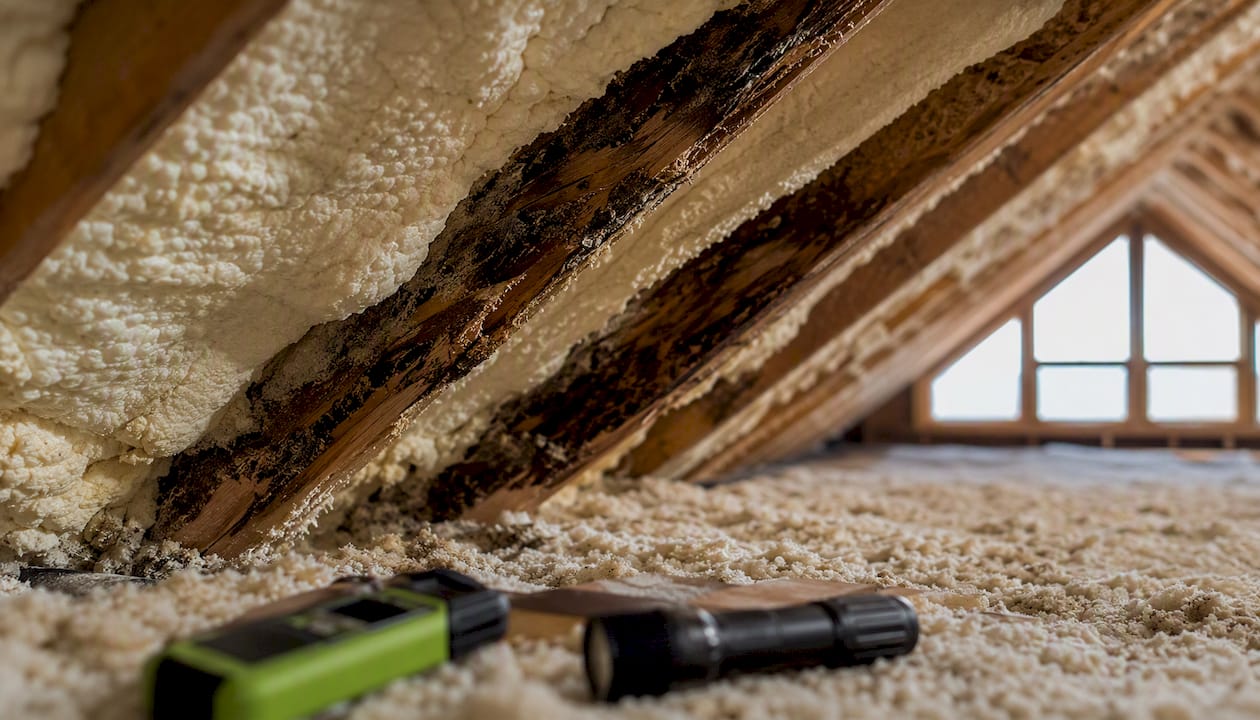
Performance can also drift if the ventilated air gap gets compromised after installation, for instance through later loft alterations, added storage boarding, or a poorly executed repair that blocks the intended airflow. None of this means open cell is inherently unreliable over time. It means the assembly around it needs to stay intact for the material to keep doing its job, which is a maintenance consideration many homeowners simply aren't told about at point of sale.
Is open cell spray foam environmentally sound?
Open cell foam's lower density means less raw material goes into each installation compared with closed cell, and its strong air-sealing performance can meaningfully cut a property's heating demand, which is the main sustainability argument in its favour.
The counterargument sits in two places. First, it needs a thicker layer to match the thermal performance of closed cell, which narrows the material-efficiency gap somewhat. Second, spray foam of either type is difficult to recycle at end of life and, once bonded to timber, is essentially impossible to separate cleanly for material recovery. Removal generates waste that typically goes to landfill rather than being reprocessed.
For homeowners weighing environmental impact against alternatives like mineral wool or rigid board, the honest picture is mixed: strong in-use energy savings, weaker end-of-life credentials. If sustainability is a priority alongside insulation performance, ask any installer directly about the specific product's embodied carbon and disposal pathway rather than accepting general reassurances.
A removal and inspection specialist's view
We see the same pattern repeatedly: foam sprayed without an AVCL, lenders stalling, homeowners caught out at sale. Certification and, where needed, professional removal resolve it.
Get a mortgage-ready inspection before it costs you a sale
If your paperwork doesn't confirm an AVCL and ventilated gap, don't wait for a buyer's surveyor to find out first. Sprayfoamremovalhelp's PCA-certified technicians inspect, certify, and where necessary remove problematic open or closed cell foam, working directly with you rather than through subcontractors, with transparent pricing and a 10-year insurance-backed warranty behind every job. Start with a free inspection to find out exactly where you stand.
Sources
- Spray foam insulation and mortgages - House of Commons Library
- Spray foam insulation applied to timber sloped roofs in dwellings (modelling report) - GOV.UK (pdf)
- Gov
- Spray foam insulation explained - Energy Saving Trust
FAQ
Is open cell spray foam okay to have in my home?
It's fine when installed to BS 5250:2021 with an AVCL and ventilated air gap; problems arise almost exclusively from incorrect application, not the material itself.
What are the disadvantages of open cell spray foam?
Lower R-value per millimetre than closed cell, the need for thicker layers, moisture vulnerability without a drying path, and harder inspection access for surveyors.
Is spray foam banned in the UK?
No, spray foam isn't banned, but government guidance doesn't recommend it as a default choice and many mortgage lenders restrict or refuse lending on properties that have it.
Is open or closed cell spray foam better?
Neither is universally better; closed cell gives higher thermal performance per millimetre and acts more like a vapour barrier, while open cell suits sound damping and assemblies with a genuine drying path.