
TL;DR:
- A single-sheet radiant barrier cannot replace conventional insulation in UK homes due to insufficient thermal resistance. Multifoil systems and properly installed traditional insulation meet building regulations, while spray foam often requires specialist removal to restore mortgage eligibility. Proper documentation and expert assessment are essential for compliance and property valuation.
A single-sheet radiant barrier (foil) cannot replace conventional insulation in a UK home. Approved Document L sets specific U-value targets that only thermal resistance (R-value) can reliably meet, and a standalone foil layer simply does not deliver that resistance in a British winter.
Here is what that means in practice:
- A foil alone will not satisfy Building Regulations. Without a measurable R-value, it cannot hit the U-value targets your local building control officer will check.
- Multifoil is a different product. A multi-layer system combining reflective foils with insulating wadding can comply, but only when installed exactly to the manufacturer's specification, including counter-battens and correct air gaps.
- Spray foam changes everything. If spray foam is already present in your roof space, a PCA/RICS inspection is the first step before any new insulation goes in. Sprayfoamremovalhelp offers PCA-certified removal and certification across London and the South East.
Table of Contents
- What is a radiant barrier and why does it fall short in the UK?
- Common UK insulation types and how they compare
- Radiant barrier vs insulation: a direct comparison for UK homes
- Does your reflective system actually meet Building Regulations?
- When a foil product genuinely helps, and when it does not
- Why spray foam causes mortgage problems and how to fix it
- How to choose the right insulation solution for your property
- Recommended next steps for London homeowners, agents, and landlords
- Key takeaways
- A practical caution for London property owners
- Sprayfoamremovalhelp: PCA-certified removal and certification in London
- Useful sources and further reading
- FAQ
What is a radiant barrier and why does it fall short in the UK?
A radiant barrier is a reflective foil sheet designed to bounce radiant heat away from a surface rather than absorb it. In a hot climate, that is genuinely useful: foil fixed to the underside of roof rafters reflects summer sun back out before it warms the living space below.
The problem in the UK is that the dominant challenge is keeping heat in through a long, cold winter, not rejecting summer heat. Radiant barriers typically carry an R-value of around R-2 or less and depend entirely on an adjoining unventilated air gap to function. Remove that air gap and the foil behaves as a thin conductive layer with negligible thermal benefit.
The Insulation Manufacturers Association has consistently argued that reflective products must be tested under the same Hot Box methodology as conventional insulation before performance claims can be accepted by building control. A single foil sheet does not pass that test at the U-values UK regulations demand.
Multifoil is a distinct product category. It combines multiple reflective layers with insulating wadding to address conduction and convection as well as radiation. That combination can achieve compliance, but the installation detail is everything.
Common UK insulation types and how they compare
The four materials you will encounter most often in London properties are mineral wool, PIR rigid boards, spray foam, and multifoil.
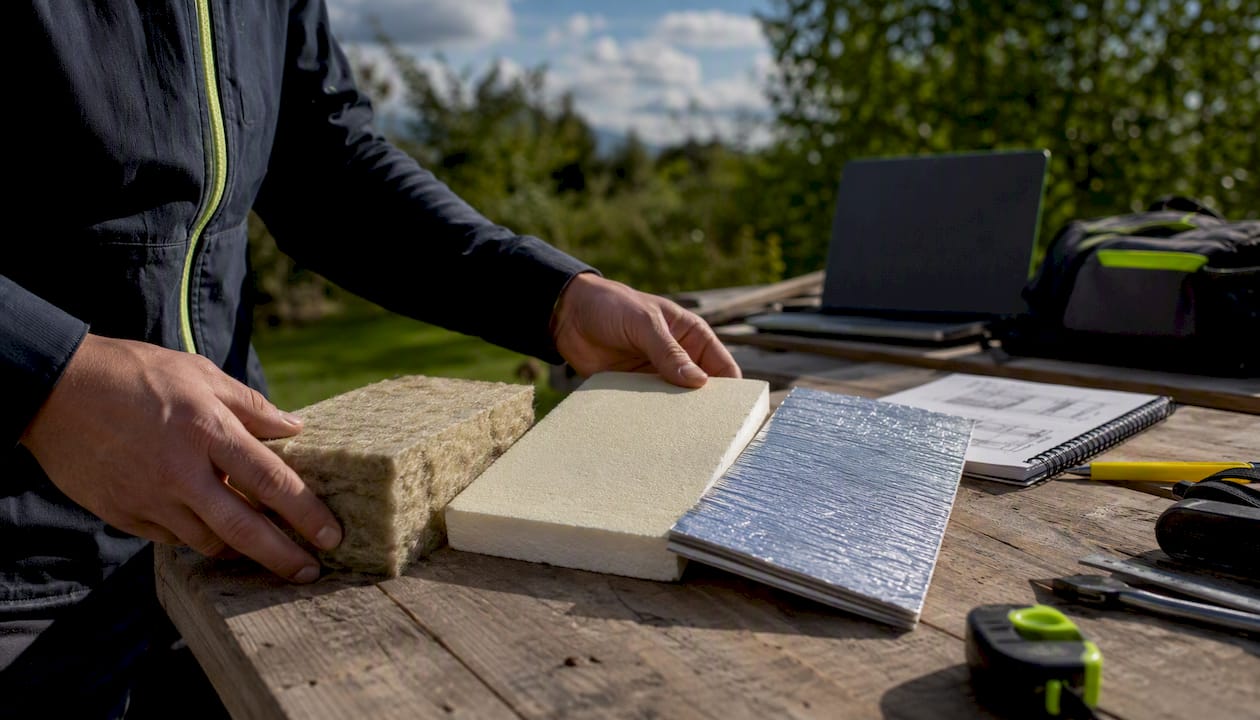
| Material | Typical R-value per 100mm | Key advantage | Key risk |
|---|---|---|---|
| Mineral wool | — | Low cost, breathable, fire-safe | Needs depth (200mm+ for loft) |
| PIR rigid board | — | High performance, thin profile | Costly; joints must be taped |
| Spray foam (closed cell) | — | Airtight, structural bond | Traps moisture; mortgage risk |
| Multifoil (BBA-tested) | Equivalent to ~100mm PIR when detailed correctly | Compact; built-in vapour control | Fails without counter-battens |
Trade guidance offers a practical rule of thumb: under 100mm of available depth, multifoil is the realistic option; 100–200mm suits PIR or a hybrid system; above 200mm, mineral wool delivers the best pounds-per-U-value ratio.
Key points for London properties specifically:
- Loft conversions often have shallow rafter sections (75–100mm), making deep mineral wool impractical without losing headroom.
- Listed buildings and party-wall constraints can rule out deep build-ups entirely, pushing designers towards multifoil hybrid solutions.
- Spray foam was widely installed in the 2000s and 2010s as a quick fix; it now creates significant mortgage complications that require specialist remediation.
BBA-tested multifoil such as Superfoil products can supply an integrated vapour control layer, which is a genuine advantage in shallow rafter retrofits where adding a separate membrane is difficult.
Radiant barrier vs insulation: a direct comparison for UK homes
| Dimension | Single foil (radiant barrier) | Multifoil system | Mineral wool / PIR |
|---|---|---|---|
| Thermal performance | R-2 or less; cannot meet UK U-value targets alone | Can meet 0.11 W/m²K roof target if detailed correctly | Reliably meets all targets at correct depth |
| Building Regulations compliance | Does not comply as standalone | Complies with counter-battens, air gaps, BBA/ETA cert | Complies at specified depths |
| Installation sensitivity | Low (but useless without air gap) | High: counter-battens and air gaps are non-negotiable | Moderate: joints and continuity matter |
| Moisture / condensation risk | Low standalone risk | Low if vapour control layer included | Low (mineral wool breathes; PIR needs taped joints) |
| Typical retrofit cost | Low | £1,100–£1,500 installed | Varies; mineral wool lower, PIR higher |
| Mortgage / surveyor acceptance | Not accepted as compliant insulation | Accepted with correct documentation | Accepted |
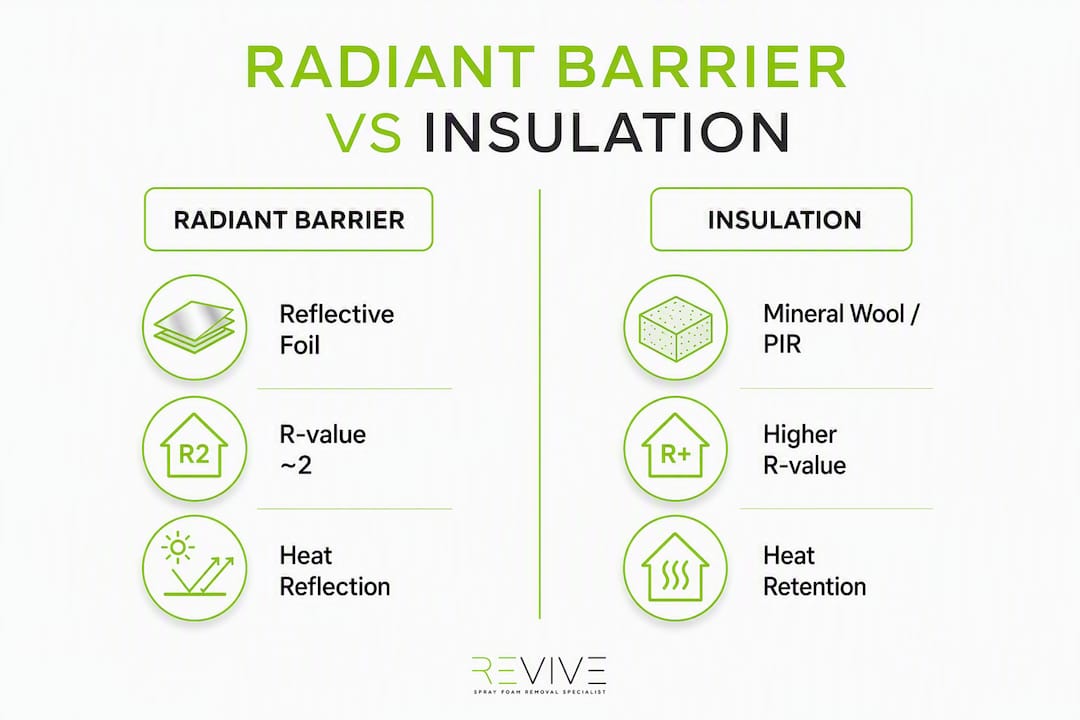
The practical conclusion: a reflective system can be part of a compliant hybrid solution when it is a BBA-tested multifoil installed with a thermal core. A single foil sheet cannot substitute for bulk insulation in any UK application.
Does your reflective system actually meet Building Regulations?
Approved Document L sets the following U-value targets for existing dwellings:
- Roof: 0.11 W/m²K
- Wall: 0.18 W/m²K
- Floor: 0.13 W/m²K
Multifoil build-ups can achieve a roof U-value of 0.11 W/m²K, but only when installed with the correct air gaps and supporting build-up. The installation details that most commonly fail are:
- Counter-battens omitted, so no unventilated air gap exists
- Layers compressed during fixing, destroying reflective performance
- Vapour control layer missing or incorrectly lapped
- Foil in direct contact with adjacent layers, turning it into a conductor
Documentation that proves compliance:
- Manufacturer's installation specification (product-specific, not generic)
- BBA, ETA, or KIWA product certificate
- U-value calculation prepared by a competent person
- Site sign-off from building control or an approved inspector
Pro Tip: Ask your installer for the U-value calculation before work starts, not after. If they cannot produce one, that is a clear sign the system has not been properly specified.
When a foil product genuinely helps, and when it does not
Where reflective systems add real value:
Room-in-roof conversions with 75–100mm rafter depth are the strongest use case. A Superfoil multifoil product combined with a thin PIR board can hit the 0.11 W/m²K target without sacrificing ceiling height.
Where a foil alone fails:
- Open loft floors with 200mm+ available depth: mineral wool is cheaper and more straightforward.
- Cavity wall retrofit: foil has no role; blown mineral wool or EPS bead is the standard.
- Flat roof overlay: PIR boards are the compliant choice; foil adds nothing meaningful.
- Any installation where the air gap cannot be guaranteed: the foil becomes decorative.
Pro Tip: For a pitched rafter installation, always specify the counter-batten depth in the written contract. "Foil insulation fitted" is not a specification; "50mm counter-batten creating unventilated air gap per manufacturer's installation certificate" is.
Why spray foam causes mortgage problems and how to fix it
Several major lenders have restricted lending on properties with spray foam, and the House of Commons Library has documented the issue formally. The core concerns are:
- Closed-cell foam bonds rigidly to roof timbers, making it impossible to inspect for decay without removal.
- Trapped moisture accelerates rot in rafters and ridge boards.
- Structural stress from foam expansion can distort timber members.
- RICS guidance confirms that surveyors frequently flag spray foam and request independent specialist reports before valuation proceeds.
The remediation path:
- Arrange a PCA-certified inspection to assess foam type, coverage, and timber condition.
- Obtain a written scope and quotation from a PCA-certified removal specialist.
- Complete specialist removal with photographic evidence at each stage.
- Commission an independent structural check of exposed timbers.
- Re-insulate using a hybrid system (multifoil + PIR or mineral wool) to meet current U-value targets.
- Obtain a certificate of remediation acceptable to lenders.
Trade press and homeowner guidance consistently advises checking your lender's position before any spray foam is installed, and securing specialist surveys if you are purchasing a property where foam is already present.
How to choose the right insulation solution for your property
A clear checklist keeps the process manageable:
- Measure the available depth in your rafter, wall, or floor void.
- Request a U-value calculation from any prospective installer before signing.
- Confirm the product carries BBA, ETA, or KIWA certification.
- For multifoil: insist on counter-battens and a written air-gap specification.
- Verify the vapour control layer is included and correctly detailed.
- If spray foam is present, arrange a PCA/RICS inspection before any other work.
Questions to ask an installer — and what a good answer sounds like:
- "Will you fit counter-battens to create an unventilated air gap?" — Acceptable answer: yes, to the depth specified in the product certificate.
- "Can you supply a U-value calculation?" — Acceptable answer: yes, prepared by a competent person before work starts.
- "What certification does the product carry?" — Acceptable answer: BBA or equivalent, with the certificate number available on request.
High-performance multifoil hybrid systems typically cost £1,100–£1,500 installed. A deeper PIR or mineral wool solution costs more but is the right long-term choice where depth allows and headroom is not a constraint.
Pro Tip: Get a written specification that names the product, its certificate number, the counter-batten depth, and the calculated U-value. That document is what a mortgage surveyor will ask for.
Recommended next steps for London homeowners, agents, and landlords
- Gather existing documentation: installation certificates, U-value calculations, and any building control sign-off already in your possession.
- If spray foam is present: arrange a PCA/RICS inspection before marketing the property or applying to remortgage. Ask the specialist for their PCA certification number and whether they carry an insurance-backed warranty.
- Get comparative quotes that include U-value calculations and product certificates, not just a price per square metre.
- Choose remediation and request a certificate in a form your lender will accept: PCA/RICS report, photographic evidence, manufacturer spec, and U-value calc.
- Check whether a free removal scheme applies to your property before committing to full-cost removal.
Hybrid systems and professional remediation preserve property value when documented correctly. An undocumented foil layer, by contrast, can actively harm a valuation.
Key takeaways
A single foil radiant barrier cannot meet UK Building Regulations U-value targets; only a correctly detailed multifoil or conventional insulation system can, and spray foam requires PCA-certified specialist removal before any re-insulation proceeds.
| Point | Details |
|---|---|
| Foil alone is not enough | A standalone radiant barrier carries R-2 or less and cannot meet Approved Document L U-value targets. |
| Multifoil can comply | BBA-tested multifoil achieves 0.11 W/m²K roof U-value only when counter-battens and air gaps are correctly installed. |
| Spray foam needs specialist removal | Major lenders restrict lending on spray-foam properties; PCA-certified removal and an independent report restore mortgageability. |
| Documentation is what lenders want | U-value calculations, product certificates (BBA/ETA/KIWA), and PCA/RICS sign-off are the paperwork that matters. |
| Sprayfoamremovalhelp | Sprayfoamremovalhelp provides PCA-certified removal, certification, and Superfoil installation across London and the South East, backed by a 10-year insurance-backed warranty. |
A practical caution for London property owners
The mistake seen repeatedly in London properties is treating a shiny foil layer as equivalent to proper insulation. It is not, and the consequences range from a failed building control inspection to a collapsed property sale.
Estate agents and landlords face a particular risk: a property with undocumented or non-compliant insulation can stall a sale for months. The foil might look professional in the loft space, but if there is no U-value calculation, no BBA certificate, and no counter-batten detail, building control officers and mortgage surveyors will not accept it.
The documents lenders actually care about are a PCA/RICS report (where spray foam is involved), the manufacturer's installation certificate with a product certificate number, and a U-value calculation prepared by a competent person. An installer's own letter of completion is not a substitute for any of these. Prioritise getting the right paperwork from the outset, and you will avoid the expensive scramble that comes when a buyer's solicitor raises a query three days before exchange.
Sprayfoamremovalhelp: PCA-certified removal and certification in London
If your property has spray foam in the roof space, the fastest route to a mortgage-ready outcome is a PCA-certified inspection followed by specialist removal and re-insulation. Sprayfoamremovalhelp (trading as Revive Maintenance) handles every stage in-house, with no middlemen and transparent pricing from the first call.

Services include PCA-certified inspections, emergency same-day removal, closed and open cell foam removal, Superfoil multifoil installation, and certification booking that produces the documentation lenders require. Over 1,000 London and South East homeowners have used the service, and every job is backed by a 10-year insurance-backed warranty.
To get started, read the spray foam removal guide or book a free inspection directly. Have your property address, approximate loft area, and any existing certificates to hand when you call.
Useful sources and further reading
The claims in this article draw on the following authoritative UK sources:
"Multifoil build-ups can achieve roof U-values of 0.11 W/m²K when installed with the correct air gaps and supporting build-up." — Approved Document L, UK Government
- Approved Document L (Conservation of Fuel and Power) — primary source for all U-value targets and compliance requirements.
- RICS — guidance on spray foam, surveyor valuation, and mortgage documentation requirements.
- Property Care Association (PCA) — certification standards for spray foam inspection and removal.
- BBA Certs — product testing and certification for multifoil and insulation systems.
- SuperFOIL — manufacturer guidance on meeting building control approval with multifoil.
- BBC News: Major lenders reject homes with spray foam — reporting on lender positions and mortgage risk.
- House of Commons Library: Spray foam insulation and mortgages — parliamentary briefing on the mortgage impact of spray foam.
- Homebuilding: Does spray foam prevent you getting a mortgage? — lender-by-lender analysis and homeowner guidance.
FAQ
Can a radiant barrier replace loft insulation in a UK home?
No. A single-sheet radiant barrier carries an R-value of around R-2 or less and cannot meet the 0.11 W/m²K roof U-value required by Approved Document L. Conventional insulation or a correctly detailed multifoil system is needed.
Does multifoil insulation meet UK Building Regulations?
Yes, provided it is a BBA-tested product installed with counter-battens to create the required unventilated air gap, accompanied by a U-value calculation and manufacturer's installation certificate.
Will spray foam stop me selling or remortgaging my home?
Several major lenders restrict lending on properties with spray foam, and RICS-registered surveyors routinely flag it. A PCA-certified inspection and specialist removal report are typically required to restore mortgageability.
What paperwork do I need after spray foam removal?
Lenders generally require a PCA/RICS inspection report, photographic evidence of removal, a post-remediation structural check, and a U-value calculation for the replacement insulation. Sprayfoamremovalhelp provides all of this documentation as part of its certification service.
How much does a multifoil hybrid system cost to install?
High-performance multifoil systems typically cost between £1,100 and £1,500 to install, depending on application and complexity.