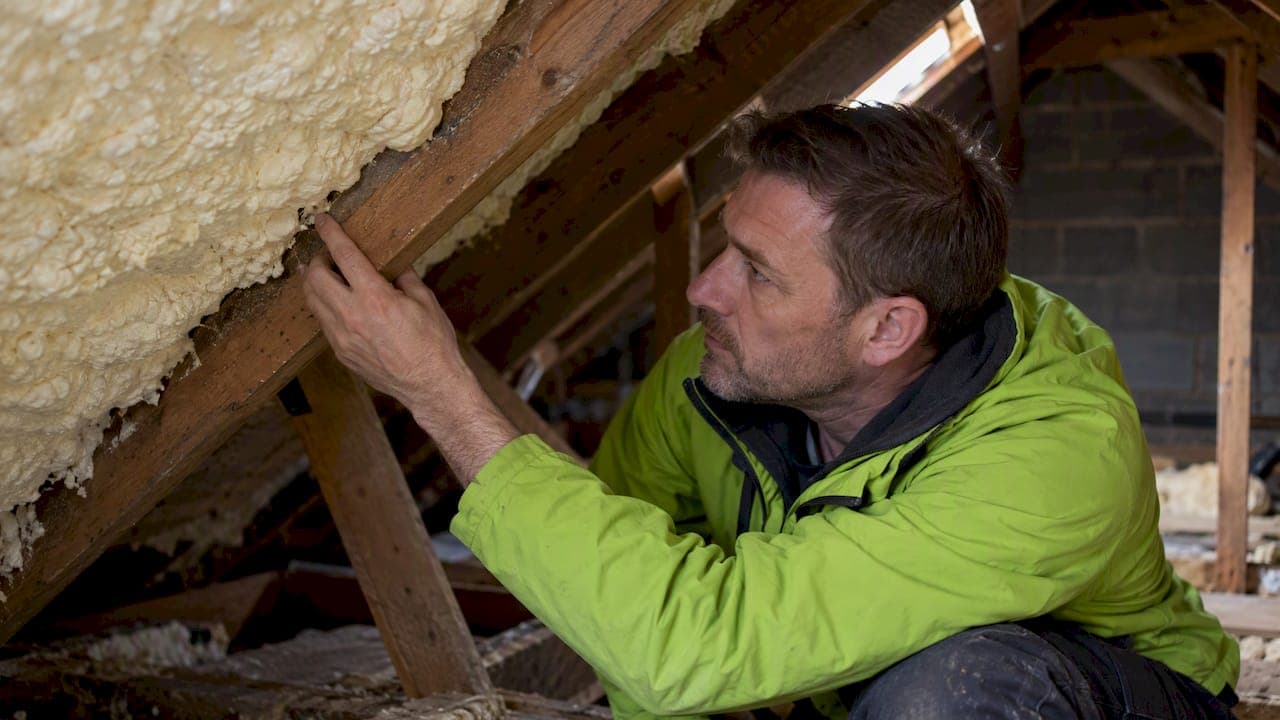
Spray foam applied directly to the backs of slates carries the highest moisture risk of any insulation method modelled by the Building Safety Regulator, so if that describes your roof, treat it as a priority. Your first move is an independent RICS or PCA-style inspection, not a removal booking. Not every installation needs stripping out: some can be managed with targeted remediation once a proper survey confirms what is actually happening up there.
TL;DR:
- A specialist inspection should include exterior photographs, selective foam removal, moisture readings at several points, and core samples where decay is suspected.
- Removal is warranted when inspection confirms timber decay, ventilation cannot be restored, or a lender requires it; otherwise, monitored remediation may suffice.
- Typical removal costs range from £1,000 to £5,000 for open cell foam and £1,500 to £7,000 for denser closed cell foam.
- To reduce sale delays, retain installation contracts, product certificates, moisture readings, and photographs, and confirm the final report meets your lender’s requirements before work starts.
Table of Contents
- How spray foam affects traditional slate roof construction
- Problems homeowners actually see when foam is used on slate roofs
- What official reports and trade bodies recommend
- How to check whether your slate roof installation is causing harm
- When removal is necessary and the safe remediation routes
- Money and timeline: how much removal typically costs and how projects are staged
- A homeowner's checklist for choosing a trustworthy removal specialist
- What fifteen years of removal jobs teaches you about slate roofs
- Get a second opinion before you commit to removal
- FAQ
- Sources
How spray foam affects traditional slate roof construction
Slate roofs were built to breathe. Air moves through gaps in the slates, timber dries out after wet weather, and moisture never gets the chance to settle in one place for long. Spray foam changes that balance the moment it goes on, and how much it changes depends on where and how it was applied.

There are two broad approaches to insulating a pitched roof. A cold roof keeps insulation at ceiling level, leaving the roof void above it cold and ventilated, much as it always was. A warm roof moves the insulation up to rafter level, which brings the whole roof structure inside the building's thermal envelope. Spray foam is usually installed as a warm roof system, sprayed onto the underside of the slates or tiles themselves, filling the rafter bays and sealing the roof covering from the inside.
That sealing is the root of the problem. Once foam is bonded to the back of a slate, moisture that would once have evaporated through ventilation gaps has nowhere to go. The Building Safety Regulator's modelling found that applying foam directly onto the roof covering, rather than over an existing breathable membrane, produced the highest moisture risk across every scenario it tested. Timber battens and rafters sit trapped between cold slate on one side and foam on the other, with no route to dry if condensation forms.
Two details decide how severe that risk becomes:
- Underlay type: a modern, vapour-permeable underlay allows some moisture to escape outward; an old bituminous felt or no underlay at all traps moisture against the timber with nowhere to go.
- Presence of an air and vapour control layer (AVCL): fitted correctly, an AVCL stops warm, moist internal air from reaching the cold roof structure in the first place; without one, that moisture migrates upward and condenses against the foam.
- Foam type: open-cell foam is more vapour-permeable and allows some moisture movement, while closed-cell foam is far denser and forms a near-total seal, which raises the risk of trapped condensation if the rest of the build-up is not designed around it.
- Installation standard: foam applied to a damp roof, over an unsuitable underlay, or without any attempt to manage vapour flow compounds every one of these risks at once.
Historic England has made a related point about older buildings generally: traditional construction is designed to breathe, and sealing components that were never meant to be sealed can stop normal drying and raise moisture risk rather than reduce it. That principle applies directly to a slate roof that has had foam sprayed straight onto its underside, regardless of the property's age.
Problems homeowners actually see when foam is used on slate roofs
The theory translates into specific, visible problems, and most homeowners discover them only once damage is already underway. Trapped moisture does not evaporate the way it used to, so it collects, and the first sign is often a musty smell in the loft or dark staining on exposed timber.
- Condensation and mould. Moisture that cannot escape condenses on the coldest surfaces it can find, typically the rafters and battens closest to the foam, encouraging mould growth in spaces that are rarely checked.
- Timber decay. Persistent dampness softens and eventually rots structural timber. Because the decay starts hidden behind the foam, it can be well advanced before anyone notices a sagging batten or a damp patch on a ceiling below.
- Hidden leaks. A cracked or slipped slate that would once have caused a visible drip now channels water into the foam layer instead, where it can spread sideways and soak timber metres from the original fault.
- Re-roofing complications. Foam that has bonded to the backs of slates makes it far harder to lift them cleanly for repair or replacement, and attempts to prise them free often crack the slate itself.
- Survey and mortgage friction. Surveyors who find spray foam in a loft frequently cannot confirm the roof's condition without further investigation, which stalls sales and remortgages until a specialist report is produced.
One documented consequence of these risks is financial. Citizens Advice has recorded a marked rise in complaints linked to spray foam, warning that mis-selling and poor installation have left some homeowners facing high costs and real difficulty selling or remortgaging their homes.
The inspection blind spot is worth dwelling on. A surveyor doing a standard visual check can see foam in the loft, but cannot see what is happening underneath it without removing a section. That uncertainty is precisely what lenders dislike, and it is why a routine valuation can turn into a stalled sale the moment foam is spotted. Rather than refusing the mortgage outright, most lenders ask for an independent specialist report confirming the roof's condition before they will proceed, which shifts the cost and the timeline onto the homeowner at the worst possible moment: partway through a sale.
What official reports and trade bodies recommend
Several official and professional bodies have now published guidance on spray foam, and their advice is broadly consistent: get an independent assessment before assuming the worst, but take the risk seriously enough to act.
The Building Safety Regulator's own modelling is the clearest technical statement available. It confirms that direct-to-tile or direct-to-slate application carries the highest theoretical moisture risk of the scenarios tested, and that the risk shifts significantly depending on the underlay fitted and whether an AVCL is present. A roof with a modern breathable membrane and a correctly installed AVCL sits in a very different risk category to one with foam sprayed straight onto bare slate and old felt.
RICS guidance focuses on what happens at the point of sale or remortgage. Surveyors are advised that spray foam can materially affect a valuation, and homeowners are encouraged to keep every piece of paperwork connected to the installation, since disputes often turn on documentation rather than the product itself. Worth keeping on file:
- The original installation contract and any specification documents.
- Product certificates, including BBA or Kiwa approval where available.
- Any independent test reports or moisture readings taken since installation.
- Photographs taken during or shortly after installation, if you have them.
Historic England's advice on insulating roofs in historic buildings reinforces the same point from a conservation angle: traditional roofs are built to breathe, and insulation strategies that ignore this tend to create moisture problems rather than solve energy ones.
Consumer bodies add a sharper warning about how homeowners end up in this position at all. Citizens Advice and local Trading Standards teams have both flagged aggressive cold-calling and high-pressure sales tactics around spray foam, both for original installation and, increasingly, for removal. The advice from both is the same: do not agree to work on the spot, and get an independent opinion before signing anything.
How to check whether your slate roof installation is causing harm
You do not need to climb into the loft with a torch and start poking at timber to get a useful first read on your roof. Start from the ground and work inward cautiously.
- Look for obvious warning signs first. Musty odours in the loft, dark staining on exposed timber, visible mould on the underside of foam, or damp patches on bedroom ceilings below the roof are all signals worth acting on.
- Avoid climbing onto the roof yourself. Slates that have been loosened or weakened by foam can crack underfoot, and the risks of working at height outweigh anything you could learn from an amateur inspection.
- Commission a RICS-qualified surveyor or PCA-recognised inspector. A proper survey should include drone or ladder photography of the roof exterior, selective exposure of foam to check the timber beneath, moisture probe readings at several points, and a sample bore or two where decay is suspected.
- Ask for thermal imaging when the visual evidence is ambiguous. Thermal cameras can pick up damp patches and missing insulation that are invisible to the naked eye, and are worth the extra cost if the first inspection raises more questions than it answers.
- Request the specific items lenders tend to ask for. Installation records, product certificates, moisture readings, and clear photographic evidence are what most remortgage surveyors want to see before they will sign off, so ask for these items the first time, not after a lender's query.
Guidance written specifically around RICS survey wording for spray foam sets out the kind of report language that tends to satisfy lenders without triggering unnecessary delays, which is worth reading before you commission anything.
Pro Tip: Ask any surveyor upfront whether their report will be written in a format your lender's underwriting team will accept; a generic condition report is not always enough for a remortgage.
When removal is necessary and the safe remediation routes
Removal is the right call in three common situations: a survey has confirmed timber decay, the roof has no working ventilation path and none can realistically be added, or a lender has refused to proceed without it after reviewing an independent report. Outside those scenarios, removal is often avoidable.
A safe removal project follows a predictable sequence:
- Containment first. The work area is sealed off to stop dust and debris from spreading into the rest of the loft or the home.
- Staged strip-out. Foam is removed in sections rather than all at once, which allows the condition of the timber underneath to be checked as the work progresses rather than discovered only at the end.
- Timber survey and repair. Any decayed battens or rafters are identified and either treated or replaced before new insulation goes in.
- Slate salvage. Where slates can be freed without damage, they are cleaned and reused; cracked or unsalvageable slates are replaced to match.
- Remediation and re-insulation. Once the structure is confirmed sound and dry, a breathable insulation system can be installed in its place.
Removal is not always the only answer. Where a survey finds the roof dry, the timber sound and the foam correctly specified for its build-up, a monitored approach can sometimes be justified instead: adding ventilation where it is missing, fitting or correcting an AVCL, and reassessing after a defined period. This is a judgement call for a qualified surveyor to make, not a default assumption.
Whichever route is chosen, a removal quote worth accepting should set out the full scope of work in writing, confirm the contractor's insurance cover, state how waste will be disposed of, and include a warranty period covering both the removal and any repairs carried out. Where removal does prove necessary, Financial Ombudsman decisions involving staged removal cases show that documented timber inspection throughout the process makes it far easier for lenders and future buyers to accept the outcome, rather than reopening the same questions a second time.
Money and timeline: how much removal typically costs and how projects are staged
Several factors drive the final bill for a spray foam removal, and quotes can vary considerably between properties that look superficially similar:
- Roof area and pitch, since steeper or larger roofs take longer to work on safely.
- Access, including whether scaffolding is needed or the loft can be worked from inside.
- Foam type and extent, as dense closed-cell foam bonded across a whole roof takes far longer to remove than a partial open-cell installation.
- Waste disposal, which carries its own cost once foam and any damaged timber are stripped out.
- Timber repairs, which can range from a handful of battens to substantial structural work if decay has spread.
For open cell spray foam removal, costs typically fall between £1,000 and £5,000, while closed cell removal, being denser and more labour-intensive, typically runs from £1,500 to £7,000, with the final figure depending heavily on the scope confirmed by survey.
A typical project runs through distinct phases: an initial survey and quote, a containment and strip-out phase lasting anywhere from a day to several days depending on roof size, a timber inspection and repair stage that can extend the timeline if decay is found, and a final re-insulation and sign-off phase. Homeowners are well served by getting more than one quote, checking each contractor's insurance documentation before work starts, and insisting on a written warranty rather than a verbal assurance.
A homeowner's checklist for choosing a trustworthy removal specialist
Spray foam removal has attracted its share of rogue operators alongside the legitimate specialists, so vetting matters as much as the work itself.
- Ask for sample reports from previous jobs so you can see the standard of documentation before committing.
- Check insurance cover and ask the contractor to confirm it in writing, not just verbally.
- Confirm PCA or RICS-aligned competence, since this is what most lenders and surveyors expect to see referenced in the final report.
- Request references from recent customers, ideally ones with a similar roof type or age.
- Ask what warranty is offered on both the removal work and any timber repairs carried out alongside it.
On that first phone call, ask directly how the removal will be carried out, how containment is managed, whether timber will be inspected as the foam comes off rather than afterwards, and what happens if decay is found partway through the job. A contractor who cannot answer these clearly is not one to hire.
Watch for red flags: high-pressure sales tactics, no mention of an independent survey option, a refusal to put the scope of work in writing, or a demand for full payment upfront. These are the same tactics Trading Standards have warned about repeatedly in relation to both spray foam installation and removal.
Pro Tip: A mortgage-compliant report is not just paperwork. It is the document your lender or a buyer's solicitor will ask to see, so confirm before work starts that the final report will be written in a format they will accept.
What fifteen years of removal jobs teaches you about slate roofs
Most of the slate roofs we have opened up over the years did not need the panic that preceded the phone call. An independent survey, done properly, usually finds a problem that can be managed rather than one that demands immediate strip-out, and that distinction saves homeowners real money.
What separates a reassuring outcome from a stressful one is documentation. A reputable team records the condition of the roof before touching it, takes drone and photographic evidence as the work progresses, and hands over a report written in language a lender or future buyer's surveyor can actually use. That paper trail is what turns a remediation job into something a mortgage valuer will sign off without further questions.
We work to a high standard, backed by a warranty and the option of replacement insulation where it is needed, because the goal is always a roof a lender will accept, not just a roof with the foam gone.
— jessica
Get a second opinion before you commit to removal
If a survey has already flagged problems with foam on your slate roof, we offer the full chain of services to resolve it properly: independent-style surveys and drone reports, open and closed cell spray foam removal, and replacement insulation once the roof is confirmed sound.

Every job comes with a warranty, and because we work directly with you rather than through a middleman, pricing stays transparent from the first quote to the final invoice. If you already have an independent report in hand, we are happy to give a second opinion on it before any work begins. Book a home visit and get a quote to get a clear, written scope for your roof.
FAQ
Is there a problem with foam roof insulation?
Spray foam applied directly to slate or tile backs can trap moisture against roof timbers, and the Building Safety Regulator's own modelling found this to be the highest-risk installation method it tested. The severity depends heavily on the underlay fitted and whether an air and vapour control layer was installed correctly, so not every foam roof has the same level of risk.
Can I claim compensation for spray foam insulation?
Financial Ombudsman decisions show that homeowners have successfully obtained remedies, including refunds or removal costs, where mis-selling or poor installation can be demonstrated. Whether a claim succeeds depends on the specific circumstances of how the foam was sold and installed, so it is worth gathering your original paperwork before pursuing one.
Do roofers remove spray foam insulation?
Yes, specialist contractors remove spray foam from roofs, though the work requires particular care because foam often bonds to the backs of slates and can damage them if removed carelessly. A proper removal job includes containment, a staged strip-out, and a timber inspection as the foam comes away, rather than one quick pass.
Is spray foam banned in the UK?
Spray foam insulation is not banned, but lenders and surveyors increasingly treat it as a factor requiring further investigation during a sale or remortgage. RICS guidance recommends homeowners keep full installation documentation to help surveyors assess the roof without automatically assuming removal is required.
Sources
- Moisture risk of spray foam insulation applied to timber sloped roofs
- RICS consumer guide: spray foam insulation
- A foamidable challenge: tackling the impact of the mis-selling of spray foam insulation — Citizens Advice