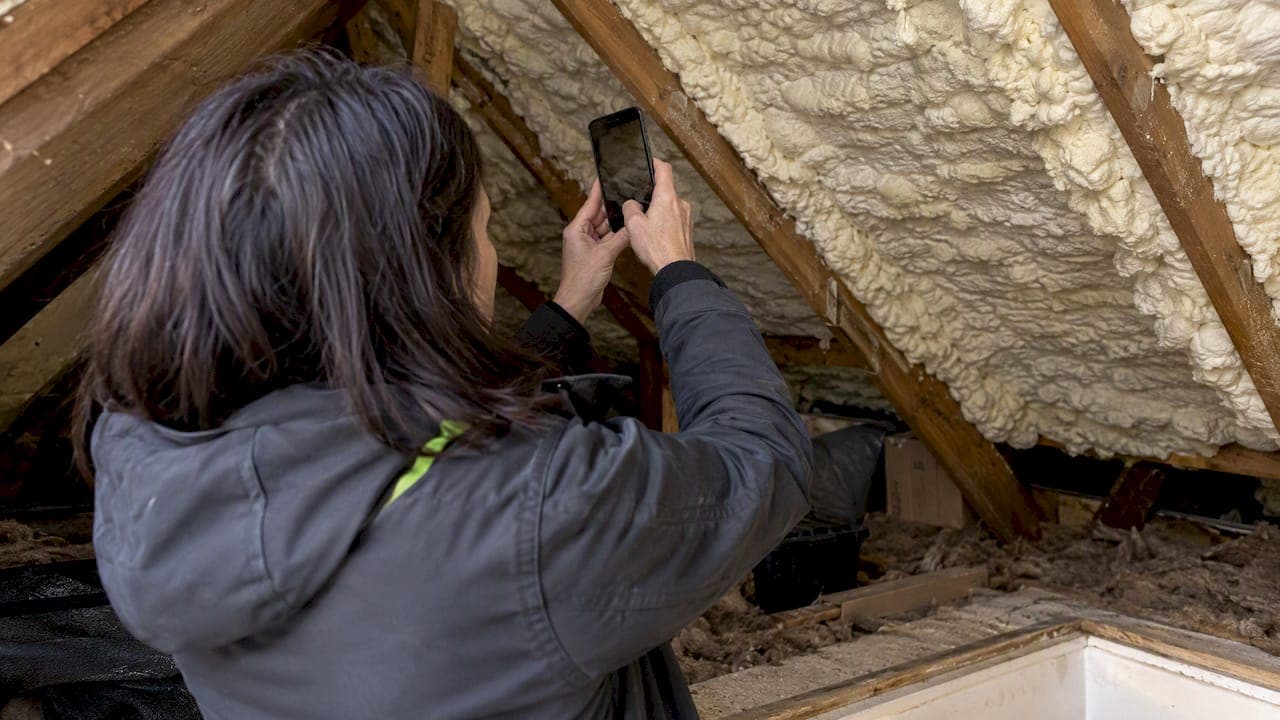
Spray foam can make mortgages harder to arrange: some major UK lenders will not lend on properties with it in the roof, while other lenders may assess applications individually and request a specialist report before proceeding. If you have found spray foam during a viewing, an important step is to ask the seller for installation paperwork and book a PCA- or RICS-aware inspection before you commit to anything.
TL;DR:
- About a quarter of major UK lenders rejected properties with roof spray foam in late 2024; others assess cases individually, so request written requirements early.
- PCA figures from more than 500 inspections found defects in 35% of properties, while 27% of cases prompted recommendations to replace insulation or reroof.
- A survey may only note the foam; ask a specialist familiar with PCA or RICS guidance to measure moisture and check ventilation and timber condition.
- Modelling found low moisture risk in many scenarios with open cell foam, vapour control, and ventilation; direct application onto tiles raised risk for either foam type.
- Make the offer conditional on a specialist inspection, and negotiate repairs or a price reduction; lenders may still require a further report after removal.
Table of Contents
- A practical checklist to run from viewing to offer
- How UK mortgage providers treat homes with spray foam
- What a PCA- or RICS-aware specialist actually inspects
- What the GOV.UK and British Standard evidence actually shows
- Remediation and removal options, and what they tend to cost
- Avoiding scams and verifying any specialist you contact
- How to negotiate and protect your offer
- The one thing buyers consistently get wrong about spray foam
- FAQ
- Sources
A practical checklist to run from viewing to offer
A few careful checks at the viewing stage can save you weeks of delay later, and they cost nothing beyond a notebook and your phone camera.
When you spot spray foam in a loft or under a roof, take photos of the extent of the coverage, the colour and texture of the foam, and any damp staining, sagging timber or mould you can see nearby. Note whether the foam has been sprayed onto the underside of the tiles directly or over a membrane, because this detail matters enormously to a surveyor later.
Before you go further, ask the seller or the estate agent for:
- The installer's name and contact details, plus the original installation certificate.
- Any BBA or Kiwa product certification and manufacturer paperwork for the foam used.
- Before-and-after photographs taken at the time of installation.
- Any humidity or moisture readings recorded when the foam was sprayed.
If this paperwork does not exist or the seller cannot produce it, treat that as a reason to commission your own specialist spray foam inspection before you remove any subject-to-survey conditions on your offer. It is also worth phoning your prospective lender at this early stage to ask directly whether they will lend on a property with sprayed foam insulation and what evidence they expect to see.
Pro Tip: Call your mortgage lender before you fall in love with the house, not after your offer has been accepted.
How UK mortgage providers treat homes with spray foam
Lender behaviour on spray foam is inconsistent, and that inconsistency is exactly what catches buyers out. As of late 2024, around a quarter of the UK's largest mortgage providers will not lend against homes with spray foam insulation in the roof, including TSB, Skipton Building Society, Co-operative Bank, Principality and the equity release provider Aviva. Other lenders assess applications case by case, relying heavily on the valuer's report and any specialist documentation you can supply.

The core worry for lenders is straightforward: spray foam, particularly closed-cell foam sprayed directly onto the underside of roof tiles, can hide the condition of the timber beneath it. A valuer cannot see whether rafters are rotting, and RICS guidance confirms that the presence of spray foam is treated as a material factor that can influence a property's valuation. Surveyors may request an independent specialist report before a lender finalises its valuation.
This caution has a documented basis. Correspondence between the Property Care Association and government departments cites PCA data from over 500 inspections in which 35% of properties had one or more defects, and in 27% of cases the surveyor recommended re-quilting or re-roofing. Figures like that explain why lenders have grown wary rather than dismissive.
What typically unblocks lending is evidence rather than removal. Lenders and their valuers generally want to see:
- The original installation paperwork and any BBA or Kiwa product certificates.
- An independent specialist report prepared using the Sprayed Foam Inspection Protocol.
- Photographic evidence of correct ventilation and an air and vapour control layer (AVCL) where open-cell foam has been used.
If this evidence cannot be produced, the consequences extend beyond your current purchase. A property that cannot be mortgaged easily now may be just as difficult to remortgage or release equity against in future, which is worth bearing in mind even if you plan to pay in cash today. Our guidance on making a property mortgage ready goes into more detail on preparing the right paperwork, and our piece on how lender caution affects property value looks at the knock-on pricing effects. Contacting your own lender early and asking for their written policy, or an example of an acceptable report format, is a useful call to make during the offer stage.
What a PCA- or RICS-aware specialist actually inspects
A standard homebuyer's survey will flag spray foam as present, but it rarely goes further than that. To satisfy a cautious lender, you usually need a surveyor working to the Sprayed Foam Inspection Protocol, the industry reference that both RICS and the Property Care Association point buyers towards through their consumer guidance and spray foam consumer guide.
A proper inspection under this protocol typically includes:
- A visual inspection of the roof void, checking coverage, application method and any visible timber condition.
- Moisture measurements taken at multiple points across the rafters and sarking felt or membrane.
- Photographic documentation of ventilation gaps, the AVCL where present, and any areas of concern.
- A hygrothermal assessment where the visual and moisture findings suggest a deeper risk needs modelling.
- A written report with a clear statement of defects found, if any, and specific recommendations.
Not every property needs the same depth of inspection. A basic visual survey is often sufficient as a first step to establish whether there is cause for concern, while a full roof report with photographs, or a drone survey where loft access is restricted or the roof pitch is steep, gives lenders the level of detail they are increasingly asking for on borderline cases. Which level you need usually depends on what your specific lender requests, so it is worth asking them directly rather than guessing.
When you choose a surveyor, check for PCA or RICS membership, confirm they hold professional indemnity insurance, and ask for a sample report so you know what you are paying for. An impartiality statement matters too: you want an assessment of the roof's condition, not a sales pitch for removal work. Even where a lender's own valuer visits the property, they will often still insist on an independent specialist report rather than relying on their own limited inspection.
Pro Tip: Ask any surveyor for a sample report before you book, so you know exactly what evidence your lender will receive.
What the GOV.UK and British Standard evidence actually shows
Much of the anxiety around spray foam comes down to one technical question: does moisture get trapped against the timber, and if so, under what conditions? The Building Safety Regulator's own modelling, published as the moisture risk report on spray foam applied to timber sloped roofs, gives a more nuanced answer than headlines often suggest.
Open-cell spray foam installed in line with BS 5250:2021, with an air and vapour control layer and properly ventilated voids, showed low moisture risk across many of the modelled scenarios, according to the GOV.UK findings. That is a meaningfully different picture from "all spray foam is dangerous", and it matters for how you read a survey report.
The risk profile changes sharply depending on application method and materials:
- A high-resistance underlay combined with open-cell foam increases moisture risk compared with a low-resistance, more breathable underlay.
- The absence of an AVCL removes a key barrier that normally stops warm, moist internal air reaching the cold roof structure.
- Foam sprayed directly onto the back of roof tiles, rather than over a membrane with a ventilated gap, produces the highest risk in the modelling regardless of whether it is open-cell or closed-cell foam.
This is why a good specialist report does not simply confirm "spray foam is present" and stop there. It should set out whether ventilation gaps exist, whether an AVCL is fitted, and whether there is any evidence of overspray directly onto the tiles. Those three details, more than the mere presence of foam, are what determine whether a lender's concern is justified in your particular case. Separate GOV.UK technical modelling reinforces the same pattern: ventilation and vapour control reduce risk, and direct-to-tile application removes that protection altogether.
Remediation and removal options, and what they tend to cost
If a specialist report flags a genuine problem, you have more options than an outright "remove everything" instruction, though which one applies depends entirely on what the surveyor finds.
The main routes homeowners and buyers consider are:
- Remedial ventilation or AVCL retrofitting, where the foam itself stays in place but gaps or a vapour barrier are added to reduce ongoing moisture risk.
- Re-quilting or partial removal, replacing foam in the worst-affected areas while leaving sound sections untouched.
- Full removal and re-roofing, which gives the clearest possible roof timber inspection but is the most disruptive and costly option.
Costs vary considerably depending on roof size, foam type and access. Our cost hub for spray foam removal sets out indicative figures for open-cell and closed-cell removal separately, since closed-cell foam is generally harder and more time-consuming to strip out. Whatever route you are quoted for, get the scope in writing from more than one source, because guidance from the Property Care Association's customer guidance is clear that removal is often time-consuming and expensive, and should not be treated as a quick fix.
It is worth being realistic about outcomes too: removing spray foam does not automatically guarantee a lender will approve your mortgage. Many lenders will still want a follow-up specialist report confirming the roof timbers are sound and correctly ventilated after the work is done, so budget for that inspection as a separate step rather than assuming removal alone closes the case.
When comparing quotes, ask each company for a detailed written scope of works, evidence of an insurance-backed guarantee, a realistic timeline, and references from previous jobs. A firm that cannot answer these questions clearly may not be the right choice for roof work on your new home.
Avoiding scams and verifying any specialist you contact
Spray foam has unfortunately become fertile ground for rogue traders, and the Property Care Association has issued direct warnings about cold calls targeting homeowners with unsolicited removal offers. There is no national spray foam removal database, so verify any firm's credentials directly with the relevant professional body.
Before engaging anyone, run through this verification list:
- Confirm PCA membership or RICS/RPSA credentials directly with the professional body, not just the company's own website.
- Ask for proof of professional indemnity and public liability insurance.
- Request a written sample report so you can see the standard of work before committing.
- Ask for references from genuinely independent past clients, not just testimonials supplied by the firm itself.
If you receive an unsolicited call or doorstep visit offering urgent removal, pause before agreeing to anything. Seek independent advice, and if something feels wrong, report it to trading standards or the PCA. Genuine specialists are happy to let you take time to check their credentials; firms pushing same-day decisions rarely are.
Pro Tip: Be cautious if a surveyor pressures you to sign a removal contract during an inspection visit.
How to negotiate and protect your offer
Finding spray foam does not have to end your purchase, but it should change how you structure your offer and your pre-sale cleaning conveyancing instructions.
- Make your offer formally conditional on a satisfactory specialist spray foam inspection, so you retain the right to renegotiate or withdraw based on the findings.
- Where the report recommends remedial work, negotiate for the seller to fund it before completion, agree a price reduction, or set up an escrow holdback so funds are released once the work is verified.
- Ask for all installer documentation, certificates and warranties in writing as part of the conveyancing pack, not as a verbal assurance from the seller.
- Instruct your conveyancer to check your specific lender's requirements early, insert protective clauses into the contract where needed, and confirm your deposit remains protected throughout.
- Be prepared to walk away if the lender will not budge or the seller refuses to provide reasonable evidence. No single property is worth taking on a mortgage risk you cannot resolve.
The one thing buyers consistently get wrong about spray foam
Most buyers treat spray foam as a binary problem: either it is fine, or it is a deal-breaker. The evidence does not support that framing. A property with open-cell foam, an AVCL and ventilated voids may fit the low-risk scenarios the Building Safety Regulator modelled. Its modelling found the highest risk when foam is applied directly to roof tiles, regardless of insulant type.
The practical plan is simple and worth repeating in order: gather every piece of installation paperwork you can get from the seller, commission a PCA- or RICS-aware survey rather than relying on a standard homebuyer's report, contact your lender before you are emotionally committed to the house, and get more than one written quote if remediation turns out to be necessary. There is no government fund to pay for spray foam removal, which is exactly the gap that high-pressure "emergency" removal firms exploit, so treat any unsolicited urgency with scepticism. For deeper reading on costs in older properties, our piece on spray foam in period properties is worth a look before you make an offer.
— jessica
This article is general information, not a substitute for advice from a qualified financial advisor. Consult a qualified financial professional about your own circumstances before acting on anything here.
FAQ
Is spray foam illegal in the UK?
The mortgage difficulties described here are practical rather than legal: some mortgage lenders will not lend on properties that have it, which is a commercial lending decision rather than a legal restriction.
Can you sell a house with spray foam?
Yes, you can sell a house with spray foam, but the pool of buyers able to get a mortgage may be smaller, since around a quarter of major UK lenders currently decline to lend against such properties. Providing installation paperwork and a specialist survey report upfront tends to make a sale go more smoothly.
Can I get a mortgage if I have spray foam insulation?
It depends on your lender and the type of foam present: some major lenders refuse outright, while others assess the case individually based on a specialist report. Evidence such as installation certificates, BBA or Kiwa documentation, and an inspection following the Sprayed Foam Inspection Protocol is usually what determines the outcome.
How much does spray foam devalue a house?
There is no fixed devaluation figure, because the impact depends on the lender's view, the foam type, and whether paperwork exists to support an independent valuation. The practical effect is often a narrower pool of mortgage-ready buyers rather than a specific percentage drop, so a current, accredited survey report is the best way to understand the position for your particular property.
Sources
For further reading, see the GOV.UK moisture risk report, RICS consumer guidance, the PCA consumer guide and the Commons Library briefing on spray foam and mortgages, plus the PCA's member directory for finding an accredited surveyor.
- Gov
- Spray Foam Insulation
- Boxallbrownandjones
- Miatta Fahnbulleh MP Parliamentary Under Secretary of State Department for Energy Security and Net Zero