
An insurance-backed guarantee (IBG) is an insurer-backed copy of your installer's workmanship guarantee that stays valid if the installer ceases trading. For most homeowners having cavity wall, loft, external wall, or room-in-roof insulation fitted, the installer arranges and funds the IBG as part of the job price. It commonly covers workmanship and material defects, often runs for a long term on cavity wall jobs, and usually transfers to the next owner when you sell.
TL;DR:
- Insurance-backed guarantees for cavity wall, external wall, loft, and room-in-roof insulation often come from recognized schemes like CIGA and TrustMark and are usually included in the installer’s price.
- These guarantees typically cover workmanship and material defects for long-term periods, often extending to future property owners, but do not replace statutory rights or cover unrelated building issues.
- Homeowners should verify the guarantee's validity using databases like CIGA, retain official certificates, and understand that the installer is responsible for arranging and paying for the policy.
- Making a claim requires prompt documentation, initial contact with the installer, and, if unresolved, escalation directly to the guarantee provider for an independent inspection.
- For failed spray foam insulation causing damp or mortgage issues, specialized removal may be necessary, with certified technicians offering free inspections and mortgage-compliant certification services.
Table of Contents
- What is an insurance backed guarantee and how does it protect insulation work?
- Which insulation jobs commonly come with IBGs?
- Who arranges and pays for the guarantee?
- How to make a claim on your insulation guarantee
- How to check if your insulation already has a guarantee
- IBG, installer guarantee, or manufacturer warranty: which applies?
- Your pre-contract checklist before insulation work starts
- When insulation problems need specialist removal, not just a claim
- A publisher's view on insurance-backed guarantees
- How Sprayfoamremovalhelp helps when insulation goes wrong
- Sources
- FAQ
What is an insurance backed guarantee and how does it protect insulation work?
An IBG mirrors whatever your installer already promised you in writing. If your fitter guarantees the cavity wall insulation for 25 years, the insurance policy behind it exists purely to make good on that promise if the company disappears.
That's the entire point of the mechanism. While your installer is trading, they remain your first port of call for any defect. The IBG only activates once the original installer cannot honour their written guarantee, typically through insolvency or liquidation. At that point, the insurer steps in, arranges an independent inspection, and organises remedial works through an approved contractor.
It's worth being realistic about what this policy will and won't do. An IBG doesn't cover damage caused by unrelated building issues, doesn't extend to work the original guarantee never mentioned, and doesn't replace your statutory consumer rights. Think of it as a backstop, not a first line of defence.
Which insulation jobs commonly come with IBGs?
Not every insulation job automatically comes wrapped in insurer-backed protection, but several common measures do, particularly where the installer is part of a recognised scheme. Coverage typically extends to:
- Cavity wall insulation (CWI): Frequently backed by CIGA, with guarantees commonly running a long term from installation.
- External wall insulation (EWI): Often carries an IBG where the job falls under a funded or TrustMark-monitored scheme.
- Loft insulation: Increasingly guaranteed where installed through accredited installers, though standalone DIY-style top-ups rarely carry one.
- Room-in-roof insulation: Treated similarly to loft work, with IBG cover more likely on larger, professionally fitted jobs.
Government-funded schemes add another layer here. Where insulation is installed under ECO funding, an appropriate insurance-backed guarantee is mandated by scheme rules, and TrustMark-approved financial protection mechanisms are used to prove compliance. If your quote mentions ECO funding and doesn't mention a guarantee, ask why.
Who arranges and pays for the guarantee?
There's no legal requirement in the UK for a contractor to provide an IBG on general home improvement work. It's a voluntary trust signal, not a statutory obligation, which is exactly why it's worth insisting on for anything beyond a small job.
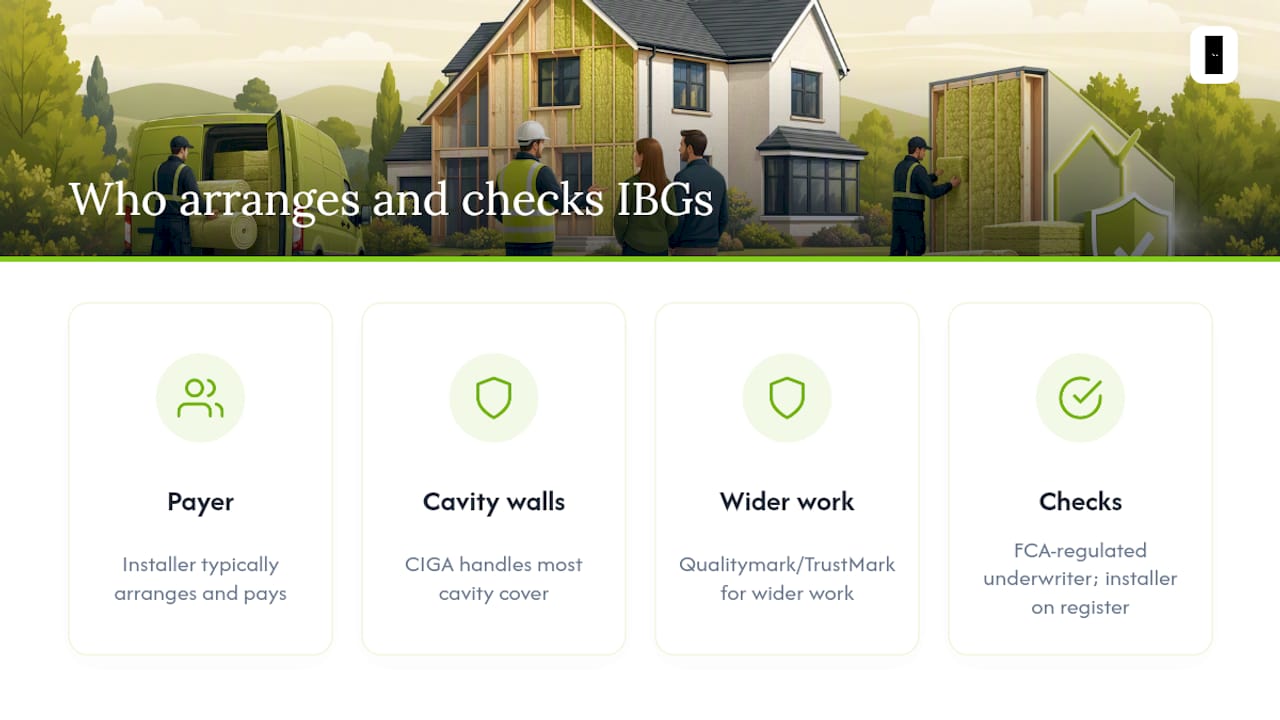
In practice, installers typically arrange and pay for the policy, folding the cost into your overall contract price rather than billing it separately. You won't usually see a line item for it, but you should see the certificate.
The providers behind these guarantees vary by insulation type. CIGA handles the bulk of cavity wall cover, while Qualitymark and other TrustMark-approved mechanisms serve wider insulation and home improvement categories. What matters most is the underwriter, not the brand on the certificate. A genuine IBG sits with an FCA-regulated insurer, and the installer issuing it should be accredited and, ideally, appear on a scheme's registered-installers list. Providers vet installers before offering cover, so an installer who can produce an IBG has already cleared a basic reliability check. One who can't, or who gets vague when you ask, is telling you something too.
How to make a claim on your insulation guarantee
Making a claim is straightforward if you've kept the right paperwork, and considerably harder if you haven't. Follow the sequence in order.
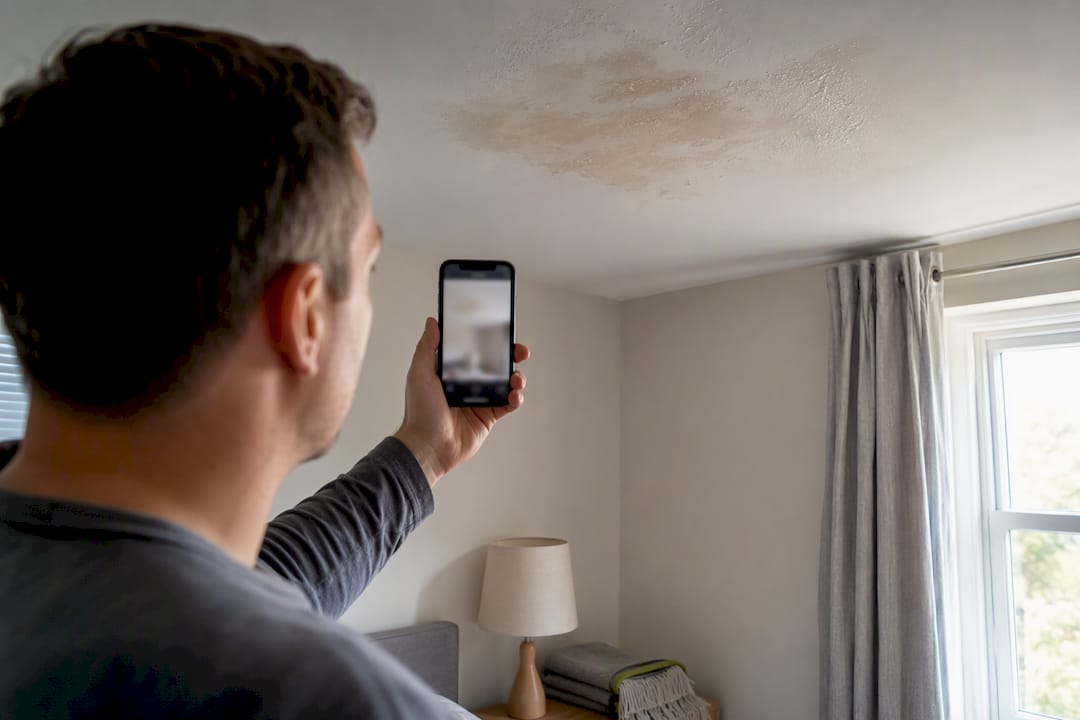
- Contact the installer first. Document the defect with dated photographs, keep a note of when the issue appeared, and have your original contract to hand.
- Escalate to the guarantee provider if the installer won't or can't help. For cavity wall insulation this usually means contacting CIGA directly; for other measures, contact the named IBG provider on your certificate.
- Provide the required documents. Expect to submit your certificate number, the original contract, and evidence of the defect.
- Wait for an independent inspection. If the claim is accepted, the insurer arranges an inspection and approved remedial works rather than simply refunding you.
Timeframes vary by provider, and some policies apply a small excess or require online registration to activate. Ofgem's guidance for ECO measures confirms this same order: installer first, guarantee provider second, and it's worth reading if your insulation was fitted under an ECO scheme.
Pro Tip: Photograph the defect the day you notice it, not the day you decide to complain. Insurers weigh dated evidence far more heavily than a description written weeks later.
If damp or condensation is what prompted the claim, our guide to spray foam condensation explains what evidence surveyors typically expect to see.
How to check if your insulation already has a guarantee
If you're buying a house, selling one, or simply can't remember what your installer promised years ago, checking is easier than you'd think. Start with the CIGA database for cavity wall insulation, since CIGA guarantees are widely recognised by solicitors, surveyors and lenders, which makes them particularly valuable evidence during a sale. TrustMark's own listings will confirm whether an installer or scheme carried approved financial protection.
Beyond the databases, ask the installer directly for a certificate of insurance and the written guarantee itself, then keep copies in your conveyancing pack alongside the contract and invoice. For anything installed under ECO funding, Ofgem's consumer guidance is the authoritative route to confirm which provider issued the paperwork and whether it's still valid.
IBG, installer guarantee, or manufacturer warranty: which applies?
These three protections get confused constantly, and knowing which one to reach for saves weeks of wasted phone calls.
Your installer's guarantee is the first port of call while that company is still trading. It's the direct promise, and the IBG exists solely to back it up if the company folds. A manufacturer warranty covers faults in the insulation material itself, such as a defective batch of foil or board, but says nothing about whether it was fitted correctly. A structural warranty is a different product entirely, covering latent structural defects in the building rather than the insulation work, and it's not a substitute for an IBG on complex jobs where both might genuinely apply.
Confusing these three is the most common reason homeowners chase the wrong provider after a defect appears.
Your pre-contract checklist before insulation work starts
Get these answers in writing before you sign anything, not after the crew has left.
- Ask which IBG provider will issue the guarantee, and when the certificate will actually arrive.
- Confirm the installer's accreditation status, whether that's TrustMark, CIGA registration, or another recognised scheme.
- Check that the underlying insurer is FCA-regulated, since that's what makes the policy enforceable rather than decorative.
- Retain the signed contract, all invoices, and the certificate itself in one place.
- Note the claims contact details and photograph the finished work before you forget what it looked like.
Pro Tip: A reputable installer will happily hand over the IBG provider's name before you've paid a deposit. Reluctance at this stage is a far bigger red flag than the price itself.
If your job involves multifoil products, our multifoil building regs guide covers the compliance points that can affect what guarantee is available.
When insulation problems need specialist removal, not just a claim
Some insulation failures go beyond what an IBG claim can fix, and spray foam is the clearest example. Non-compliant closed or open cell foam can trap damp, cause timber decay, and stop lenders approving a mortgage or remortgage outright. Our rockwool vs fibreglass comparison shows why some replacement materials fare better under these conditions.
Sprayfoamremovalhelp's PCA-certified technicians document every removal for exactly this reason, issuing mortgage-compliant certification that lenders and surveyors accept, backed by a 10-year insurance-backed warranty of our own.
A publisher's view on insurance-backed guarantees
Homeowners tend to treat IBGs as paperwork rather than protection, which is backwards. Treat them as a sensible protective layer for any insulation job substantial enough to matter financially, and push back gently when an installer seems reluctant to name their provider.
The certificate itself is worth more than most people realise, especially at sale time, when a solicitor asking for proof of guarantee can hold up completion for weeks if you can't produce one. Confirm it, file it, and keep it with your conveyancing paperwork.
— jessica
How Sprayfoamremovalhelp helps when insulation goes wrong
An IBG protects you against a vanished installer, but it won't fix insulation that was the wrong product for the job in the first place. That's a different problem, and it's the one Sprayfoamremovalhelp exists to solve, working directly with London and Southeast homeowners rather than through call centres or subcontracted crews.

If damp, mortgage refusals, or a failed survey have pointed to spray foam as the cause, our team offers a free inspection to assess whether removal is genuinely necessary before you commit to anything. Where it is, our PCA-certified technicians carry out safe closed and open cell removal and issue the mortgage-compliant certification lenders ask for, all detailed in our spray foam removal guide. For anyone facing a lender query right now, our Spray Foam Mortgage Guide explains exactly what documentation gets a remortgage back on track. Book the free inspection first. It costs nothing to find out where you stand.
Sources
- Insurance Backed Guarantees (AHCI)
- Insulation Insurance Backed Guarantees | Qualitymark Protection
- Approved Financial Protection Mechanisms | TrustMark
- Cavity wall insulation: consumer guide to issues arising from installations (gov.uk PDF)
FAQ
What companies offer insurance-backed guarantees for insulation?
CIGA is the main provider for cavity wall insulation, while Qualitymark and other TrustMark-approved mechanisms cover external wall, loft, and room-in-roof insulation, depending on which scheme your installer is registered with.
Are insurance-backed guarantees worth having?
Yes, for any insulation job of meaningful cost, since the guarantee costs you nothing extra beyond what's already built into the installer's price and it protects you if that company later ceases trading.
What are the regulations for insulation in the UK?
There's no legal requirement to hold an IBG for standard home improvement insulation work, but ECO-funded measures must carry an appropriate insurance-backed guarantee under TrustMark-approved financial protection mechanisms as a condition of the funding.
Who pays for an insurance-backed guarantee?
The installer typically arranges and pays for the policy, building the cost into your overall contract price rather than charging it as a separate fee.