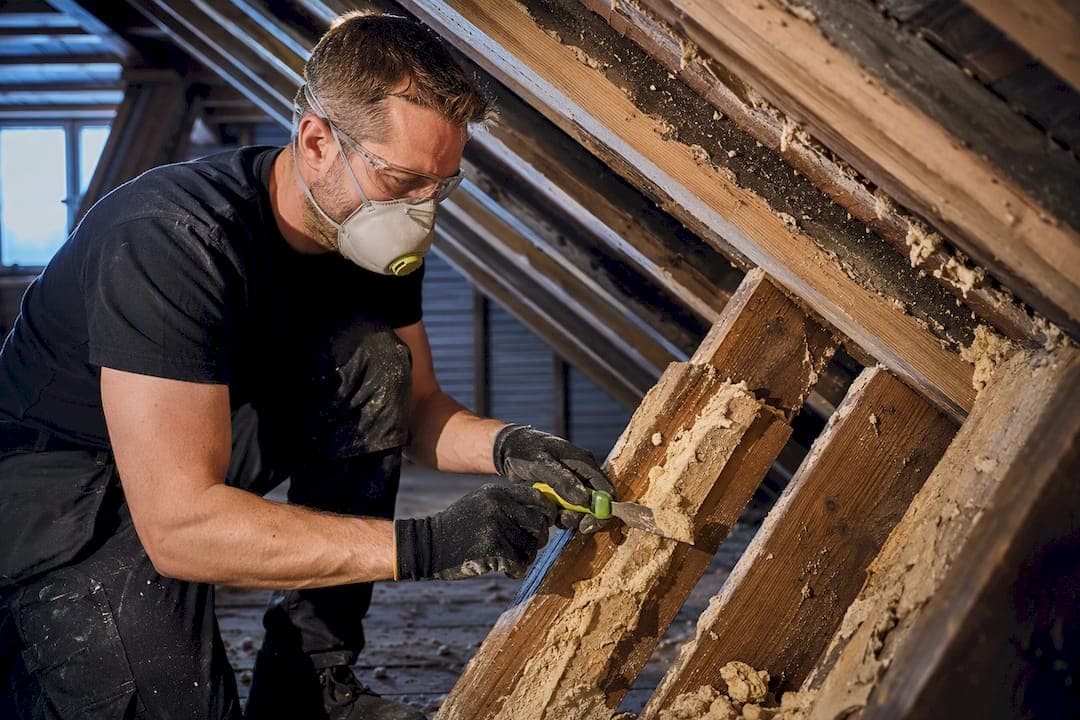
Removing spray foam insulation from a UK loft typically costs between £2,500 and £8,000, with most three-bed properties landing around £3,000 to £5,500 depending on foam type and access. Open-cell foam costs less to strip than closed-cell. If a survey or mortgage valuation has flagged foam in your loft, the priority isn't just booking removal, it's booking a survey that ends in mortgage-compliant paperwork, because that's what lenders will actually ask for.
TL;DR:
- Most loft foam removal in the UK costs between £2,500 and £8,000, depending on foam type, loft size, and access complexity.
- Closed-cell foam removals are more expensive due to their density, adherence, and need for mechanical scraping, especially in larger or complex lofts.
- Accurate quotes require specifying loft area, access type, foam depth, and whether additional repairs or scaffolding are needed to avoid hidden costs.
- Lenders often demand post-removal surveys and certification to approve mortgages, making documentation crucial for property sale or remortgage.
- A proper removal includes a fixed survey, itemised costs, safety measures, licensed waste disposal, and a mortgage-compliant certificate to ensure full compliance.
Table of Contents
- How much does loft foam removal cost in the UK?
- Working out your own loft foam insulation cost
- What actually drives your quote up or down
- What should be included in a professional removal quote?
- How long does loft foam removal actually take?
- Why mortgage lenders care about spray foam removal
- Choosing a contractor without getting stung
- What sets a specialist removal team apart
- The verdict on cost estimates versus what actually matters
- Get a straight answer on your loft, not just a quote
- Sources
- FAQ
How much does loft foam removal cost in the UK?
Published figures for loft foam removal cost vary more than you'd expect for what sounds like a simple job. The most commonly cited range across specialist removal guides sits at £2,500 to £8,000, with a typical three-bed semi falling in the middle of that band. Checkatrade puts a three-bed detached roof removal at roughly £3,200, which sits comfortably inside the wider range.
Per-square-metre pricing tells a similar story. Specialist removal advice sites report bands of roughly £28 to £75 per m², with the lower end covering straightforward open-cell jobs with good access and the upper end reflecting closed-cell foam that needs mechanical scraping or specialist tooling.
Why do the numbers spread so widely? A few reasons:
- Scope differences — some quotes cover stripping only; others bundle disposal, a post-removal survey, and certification.
- Sample size and region — a guide built from London jobs will skew higher than one averaging rural quotes.
- Foam type mix — closed-cell jobs pull the average up; open-cell jobs pull it down.
- Hidden extras — timber repairs, scaffolding, and skip hire aren't always included in the headline figure.
When you're comparing quotes, treat the £2,500 to £8,000 range as a sanity check, not a quote in itself. If a contractor comes in well below £2,500 for a full three-bed loft, ask exactly what's excluded before you sign anything.
Working out your own loft foam insulation cost
Published ranges are useful, but you'll get a far better feel for your own bill by doing some rough arithmetic against your loft's floor area. Here's how to approach it:
- Small terraced house (roughly 25–35m²): at £28–£45/m² for open-cell foam, expect a ballpark of £900 to £1,600 for stripping alone, before survey, disposal, and certification are added. Once those are included, totals commonly land closer to £2,500 to £3,000.
- Standard three-bed semi (roughly 40–55m²): this is where most published totals cluster, typically £3,000 to £5,500 all-in, assuming reasonable loft access and no major timber damage underneath.
- Four-bed detached (roughly 60–80m²): expect £4,500 to £7,000, rising toward the top of that if the foam is closed-cell or the roof has multiple hips and valleys that slow the strip-out.
- Large or complex detached (80m²+, closed-cell throughout): this is where jobs push toward or past £8,000, particularly if scaffolding is needed for external access or timber sections need replacing.
Closed-cell foam typically adds a meaningful premium over open-cell at the same square metreage, because it bonds rigidly to timber and needs mechanical removal rather than simple hand-stripping. Before calling anyone for a quote, have three things ready: an approximate loft floor area in m², a note on roof access (loft hatch only, or external scaffolding likely), and whether you know the foam's approximate depth. That alone will get you a far more accurate ballpark on the phone.
What actually drives your quote up or down
Contractors price a loft foam removal job against a handful of variables, and understanding them means you can spot when a quote is missing something important rather than simply being cheap.
- Foam type: open-cell is softer and generally quicker to remove; closed-cell is dense, adheres more firmly to rafters and boards, and usually carries a surcharge for the extra labour and tooling.
- Access and roof geometry: a simple loft hatch is straightforward; a steep roof, multiple dormers, or a loft that needs scaffolding for safe access adds cost before any foam is even touched.
- Hidden timber damage: foam trapped moisture against rafters for years in some properties, and contractors regularly find rot or damaged sarking boards only once the foam comes away.
- Waste handling and disposal rules: spray foam waste has to be bagged and disposed of correctly, and skip hire or licensed waste transfer fees are a common addition to the final invoice.
- Local labour rates and demand: London and the Southeast tend to run higher than the national average, and quotes can rise in winter when demand for insulation-related work increases.
Pro Tip: Ask every contractor to quote separately for stripping, disposal, and any timber repair contingency. A single lump-sum figure hides which of those three is driving your price up, and makes it far harder to compare quotes properly.
What should be included in a professional removal quote?
A proper written quote for loft foam removal cost should read as a breakdown, not a single number. If a contractor doesn't itemise, that's worth noting before you go any further.
- A site survey and fixed written price, broken into stripping, disposal, and any anticipated repair work, rather than one bundled total.
- Containment and health and safety measures, including PPE for technicians and dust or particulate control while the foam is stripped out.
- Waste disposal with proper paperwork, confirming the foam was taken to a licensed facility rather than dumped informally.
- A post-removal inspection and mortgage-compliant certificate, confirming the roof timbers were checked and the loft is now in a lendable condition.
- An insurance-backed guarantee or warranty, covering the work itself rather than relying solely on the contractor's own promise.
Skip any of these and you risk paying for a job that looks finished but doesn't satisfy a mortgage lender later. Our guide on what a spray foam survey costs breaks down what that initial assessment fee typically buys you.
How long does loft foam removal actually take?
Most residential jobs run one to five days from start to finish, though the schedule usually splits into distinct stages rather than one continuous job.
- Survey and quote appointment: often booked within a week or two, sometimes with a small assessment fee that's credited against the job if you proceed.
- Removal day(s): containment goes up, foam is stripped and bagged, and waste is removed from site; straightforward open-cell jobs often finish in a day, closed-cell or larger lofts take longer.
- Post-removal inspection: timber and roof tiles get checked once the foam is gone, and any remedial repairs are scoped here.
- Re-insulation and paperwork: once repairs are signed off, new insulation goes in and completion certificates are issued.
Our full walkthrough of the spray foam removal process covers what happens on each of those days in more detail.
Why mortgage lenders care about spray foam removal
Several major UK lenders have restricted or refused mortgages on properties where spray foam is present, and BBC reporting has documented cases where homeowners faced substantial extra costs simply to regain standard mortgage eligibility. This is the part of loft insulation extraction cost that catches people out: the physical removal is only half the job.
Successful remediation for mortgage purposes usually requires both the physical removal and a post-removal structural or roof report from a qualified inspector. The paperwork, not just the stripping, is frequently what lenders actually demand.
Lenders typically want to see a post-removal survey report, dated photographs of the cleared loft, and a formal certificate confirming the roof structure was inspected once the foam was gone. Without that documentation, you can have a perfectly clean loft and still struggle to remortgage or sell.
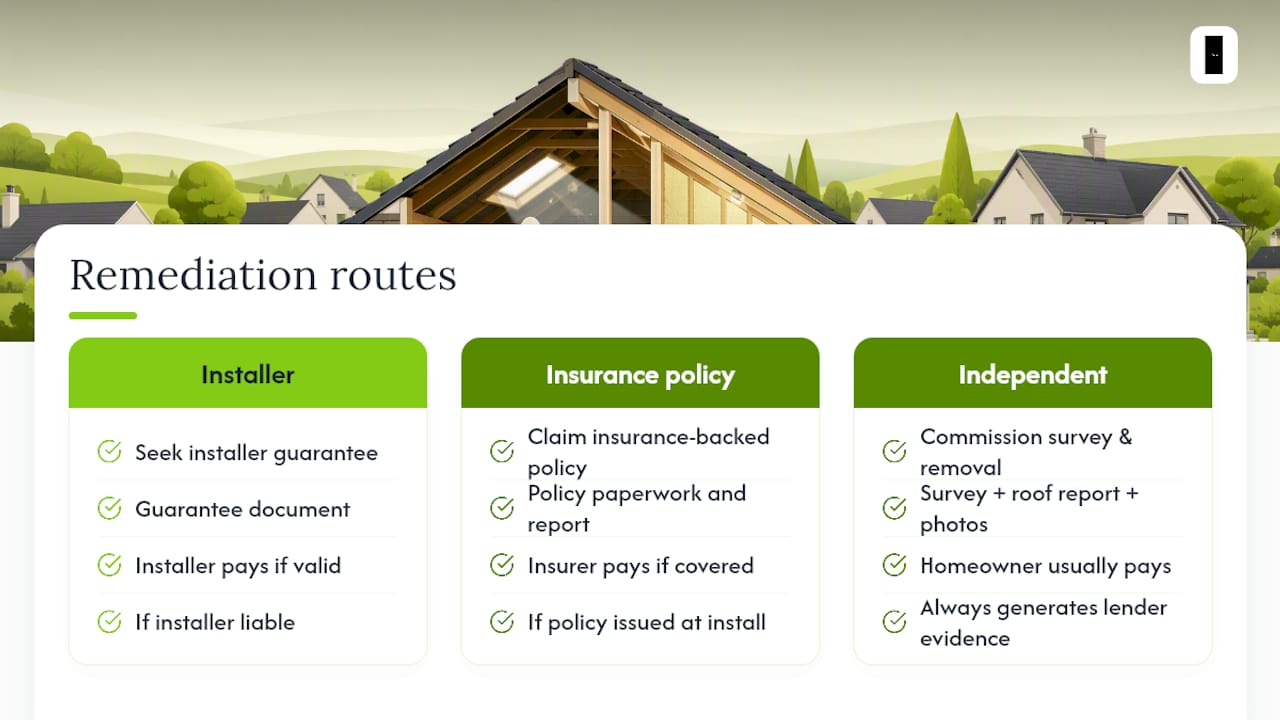
If a survey has already flagged foam on your property, there are three realistic remediation routes: chase the original installer for a guarantee if one exists, claim against an insurance-backed remediation policy where one was issued at installation, or commission an independent survey and removal to generate fresh, lender-acceptable evidence. The House of Commons Library notes there is no general government fund for spray foam removal, so this sits with the homeowner or, where applicable, the original installer's guarantee. If your surveyor has already raised concerns, our piece on what to do when a surveyor refuses loft spray foam walks through the next steps, and TrustMark or the relevant ombudsman are worth contacting if an installer won't honour a guarantee.
Choosing a contractor without getting stung
The insulation removal market has attracted its share of cold callers and lowball quotes, and Plymouth City Council's own scam warning is a useful reminder that "cheap and fast" isn't always what it claims to be. A short set of questions on your first call filters out most of the risk.
- Are your technicians PCA-certified, and can you show a sample of the certificate you'll issue afterwards?
- Is the work covered by an insurance-backed guarantee, and for how long?
- Will you provide a written, itemised quote before any work starts?
- Does the price include a post-removal survey, or is that billed separately?
- Can you provide references from recent jobs of a similar size?
Red flags are easy to spot once you know them: unsolicited calls, verbal-only pricing, no mention of certification, and pressure to book "today's discount." Trust signals run the other way, PCA or RICS awareness, an insurance-backed warranty offered upfront, and a written quote that survives being read twice.
Pro Tip: Copy those five questions into an email and send them to every contractor you're considering. The ones who answer clearly and promptly are usually the ones who'll turn up and do the job properly.
What sets a specialist removal team apart
Sprayfoamremovalhelp provides spray foam removal services across London and the Southeast, with PCA-certified technicians carrying out safe, mortgage-compliant removal on both closed and open-cell foam. Clients may deal directly with the team doing the physical work rather than through a subcontracting chain, which can keep pricing transparent and avoid markups that often creep in when middlemen are involved.
A direct model can matter for the reasons lenders and homeowners care about: certification paperwork that satisfies a mortgage valuation, a fixed price with no surprise line items, and an insurance-backed warranty rather than a verbal promise. When the job's success depends on documentation as much as the stripping itself, having the certifying technicians and the removal technicians be the same people removes a step that often goes wrong.
The verdict on cost estimates versus what actually matters
Cost ranges get all the attention in this market, and that's understandable, homeowners want a number before they pick up the phone. But treating loft foam removal cost as the whole problem is where most people go wrong. A £2,500 quote that skips the post-removal survey is more expensive than a £3,500 quote that includes one, because you'll pay for that survey separately later, usually under more time pressure, often mid-sale.
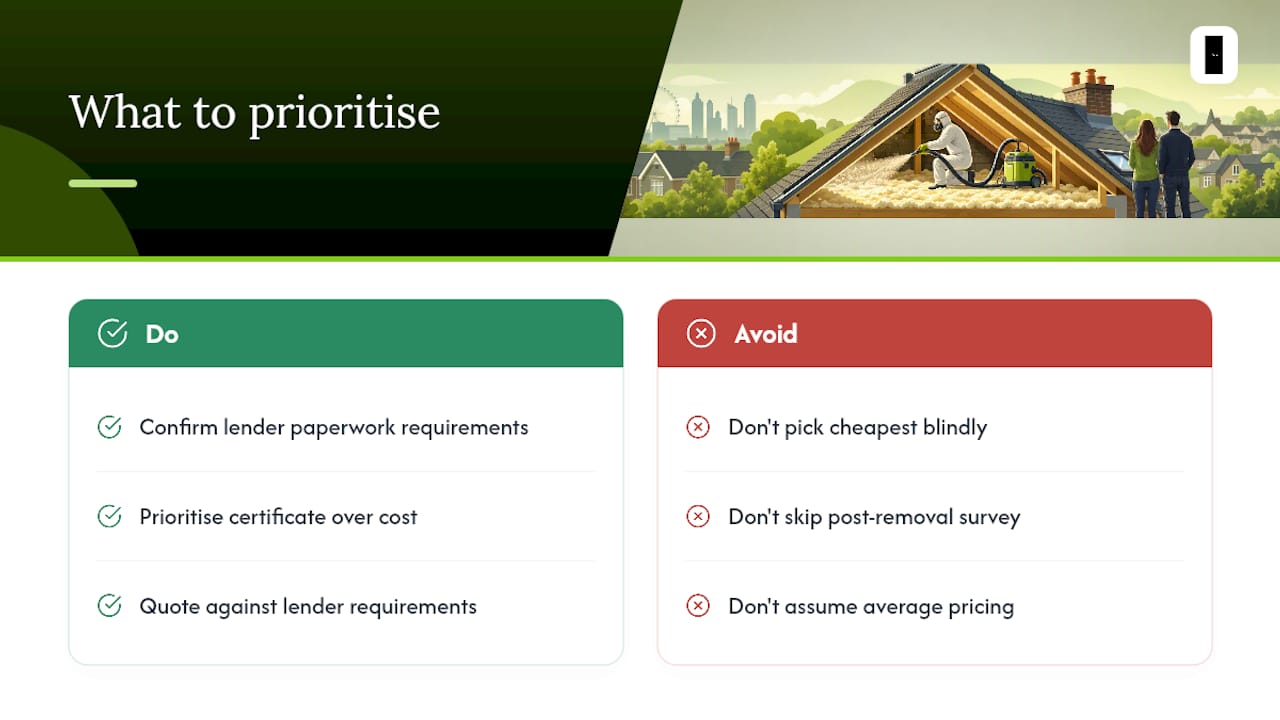
The conventional advice, "get three quotes and pick the cheapest," works fine for a kitchen refit. It works badly here, because the cheapest stripping job and the job that actually restores your mortgage eligibility aren't automatically the same job. Lender behaviour, not average pricing, should set your priorities: confirm what documentation your specific lender or buyer's lender wants before you book anyone, then quote against that requirement rather than a generic price list.
If you take one thing from this, prioritise the certificate over the cost. A slightly higher quote that guarantees mortgage-ready paperwork will save you far more than it costs, measured against the alternative of a failed valuation months later.
— jessica
Get a straight answer on your loft, not just a quote
Some providers offer a fixed, itemised price from certified technicians who will do the removal, sometimes backed by an insurance-backed warranty rather than just a verbal assurance.
If a surveyor has flagged spray foam in your loft, or you're simply trying to work out where your property sits within the ranges covered above, the sensible next step is a proper inspection rather than another guess at a number. A specialist team can assess your loft, confirm whether you have open or closed-cell foam, and provide a written quote without hidden extras. Check current spray foam removal costs for your property type, or book a free inspection to get a report you can actually hand to a lender.
Sources
The House of Commons Library briefing is the clearest official summary of lender behaviour and the lack of government funding for removal. BBC News documents real cases of lenders refusing mortgages over spray foam. Spray Foam Removal Advice provides the most detailed UK price breakdown by property type, and MyBuilder is a solid check on typical trade extras like skip hire and timber repairs. For related structural surveys, UpKeep UK's guide to fire compartmentation surveys is a useful reference if remedial work extends beyond insulation.
- Major lenders reject homes with spray foam insulation - BBC News
- Spray Foam Insulation Removal Cost UK: Full 2026 Price Breakdown
- Spray Foam Removal Cost
FAQ
How much does it cost to remove foam from a loft?
Most UK loft foam removal jobs cost between £2,500 and £8,000, with a typical three-bed property landing around £3,000 to £5,500 depending on foam type, access, and whether timber repairs are needed.
Can you sell a house with foam loft insulation?
You can, but several major lenders restrict mortgages on properties with spray foam present, so buyers relying on standard mortgage finance may struggle unless you can provide post-removal survey paperwork or an acceptable remediation report.
Should I remove old loft insulation before laying new insulation?
Yes, old spray foam should be fully removed and the roof timbers inspected before new insulation goes in, since foam trapped moisture can hide rot that needs repairing first.
How do I get rid of foam loft insulation?
Book a survey with a certified removal specialist who can assess the foam type and access, then arrange professional stripping, licensed waste disposal, and a post-removal inspection that generates mortgage-compliant certification.