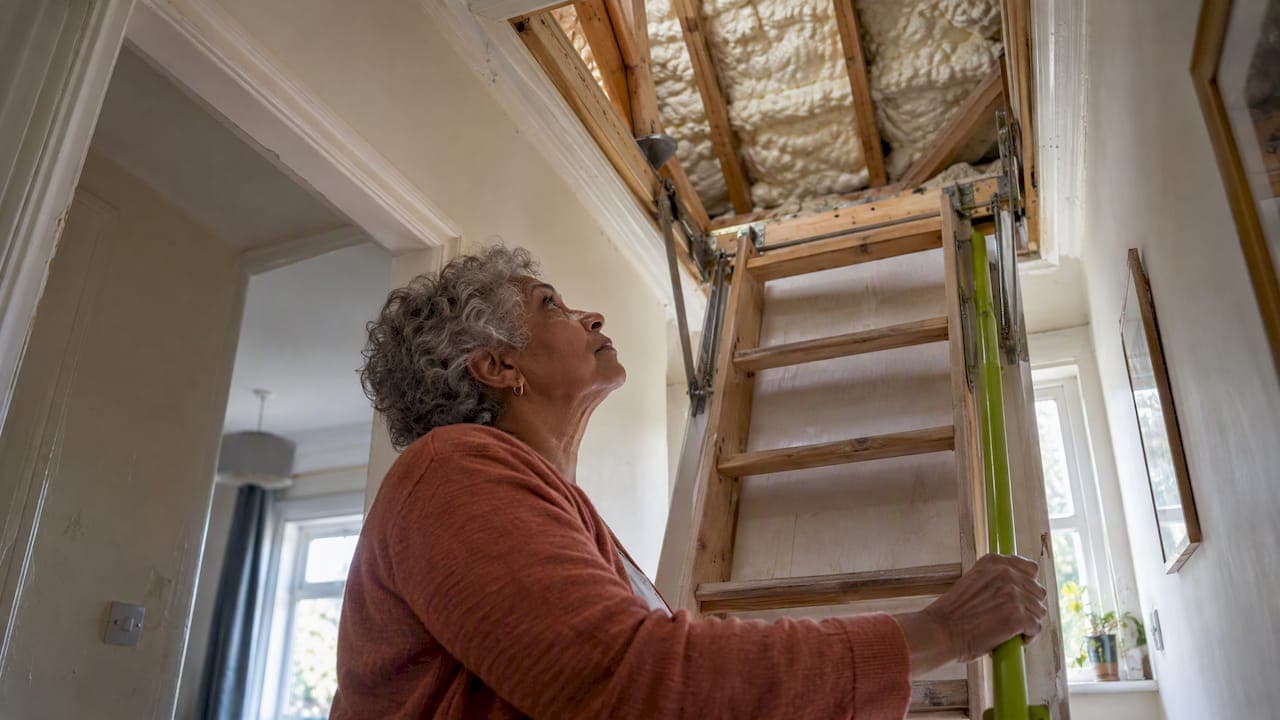
If your loft has spray foam insulation that was added after the house was built, equity release is likely to be difficult or impossible until the problem is dealt with. The HomeOwners Alliance reports that, at the time of writing its guide, no equity release lenders would lend on a property with spray foam roof insulation installed after construction. The usual route is to have the foam removed by a certified specialist, document the roof timbers properly, and then ask an adviser to approach lenders again.
This guide explains why lenders react this way, how to find out what you have, what removal and paperwork involve, and the order of steps that avoids wasted money. We are a specialist removal team, so we say where we can help. We also say where you need someone else, such as a regulated equity release adviser.
TL;DR
- Equity release lenders are far more cautious about spray foam than ordinary mortgage lenders, largely because the foam can hide timber problems and make roof repairs hard.
- Spray foam fitted when the house was built is treated differently from foam added later. Foam added later is the usual blocker.
- Removal alone is not always enough. Lenders and surveyors want documented proof of the roof's condition, including photos before, during and after.
- Open cell removal on our published pricing is £1,000 to £5,000 and closed cell is £1,500 to £7,000. Surveys start from £100.
- Equity release is a regulated, advised decision. Get a survey and a quote first, then speak to an FCA-regulated adviser.
Table of Contents
- Why equity release lenders object to spray foam
- Is all spray foam a problem?
- How to find out what is in your loft
- Why removal is the first step, not the last
- What removal costs
- Should you have it removed before applying for equity release?
- Equity release is regulated, so take advice
- If you are buying a home with spray foam
- Avoiding mis-selling the second time
- Our perspective on equity release and spray foam
- How we can help
- FAQ
- Sources
Why equity release lenders object to spray foam
Equity release, usually a lifetime mortgage, lends against your home and is repaid when you die or move into long-term care. The lender is therefore exposed to the property's value for decades, and it wants to be sure the building will hold that value.
The HomeOwners Alliance explains that equity release lenders are more risk-averse than ordinary lenders because they may end up owning the property outright. A roof that cannot be inspected and may be decaying is a large unknown.
Three practical problems sit behind the caution.
Hidden moisture and timber decay
Spray foam sticks directly to rafters and the underside of the roof covering. If moisture gets in, it can be trapped against the timbers with no way to dry out. Warwickshire County Council's guidance warns of this hidden moisture and long-term rot, and advises keeping an unused loft ventilated and dry.
The Building Safety Regulator takes a measured view. Its response to the minister notes that some scenarios carry low moisture risk, while high-risk ones involve foam applied directly to tiles or high-resistance underlay without proper air and vapour control. That is why a clear, certified installation history matters so much to a lender.
A roof that is hard to repair
When foam is applied directly to the underside of roof tiles, it can bond the whole roof into one structure. Warwickshire's guidance points out that replacing an individual tile can then become close to impossible without damaging the foam. Surveyors flag this as future maintenance cost, and future maintenance cost is exactly what a lender looking at a 20 or 30 year loan worries about.
Missing paperwork
Most foam was installed with little or no documentation. The HomeOwners Alliance notes that some mortgage lenders do lend where the correct paperwork exists, but the vast majority of homeowners do not have it. Without paperwork, a lender cannot tell a well-installed roof from a risky one, so it treats them all as risky.
Is all spray foam a problem?
No. The type of foam, where it was applied and when matter a great deal.
| Situation | How lenders tend to see it |
|---|---|
| Foam installed when the house was built, with documentation | Usually the least problematic, though each lender sets its own policy |
| Foam added later to the roof, no paperwork | Most likely to block equity release |
| Open cell foam | Generally easier to remove, and cheaper to remove |
| Closed cell foam | Harder to remove, and more often associated with survey flags |
| Foam on walls or floors rather than the roof | Treated differently from roof foam, but still declared and assessed |
This table is a general guide, not a lender policy. Lender rules change, and an equity release adviser is the person who knows which providers will currently look at your case.
The RICS consumer guide on spray foam is clear that foam is a serious modification and that its presence will be reflected in a surveyor's valuation. It may require an independent specialist report to satisfy lender concerns. In other words, the presence of foam is a valuation matter, not just an insulation matter.
How to find out what is in your loft
Many homeowners do not know what they have. Foam may have been added by a previous owner, or sold to you under a scheme or a doorstep offer years ago.
Check these first:
- Your paperwork. Look for an installation certificate, an invoice, a guarantee or any scheme documents.
- The date. Foam installed during original construction is a different case from foam added to an older house.
- The loft itself. A hatch-level look often shows a yellowish or off-white foam stuck to the rafters and tiles rather than mineral wool laid on the floor.
- The cell type. Open cell foam is soft and spongy. Closed cell is hard and rigid. The type affects both lender attitude and removal cost.
If you cannot tell, a survey removes the guesswork. We offer a Basic Visual Survey from £100, a Full Roof Report with photos from £200, a Drone Survey and Report from £250, and a Full Drone and Detailed Report at £350 to £450. The more detailed reports give you evidence a lender or surveyor can read, rather than your own description. You can see them on our surveys and services page.
Why removal is the first step, not the last
This is the point most homeowners miss. Taking the foam out does not automatically restore mortgageability.
Cornwall Council's Trading Standards advice covers problems with mortgages, property condition and misleading sales. Lenders may want documented proof that the roof structure was not damaged before or during installation, so removal is only the first stage.
RICS stresses independent, professional documentation over impulsive removal. In practice that means:
- Photographs of the roof timbers before removal.
- Photographs and notes during removal.
- Photographs and a condition report after removal.
- A report from a suitably qualified surveyor or specialist that a lender can accept.
Without that file, it is much harder to satisfy a future lender or surveyor. This is a point we build into every job. If you hire someone who removes the foam, hands you an invoice and leaves, you may have the foam gone and still be unable to prove the timbers are sound.
It also explains why removal sometimes reveals nothing wrong. A clean, dry roof structure with records is a very different proposition from a roof nobody has looked at.
What removal costs
Cost depends on the type of foam, the roof area and access. Our published ranges are:
| Service | Published price |
|---|---|
| Spray foam removal (overall range) | £1,000 to £7,000 |
| Open cell spray foam removal | £1,000 to £5,000 |
| Closed cell spray foam removal | £1,500 to £7,000 |
| Basic Visual Survey | from £100 |
| Full Roof Report (with photos) | from £200 |
| Drone Survey + Report | from £250 |
| Full Drone + Detailed Report | £350 to £450 |
These are one-off prices. You can read more on our spray foam removal cost page. We work to transparent pricing with no hidden fees, and you speak directly to the team doing the work.
For context, an equity release specialist posted on LinkedIn about clients who had paid £7,250 for spray foam installation in December 2021, only to find it blocked their plans. We cannot verify that case, so treat it as an illustration of how the cost of installing can be followed by the cost of removing. A survey first is the cheapest way to avoid repeating that.
Should you have it removed before applying for equity release?
In most cases where foam was added after construction, yes, removal and documentation are the realistic path. One equity release broker's guidance says that if foam was installed when the property was built you could still get equity release, and if not, you must remove it first. Afterwards a RICS surveyor needs to be satisfied the property is sound. That is a broker's view, not a rule from the regulator, so confirm it with your own adviser.
A sensible order looks like this:
- Identify the foam. Get a survey and report, so you know the cell type and the roof's condition.
- Talk to an equity release adviser. Ask what evidence their panel of lenders would want. Advisers change what lenders look at faster than any article can.
- Get a fixed quote for removal. Compare quotes on what is included: waste disposal, timber inspection, photographic records, replacement insulation and any warranty.
- Remove and document. Make sure the before, during and after file is part of the job.
- Obtain the report lenders accept. That is typically a PCA or RICS style inspection of the finished roof.
- Return to your adviser. With the documents in hand, your adviser can approach lenders.
If you are also thinking of a standard remortgage, our guide on whether you can remortgage a house with spray foam covers that route, and our piece on what to expect from a RICS survey's spray foam wording explains what surveyors write.
Equity release is regulated, so take advice
This is a major financial decision, and spray foam is only one part of it. Equity release, including lifetime mortgages, is regulated by the Financial Conduct Authority. Under rules in MCOB 8, an adviser must consider things such as your health, life expectancy, the effect on means-tested benefits, your tax position and what you want to leave behind before recommending a product.
We are insulation specialists, not financial advisers. We can tell you what is in your roof, remove it and give you the documentation. We cannot tell you whether equity release is right for you. Speak to an FCA-regulated equity release adviser for that, ideally before you spend money on removal, so you know what a lender would need to see.
If you are comparing options, a regulated adviser should also be willing to discuss alternatives to a lifetime mortgage, such as downsizing or other borrowing. Ask directly.
If you are buying a home with spray foam
Sometimes the issue arrives from the other side. You may be buying, or helping a parent buy, a house with foam already in the loft. Before you offer, it helps to understand the property in detail. Our guide to a report before accepting a cash offer covers the seller's side, and for the buyer's side, buyer property reports can give you valuation estimates and comparable sales to weigh against a likely removal bill.
A known foam problem is a legitimate negotiation point. Price in removal, documentation and the time a sale may take.
Avoiding mis-selling the second time
People who need equity release later in life are sometimes targeted by firms selling foam as essential. North East Lincolnshire Trading Standards has identified widespread mis-selling, including claims that foam is a mandatory energy-efficiency requirement. It says standard mineral wool laid to 300mm at ceiling level is generally the recommended method, and is often available free through energy suppliers.
If you are replacing foam, ask about this. Warwickshire County Council also warns about aggressive installers and removers, and notes that rogue traders can disappear and reappear under new names. Before you sign anything:
- Be wary of cold calls and doorstep offers.
- Ask for written quotes with the scope listed.
- Check certifications and insurance.
- Never pay a large deposit upfront because of a "limited time" offer.
- Ask who will actually do the work and whether you deal with them directly.
Our perspective on equity release and spray foam
We see the same pattern again and again. A homeowner, often in their 60s or 70s, decides to release some equity for home repairs, family help or retirement. The adviser says the foam is a problem. They feel the roof they paid to improve has become a liability.
First, it is solvable. Foam can be removed. We are PCA-certified, we deal with both open and closed cell foam, and we have helped over 1,000 homeowners.
Second, the paperwork is as important as the removal. We would rather you paid for a survey and knew exactly what you have than rushed into a removal that left you with no evidence. That is why we record the roof condition at each stage.

Third, direct dealing matters. You speak to the team doing the work, not a middleman or a lead-selling website, so the price you are quoted is the price you pay. Our work carries a 10-year insurance-backed warranty, and we offer a price-beat guarantee and complimentary replacement insulation.
Finally, equity release is not a decision we want anyone to make in a hurry because of us. Take advice, take your time, and use us for the roof.
— jessica
How we can help
If you need the foam out and the paperwork in order, start with a survey or a quote. We cover London and the Southeast. You can request a home visit quote or see our removal pricing first. If you are a landlord or an estate agent dealing with the same lender problem, our guides for landlords and estate agents explain what lenders accept.
FAQ
Can I get equity release with spray foam in my loft?
It is difficult if the foam was added after the house was built. The HomeOwners Alliance reports that no equity release lenders would lend in that situation at the time of its guide. Foam installed during construction, with documentation, is treated differently, so ask an adviser about your specific case.
Will removing the spray foam guarantee equity release?
No. Removal is the first step, but lenders may still want proof that the roof structure was not damaged. A before, during and after photographic record and a report from a qualified surveyor or specialist give you the best chance. Your adviser can confirm what a particular lender needs.
Is spray foam insulation illegal in the UK?
No, it is not illegal. The problems are with how it has been sold, installed and documented, and with how lenders treat it. Trading Standards teams have warned about mis-selling, and surveyors value the property with the foam in mind.
How much does it cost to remove spray foam?
Our published prices are £1,000 to £5,000 for open cell and £1,500 to £7,000 for closed cell. Surveys start from £100. The final figure depends on roof size, foam type and access, so a survey or home visit quote gives you a firm number.
Sources
- HomeOwners Alliance: spray foam insulation warning to homeowners
- RICS: spray foam insulation consumer guide
- Building Safety Regulator response on spray foam moisture risks
- Warwickshire County Council: spray foam guidance
- Cornwall Council: spray foam insulation advice
- North East Lincolnshire Trading Standards warning
- FCA Handbook: MCOB 8