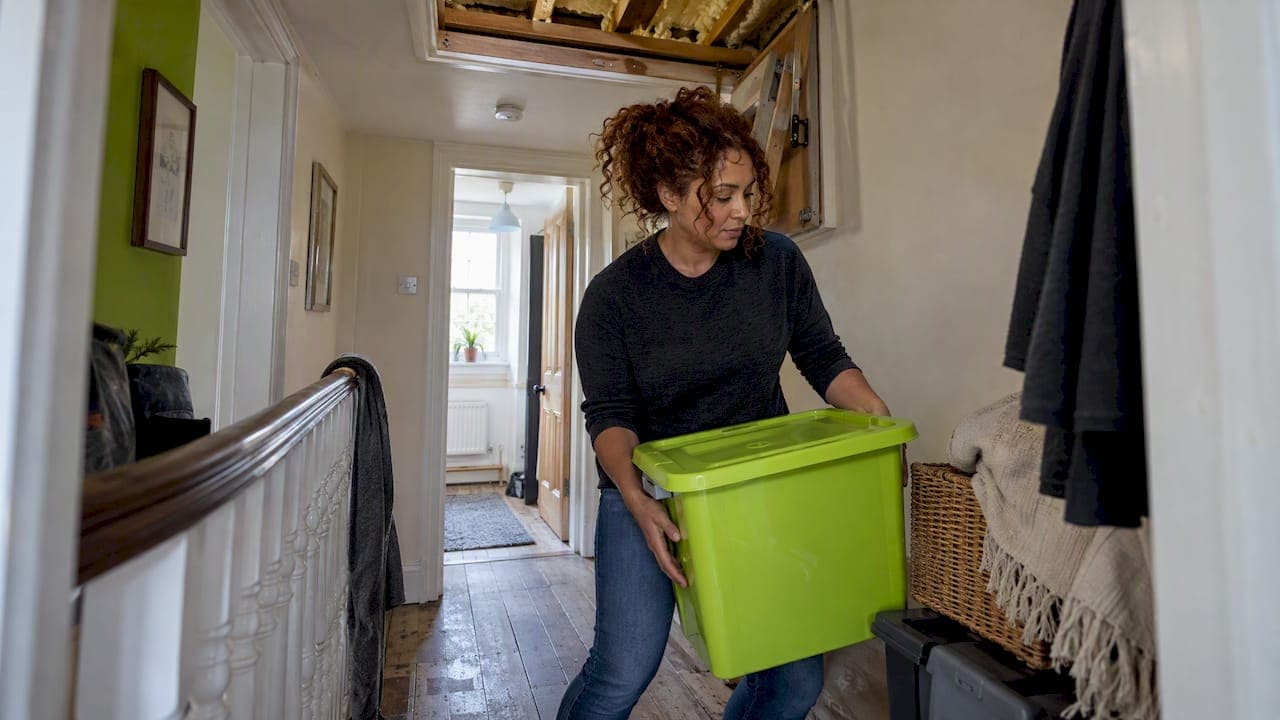
Good preparation for spray foam removal starts before anyone touches your roof. First, confirm that removal is actually needed. Next, check what your mortgage lender will accept. Then clear the loft, plan for noise and dust, and agree in writing how the work will be documented. Do these four things and the job itself is usually the easy part.
We remove spray foam from homes across London and the Southeast, and the problems we see are rarely about the removal. They come from decisions made in the weeks before: a rushed quote, a missing survey, a lender nobody rang. This guide covers the lot, in the order you will need it.
TL;DR
- Do not book removal first. Government guidance says removal is not always necessary and urges you to get independent surveying advice and check your lender's policy.
- Ask your lender in writing what evidence it wants, and get a survey that tells you the foam type, condition and roof timber state.
- Clear the loft and access routes, protect the rooms below, and plan for a few noisy, dusty days with the house still liveable.
- Never remove it yourself. HSE guidance expects trained people, respiratory protection and containment.
- Insist on before and after photographs and a certificate. They are what lenders and surveyors rely on later.
Table of Contents
- Step one: decide whether you need removal at all
- Talk to your mortgage lender first
- Get an independent survey before you get quotes
- Why you should never do it yourself
- Choosing who does the work
- Preparing your home, room by room
- Noise, dust and disruption: what to expect
- Documentation: the part that gets you the mortgage
- Our perspective: what we tell every customer before they book
- Your preparation timeline
- Ready to get a clear answer on your roof?
- FAQ
- Sources
Step one: decide whether you need removal at all
The most expensive mistake is removing foam that did not need to come out. The government's guidance on spray foam remediation, removal and lending is clear that removal is not always necessary. It tells homeowners to get independent, qualified advice and to avoid cold-calling companies.
Lender policy varies a great deal. Some lenders will lend with foam in place if it has been professionally assessed and documented. Others will not. If you are selling or remortgaging, your lender's position decides your route, not a salesperson's.
Citizens Advice reports that complaints about spray foam to its consumer service more than doubled in a year. Its work on mis-selling is a useful reminder: be wary of anyone who pushes you to commit on the first call.
So before you spend anything on removal, work through this short list:
- Do you have spray foam on the underside of the roof? A solid layer that sticks to the rafters and tiles is the giveaway.
- Do you know whether it is open cell or closed cell?
- Is a sale, remortgage or insurance renewal coming up?
- Has your lender told you in writing what it needs?
- Have you had a survey from someone who does not profit from the removal?
If you cannot answer all five, you are not ready to book. That is fine. Answering them is the first stage of preparation.
Talk to your mortgage lender first
Phone or email your lender, or your broker, and ask three things:
- Will you lend against this property with spray foam in the roof space?
- If not, what exactly do you require: removal, a surveyor's report, a certificate, or all three?
- What wording or format must the evidence take?
Keep the reply. If a lender says removal is required, you then know the job is not optional. If it says it will accept a surveyor's assessment, you may be able to avoid a four-figure bill. Either way you have paid nothing yet.
The lender question matters most when a buyer is involved. Our guides on what a RICS survey says about spray foam and buying a house with spray foam explain how survey wording can hold up a sale.
If you are mid-purchase and the foam has come up in the survey, the price may be negotiable. This piece on negotiating a house price after a survey is worth a read before you agree to absorb the whole removal cost.
Get an independent survey before you get quotes
A proper survey tells you what you are dealing with, which makes every quote after it comparable. The RICS consumer guide to spray foam insulation is the place to start for what surveyors look for and why foam on roof timbers causes trouble. In short, the foam sticks to the timbers, so inspectors cannot see the wood underneath. That is the root of most lending problems, as Business Manchester reported.
A good survey should record:
- the foam type (open or closed cell) and where it is applied
- its approximate thickness and coverage
- visible signs of damp, rot or staining on accessible timbers
- the condition of the roof covering from inside and out
- photographs of everything above
We offer surveys at published prices, which you can see on our services page:
| Survey | Price |
|---|---|
| Basic Visual Survey | from £100 |
| Full Roof Report (with photos) | from £200 |
| Drone Survey + Report | from £250 |
| Full Drone + Detailed Report | £350–£450 |
Which one you need depends on the roof and on what your lender asks for. Our post on what a spray foam survey costs in the UK breaks the options down. If you are buying, a Level 3 report is often the route to a smoother mortgage.
Citizens Advice also recommends finding an independent, PCA-certified surveyor with no financial stake in the removal work. That is good advice. If a surveyor will only ever recommend one outcome, treat the report with caution.

Why you should never do it yourself
It can be tempting to scrape out a bit of foam yourself, particularly if you only see a small patch. Don't. The HSE's guidance on insulation removal describes good practice for controlling exposure as part of a COSHH assessment, and it expects suitable respiratory protection and containment. Trained teams have both. A homeowner with a dust mask and a bin bag does not.
There is a structural risk too. Foam bonded to roof timbers and membranes can damage them if pulled the wrong way, and a damaged membrane is a new problem on top of the old one. Fire is another reason for care: HSE's guidance on cellular plastics notes that these materials can ignite easily from the smallest of sources. Keep ignition sources away from any foam, and from the loft while work is on.
And a DIY job leaves you without the one thing a lender wants: independent evidence that the work was done properly. We cover that below.
Choosing who does the work
Once you know removal is needed, you will want to compare quotes. These checks make the comparison fair:
- Who actually does the work? Many firms are lead-sellers that pass your details to a subcontractor. Ask who will be on your roof, and whether you can speak to them directly.
- Is the quote fixed and itemised? It should state what is included: foam removal, timber treatment, disposal, making good, any replacement insulation.
- What certification do they hold? Look for PCA-certified technicians and ask what certificate you will receive at the end.
- What is the warranty, and who backs it? An insurance-backed warranty is worth more than a promise.
- Will they say when removal is not needed? Honest firms will.
Our post on spotting insulation removal scams has the warning signs in more detail. The pattern is nearly always the same: unsolicited contact, pressure to sign today, and no independent survey.
On cost, our published ranges are £1,000–£7,000 for spray foam removal overall. Open cell removal runs £1,000–£5,000 and closed cell £1,500–£7,000. Closed cell costs more because it is dense and bonds hard to timbers. You can see how those numbers work on our spray foam removal cost page. The final figure depends on roof size, foam depth and access, which is why we price after a survey rather than guessing over the phone.

Preparing your home, room by room
This is the practical part. The aim is simple: give the team clear access, and keep dust out of the living space.
The loft and roof space
- Empty it. Remove boxes, suitcases, Christmas decorations, old furniture and anything stored on boards. Anything left behind will be covered in dust or have to be moved by the team.
- Take out valuables and fragile items rather than leaving them wrapped in sheets. Dust travels.
- Clear electrical items you own. Leave the fixed wiring alone, but tell us about anything fitted: cables, lights, a water tank, a mechanical ventilation unit, solar panel cabling or a satellite feed.
- Note anything that has been boarded. Boarding sometimes sits on top of foam, and the team needs to know where it can be lifted.
- Take photographs yourself before work begins. They are a useful back-up to the professional report.
The access route
The team will carry tools in and bagged waste out. Think about the whole path from the front door to the loft hatch.
- Clear the landing, stairs and hallway of furniture, rugs and ornaments.
- Move wall pictures near the route. Bags and ladders knock things.
- Tell us about narrow staircases, loft ladders that do not extend fully, or small hatches. If the hatch is small, it affects how waste comes out.
- Make sure someone can let the team in, or arrange a key safe.
The rooms below the loft
Bedrooms and landing ceilings take the vibration. Cover or move what you can.
- Strip beds in rooms directly below the work, or cover them with dust sheets.
- Move wardrobes and chests away from walls if you can, and close wardrobe doors.
- Cover electronics and remove light shades if they are loose.
- Keep doors to rooms not in use closed.
The team brings its own protection and containment, but removing foam above a ceiling is a physical job. A little extra covering from you costs nothing.
Outside
Reserve space for a skip or waste containers if we have agreed that. Tell us about parking restrictions, permit zones or narrow roads, which are common in London. If scaffolding is needed for the roof, your quote should say so and say who arranges it.
Noise, dust and disruption: what to expect
Homeowners often ask what living through a removal is actually like. Honest answer: it is a building job, and it is not silent. Manual extraction means the team strips foam from the rafters and underside of the roof, bags it and carries it out. You will hear footsteps, scraping, tools and movement above you, and there will be traffic in and out of the house.
What that means in practice:
- Noise: it is steady during working hours rather than constant. Expect it mainly in the rooms below the roof space. If you work from home, plan to be in a room at the other end of the house, or out for the day.
- Dust: a good team contains the work area and cleans as it goes, but a loft hatch is not a sealed door. Keep bedroom and landing doors shut and covered items clean.
- Smell: you may notice a chemical or dusty smell near the hatch. If you or anyone in the house has asthma or another breathing condition, talk to your GP before the work starts and tell the team. Plan for them to stay elsewhere during the busiest stage if the GP advises it.
- Access: you will need to let people in and out for the length of the job. Ask for start times and a named person to contact each day.
- Children and pets: keep both away from the hatch, ladders and bagged waste.
The length of the job depends on the size of the roof, the type of foam and the access, and we confirm it after the survey. Be wary of anyone who promises a precise finish date before seeing the roof. Rushing the removal is a quality risk, because remaining foam on timbers is what causes trouble later with surveyors and lenders.
If you are selling, tell your estate agent and buyer's solicitor when the work is scheduled. They may want to see the finished work before exchange.
Documentation: the part that gets you the mortgage
This is where preparation pays off. The government's guidance points to the post-removal certificate as the standard evidence for restoring mortgage eligibility, and surveyors gain confidence from photographic reports before and after the work. That matches what we see.
Agree these in writing before work starts:
- Pre-work photographs of the roof timbers, foam and roof covering.
- Photographs during the work, especially of timbers as they are exposed.
- A post-removal report with photographs showing clean, inspectable timbers.
- A certificate that your lender will accept. Confirm the wording with the lender in advance.
- A written warranty and the name of whoever insures it.
Once the certificate is in hand, send it to your lender or broker straight away. Our guide on getting a mortgage after spray foam removal sets out a realistic timeline of 5 to 7 weeks from there, and our post on insurance and mortgage delays explains what PCA and RICS reports need to say.
If you are a landlord or an estate agent, keep a copy of the whole file with the property records. A future buyer's surveyor will ask for it.
Our perspective: what we tell every customer before they book
We are Revive Maintenance, and we remove spray foam for homeowners, landlords and estate agents across London and the Southeast. Here is what we say first, every time.
Get the survey before the quote. We would rather you know exactly what is on your roof than sign for a job you do not need. If your lender will accept an assessed and documented roof, we will tell you so.
Speak to the people doing the work. We are a direct service. You talk to the skilled team who will be in your loft, not a call centre or a lead-selling website. That means the person who explains the job is the person responsible for it.
Fixed pricing, nothing hidden. Our quote states what is included. If another firm quotes lower for the same scope, we have a price-beat guarantee.
Evidence you can hand to a lender. Our technicians are PCA-certified, we document the work with photographs, and the work is covered by a 10-year insurance-backed warranty. More than 1,000 homeowners have used us. We also provide complimentary replacement insulation after removal, so your loft is not left bare.
Most of the stress in these jobs comes from not knowing what to expect. Preparation takes that away.
— jessica
Your preparation timeline
Here is how the weeks usually line up for someone selling or remortgaging.
| When | What to do |
|---|---|
| As soon as you suspect foam | Check the roof space, note foam type if you can, collect any installation paperwork |
| Week 1 | Ask your lender or broker what it requires, in writing |
| Week 1 to 2 | Book an independent survey and read the report |
| Week 2 to 3 | Gather quotes that match the survey, check certification and warranty |
| Before the start date | Clear the loft and access, cover rooms below, arrange parking and a skip, tell your agent |
| Work days | Be reachable, keep pets and children away, ask for photographs as work progresses |
| After the work | Check the report and certificate, send them to your lender, keep copies |
If you are buying a new build or dealing with a cash buyer, the order shifts slightly. We have notes on new build spray foam and on getting a report before accepting a cash offer.
Ready to get a clear answer on your roof?
We can survey your roof, tell you what is there and quote a fixed price for removal if it is needed. No pressure, and no obligation to book. Start with our home visit quote page, or look at our services and survey prices first.
FAQ
Do I have to leave the house during spray foam removal?
Not normally, but it depends on the job and on who lives with you. The work is above you, so you can usually stay at home, ideally in a room away from the loft. If anyone has a breathing condition, ask your GP first and tell the team before the start date.
Can I leave my stuff in the loft?
No. Clear it before the team arrives. Stored items get covered in dust and slow the team down. Move valuables and fragile things out of the house or into a room well away from the work.
How noisy is spray foam removal?
It is a building job, so expect scraping, footsteps and tool noise from the roof space during working hours. It is steady rather than constant, and mostly heard in the rooms below. Ask for daily start and finish times so you can plan around it.
Should I get a survey before booking removal?
Yes. Government guidance says removal is not always necessary and recommends independent surveying advice. A survey tells you the foam type and roof condition, and lets you compare quotes fairly.
Can I remove a small area of spray foam myself?
We advise against it. HSE guidance on insulation removal expects respiratory protection and containment, and bonded foam can damage timbers and membranes. A DIY job also leaves you with no certificate or photographic record for your lender.
Sources
- Spray foam insulation: Remediation, removal and lending, GOV.UK
- A Foamidable Challenge, Citizens Advice
- Spray Foam Insulation, RICS consumer guide
- Spray foam insulation preventing thousands of UK homeowners from selling or refinancing, Business Manchester
- Insulation removal, HSE
- Safe use and storage of cellular plastics, HSE