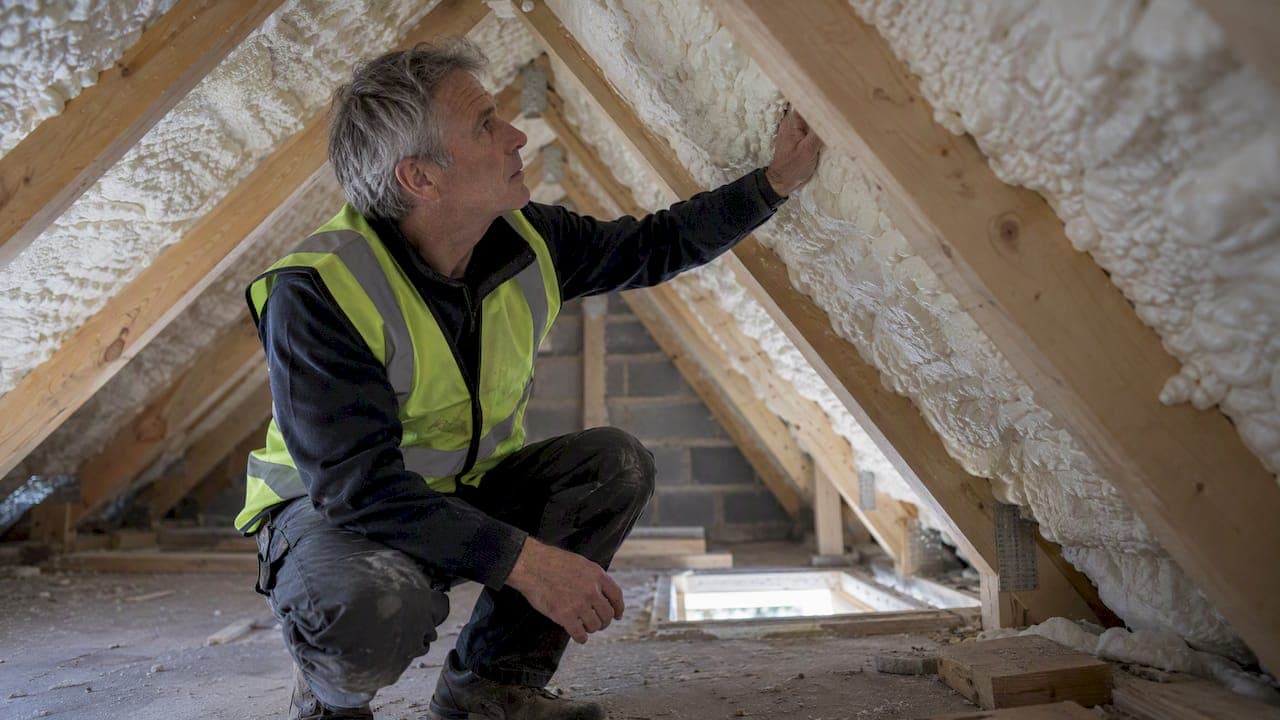
Spray foam in a new build is not illegal, and it is not automatically a problem. The risk comes from how it was installed, whether the roof timbers can still be inspected, and whether you hold the paperwork a lender will ask for. If you are buying a new build, or you own one and found foam in the loft, the sensible first step is to establish what was sprayed, where, and with what documents. Do that before you panic, and before you agree to any removal quote.
This guide explains how UK lenders and surveyors approach spray foam, what to ask a developer or seller, what a survey costs, and when removal makes sense. We are Revive Maintenance, and removal is what we do, so we will also be clear about when you should not rush into it.
TL;DR
- Spray foam is not banned in the UK, but individual lenders set their own policies, so a new build with foam in the roof can still meet resistance at sale or remortgage.
- The foam itself is rarely the issue. Lenders worry that it hides the roof timbers and stops a surveyor assessing their condition.
- Ask the developer or seller for the contract, calculations, product certificates and warranties. A missing paper trail is the most common reason for a "fail".
- Get an independent assessment first. Removal is sometimes needed, and when it is, our published range is £1,000 to £7,000 depending on foam type and access.
- Be wary of unsolicited calls claiming removal is urgent or mandatory.
Table of Contents
- Why a new build with spray foam is a different case
- What UK lenders and surveyors actually worry about
- Moisture and timber: where the real risk sits
- What to ask a developer or seller
- Surveying first: what a sensible first step costs
- When removal is needed, and when it is not
- What spray foam removal costs
- A short checklist for new build owners
- Our view: what we tell new build owners
- Get your roof assessed by a certified team
- FAQ
- Sources
Why a new build with spray foam is a different case
Most of the spray foam stories in the UK press involve older houses retrofitted under government-backed schemes. The Green Homes Grant covered spray foam before it closed in March 2022, and many of the problem installations date from that period.
A new build is different in a few ways:
- Foam may be part of the original specification. A developer or self-build contractor may have chosen it for the roof, walls or floor, rather than a homeowner buying it from a salesperson.
- The roof is young. There is less chance of existing decay, but timber can still be at risk if the roof was designed for ventilation and then foamed over.
- Documentation should exist. Building control sign-off, product certificates and a structural warranty should all be in a handover pack. If foam is there and the papers are not, that is your first red flag.
- Resale and remortgage come soon. The first time many new build owners meet the issue is when a buyer's surveyor or a remortgage valuer climbs into the loft.
The point is that "new" does not mean "safe to ignore". A recent roof with foam applied the wrong way can cause the same inspection and moisture problems as an older one.
What UK lenders and surveyors actually worry about
The headline that spray foam is "banned" is not accurate. RICS says there is no blanket ban, and that lenders decide eligibility based on their own policies and the condition of the property.
What surveyors dislike is that foam covers the roof structure. RICS guidance, updated in March 2023, notes that it can affect a surveyor's ability to inspect roof timbers, and that a surveyor who finds it may ask for an independent specialist report. That report then shapes the mortgage decision and the valuation.
The lending picture has been uneven. The House of Commons Library notes that in November 2024 the BBC reported that a quarter of the UK's biggest mortgage providers and all the equity release lenders it surveyed would not lend against homes with spray foam in the roof. Policies move, so check a current lender's position through a broker rather than relying on a figure in an article.
The paper trail matters as much as the foam
RICS is plain that the burden of proof sits with the owner. To satisfy a lender you should be able to show the contract, the calculations, test certificates such as BBA or Kiwa, and the warranties. Where that paper trail is missing, surveyors are more likely to fail the property or ask for destructive testing or removal.
In a new build, this is your advantage. A developer should be able to produce that documentation. If you are still in the buying process, ask for it now.
An approved product is not an approved roof
A common misunderstanding is that a product certificate makes a roof "mortgage-safe". It does not. Surveyors care mostly about whether the foam hides the structure and prevents them judging its condition. A well-certified product can still be installed in a way that makes a property hard to mortgage. The Building Safety Regulator has also made clear that theoretical modelling cannot certify an existing installation: compliance is a property-specific assessment, shaped by humidity, climate and roof build-up.
Moisture and timber: where the real risk sits
Government-commissioned modelling gives a useful picture. It found the highest moisture risk when foam is applied directly to roof tiles or to a high-resistance underlay without an air and vapour control layer, which can lead to timber degradation. Risk was low when open cell foam was applied in line with BS 5250:2021, with adequate ventilation and a control layer.
For a new build owner, this translates into questions you can actually ask:
- Is the foam open cell or closed cell?
- Was it sprayed onto the underside of the tiles or underlay, or onto a ceiling or rafter-level build-up with a designed ventilation strategy?
- Is there an air and vapour control layer?
- What type of underlay is under the tiles? Felt roofs raise their own questions, which we cover in our guide to felt roofs and spray foam before a remortgage.
- Who designed the roof build-up, and is there a sign-off from building control?
If nobody can answer these, you need an independent look at the roof.
What to ask a developer or seller
Whether you are exchanging contracts or have just moved in, put these requests in writing:
- The specification showing where foam was used and the product name.
- The installer's identity, contract and any guarantee.
- Product certificates, such as BBA or Kiwa.
- Thermal and moisture calculations for the roof design.
- Building control completion documents.
- The structural warranty terms and whether they mention insulation.
- Any survey or inspection reports completed on the roof.
Insulation work normally needs a building regulations application. The Northern Ireland Department of Finance makes that point in its information note on spray foam, which applies to Northern Ireland. Rules in England, Scotland and Wales are set separately, so check the approach where your home is, and ask your solicitor to raise the point with the seller's side.
Keep copies of everything. If you resell in five years, this folder is what a buyer's surveyor will ask for first. The same goes for airtightness and ventilation evidence: if you want to understand how a building's leakage is tested and why it matters for insulation decisions, this overseas guide to building airtightness testing explains the general principle, though UK testing standards and procedures will differ.
Surveying first: what a sensible first step costs
The guidance from Trading Standards is consistent: do not start with a sales visit from a firm that earns money from removal. Cornwall Council's Trading Standards advice warns that some homeowners face misleading sales practices around spray foam, and North East Lincolnshire Trading Standards has issued its own warning about spray foam sellers.
If a lender or buyer has asked for a specialist report, or you want to know where you stand, a survey is a proportionate step. Our published survey prices are:
| Survey | Price |
|---|---|
| Basic Visual Survey | from £100 |
| Full Roof Report (with photos) | from £200 |
| Drone Survey + Report | from £250 |
| Full Drone + Detailed Report | £350 to £450 |
These are one-off fees, and the full list sits on our services page. A basic visual check may be enough to tell you what you have. A photographic or drone report gives a lender or buyer something concrete to review, which can save weeks of back and forth. Our article on PCA and RICS reports for insurance and mortgage delays covers how those reports are used in practice.
If your concern is a lender rather than the roof itself, a mortgage broker who knows current lender attitudes to spray foam is worth speaking to alongside any survey.

When removal is needed, and when it is not
Removal is not always the only route. The government modelling suggests that where timber is sound and the structure allows it, correcting ventilation or adding a control layer can address moisture risk. Yet lenders often still ask for complete removal because the foam blocks inspection. That is the practical reality: the question is not only "is my roof safe?" but "will a lender accept it?"
Removal tends to make sense when:
- A lender or valuer has refused or conditioned a mortgage because of the foam.
- A survey finds damp, staining or timber decay beneath it.
- There is no paperwork and you cannot obtain it.
- The foam was applied directly to tiles or underlay with no ventilation strategy.
- You plan to sell soon and want a clean, inspectable roof.
It may not be necessary when a specialist report shows a well-documented, correctly specified installation and your lender accepts it. If you are not sure, start with the survey. We would rather you have the right information than a job you did not need. Citizens Advice has reported that many homeowners are targeted by firms that sell removal on the back of fear of mortgage refusal, sometimes the same firms that promoted the foam in the first place.
What spray foam removal costs
Our published ranges are fixed-fee, one-off prices:
| Service | Price |
|---|---|
| Spray Foam Removal | £1,000 to £7,000 |
| Open Cell Spray Foam Removal | £1,000 to £5,000 |
| Closed Cell Spray Foam Removal | £1,500 to £7,000 |
Where you fall in the range depends on the size of the roof, how the foam was applied, and how much access we have. Closed cell is denser and more bonded to the structure, which is why it costs more to take out. Details are on our spray foam cost page.
You may see far higher numbers quoted elsewhere. Citizens Advice has said some homeowners face potential removal costs exceeding £50,000 in the worst cases. Those are exceptional, and they are not a reason to accept a quote you cannot explain. Always ask for a written breakdown. Our guide to insulation removal scams lists the warning signs.
A short checklist for new build owners
- Find out whether your roof, walls or floors contain spray foam, and which type.
- Gather the developer's documents and installer details.
- Check whether a structural warranty is in place and read its insulation clauses.
- Get an independent survey if a lender, buyer or insurer raises the issue, or if you cannot get the paperwork.
- Speak to a mortgage broker about current lender policies before you apply.
- Compare removal quotes in writing, and ignore anyone who says you must act immediately.
Different roof types raise different questions. If yours is a bungalow, see bungalow roof spray foam checks. If it uses prefabricated timbers, read about trussed roof spray foam risks. If you plan to add solar panels later, survey first.
Our view: what we tell new build owners
We remove spray foam for homeowners, landlords and estate agents across London and the Southeast, and our team holds PCA certification. A lot of calls we take begin with the words "but the house is only a few years old". Our answer is always the same.
Age is not the test. Inspectability is. If a surveyor cannot see and assess the timbers, a lender will probably hesitate, whatever the age of the house. So the first thing we do is establish the facts: what foam, how applied, what paperwork. We do not pretend that every foamed roof needs to come out.

We also work directly. The people who survey your roof and quote the work are the people who do it. You do not pass through a lead-selling website or a middleman, and our prices are fixed and transparent, with no hidden fees. If we do remove foam, we back it with a 10-year insurance-backed warranty, and we offer complimentary replacement insulation. We have helped over 1000 homeowners, and the pattern is clear: people who gather the facts early make calmer, cheaper decisions than those who wait for a mortgage refusal.
If you are a buyer, use the developer's obligation to provide documents as leverage. If you are an owner, do not let anyone rush you. A sound decision on a roof takes a few days, not a few hours.
— jessica
Get your roof assessed by a certified team
If you want to know where your new build stands, start with a survey. We offer visual, photographic and drone reports, and if removal turns out to be needed we quote a fixed price. You can see all options on our services page, or book a home visit quote and speak directly to the team who would do the work.
FAQ
Is spray foam insulation banned in new builds in the UK?
No. There is no blanket ban, and RICS confirms that lenders set their own policies. What matters is whether the installation is properly specified, documented and inspectable. A new build with foam can be mortgageable, but the paperwork needs to be in order.
Can a new build with spray foam get a mortgage?
Sometimes, yes. It depends on the lender, the surveyor's findings and the evidence you can provide. A broker who knows current lender criteria can tell you which lenders to approach, and a specialist report can help a surveyor decide.
Who is responsible if the developer used spray foam badly?
That depends on your contract, your structural warranty and the developer's obligations, so take advice from a solicitor. Start by gathering the specification, certificates and any survey reports. Keep all correspondence in writing.
Do I have to remove spray foam before selling?
Not necessarily. If a buyer's surveyor cannot assess the roof, or the buyer's lender refuses to lend, removal or a specialist report may become the practical option. An early survey tells you which situation you are in, before the sale is under pressure.
How much does it cost to remove spray foam?
Our published prices run from £1,000 to £7,000, with open cell from £1,000 to £5,000 and closed cell from £1,500 to £7,000. The final fixed price depends on roof size, foam type and access.
Sources
- RICS: Spray foam insulation consumer guide
- House of Commons Library: Spray foam insulation and mortgages
- Building Safety Regulator response on spray foam
- GOV.UK: Moisture risk of spray foam insulation applied to timber sloped roofs
- Northern Ireland Department of Finance: Information note on spray foam insulation
- Cornwall Council: Spray foam insulation advice
- North East Lincolnshire Trading Standards warning
- Citizens Advice: A Foamidable Challenge