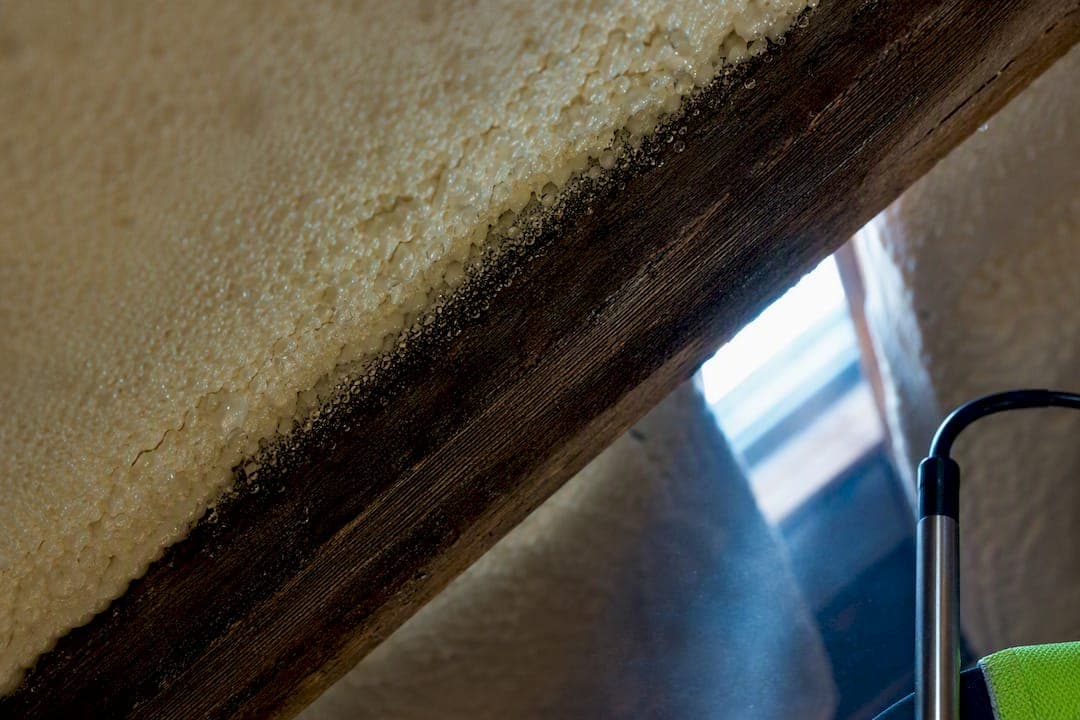
Spray foam can cause or conceal damp where it is applied directly to roof tiles or slates, or used without an air and vapour control layer. The highest-risk pattern is closed-cell foam sprayed straight onto the underside of an unventilated roof covering with no AVCL and no ventilation gap. If you suspect a problem, preserve your installer paperwork, photograph any staining or soft timber, and commission a PCA-aware inspection before you do anything else.
TL;DR:
- Proper installation requires an air and vapour control layer and ventilation gaps; without these, spray foam risks trapping moisture and causing decay.
- Closed-cell foam can seal moisture behind it, increasing risk in colder, wetter regions, especially if applied directly onto tiles or slates without ventilation.
- Common errors include spraying foam directly onto roof coverings or onto high-resistance underlays without proper barriers, leading to hidden condensation and timber rot.
- Early signs of damp may include musty smells, staining, foam delamination, or soft timber; documenting these observations with photos and moisture readings is crucial.
- Removal is often necessary if foam was applied directly to tiles or moisture logs show rising levels, while targeted repairs are suitable if foam is well-bonded and ventilation can be retrofitted.
Table of Contents
- What spray foam damp problems actually are and why the term causes confusion
- How spray foam alters ventilation and vapour movement in a roof
- Open-cell versus closed-cell foam: which carries more moisture risk?
- Installation errors and roof conditions that commonly produce damp
- What are the warning signs of damp under spray foam?
- Structural, safety and mortgage consequences of unresolved damp
- What inspections and paperwork should you commission?
- Remediation options: targeted repair or full removal?
- What professionals actually check, and why documentation carries so much weight
- How should you decide between repair and removal?
- Get a mortgage-compliant survey before you commit to a fix
- Sources
- FAQ
What spray foam damp problems actually are and why the term causes confusion
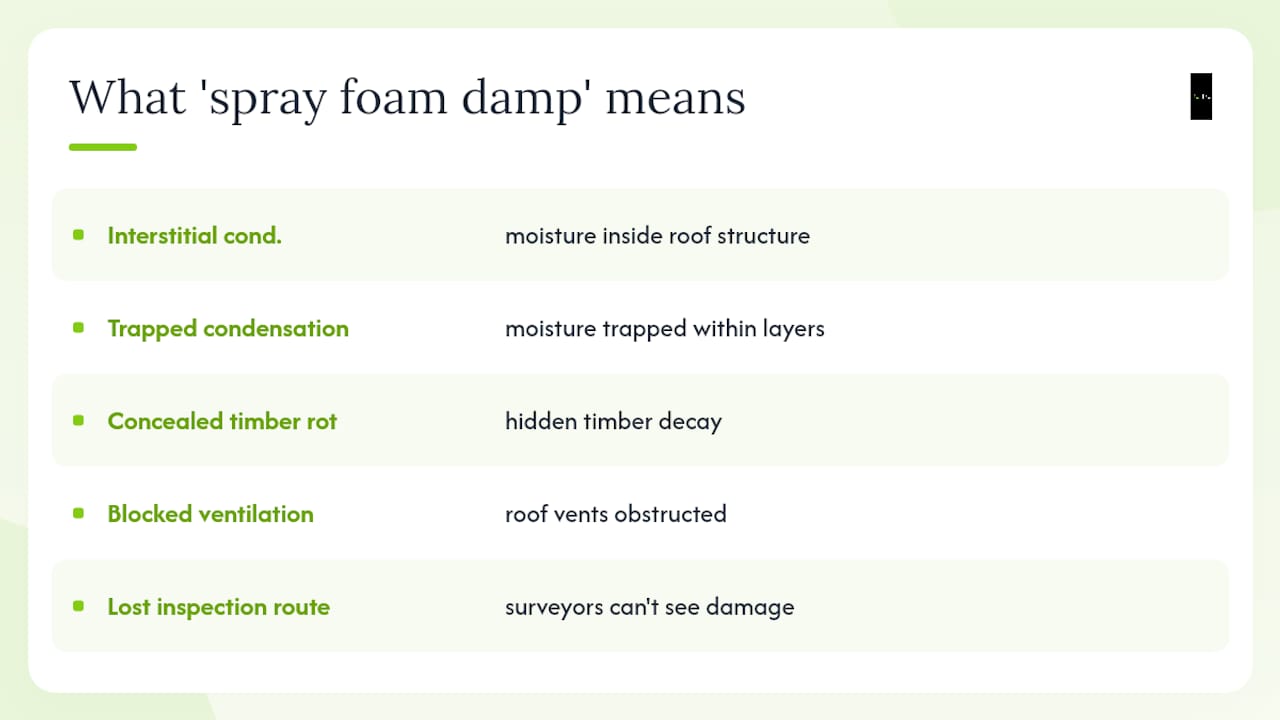
"Spray foam damp problems" is not a single defect. It is the shorthand homeowners use for a cluster of separate issues: trapped condensation, concealed timber rot, blocked roof ventilation, and the loss of a visual inspection route for surveyors. The proper industry term for the underlying cause is interstitial condensation, moisture that forms inside a roof structure rather than on a visible surface, and it is this mechanism that sits behind most cases people describe simply as "damp under spray foam."
Understanding that distinction matters because the fix depends entirely on which problem you actually have. A roof with a genuine AVCL failure needs a different remedy from one where foam has simply hidden a pre-existing slate leak. Both get called "spray foam damp problems" by homeowners, but a surveyor treats them very differently.
How spray foam alters ventilation and vapour movement in a roof
A traditional cold loft works because air moves freely above the insulation, carrying moisture vapour out through eaves and ridge vents before it can condense. Spray foam, applied to the underside of the roof slope, converts that space into a warm roof. The loft becomes part of the heated envelope, and the ventilation path that used to clear moisture is gone.
That shift only works safely when the assembly includes an air and vapour control layer, a membrane or barrier that stops warm, moist household air reaching the cold outer roof surface where it condenses. Government modelling on moisture risk in timber sloped roofs found risk drops significantly where an AVCL is correctly installed or where closed-cell foam is used in the right configuration. Skip the AVCL, and vapour has nowhere to go.
RICS makes the same point in plainer terms: spray foam can turn a ventilated cold loft into an unventilated warm void, and that shift raises the risk of condensation and timber decay unless the roof was verified as sound and properly detailed beforehand.
A typical failing case looks like this:
- A roof with a modern, high-resistance underlay (designed to be vapour-tight from below) gets foam sprayed directly onto it with no ventilation gap or AVCL.
- Warm, moist air from the house rises into the roof void and meets the cold underlay.
- Condensation forms at that junction, soaks into the felt or timber, and sits there unseen because the foam has sealed the void from view.
Open-cell versus closed-cell foam: which carries more moisture risk?
The two foam types behave completely differently once moisture enters the picture, and knowing which one is in your roof changes what you should expect to find.
- Open-cell foam is vapour permeable. Moisture can pass through it more easily, which makes it more forgiving if small amounts of vapour do reach the timber, though it insulates less efficiently per inch and can itself hold water if soaked.
- Closed-cell foam behaves like a vapour barrier. It seals the timber from view and from airflow, so if moisture does get trapped behind it, there is nowhere for that moisture to escape and no way to see it happening.
The Centre for Sustainable Energy is blunt about this trade-off: closed-cell foam is more likely to trap moisture where ventilation is inadequate, which is exactly why it tends to feature in the worst concealment cases surveyors report.
Climate plays a role too. Modelling comparing milder and more severe UK climate scenarios found that colder, wetter regions carry higher moisture risk under the same installation conditions. A closed-cell job that might just about get away with poor detailing in a mild coastal town is a different proposition on an exposed roof further north.
Installation errors and roof conditions that commonly produce damp
Most spray foam damp problems trace back to a small number of repeatable mistakes, and it is worth knowing them because they tell you where to look first.
- Foam sprayed directly onto tiles or slates. Government modelling identifies this as the highest-risk pattern of all, since the foam bonds to the roof covering itself with no ventilation path whatsoever.
- Application against a high-resistance underlay with no AVCL or ventilation channel. This is the classic warm-roof failure described above, and it is disturbingly common in older installations carried out before current guidance tightened up.
- Patchy, discontinuous coverage, gaps, or shrinkage over time. Cold spots form where foam has pulled away or was applied too thinly, and these become condensation hotspots even in an otherwise reasonable installation.
- Pre-existing leaks or deferred roof maintenance concealed by the foam. A slipped slate or a slow flashing leak that predates the insulation gets sealed in rather than fixed, and the foam then takes the blame for rot the roof was already developing.
RICS journal commentary makes a useful practitioner point here: many failures blamed on the foam itself are actually a combination of pre-existing humidity, poor ventilation, and insulating a roof that needed repair first. Working out which category your roof falls into changes the entire remediation conversation.
What are the warning signs of damp under spray foam?
You will not always see obvious dripping water. Damp trapped behind foam tends to announce itself more subtly, and catching it early makes a real difference to cost and disruption.
- A persistent musty smell in the loft, even when the space looks dry.
- Staining, discolouration, or visible mould on the foam surface itself.
- Foam that has begun delaminating or peeling away from the timber underneath.
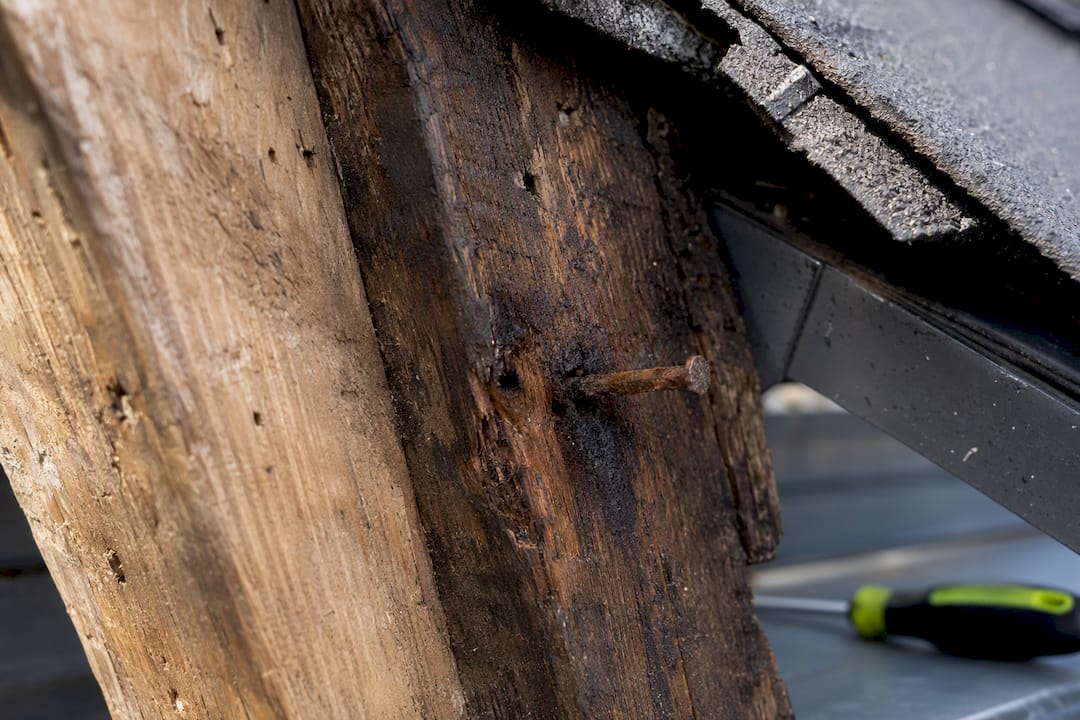
- Soft or spongy timber, especially around rafters, purlins, or fixings, which points to wet rot rather than surface condensation.
- Elevated readings on a moisture meter pressed against exposed timber near the eaves or ridge, where cold spots concentrate.
Read our detailed guide on spray foam condensation if any of these sound familiar.
Pro Tip: Photograph every suspect area with a ruler or coin in shot for scale, note the date, and take three or four moisture meter readings across the same timber section rather than one. A single reading tells you very little; a dated log showing readings rising over weeks is the kind of evidence a surveyor or lender actually takes seriously.
Structural, safety and mortgage consequences of unresolved damp
Trapped moisture does not sit still. Left long enough, it drives timber decay, corrodes metal fixings and roofing nails, and can compromise the structural integrity of rafters that were never designed to sit permanently wet. None of this happens overnight, which is precisely the problem: by the time it is visible, the damage is often already significant.
The bigger practical risk for most homeowners is not the roof itself but what happens when they try to sell or remortgage. Surveyors cannot visually inspect timber that spray foam has sealed over, and that inability to see the structure is reason enough for many to flag the property. A parliamentary briefing on spray foam and mortgages confirms that some lenders have refused to lend outright on properties with spray foam present, regardless of its actual condition.
Media coverage in late 2024 reinforced this, reporting that a number of major lenders had restricted or refused mortgage applications where spray foam was found during survey. That caution is not really about the foam being inherently dangerous. It is about uncertainty, and uncertainty is what a specialist report is designed to remove.
The documentation that reduces refusal risk includes:
- A PCA-aware inspection report addressing the specific installation, not a generic valuation survey.
- Dated moisture logs showing readings over time rather than a single snapshot.
- Original installer paperwork, guarantees, and any BBA certification for the product used.
Our piece on RICS spray foam guidance walks through what lenders and surveyors expect to see before they will proceed.
What inspections and paperwork should you commission?
If you suspect a problem, the next steps are straightforward, but skipping any of them tends to cost more time later than it saves now.
- Book a PCA-aware or RICS-qualified surveyor, and specifically ask whether a Level 3 building survey or a dedicated PCA spray foam inspection is more appropriate for your case. A Level 3 report goes into far more structural detail than a standard homebuyer's survey.
- Request moisture logging over more than one visit, plus drone survey photography where roof access is difficult, so you have dated visual evidence rather than a single verbal opinion.
- Ask for a full written roof report with recommendations, not just a pass or fail verdict, since lenders generally want to see the reasoning as well as the conclusion.
- Contact the original installer if the work is recent enough to fall under a guarantee, and check whether it was registered with a scheme such as TrustMark, since this affects any warranty or insurance claim.
- Compile a document pack for the surveyor or lender: installer invoice and product data, any BBA certificate, guarantee documents, moisture readings, and your own dated photographs.
Our PCA spray foam certification guide covers what a proper certification inspection involves and what it should tell you.
Remediation options: targeted repair or full removal?
Once an inspection confirms a problem, the choice usually sits between two paths, and the right one depends entirely on what the survey finds rather than on cost alone.
- Targeted remediation works where the foam itself is sound but the assembly lacks ventilation. Adding an AVCL, cutting ventilation channels, and repairing isolated sections of decayed timber can resolve the moisture issue without a full strip-out. This is cheaper and less disruptive, but it will not satisfy every lender, particularly where the original application was direct-to-tiles.
- Full removal becomes necessary where foam has concealed active decay, where the application method itself is high-risk (direct-to-tiles closed-cell being the clearest example), or where a lender simply will not proceed without it. Closed-cell foam is generally more labour-intensive to strip than open-cell, because it bonds more aggressively to timber and roofing felt.
After removal, most homes are re-insulated using a ventilated, breathable system such as Superfoil that preserves airflow through the roof space rather than sealing it. Whichever route you take, insist on photographic records throughout, and confirm the contractor carries insurance-backed guarantees rather than a verbal assurance.
What professionals actually check, and why documentation carries so much weight
Credible inspection practice has converged around a few consistent principles. RICS expects roofs to be verified wind- and watertight before any insulation goes in, and expects an AVCL or ventilation strategy suited to the specific roof build-up. The government's own modelling backs this: correct detailing measurably lowers risk, regardless of foam type.
PCA inspection protocols exist precisely so surveyors can assess installations case by case rather than reject a property automatically the moment foam is mentioned. The technicians work to PCA-certified standards, carrying out mortgage-compliant inspections that have supported many homeowners through sale, remortgage, or straightforward peace of mind, backed by a 10-year insurance-backed warranty on remedial work.
How should you decide between repair and removal?
The evidence points to removal where the installation was applied direct-to-tiles, where moisture logs show elevated and rising readings, or where a lender has already said no. Those are not judgement calls, they are documented facts a surveyor can point to.
Targeted remediation earns its place only when the foam itself is well-bonded, ventilation can realistically be retrofitted, and the surveyor's report supports a lighter-touch fix. Even then, keep dated photographs and readings before you list a property or approach a lender. A well-documented file turns a nervous conversation into a routine one, and that difference alone can save weeks on a sale that would otherwise stall at survey stage.
— jessica
Get a mortgage-compliant survey before you commit to a fix
A direct route to a PCA-certified answer, not a guess. Clients deal straight with the technicians doing the work, with fixed, transparent pricing and no hidden fees, backed by a 10-year insurance-backed warranty on every job.

If you recognise any of the warning signs covered above, start with a proper survey rather than a demolition decision. Sprayfoamremovalhelp offers everything from a Basic Visual Survey through to a Full Drone + Detailed Report, and where removal proves necessary, open and closed-cell removal costs are quoted upfront before any work begins. Complete the spray foam survey form today to get a specialist's eyes on your roof and a report your lender will actually accept.
Sources
Key references used throughout this guide: GOV.UK moisture risk modelling, RICS consumer guidance, PCA homeowner advice, the Commons Library mortgage briefing, and Centre for Sustainable Energy guidance. For a survey or removal quote, visit Sprayfoamremovalhelp's cost hub.
- Moisture risk of spray foam insulation applied to timber sloped roofs
- Spray foam insulation
- Spray foam insulation and mortgages
- Spray foam insulation
FAQ
Can damp get through expanding foam?
Damp cannot pass through closed-cell foam easily because it acts as a vapour barrier, which is exactly why trapped moisture behind it can go undetected for years. Open-cell foam is more vapour permeable, so it allows some movement but can still hold moisture if repeatedly saturated.
Can you sell a house with spray foam?
Yes, but expect extra scrutiny. Some lenders have refused mortgages on properties with spray foam present, so a PCA-aware inspection report and dated moisture logs significantly improve your chances of a smooth sale.
Does spray foam cause moisture problems?
Spray foam itself does not create moisture, but poor installation, missing AVCLs, and application direct to tiles or slates can trap existing vapour and cause condensation and timber decay that would not otherwise occur.
Is spray foam insulation banned in the UK?
Spray foam is not banned in the UK, but several major lenders have restricted or refused lending against properties where it has been installed, particularly without proper certification or documentation.