Stop the moisture source first, cut back decayed timber with a proper safety margin, and treat everything you're keeping with an appropriate biocide before closing anything up. Reinstate with pre-treated timber that meets BS8417:2011 use-class guidance. If the damage touches structural joists, beams, or affects a mortgage sale, pause and call a Property Care Association (PCA) registered specialist before you go further.
TL;DR:
- Proper diagnosis of moisture sources remains the most critical step before any timber treatment or repair attempts.
- Structural timber with more than one-third decay or evidence of dry rot requires full replacement rather than patch repairs.
- Re-treatment with biocides must occur on all cut, drill, or notched surfaces to prevent spore entry and future decay.
- Drying timber to below 20% moisture content should precede chemical treatment for effective results.
- Regular inspections every three to five years are essential to maintain the longevity of timber treatments and detect early signs of decay.
Table of Contents
- Replacing or repairing: pre-treated timber and isolation methods
- What in-situ treatments work on timber you're keeping?
- Drying timbers out before you close anything up
- How long does timber treatment last, and how often should you check it?
- When should you call a timber specialist instead of doing it yourself?
- Standards and guidance worth keeping to hand
- Getting professional support for timber uncovered during spray foam removal
- Why the standard advice undersells the moisture question
- Sources
- FAQ
Replacing or repairing: pre-treated timber and isolation methods
Not every damaged joist needs full replacement, but the threshold for keeping timber in place is stricter than most homeowners assume. Full replacement is required where more than a third of the structural section has been lost, where decay runs along a significant length of a load-bearing member, or where dry rot has been confirmed (dry rot spreads through masonry, not just wood, and rarely responds to partial repair). Splicing or scarfing in a new section may be acceptable for isolated, non-structural damage where sound timber remains either side.
Whatever you reinstate must be pre-treated to the correct use class. BS8417:2011 sets out use-class requirements for wood preservation, and if pre-treated stock isn't available for a particular section, any site-applied treatment must meet the same standard. This isn't paperwork for its own sake. Use class dictates how much biocide loading the timber carries relative to its exposure risk, and getting it wrong means paying for the same repair twice.
To stop history repeating, isolate new timber from the masonry that caused the original problem:
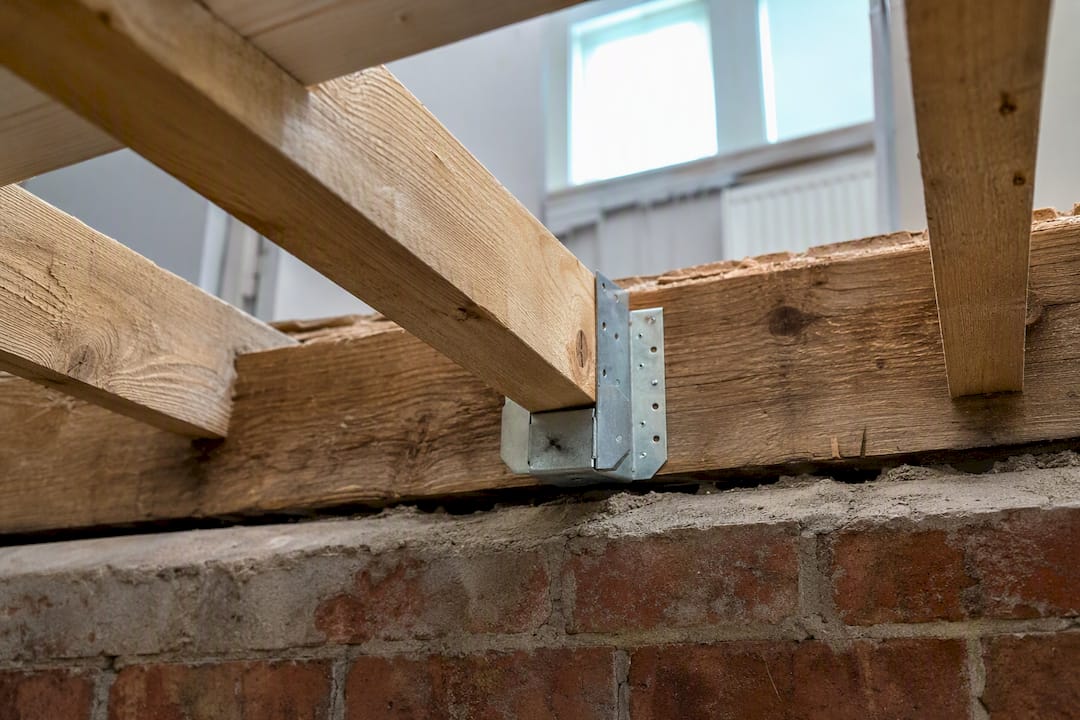
- Use galvanised or stainless joist hangers instead of building ends directly into damp brickwork
- Fit a damp-proof membrane between timber and any wall it contacts
- Consider a steel or concrete lintel where persistent dampness in the wall can't be fully resolved
Any cut end made on site, even on timber that arrived pre-treated, loses its protective coating at that cut face. PCA guidance is explicit that freshly cut surfaces must be retreated on site before the timber goes in. If you're sourcing solid replacement stock for doors or structural sections, it's worth understanding what makes solid timber suitable for the job before you commit to a specification.
What in-situ treatments work on timber you're keeping?
Timber that survived assessment sound but sits near a previous outbreak still needs protecting. The choice of treatment depends on access, the extent of remaining risk, and how much penetration you actually need.
- Borate rods and pastes. These diffuse slowly through damp timber from the inside out, making them well suited to sections where moisture may return intermittently. They're low in toxicity relative to older fumigant treatments and work well in enclosed voids you can't easily re-treat.
- Fungicidal gels and pastes. Applied by brush or spray to timber surfaces near the treated area, these give a fast-acting barrier but sit mostly on the surface.
- Injected preservatives. Drilled and injected into larger structural sections, these reach deeper than surface gels and are the standard approach contractors use on retained beams close to a former outbreak.
Here's the limitation nobody likes to hear: surface and injected treatments alike have shallow penetration compared to factory pre-treatment, and none of them substitute for fixing the moisture source or replacing timber that's already structurally compromised. A biocide buys time and reduces recurrence risk. It doesn't reverse decay that's already happened.
Handle fungal debris as contaminated waste, not general rubbish. Wear gloves and a suitable mask when brushing down affected surfaces, and never use fumigant-style treatments in an occupied space without proper ventilation.
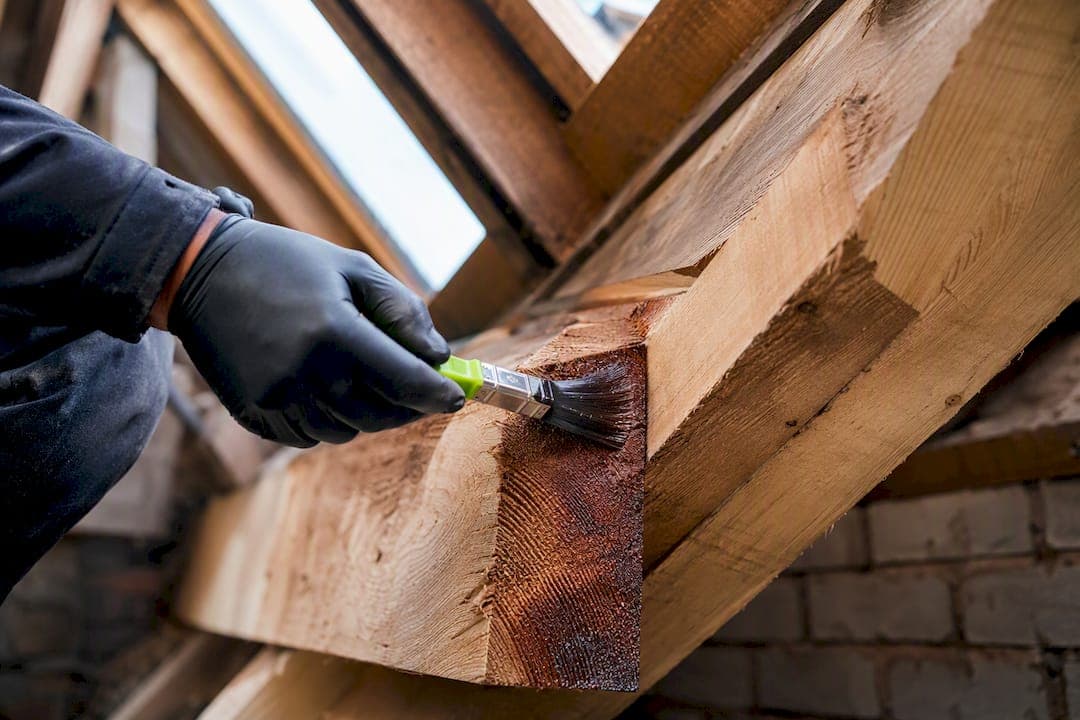
Pro Tip: Treat every cut end, notch, and drill hole created during repair, not just the main timber face. Fungal spores find their way in through the smallest untreated gap, and it's the detail most DIY jobs miss.
Drying timbers out before you close anything up
Treatment applied to damp timber doesn't work properly, so drying comes before or alongside any biocide application. Aim for a moisture content below 20% wherever practical, since that's roughly the threshold below which most wood-rotting fungi can't sustain active growth.
Getting there usually means combining a few approaches:
- Natural airing with windows and access hatches open, where weather allows
- Dehumidifiers running in enclosed voids or subfloors where airflow alone won't shift trapped moisture
- Temporary heating in colder months to speed evaporation without over-drying surrounding materials
- Checking ventilation paths: airbricks that have been blocked, boarded over, or buried under raised ground levels are a common, easily fixed culprit
If the property has spray foam insulation anywhere near the affected timber, check whether it's trapping condensation against structural surfaces rather than letting them breathe. Roof voids in particular need proper ventilation regardless of what insulation sits above the timber.
For reinstated timbers, physical support does real work alongside chemical treatment. Joist hangers, sleeper walls, and steel lintels all keep new wood away from residual damp in surrounding masonry. Drying itself can take anywhere from a few days for a small, well-ventilated void to several weeks for a solid floor buildup, and that timeline usually dictates when the wider repair can be finished.
How long does timber treatment last, and how often should you check it?
Surface treatments give shallow, short-term protection. Deeper preservative methods, correctly applied to properly dried timber, extend service life considerably further, though reapplication and periodic reinspection remain part of any sensible maintenance cycle rather than a one-off fix.
Set a realistic inspection schedule rather than assuming the job is done once the paint dries:
- First inspection: 6 to 12 months after treatment, to confirm the moisture problem hasn't returned
- Ongoing checks: every 3 to 5 years, sooner in high-exposure locations like ground floor voids or roof valleys
Keep a simple log: dates of work, products used, photographs of the treated area, and who carried it out. This record isn't bureaucratic box-ticking. It's exactly what a surveyor or mortgage lender will ask to see if the property changes hands, and it's what an insurer expects if you ever need to claim.
Watch for fresh fungal growth, a returning musty smell, or new soft spots near the treated zone. Any of these mean retreatment or further investigation, not a wait-and-see approach.
When should you call a timber specialist instead of doing it yourself?
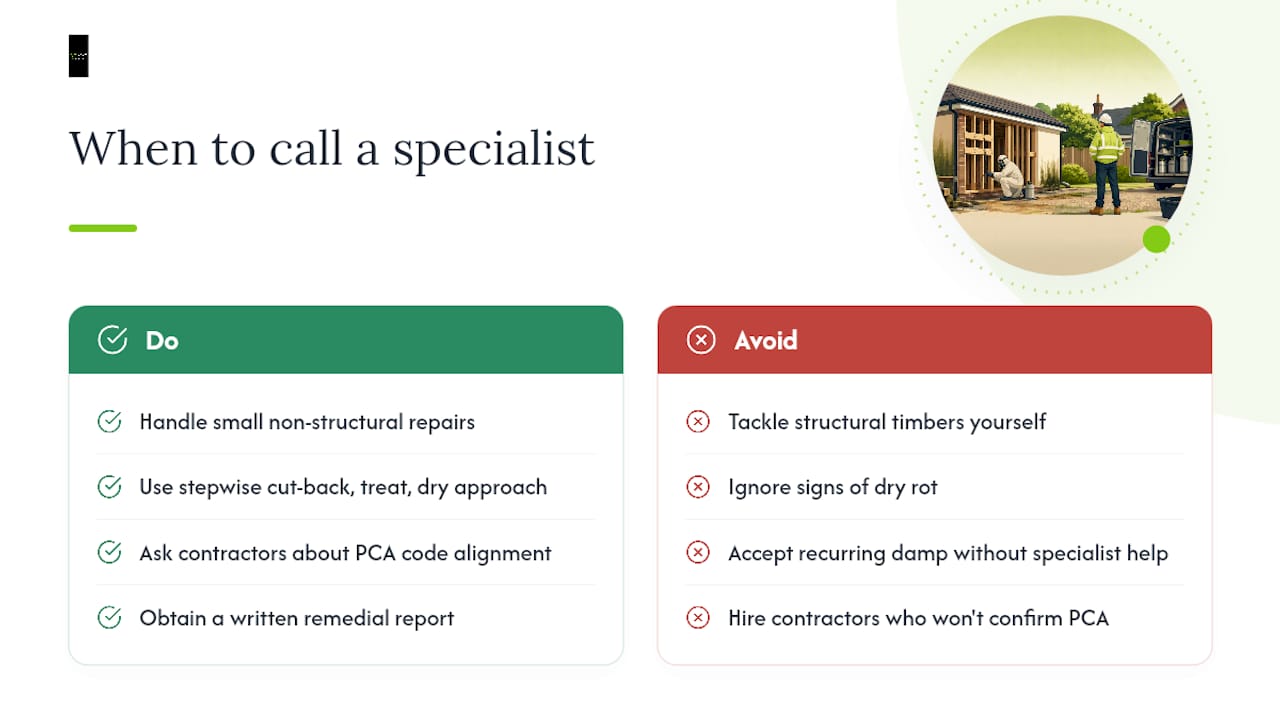
Small, non-structural repairs, a single skirting board, a section of shed timber, can often be handled competently by a careful homeowner following a stepwise cut back, treat, and dry approach. Structural timbers are a different matter entirely.
Call a specialist once decay affects load-bearing joists or beams, once you suspect dry rot rather than wet rot, once damp keeps returning despite your efforts, or once the work needs to satisfy a mortgage lender or buyer's surveyor. The PCA has recently updated its code of practice for remedial timber treatment, reflecting current thinking on biocide use and surveyor responsibility, so ask any contractor whether their method statement aligns with it.
A proper remedial report should set out the extent of decay found, the treatment applied, the products and their use classes, and a recommended reinspection date. Sprayfoamremovalhelp's certified technicians work to this standard when timber decay is uncovered during insulation removal, backed by an insurance-backed warranty and direct communication with the team actually doing the work, rather than a call centre relaying updates secondhand.
Standards and guidance worth keeping to hand
For anything beyond a minor repair, work from primary sources rather than forum advice: BS8417:2011 for pre-treatment and use-class requirements, and the PCA's guidance note on fungal decay in buildings for practical remedial detail.
Getting professional support for timber uncovered during spray foam removal
If decayed timber turned up because spray foam was hiding a moisture problem underneath it, that's not a coincidence worth ignoring. Spray foam applied directly to roof timbers or rafters routinely traps condensation against the wood for years before anyone notices, which is exactly the kind of hidden moisture source this guide keeps returning to. Sprayfoamremovalhelp assesses that damage as part of every removal job across London and the Southeast, rather than leaving homeowners to discover rot only once a surveyor flags it during a sale.
If you're dealing with spray foam and suspect timber damage underneath, start with a free inspection to find out what condition your timbers are actually in before you commit to any treatment plan.
Why the standard advice undersells the moisture question
Most guidance on timber treatment reads like a product catalogue: apply this gel, inject this preservative, job done. That framing gets the priorities backwards. Every case reviewed for this piece points to the same conclusion: treatment failures trace back to moisture sources that were never properly identified, not to the wrong biocide being chosen.
The industry's own guidance backs this up plainly. Isolating new timber from damp masonry cuts recurrence risk substantially, but where that isolation isn't practical, the guidance itself warns owners the replacement stays at heightened risk regardless of what treatment goes on it. That's an honest admission the marketing around most timber products glosses over.
If you take one thing from this, spend your effort on diagnosis before you spend it on product selection. A £15 tin of preservative applied to timber that's still sitting against a leaking gutter buys you nothing but a few extra months before the same rot returns. Fix the water. Then treat the wood.
— jessica
Sources
Timber does not rot on its own. Something is feeding it moisture, and treating the wood without fixing that source is wasted effort. According to the Property Care Association, correcting the moisture source is the essential first step before any remedial treatment can succeed in wet rot cases.
Before you treat anything, track down where the water came from. Common culprits include:
Once you've found the source, assess the timber itself. Sound wood resists a bradawl or screwdriver; decayed timber gives way with little pressure, often crumbling into cubes (a classic sign of dry rot) or feeling soft and stringy (more typical of wet rot). A musty, damp smell and visible fungal strands or fruiting bodies confirm active decay.
Decay almost always spreads further than it looks. A widely used rule of thumb is to cut back at least 500 to 600 millimetres beyond the last visible sign, since fungal spread frequently extends past what's visible on the surface. Photograph everything with dates before you cut. That record matters later for insurance claims, mortgage compliance, or if a dispute ever arises over the standard of work.
FAQ
How long does timber treatment last?
Surface treatments offer shorter-term protection and typically need reapplication within a few years, while properly applied deeper preservative methods on dried, correctly diagnosed timber last considerably longer. Either way, periodic reinspection every 3 to 5 years is standard practice regardless of which method was used.
Can you stop wood rot once it starts?
Yes, provided you remove the decayed section, correct the moisture source causing it, and treat the surrounding sound timber. Rot that's already destroyed the wood's structure can't be reversed, but active spread can be halted once the conditions feeding it are removed.
How long can I leave untreated wood outside?
There's no fixed safe period, since it depends entirely on species, exposure, and ground contact. Untreated softwood exposed to weather or damp ground can start showing decay within months, which is why pre-treatment to the correct use class under BS8417:2011 matters before installation rather than after.
What is the best treatment for timber?
There's no single best product. It depends on whether you're treating factory replacement stock (pre-treated to use class under BS8417:2011), retained sound timber near a former outbreak (borate diffusion or fungicidal injection), or a freshly cut end (site-applied retreatment). The right choice follows the diagnosis, not the other way round.