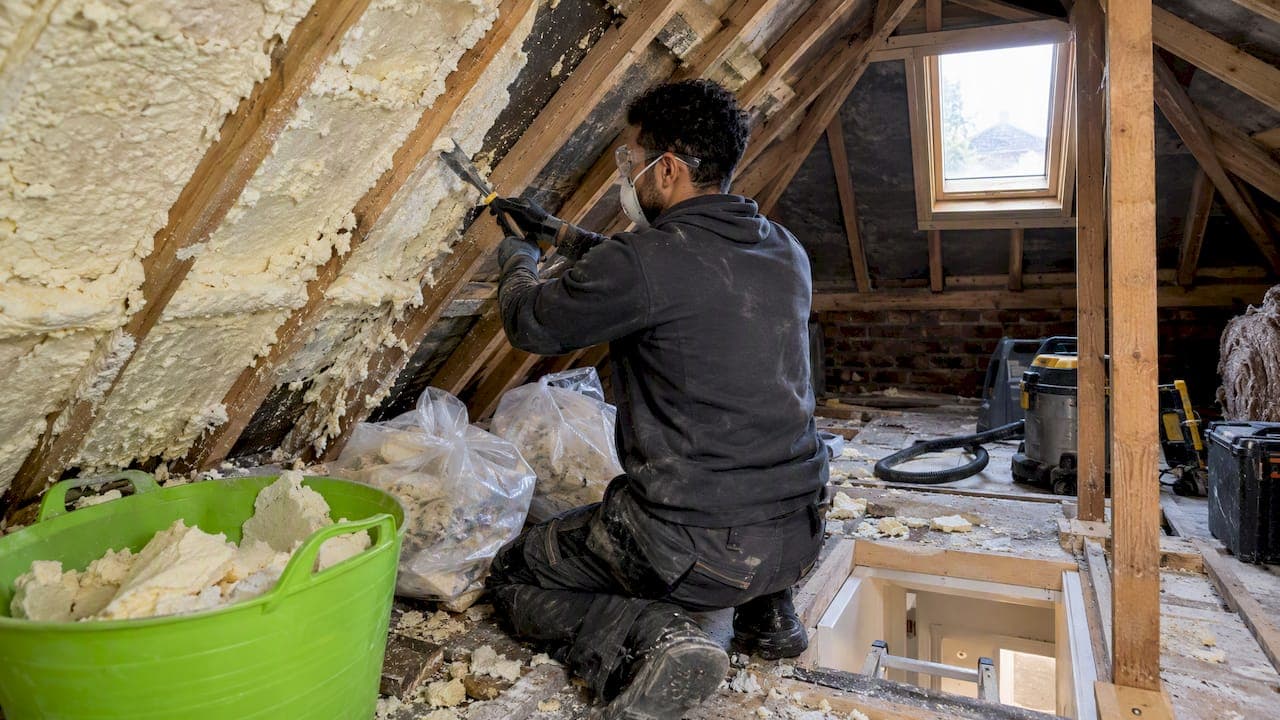
For a typical UK house, the removal itself takes a few working days on site, but the whole job, from first survey to the paperwork a lender will accept, takes longer. Open cell foam in a modest loft sits at the short end. Closed cell foam on a large or awkward roof, or a roof where the timbers turn out to be damaged, sits at the long end. This guide breaks the timeline into stages so you can see where the days go and what you can do to keep the job moving.
We are Revive Maintenance, a direct spray foam removal team working across London and the Southeast. You talk to the people who do the work, so the timings below are the ones we would explain to you across the kitchen table.
TL;DR
- Expect removal on site to take a few working days for most homes. Open cell is usually quicker than closed cell, and loft size, roof pitch and access move the figure more than anything else.
- Timber damage found once the foam is off can add 1 to 2 days for minor repairs, or 3 to 7 days or more for significant structural work, according to one UK removal specialist's process guide.
- You do not normally need to move out, but you should plan for noise, dust control, restricted access to the loft and a few days of disruption.
- Allow extra time before and after the work: a survey first, a booking window, then the inspection or certificate your lender or buyer wants.
- Removal does not automatically fix a mortgage problem, so check what your lender needs before you book.
Table of Contents
- The short answer: how long the work takes
- Open cell versus closed cell: why the foam type matters
- What changes the number of days
- The full timeline, stage by stage
- Can you stay at home during spray foam removal?
- Worked examples
- Will removal fix my mortgage or sale?
- How to keep the job short
- Be wary of urgency
- Our perspective on timescales
- Get a clear timeline for your roof
- FAQ
- Sources
The short answer: how long the work takes
There is no single number, and any firm that gives you one without seeing your roof is guessing. What can be said honestly is this:
| Situation | What to expect on site |
|---|---|
| Small or average loft, open cell foam, easy access | Shortest end of the range, often only a day or two |
| Average semi-detached or terraced roof, closed cell foam | Several working days |
| Large detached house, steep or complex roof, thick closed cell foam | Longest end, with a week possible |
| Any of the above with rotten or damaged timbers | Add repair time on top |
These are planning ranges, not promises. Your written quote after a survey should state the number of days for your roof, and a firm that has surveyed properly will stand behind it.
Open cell versus closed cell: why the foam type matters
The UK Insulation Manufacturers Association's guide to spray and injected foam describes open cell foam as softer and more flexible and closed cell foam as denser and more solid. That difference is exactly what drives removal time.
Open cell foam is spongy. It can be cut, scraped and pulled away from rafters in larger pieces. It still has to be bagged and carried out, and the timber underneath still has to be cleaned, but the physical work is lighter. Our published price range for open cell removal is £1,000 to £5,000.
Closed cell foam is rigid and bonds firmly to timber and felt. It has to be taken off in smaller sections, with more care to avoid damaging rafters, battens, membranes and wiring. More careful work means more days. Our published price range for closed cell removal is £1,500 to £7,000, and the time and the price rise together for the same reason: labour.
The price pages give the full picture on our spray foam removal cost page.

What changes the number of days
Five things decide whether your job lands at the short or long end.
Loft and roof size
More surface area means more foam to remove, more waste to carry and more timber to clean. A two-bedroom terrace and a five-bedroom detached house are not the same job even with identical foam.
Foam thickness
A thin coat on the underside of the roof deck comes off faster than foam that has been sprayed thickly into rafter bays and around joints. Thickness is something a surveyor can check in advance, which is one reason the survey is worth having.
Access
A wide loft hatch and boarded floor let the team bring in kit and take out waste quickly. A narrow hatch, no boarding, low eaves or a cut-up roof structure slow everything down. Waste has to leave the house in bags, so the route from loft to skip matters.
Roof pitch and layout
Dormers, hips, valleys, chimneys and low-pitched sections all create areas where foam sits in awkward corners. Complex roofs take longer than a simple gable.
Hidden damage
This is the big unknown. Foam hides what is underneath it. If the roof timbers have been damp, the first time anyone sees them clearly is once the foam comes off. Warwickshire County Council Trading Standards warns that spray foam can seal in moisture, leading to damp and timber rot, and recommends an independent surveyor's report before removal. If rot is found, one UK specialist's process guide puts the extra time at 1 to 2 days for minor repairs or 3 to 7 days or more for significant structural remediation.
The full timeline, stage by stage
The on-site days are only part of it. Here is the whole sequence.
1. Enquiry and survey: days to a couple of weeks
Everything starts with finding out what you actually have: open or closed cell, how thick, how much of the roof it covers, and what condition the timbers and felt are in. We offer visual surveys and reports as stand-alone services, with published prices:
- Basic Visual Survey: from £100
- Full Roof Report (with photos): from £200
- Drone Survey + Report: from £250
- Full Drone + Detailed Report: £350 to £450
All are listed on our surveys and services page. A drone survey can be useful where the roof is steep or you do not want anyone walking on it.
If you want the quickest route to a figure, the home visit quote page is the place to start.
2. Booking: days to a few weeks
The gap between accepting a quote and the team arriving depends on demand and on whether you need an urgent slot. We also offer emergency same-day removals, so if you are mid-sale and the clock is running, say so when you call. Booking lead times change through the year, so ask for the current availability rather than relying on any figure printed in a guide.
3. Set-up and containment: part of day one
Before any foam is touched, the team protects the house. That means floor protection on the route to the loft, sealing off the hatch area, dust control and safe access. Foam is a synthetic material and the dust and offcuts are unpleasant to breathe in, so this stage is not optional. Allow the first part of the first morning for it.
4. Removal: the main days
This is the part everyone asks about. Foam is taken off the rafters, the underside of the roof deck and any gable areas by hand tools and mechanical methods, bagged as it comes off and carried down. It is slow, physical work, and the pace is set by foam type and thickness.
5. Timber inspection and remedial work: hours, or extra days
Once the foam is clear, the timbers can finally be seen properly. If they are sound, this takes minutes to hours. If there is staining, softness or rot, the job pauses for a decision: treat, repair or replace. This is the stage that turns a three-day job into a five-day one, and it is why we do not guarantee an end date without the caveat that hidden damage can change it.
6. Clean-up and waste: end of the last day
The loft is cleaned, waste is removed and disposed of, and the area is left tidy. We then talk through what we found.
7. Certification and paperwork: days to weeks
If you are selling or remortgaging, the removal is rarely the end. A lender or buyer may want a report confirming the foam is gone and the roof is in good condition. Our team provides PCA and RICS certification inspections for this. The time here depends on who needs what, so ask the lender or the buyer's solicitor what they want before the work starts, not after.
Can you stay at home during spray foam removal?
In most cases, yes. The work happens in the loft or roof void, not in your living space, and you do not usually need to move out. That said, "you can stay" is not the same as "you will not notice".
Plan for these:
- Noise. Scraping and cutting above your head is audible, especially in bedrooms below the loft.
- Access. Parts of the house, such as the landing and the stairs, will be busy as bags of waste come down.
- Dust. Good containment keeps it to a minimum, but keep valuables and open food away from the hatch area.
- Pets and young children. Keep them away from the work zone and the route out.
- Health. If anyone in the house has a respiratory condition such as asthma, tell the team when you book so they can plan containment, and ask your GP whether they would prefer the person to be out for the day.
If the roof has to be opened up for repairs, ask in advance how the house will be kept weathertight overnight.
Worked examples
These are illustrations of how the stages add up, not records of particular jobs.
A semi-detached with open cell foam, good access. Survey in the first week, booking within a couple of weeks, one or two days on site, timbers dry and sound, certificate follows. From enquiry to finished paperwork: roughly three to four weeks, with only a couple of days of disruption in the house.
A detached house with thick closed cell foam on a complex roof. Survey and drone report, booking, then several days on site. Rot found at the eaves adds a repair phase. The on-site time stretches towards a week or more, and you would want a lender-ready report at the end. Plan for a month or more from first call.
A seller with a buyer waiting. The limiting factor is rarely the removal. It is the survey, the booking slot and the lender's acceptance of the evidence. This is where the same-day emergency option and a pre-agreed report format save time.
Will removal fix my mortgage or sale?
Not automatically, and it is better to know that before you spend money. The government's own page on spray foam remediation, removal and lending says removing the foam will not always guarantee that lenders will still lend. Cornwall Council's trading standards team says removal can be costly and may not resolve mortgage issues.
So the sensible order is: find out what the lender requires, get an independent assessment, then decide. Our guides on how spray foam affects property value and what to do about landlord obligations cover the lending side in more detail.
How to keep the job short
- Get the survey done first. Knowing foam type, thickness and timber condition turns a guess into a schedule.
- Clear the loft. Move boxes and stored items out, and make sure the hatch is easy to use.
- Ask what the lender or buyer needs. Agree the evidence before the first day.
- Agree what happens if rot is found. A pre-agreed approach to repairs avoids waiting for a second quote mid-job.
- Keep parking and skip access clear. Waste leaving the property in good time stops the job slowing in the afternoon.
- Ask for the days in writing. A written number of days, with the reasons it could change, is a sign of an honest quote.
Be wary of urgency
A fast timeline is useful. A fast sales pitch is not. Cornwall Council's trading standards team advises caution with cold calls, doorstep visits and urgent-removal claims, and says some consumers have paid thousands for work they did not need. The Property Care Association points out that many removal companies use aggressive pressure selling and also says that not every spray foam installation is problematic.
If someone tells you the foam must come out this week and offers no survey, walk away. Our guides on spotting insulation removal scams and independent damp surveys explain what a genuine assessment looks like.
Our perspective on timescales
We would rather give you a realistic window than a headline number. In our experience of removing foam for homeowners across London and the Southeast, the days on site are the part people worry about least once they understand them. The part that catches people out is the sequence around the work: a survey, a booking slot, a lender's wishes, and the possibility that the timbers need attention.
Because you speak directly to the team doing the work, not a lead-selling website, the person who surveys your loft can tell you how many days it should take and why. Our quotes are fixed, with no hidden fees, and our work carries a 10-year insurance-backed warranty. That only means something if the timeline we give you is honest, so we give you the reasons it could move.
We also say plainly when removal is not the answer. If a survey shows the foam is sound and the timbers are dry, a report may do more for your sale than a rip-out.
— jessica
Get a clear timeline for your roof
If you want a number of days for your own property, start with a survey. We can quote from a home visit, and the survey tells you the foam type, thickness and timber condition so the schedule is based on facts. See our removal prices and options, or book a home visit quote. Our published ranges are £1,000 to £7,000 for spray foam removal overall, and we give a fixed quote before work starts.
FAQ
How long does spray foam removal take for a typical house?
Most homes need a few working days on site. Open cell foam in a smaller loft can be quicker, while closed cell foam on a large or complex roof takes longer. Your written quote should give the number of days for your roof after a survey.
Do I have to leave my house while spray foam is removed?
Usually not, because the work is in the loft or roof void. You should expect noise, people moving through the house and some disruption on the landing and stairs. If anyone has a breathing condition, tell the team when you book and ask your GP for advice.
Why did my removal take longer than quoted?
The usual cause is hidden damage. Once the foam is off, rotten or damp timber can need repair, which can add 1 to 2 days for minor work and 3 to 7 days or more for structural work. A good quote explains in advance how that situation would be handled.
Is open cell quicker to remove than closed cell?
Generally yes. Open cell is softer and more flexible, while closed cell is denser and bonds more firmly, so it takes more careful work and more days. Thickness and access still matter as much as type.
How long before I can sell or remortgage after removal?
That depends on your lender or buyer rather than on the removal. Removal does not always guarantee that lenders will lend, so ask what evidence they need before you book, and allow time for any inspection or certificate.
Sources
- A guide to spray and injected foam insulation, UK Insulation Manufacturers Association
- Beware high pressure spray foam insulation installers and removers, Warwickshire County Council
- Spray foam insulation advice for homeowners, Cornwall Council
- Spray foam insulation: remediation, removal and lending, GOV.UK
- Spray Foam Customer Guidance, Property Care Association
- Spray foam removal process UK: what to expect