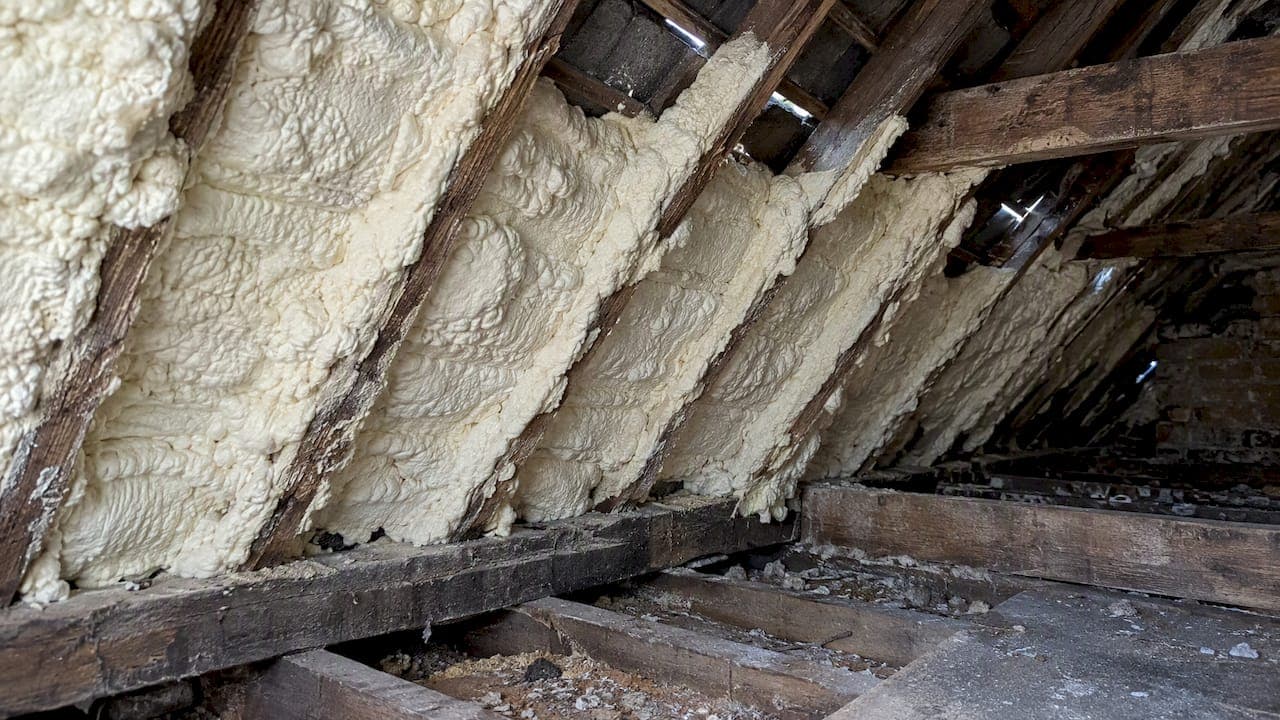
If your listed building has spray foam in the roof, or you are about to buy one that does, you have two problems at once. The foam is a mortgage and survey issue, as it is in any home. In a listed building it is also a heritage issue, because RICS says spray foam must not be installed in a listed building without prior consent, and consent is rarely given. The sensible order is to speak to your local conservation officer, get an independent specialist report on the roof, and only then decide whether, and how, to take the foam out.
This guide explains why listed buildings are treated differently, what lenders and surveyors look for, how removal should be approached on historic timbers, and what the work can cost.
TL;DR
- Spray foam in a listed building needs listed building consent before it is installed. Foam fitted without it is a likely breach of heritage law, so tell your local authority's conservation officer early.
- Foam bonds to old timbers and hides the roof structure. That is why surveyors flag it and some lenders refuse to lend.
- Removing the foam does not automatically fix mortgageability. Lenders may still want a specialist report or follow-up inspection.
- Start with an independent survey of the roof, not a sales visit. Be wary of anyone pressuring you to sign on the day.
- Our published removal prices run from £1,000 to £7,000 depending on foam type and roof, and surveys start from £100.
Table of Contents
- Why a listed building is a special case
- What spray foam does to old roofs
- How lenders and surveyors react
- Removing the foam is not an automatic fix
- Do you need consent to remove it?
- What good removal looks like on historic timbers
- What it costs
- Our perspective
- Next steps if you own or are buying a listed home with foam
- Book a survey of your roof
- Replacing the insulation afterwards
- FAQ
- Sources
Why a listed building is a special case
Most homeowners with spray foam face a commercial problem: a buyer's surveyor flags it, a lender hesitates, the sale slows. A listed building adds a legal layer. Listing protects the character and historic fabric of the building, and that fabric includes roof timbers, which is exactly where spray foam goes.
Historic England's advice note on listed building consent says that installing spray foam in a listed building without consent is a likely breach of heritage law. The reasons authorities give are consistent:
- It is not reversible. Foam bonds to timber, slate and tile. You cannot lift it off and put the roof back as it was.
- It can harm historic significance. Original rafters, pegged joints and old battens are part of what makes the building worth listing.
- It complicates maintenance. Once timbers are covered, nobody can inspect them for rot, beetle or movement without disturbing the foam.
Historic England's own guidance on insulating pitched roofs at rafter level has a specific section on sprayed foam insulation, which is a good place to see how the heritage sector frames the risks.
Grade I, II* and II, and unlisted but protected
The rules on consent apply across listed grades, and RICS extends the same point to other protected buildings and structures. If your home is in a conservation area but not listed, or is covered by an Article 4 direction, ring the planning department as well. Rules differ by council, and the conservation officer is the person who will tell you how yours applies.
What spray foam does to old roofs
Traditional timber roofs were designed to breathe. Air moves through gaps in slate and tile, and moisture escapes. Foam sprayed to the underside seals that system.
The Energy Saving Trust explains that spraying foam onto a roof that is already leaking or damp is high risk, because the foam can trap moisture against the structure and stop it drying out. It also stops anyone seeing what is happening. Its roof guidance adds that it does not recommend spraying foam to fix a damaged or leaking roof without fixing the underlying problem first.
In a listed building the stakes are higher. Historic England stresses that energy efficiency work should take a whole-house approach, and it favours reversible, breathable materials. Retrofitting roofs can risk trapped moisture and long-term decay in traditional timber frames.
Open cell and closed cell foam
Both types are found in older properties, and both cause concern:
| Open cell | Closed cell | |
|---|---|---|
| Texture | Soft, spongy | Hard, rigid |
| Typical claim at sale | "Breathable" | High insulation value |
| Main worry | Can still hold moisture against timber | Seals the roof and bonds hard to timber |
| Our published removal price | £1,000 to £5,000 | £1,500 to £7,000 |
The "breathable" label on open cell foam does not make it safe for a historic roof. Surveyors still cannot see the timbers behind it, and lenders usually do not treat the two types very differently.
How lenders and surveyors react
The foam itself is only part of the story. According to RICS, the primary concern for lenders is the lack of clarity about what was installed and the chance it is hiding defects in the roof. A surveyor cannot inspect timbers they cannot see.
Cornwall Council's Trading Standards advice says foam can affect mortgageability and valuation, and that some lenders refuse loans. Surveyors may ask for an independent specialist report on the roof's condition, and that report directly influences the lender's decision.
On a listed building you should expect extra questions:
- Was listed building consent obtained before the foam went in?
- Who installed it, what product was used, and is there paperwork?
- What condition are the timbers in underneath?
- Has anyone told the local authority?
A missing consent is a separate problem from the foam, and it can show up in the solicitor's searches even when the surveyor is satisfied with the roof.
We have written more on the lender side in our guide to buying a house with spray foam and on how sellers restore property value. Our piece on spray foam in UK period properties covers the older-home picture beyond listing.
Removing the foam is not an automatic fix
It is tempting to think: foam out, problem gone. Cornwall Council's guidance is more careful. Lenders often ask for an independent specialist report when foam is present, but taking it out does not guarantee approval. They may still want follow-up inspection or evidence that the roof is structurally sound afterwards.
For a listed building, that means you should plan three things together:
- The condition of the roof once the foam is gone. Removal can expose rot, old leaks or damaged battens that were hidden.
- What replaces it. Reversible, breathable insulation is the heritage-friendly option, and the conservation officer will want to see what you propose.
- The paperwork. A written record of the removal, before and after photographs, and a report a lender will accept.
Do you need consent to remove it?
We cannot give you a legal answer for your building, and nobody should without reading the listing entry and speaking to your council. What we can say is this: removal is work to a listed building, and the sensible, low-risk course is to call your conservation officer before anyone starts. Explain that the foam is already there, say you want to take it out and restore the roof, and ask whether they need a listed building consent application or can advise in writing.
Bath and North East Somerset Council's guidance gives a sense of how this works in practice. It notes that insulation at ceiling level is not normally a consent matter provided it is not adhesive, avoids disturbing historic fabric and is easily removed. Foam fails that test on every count, which is why it is treated so differently. Your own council may word it differently, so ask them directly.

If you are replacing foam with another form of insulation, say so in the same conversation. A single approach to consent is easier than two.
What good removal looks like on historic timbers
Foam removal on an ordinary 1990s roof is a defined job. On a listed building, the removal itself can damage what you are trying to protect, so the method matters. In practice a careful job involves:
- A survey first. Photographs, moisture readings where the foam allows, and a record of the roof's condition. A drone survey can help where access is poor or the roof is steep.
- A method statement agreed in advance, especially if the conservation officer has asked for one.
- Controlled removal. Foam is taken off the timbers and slates without levering against old fabric more than necessary.
- Inspection once it is clear. The timbers are checked for rot and beetle, and the result recorded.
- A report you can hand to a surveyor or lender, with before and after evidence.
Be cautious of anyone who promises a fixed outcome before they have seen the roof. Warwickshire Trading Standards has reported rising complaints about high-pressure spray foam installers and removers, and advises getting an independent survey before spending on removal or installation.
What it costs
Our prices are published, and we do not add hidden fees. Final cost depends on the roof size, the foam type, its thickness and access.
| Service | Published price |
|---|---|
| Spray foam removal (general range) | £1,000 to £7,000, one-off |
| Open cell spray foam removal | £1,000 to £5,000, one-off |
| Closed cell spray foam removal | £1,500 to £7,000, one-off |
| Basic visual survey | from £100, one-off |
| Full roof report (with photos) | from £200, one-off |
| Drone survey and report | from £250, one-off |
| Full drone survey and detailed report | £350 to £450, one-off |
A listed building may sit at the upper end of any range if access is awkward or the work has to be slower. Because we price after seeing the property, you know the figure before you agree to anything. The survey cost is small next to the removal bill and the cost of a failed sale.
For the wider picture, see our spray foam removal cost page.
Our perspective
We get asked about listed buildings less often than about ordinary homes, and that is part of the problem. Owners assume foam is a standard upgrade, and installers sometimes do not mention consent at all. By the time we see the roof, the owner is usually dealing with a buyer's surveyor or a lender's valuer.
Here is what we would say to any owner in that position.
Start with the facts, not the quote. Find out what is on the roof, how thick it is and what condition the timbers are in. We offer surveys from £100 for exactly this reason. You should know what you are dealing with before you decide anything.
Talk to the conservation officer early. It feels like owning up, but councils generally prefer an owner who comes forward to one who is found out at sale. Having a clear plan to restore the roof puts you in a far better position.

Do not treat removal as the finish line. A lender wants evidence. We work as a direct team: you speak to the people who do the work, not a call centre or a lead-selling website, and the report we give you is written to be handed to a surveyor or lender. Our removals carry a 10-year insurance-backed warranty.
Be wary of pressure. If anyone tells you the foam must come out this week and asks for a deposit on the doorstep, stop. A good job survives a few days of thinking.
— jessica
Next steps if you own or are buying a listed home with foam
If you own it:
- Gather any paperwork from the installation: invoices, product data, warranties, any consent letters.
- Contact your conservation officer and ask what they need.
- Book an independent survey of the roof.
- Decide on removal and replacement only once you have the report.
If you are buying it:
- Ask the seller for the installation paperwork and any consent. If there is none, tell your solicitor.
- Ask your lender how they treat spray foam before you pay for a survey. Cornwall Council's guidance recommends checking lender policy specifically.
- Get a specialist roof report so you can negotiate on real numbers.
Our article on PCA and RICS reports for home insurance and mortgage delays explains the reports lenders and insurers tend to ask for. If you are an agent handling a listed property, our estate agents' guide sets out how to keep a sale moving, and landlords can read about their spray foam duties.
Book a survey of your roof
We provide PCA-certified spray foam removal and roof surveys across London and the Southeast, with transparent fixed pricing and a price-beat guarantee. If you want to know what is on your roof before you speak to your council or lender, start with a survey: see our survey and report options, or request a home visit quote. Tell us at the start that the building is listed, so we can plan around it.
Replacing the insulation afterwards
Whatever comes out needs to be replaced by something that keeps the building warm without sealing the roof. The Energy Saving Trust gives 270mm as the recommended minimum depth for loft insulation in typical UK homes, using mineral fibre or similar material laid between and across joists. For a listed building, the right answer depends on how the roof is used and what the conservation officer accepts.
Two broad routes exist:
- Insulating at ceiling or joist level, keeping the roof space cold and ventilated. This is usually the least invasive.
- Insulating at rafter level, where the loft is a living space. Historic England's guidance sets out how to do this with breathable materials and attention to ventilation.
We install Superfoil SF40 and SF60 insulation, as well as loft boarding and other loft services, which you can see on our services page. Whether a particular product suits a particular listed building is a decision for you, the conservation officer and a suitably qualified heritage professional. We will be straightforward if we think a different route is better.
FAQ
Can you have spray foam in a listed building?
Only with prior listed building consent, and consent is rarely given. RICS states that foam must not be installed in a listed or protected building without it. Historic England treats foam as hard to reverse and potentially harmful to historic fabric.
Will a lender mortgage a listed building with spray foam?
Some will not. Cornwall Council's guidance says foam can affect mortgageability and that some lenders refuse to lend, so check your lender's policy before you commit. A specialist roof report is often required, and removal alone does not guarantee approval.
How much does it cost to remove spray foam from a listed building?
Our published removal prices run from £1,000 to £7,000, with open cell at £1,000 to £5,000 and closed cell at £1,500 to £7,000. Surveys start from £100. A listed building is priced after we see it, because access and the condition of the timbers affect the work.
Who should I tell first if my listed home has foam?
Your local authority's conservation officer. Explain what is there, whether you have any consent paperwork, and what you plan to do. Then get an independent roof survey so you have facts to discuss.
Sources
- RICS: Spray foam insulation consumer guide
- Historic England: Listed building consent advice note (HEAG304)
- Historic England: Insulating pitched roofs at rafter level
- Energy Saving Trust: Spray foam insulation explained
- Energy Saving Trust: Roof and loft insulation guide
- Cornwall Council: Spray foam insulation advice for homeowners
- Warwickshire County Council: Beware high pressure spray foam installers and removers
- Bath and North East Somerset Council: Roof insulation at ceiling level