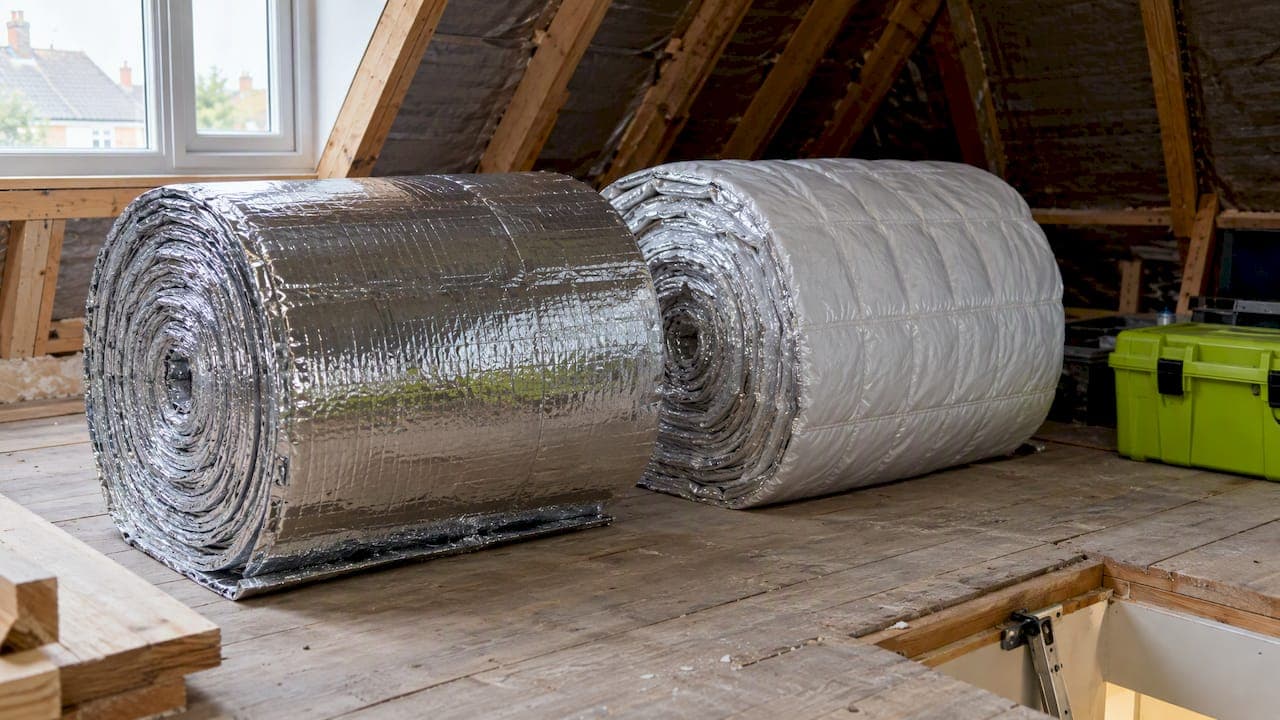
SuperFOIL and SuperQuilt are both multilayer reflective quilts, and both are sold for roofs, walls and floors in UK homes. The real differences are thickness, declared thermal performance, certification paperwork and how each is detailed on site. Neither is a drop-in replacement for a thick layer of mineral wool or PIR in every situation, and neither is anything like spray foam. This guide sets the two side by side, explains what the numbers mean, and shows where each fits, especially if you are replacing spray foam that a surveyor or lender has flagged.
We remove spray foam for a living and we install SuperFOIL afterwards, so we say plainly where we sit. We still give you the facts on both products, with the manufacturers' own figures.
TL;DR
- Both products are multifoils: reflective foils plus wadding, installed as a thin, flexible layer. They work best as part of a full build-up with proper air gaps, not as a magic single layer.
- SuperFOIL comes in four thicknesses (SF6, SF19+, SF40, SF60). SuperQuilt is a single 19-layer product of about 40 mm, so the choice is wider on the SuperFOIL side.
- Always compare R-values on the same basis: core value alone, or core plus air spaces. Check the certificate for the exact installation the figure applies to.
- Multifoil is lightweight and can be lifted out or replaced later. Spray foam is difficult to remove and can stall a sale or remortgage.
- If you have spray foam to remove first, a survey and a certified removal come before any new insulation goes in.
Table of Contents
- What SuperFOIL and SuperQuilt actually are
- Specifications side by side
- How effective is multifoil, really?
- Certification, fire and Building Regulations
- Installation: where the two differ in practice
- Which should you choose?
- SuperFOIL vs spray foam
- Our perspective
- What removal and replacement cost with us
- Practical checklist before you buy any multifoil
- FAQ
- Sources
What SuperFOIL and SuperQuilt actually are
Both belong to the multifoil family. Instead of trapping air in a thick fibrous or foam slab, a multifoil uses several reflective layers and wadding to cut heat transfer in a much thinner package.
SuperQuilt (previously sold as YBS SuperQuilt) is described on the SOPREMA UK product page as a 19-layer reflective insulation containing reflective foils and wadding, around 40 mm thick. It is intended, subject to project design, for roofs, walls and floors in new-build and refurbishment work. The same page says it can act as a vapour-control layer when installed and sealed to the manufacturer's guidance, and that it uses approximately 83% recycled materials.
SuperFOIL is a UK-manufactured range. Its July 2025 brochure describes the SF6, SF19+, SF40 and SF60 products as three-in-one: insulation, radiant barrier and vapour check, for roofs, walls and floors. They can be installed as continuous layers and are designed to be lightweight and easy to fit.
So the headline difference is structural. SuperQuilt is one product at roughly 40 mm. SuperFOIL is a ladder of products from 30 mm to 100 mm, which lets a designer choose the thickness to suit the space and the target U-value.

Foil tape and sealing
Both systems rely on a foil tape system to seal joints. That matters more than it sounds. If the quilt is meant to act as a vapour layer, every lap and edge has to be taped properly, and every penetration (cables, pipes, rafters) sealed. A beautifully specified product with untaped laps is simply a weaker product.

Specifications side by side
Here is what each manufacturer publishes. The SuperFOIL figures come from its brochure. The SuperQuilt figures come from the SOPREMA UK page.
| Product | Nominal thickness | Core R-value (m²K/W) | Roof R-value incl. air spaces (m²K/W) |
|---|---|---|---|
| SuperFOIL SF6 | 30 mm | 0.99 | 1.90 |
| SuperFOIL SF19+ | 45 mm | 1.63 | 2.53 |
| SuperFOIL SF40 | 65 mm | 2.57 | 3.47 |
| SuperFOIL SF60 | 100 mm | 3.58 | 4.48 |
| SuperQuilt | approx. 40 mm | not compared here | declared up to 3.0 |
The SuperFOIL numbers are from the brochure's specification table. The SuperQuilt figure is the declared thermal performance of up to R 3.0 m²K/W, which SOPREMA UK ties to installation in accordance with its certification and assessment documentation.
Reading the table without being misled
The two right-hand columns are not like for like. SuperFOIL publishes a core value, which is the quilt on its own, and a roof value, which adds the thermal resistance of two air spaces. Its pitched roof page explains that these figures are calculated as core value plus two air spaces under EN 16012, and gives different totals for roofs, walls and floors. For SF40, for example, it lists 3.47 for a roof, 3.90 for a wall and 5.23 for a floor.
So a quick glance that puts SuperFOIL SF40 at 3.47 against SuperQuilt at 3.0 tells you very little. Ask three questions of any figure:
- Is it the core value or does it include air spaces?
- Which element is it for: roof, wall or floor?
- Which test or assessment sits behind it, and does the certificate describe your exact build-up?
SuperFOIL also notes in its multifoil overview that the best solution is unique to each project and may combine multifoil with other insulation or use a duet system. That honesty is worth taking seriously: the product is a component, not a whole answer.
How effective is multifoil, really?
This is the question behind most searches for "is SuperQuilt any good" or "is SuperFOIL as good as PIR". The straight answer: both can perform well when detailed correctly, but the way multifoil is tested has been argued over for years.
The LABC (the body representing local authority building control) published a technical guidance note on multifoil insulation. It describes a long-standing debate over whether comparative in-situ testing, often favoured by some multifoil manufacturers, is as accurate as standard hot-box testing. Its position is that thermal performance should be determined by testing to recognised national, European or international standards. The note is dated April 2008, so treat it as background to the debate rather than a current ruling. Standards and certificates have moved on since, and both products now carry declared figures under EN 16012.
The same note advises using an Agrément-certified multifoil strictly as set out in its certificate, and says Building Regulations compliance is for the local authority to decide. It also said LABC was not aware of a multifoil meeting the normal roof U-value requirement of 0.2 as a single layer without additional insulation. That is the practical point to hold on to: in a typical loft or rafter job aiming at a modern U-value, multifoil is usually one layer in a combination, not the only layer.
SOPREMA UK says the same thing from the manufacturer's side: on its insulation solutions page it explains that multifoils normally form part of a combined build-up and that performance depends on correct installation, air spaces and detailing.
Why air gaps matter
A reflective foil works by reflecting radiant heat across an air space. Without an air space facing the foil, you lose much of the benefit. That is why the SuperFOIL roof, wall and floor figures include two air spaces, and why a tightly compressed quilt stuffed between joists will underperform its datasheet. Plan for the gaps at the design stage, not on the day.
Certification, fire and Building Regulations
For a home you plan to sell or remortgage, paperwork matters as much as R-values.
SuperQuilt. SOPREMA UK states that it is fully Agrément Certified, Building Control compliant and NHBC accepted. It also warns that SuperQuilt should not be used in external walls of buildings over 11 metres in height, and that users must still satisfy the applicable UK Building Regulations, standards and fire requirements. A BDA Agrément certificate for flat roof applications covers independently assessed thermal resistance, fitness for intended use and contribution to Building Regulations when installed as specified.
SuperFOIL. Its manufacturer page says products are independently tested by notified bodies and third-party certified laboratories to comply with relevant UK Building Regulations. It also offers complimentary U-value calculations for elemental and SAP assessments, says its products use up to 40% recycled plastics, and quotes a 50+ year lifespan with recyclability at end of life. Those are the manufacturer's claims, so ask for the specific test reports and certificates for the product and application you are buying.
Some competing marketing pages say one brand has a lower fire classification than the other. Do not decide on a sales line. Ask each manufacturer for the current fire test data for the exact product, and ask your building control body or designer which classification your element needs. The 11 metre warning above shows why height and wall location matter.
What to ask for before work starts
- The current certificate or assessment for the exact product and element (roof, wall or floor).
- A U-value calculation for your build-up, not a generic figure.
- A condensation risk assessment, particularly for roof spaces. SuperFOIL's brochure lists free U-value calculations, condensation-risk analysis and specification advice.
- Confirmation of how laps, edges and penetrations will be taped and sealed.
- Whether the work needs a building control notification.
Installation: where the two differ in practice
In use, the two feel similar. Both are rolled out, cut with sharp scissors or a knife, stapled or fixed, and taped. The practical differences come from thickness and roll size.
- Thickness choice. With SuperQuilt you work with about 40 mm. With SuperFOIL you can step down to SF6 at 30 mm where headroom is tight, or up to SF60 at 100 mm where you need more resistance and have room.
- Roll sizes. SuperFOIL's brochure lists SF40 at 10 m long and 1.5 m wide, giving 15 m² per roll, and SF60 at 8 m by 1.5 m, giving 12 m². Check the roll size of any product against your rafter spacing to reduce waste.
- Fit around timber. A thicker quilt is harder to dress neatly around rafters and wiring. Take that into account when choosing thickness, and do not squash it to make it fit.
- Vapour behaviour. SuperQuilt is vapour-resistant, whereas SOPREMA UK's separate BreatherQuilt is vapour-permeable. Putting a vapour-resistant layer in the wrong place can trap moisture, so a designer should confirm the position in the build-up.
SuperFOIL says its products can be installed without specialist tools. That is true of cutting and fixing, but good detailing is a skill. A neat, sealed, well-gapped install is what turns the datasheet figure into real-world performance.
Which should you choose?
There is no universal winner. Use the situation to decide.
Choose SuperFOIL when:
- You need a choice of thickness, for example a thin layer in a shallow rafter or a thicker one for a higher target.
- You want free U-value calculations and condensation-risk analysis from the manufacturer for your specific project.
- You are replacing spray foam and want a lightweight, removable system in the roof.
Choose SuperQuilt when:
- Your designer or building control has specified it, or your existing specification or certificate names it.
- A single approximately 40 mm product suits the space and the detailing.
- You want a product that SOPREMA UK describes as Agrément Certified and NHBC accepted, with the height limit on external walls respected.
Choose neither on its own when:
- You must hit a modern roof U-value and have no room for extra layers. Combine the multifoil with another insulation, as both manufacturers and LABC indicate.
- The roof structure has not been inspected. Insulating over a problem hides it.
A worked way to compare quotes
Ask each installer for the same three things in writing: product and thickness, the U-value for your roof, and the air gap plan. If one quote says "multifoil" with no brand, thickness or calculation, you are not comparing like with like. Multifoils Direct and similar retailers list rolls, but a roll price is not an installed price, and none of the product pages we reviewed gave a current price you could rely on, so ask for a written quote.
SuperFOIL vs spray foam
Many homeowners reach this topic because they have spray foam in the roof and are looking for what to put in its place. The two are very different materials.
Spray foam is applied wet and expands to stick to the timbers, felt or tiles. SuperFOIL's own insulation guide says multifoil is a flexible product, while spray foam requires professional installation and is difficult to remove. Note the source is a multifoil manufacturer, but the point about removal is the one that matters to buyers and lenders.
The issue is not whether spray foam insulates. It is what it does to a sale, a survey or a remortgage:
- Foam bonded to rafters hides the timber, so a surveyor cannot see rot or damage.
- Many mainstream lenders decline or ask for evidence. The Insulation Manufacturers Association says it worked with surveyor groups, building societies and others on an industry protocol for those surveying properties with spray foam, set out in its guide to spray and injected foam insulation.
- Removal can be messy and costly, and cost rises with closed cell foam.
A multifoil quilt fixed between or under rafters leaves the timbers accessible and can be lifted for inspection. That is the main reason it is a common replacement choice after removal.
If you are in the middle of a sale or remortgage, our guides cover the lender side in detail: can you remortgage a house with spray foam insulation, PCA/RICS reports and insurance, and what landlords need to know. Roof type changes the checks too, so see our pages on felt roofs and trussed roofs.
Our perspective
We see the end of the story that insulation brochures skip. By the time homeowners call us, the question is rarely "which product has the better R-value". It is "why has my buyer's lender pulled out" or "can I get this roof signed off".
From that position, we would put it this way. First, the product matters less than the survey, the design and the detailing. A well-gapped, well-taped SuperFOIL build-up beats a badly fitted anything. Second, compare figures on the same basis, and ask for the certificate that matches your roof. Third, if there is spray foam up there, deal with it first. Fitting new insulation over or around foam just moves the problem down the road.
We work directly with our customers. You speak to the team doing the job, not a middleman or a lead-selling website, and we install SuperFOIL SF40 and SF60 as replacement insulation. We would rather you pick the right product for your roof than the one we happen to fit, so we explain the trade-offs before you commit.
— jessica
What removal and replacement cost with us
Our published prices for removal are one-off fees:
| Service | Price |
|---|---|
| Spray foam removal | £1,000–£7,000 |
| Open cell spray foam removal | £1,000–£5,000 |
| Closed cell spray foam removal | £1,500–£7,000 |
The spread reflects roof size, access and foam type. Closed cell is denser and harder to take off, so it sits at the upper end. You can see the breakdown on our spray foam cost page.
Before any removal, a survey tells you what you are dealing with. Ours are:
- Basic visual survey: from £100
- Full roof report with photos: from £200
- Drone survey and report: from £250
- Full drone and detailed report: £350–£450
SuperFOIL SF40 and SF60 installation are on our services page. We do not publish a price for them, because it depends on roof size and build-up, so we quote after we have seen the roof.
Ready to find out what is in your roof?
If you are not sure whether you have spray foam, what type it is, or whether it will cause trouble with a lender, start with a survey. Book a home visit quote and we will tell you plainly what we find, what removal would involve and what we would fit afterwards. Our technicians are PCA-certified, we offer a 10-year insurance-backed warranty, and you deal with the team doing the work.
Practical checklist before you buy any multifoil
- Inspect the structure. Have the roof timbers checked for damp, rot and old foam before anything is covered.
- Decide what U-value you need. Ask building control or a designer whether the work triggers a requirement.
- Get a calculation. Both manufacturers describe design support; use it.
- Plan the air gaps. The R-values in the brochures assume them.
- Specify the tape and sealing. Laps, edges and penetrations need to be sealed in line with the manufacturer's guidance.
- Keep the paperwork. Certificates, calculations and photographs of the installation help at sale and remortgage.
- Check your wall height. SuperQuilt carries a stated limit for external walls of buildings over 11 metres.
FAQ
Is SuperFOIL as good as PIR?
Not on thickness alone. PIR boards are rigid slabs with a high resistance for their depth, whereas multifoil relies on reflective layers and air gaps. LABC noted it knew of no multifoil reaching a roof U-value of 0.2 as a single layer without extra insulation, so multifoil is usually combined with other products. Ask for a U-value calculation for your specific roof and compare like with like.
Is SuperQuilt insulation any good?
SOPREMA UK declares thermal performance of up to R 3.0 m²K/W when installed in line with its certification, and describes the product as Agrément Certified and NHBC accepted. Results depend on correct installation, air spaces and sealing. Used within a properly designed build-up, it is a credible product.
What is the difference between SuperFOIL and SuperQuilt?
SuperQuilt is a single 19-layer product of about 40 mm. SuperFOIL is a range from 30 mm to 100 mm (SF6, SF19+, SF40 and SF60) with published core and in-situ R-values for each. Both are multilayer reflective quilts used in roofs, walls and floors with a foil tape system. Check the certificate for each against your application.
Can I fit multifoil over spray foam?
We would not advise it. Foam left in place hides the timbers and is exactly what surveyors and lenders query, so covering it does not solve the problem. Get the foam surveyed and, where needed, removed with certification, then insulate.
Is multifoil easier to deal with than spray foam at sale time?
Generally yes. A flexible quilt can be lifted so the timbers can be inspected, whereas foam bonded to the roof structure cannot. Keep the product certificates and U-value calculation so a buyer's surveyor can see what was installed.
Sources
- SUPERQUILT | SOPREMA UK
- Insulation Solutions | SOPREMA UK
- SuperFOIL July 2025 brochure
- SuperFOIL pitched roof under-rafter page
- SuperFOIL multifoil insulation overview
- SuperFOIL insulation guide (2019)
- LABC technical guidance note on multifoil insulation
- BDA Agrément certificate, SuperQuilt flat roof applications
- IMA guide to spray and injected foam insulation