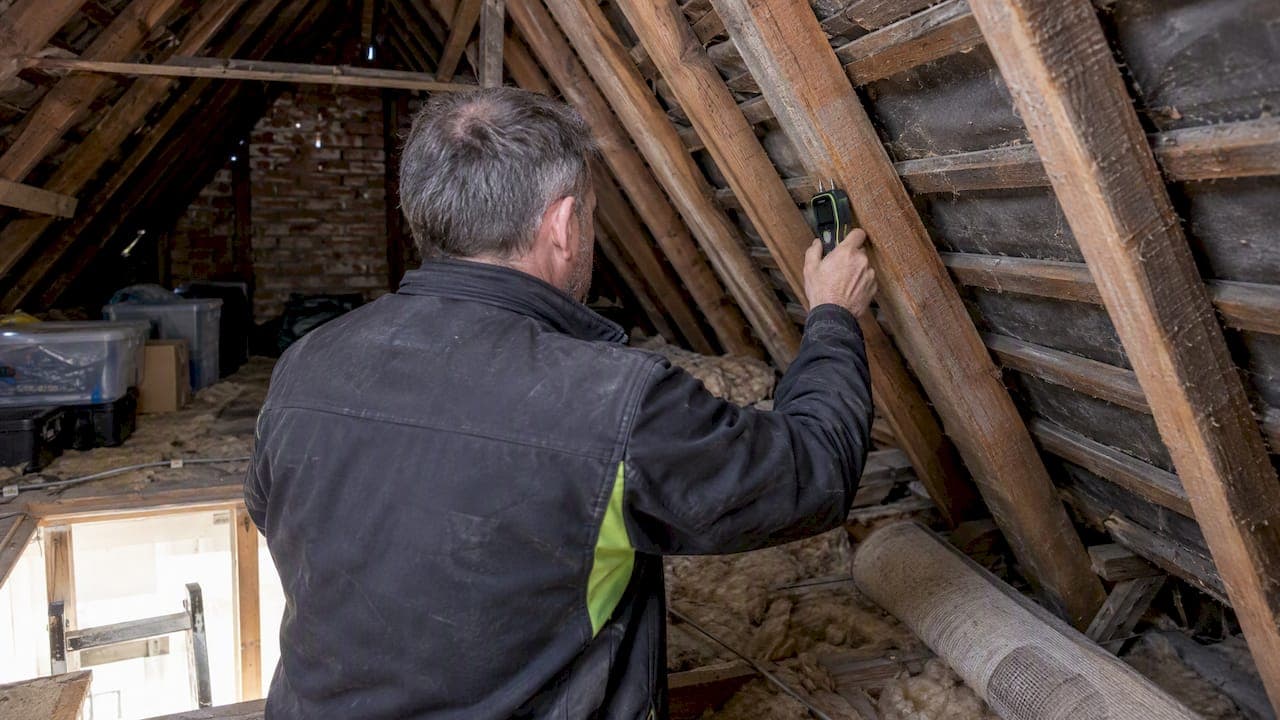
A healthy solid roof timber in a UK loft should read comfortably below 20% moisture content. At 20% or above, government-commissioned research treats solid timber as at risk of decay. For plywood, OSB and other timber-based boards the line is lower, at 18%. But one reading on one day tells you very little, especially if spray foam covers the timber. This guide explains how to read the numbers, what affects them, and when a lender or buyer will want more than a meter reading.
TL;DR
- Solid roof timber is considered at risk of decay at 20% moisture content or above. Boards such as plywood and OSB are at risk from 18%.
- A single reading is a snapshot. Surveyors look for patterns over time, across the whole roof, and for the cause of any moisture.
- Spray foam can hide the timber and trap moisture, so a dry-feeling loft or a surface reading can give false comfort.
- Mortgage lenders rely on an independent, qualified surveyor's report. Removal does not by itself guarantee approval.
- Get the roof assessed before you commit to removal. Surveys with us start from £100.
Table of Contents
- What a timber moisture reading actually measures
- The readings that matter in a loft
- Why one reading is never enough
- How spray foam changes the picture
- Signs that a reading is hiding a problem
- How the timber gets checked when foam is in the way
- What lenders and buyers want to see
- Our view: read the roof, not just the meter
- What a survey and removal cost with us
- Book a roof assessment
- Questions homeowners ask about timber moisture in lofts
- Sources
What a timber moisture reading actually measures
Moisture content is the weight of water in the timber compared with the weight of the timber when dry, shown as a percentage. A reading of 15% means the water weighs 15% as much as the dry wood. It is a measure of what is in the timber now, not a verdict on whether the roof is sound.
The figures that appear in search results often come from different jobs. Flooring guidance talks about 6% to 9% because heated rooms dry timber out. Structural timber in a roof void is a different case. It sits in an unheated or partly heated space, follows the seasons and can sit higher without any problem. Comparing your loft rafters with a floorboard target will alarm you for no reason.
If you want to see how a hand-held meter is used in practice, this moisture meter protocol written for flooring installers explains the method of taking multiple readings rather than relying on one. It is written for floors, not roofs, so use it for technique and not for roof targets.
The readings that matter in a loft
For roof structures, two numbers do most of the work. They come from modelling research on spray foam applied to timber sloped roofs, prepared for the Building Safety Regulator.
| Material | Decay-risk threshold |
|---|---|
| Solid timber (rafters, purlins, ceiling joists, battens) | 20% moisture content |
| Timber-based products (plywood, OSB, wood fibre boards) | 18% moisture content |
In plain terms:
- Under about 16% to 18% in solid timber: generally nothing to worry about on its own, but note where and when you took it.
- 18% to 20%: worth watching. Take repeat readings in different weather and look for a cause.
- 20% and above in solid timber: decay risk. Surveyors often recommend further investigation or remedial work when readings stay above this level.
The bands below 20% are our working guide for how we read results, not a published standard. The 20% and 18% thresholds are the figures with a source behind them.
What matters just as much is how long the timber stays wet. A brief spike after a rainy week is not the same as rafters that sit above 20% for months. This is why practitioners favour readings over time.
Why one reading is never enough
Moisture readings move with the weather, the temperature inside the roof and the humidity of the air. The RICS guidance on investigating moisture in buildings is clear that the aim of a survey is to find the root cause of moisture, not just to measure it. It describes a framework meant for buildings of all types and ages, and it points surveyors to the whole picture: ventilation, heating and how the building was designed to perform.
In practice that means a good loft assessment:
- Takes readings at several points: low and high on rafters, near the eaves, around the ridge, at roof valleys and chimneys, and near any known leak.
- Compares those points with each other, not just with a single target.
- Records conditions on the day, including recent weather and whether the heating has been on.
- Looks for obvious defects first, such as slipped tiles, failed flashings or blocked eaves vents.
- Repeats the readings later where the first set raises a question.
If you are choosing between a surveyor who hands you a figure and one who explains the pattern, pick the second. A number without context is easy to misread in either direction.
How spray foam changes the picture
Spray foam is applied to the underside of the roof, often directly onto the timber. That creates two problems for anyone trying to take a reading.
First, access. The timber is covered, so a meter cannot touch it without cutting into or removing foam. The RICS consumer guide on spray foam notes that foam often prevents standard inspections, which is why lenders lean on independent specialist assessments.
Second, moisture behaviour. A traditional ventilated loft is designed so that air movement carries water vapour away. Spray foam turns it into a warm roof void and seals the gaps. The RICS guidance explains that this changes how the roof handles vapour. RICS has also raised the concern that any moisture getting below the roof covering might not escape or dry out properly, particularly with closed cell foam, raising the risk of decay.

Open cell and closed cell
The government's modelling found that risks are low when an open cell insulant is applied in line with BS 5250:2021, the code of practice for moisture management in buildings. Risks are categorised as higher when foam is applied directly to roof tiles, or to high-resistance underlay, without an air and vapour control layer.
That has a practical consequence. Two lofts with spray foam can behave very differently. A slate or tiled roof with a breathable underlay and open cell foam is a different case from a felt-lined roof with closed cell foam sprayed against the tiles. Our guide to felt roofs and spray foam before a remortgage covers the felt scenario in more detail.
Modelling is not a survey
The Building Safety Regulator has said that its modelling should not replace established protocols and structured assessments for existing properties. Put simply, a government report saying risk is low under certain conditions does not prove that your roof is fine. Only a site-specific survey can do that.
Signs that a reading is hiding a problem
A dry-feeling loft is not proof of a dry roof. Moisture can sit behind foam, out of sight, and a surface reading may show nothing. These signs are worth acting on even when a quick meter check looks fine:
- Damp or musty smells in the loft or the rooms below.
- Staining on ceilings, or on the foam itself.
- Mould on exposed timber, at eaves, or around the hatch.
- Slipped, cracked or missing tiles, or visible daylight.
- No visible ventilation at eaves or ridge, or vents that have been foamed over.
- Condensation on rooflights, or on cold surfaces such as pipework.
- Corrosion on nail tips or metal fixings where visible.
If you see mould, our article on when surveyors decide spray foam removal is needed explains how those decisions are made.
The type of roof also changes what you are likely to find. We have written separate guidance for trussed roofs, slate roofs, period properties and metal roofs.
How the timber gets checked when foam is in the way
There is no single method. A surveyor chooses the least damaging route that still gives reliable evidence. The options typically include:
- Visual inspection from the loft and outside, looking at the roof covering, eaves, ridge and any exposed timber.
- Surface checks with a meter where timber is exposed, such as the ends of rafters, the wall plate or the ceiling joists below the foam line.
- Drone or elevated imaging of the roof covering, to spot defects without walking on the roof.
- Small, controlled openings where the surveyor needs to reach covered timber. This takes specific knowledge, because careless access can worsen the damage.
The point is to build a case from several pieces of evidence. If the covering is sound, the vents are clear, the exposed timbers read low and the foam is open cell on a breathable underlay, that tells a different story from a failing felt, wet battens and closed cell foam pressed against the tiles.
What lenders and buyers want to see
Many homeowners first come across moisture readings when a sale or remortgage stalls. The lender's valuer sees spray foam and asks for more information. The RICS advice for homeowners is to engage an independent, qualified surveyor to provide a professional report, because lenders use these reports to decide whether the property meets their own lending policy.
Two things are worth knowing:
- Lender requirements are individual. One lender may accept a satisfactory condition report with the foam left in place. Another may ask for removal and certification.
- Removal does not guarantee approval. Independent inspection is recommended before paying for removal.
Cornwall Council's trading standards team gives similar advice. It warns that spray foam can trap moisture where ventilation is inadequate and urges homeowners to seek independent, non-commercial advice before committing to remedial work.
If a cash buyer is offering a quick sale, read what to get in writing before accepting a cash offer. Landlords weighing the risk across several properties may find our landlord spray foam guide useful.
Our view: read the roof, not just the meter
We remove spray foam for a living, so you might expect us to say the foam has to come out. We don't. Here is how we approach readings.
A reading is evidence, not an answer. We want to know why the timber is at the level it is. If the cause is a leaking roof covering, removing foam will not fix it. If the cause is trapped condensation behind closed cell foam on felt, it might.
Get the assessment before the quote for removal. A removal job is a costly commitment. Most homeowners are better served by knowing the condition of the timber first. For lender purposes, an independent report is often what is asked for, and we say so at the outset.
Be wary of a rush to strip. Taking foam off without understanding the roof can leave you with exposed timber, no replacement insulation and a lender who still asks questions. We would rather you knew the condition and then chose.
When removal is the right call, do it properly. Our PCA-certified team removes both open and closed cell foam, and you deal directly with the people doing the work, not a middleman or a lead-selling site. The work carries a 10-year insurance-backed warranty, and we have helped more than 1,000 homeowners.
— jessica
What a survey and removal cost with us
Prices below are the ones published on our site. Removal varies with roof size, foam type, thickness and access, so the range is wide.
| Service | Price |
|---|---|
| Basic Visual Survey | from £100 |
| Full Roof Report (with photos) | from £200 |
| Drone Survey + Report | from £250 |
| Full Drone + Detailed Report | £350 to £450 |
| Open cell spray foam removal | £1,000 to £5,000 |
| Closed cell spray foam removal | £1,500 to £7,000 |
| Spray foam removal (overall range) | £1,000 to £7,000 |
The survey cost is small beside the removal range. If a report shows the foam can stay, you may save thousands. If it shows removal is needed, you will have the evidence to back it. Our article on avoiding costly loft spray foam problems walks through how these costs arise.
Book a roof assessment
If you have been asked for a moisture reading, a condition report or a certificate, start with a survey. See the full list of survey and report options, or request a home visit quote. If a survey says removal is the right route, our spray foam removal pricing page sets out the cost ranges for open and closed cell foam. We offer fixed pricing with no hidden fees, and no pressure to go ahead.
Questions homeowners ask about timber moisture in lofts
What is a good moisture reading for timber in a loft?
For solid roof timber, readings below 20% are outside the decay-risk zone identified in the government-commissioned research. For plywood and OSB the line is 18%. Consistently lower readings across several points, in different seasons, are what a surveyor wants to see.

Can I take my own reading with a cheap meter?
You can get an indication on exposed timber, but it is not a substitute for a survey. Meters vary in accuracy, and readings depend on species, temperature and where you probe. A lender will want an independent, qualified surveyor's report, not a homeowner's figure.
Will a high reading mean I have to remove the spray foam?
Not automatically. A surveyor will first look for the cause, such as a leaking covering or poor ventilation. Removal is considered when the evidence points to the foam as the cause, or when a lender requires it. Independent advice before removal is strongly recommended.
Why does my loft feel dry when there may be a problem?
Moisture can be trapped behind foam, out of sight. RICS notes that foam often masks the true condition of the roof, so surface checks and the feel of the air can be misleading.
Sources
- Appendices: Spray foam insulation applied to timber sloped roofs in dwellings (Building Safety Regulator research)
- Moisture risk of spray foam insulation applied to timber sloped roofs (GOV.UK)
- Response from the Building Safety Regulator
- Spray foam insulation consumer guide (RICS)
- Investigation of moisture and its effects on traditional buildings (RICS)
- Understanding spray foam insulation (RICS Built Environment Journal)
- Spray Foam Insulation Advice for Homeowners (Cornwall Council)